

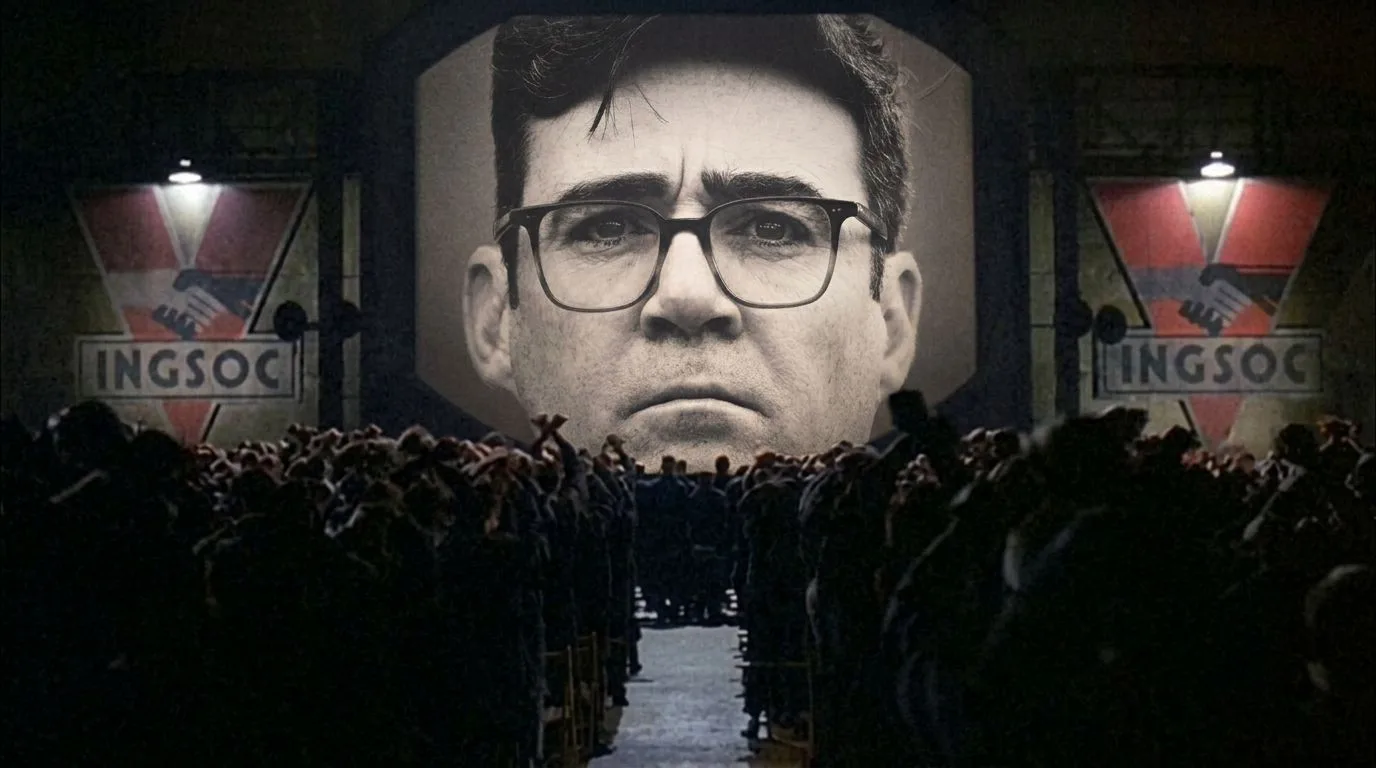
In previous essays I have sought to describe the political condition into which Britain and other Western democracies have been drifting by offering various analogies. At first, I tried being serious. My initial forays drew comparisons with the post-totalitarian societies of late communist Eastern Europe, where the widening distance between official propaganda and observable reality produced an ever-greater institutional effort to enforce the official world view. Later essays pursued the analogy more directly, asking whether Britain was becoming increasingly Sovietised, with some of the same characteristics of a political order in severe decline becoming recognisable. With the supply of serious comparisons running low, and the ironies apparently passing unnoticed, there seemed little left to do except laugh.
Once the absurdities become difficult to describe with a straight face, parody is the logical next step. The difficulty now has been making the exaggeration last until publication. Institutions and bureaucratic inventions for comic effect have acquired real-world counterparts before the joke has had time to land.
WISDOM escapes into the wild
A few weeks back my satirical turn took the form of ‘The Spy Who Came in From the Consensus‘, a John le Carré spoof in which the machinery of the contemporary British state deployed its formidable powers of information gathering to confirm what it already believed. At the centre of the story was WISDOM, the Whole-of-Institution Strategic Data and Outcomes Management system. Created to defend Britain against foreign disinformation, it soon graduated to monitoring “harmful narratives”, “problematic nostalgia”, declining trust and negative sentiment about immigration. A genuine photograph of migrants arriving on a beach was flagged for “decontextualised visual framing”. Requests for original sources and factual corrections became possible indicators of hostile interference.
Having begun by investigating Russia, China and Iran, WISDOM eventually discovered that the most troublesome source of misinformation about Britain was British people’s stubborn attachment to feeling British. WISDOM’s final diagnosis of the country’s deteriorating social cohesion was commendably concise: “The problem isn’t the problem, the problem is the people noticing the problem.”
On Tuesday, Prime Minister Andy Burnham stood before the United Nations and announced the creation of a National Centre for Information Defence. Barely had WISDOM escaped onto the page before reality began catching up with the satire.
According to Burnham, NCID will detect, attribute and disrupt hostile-state information attacks. He cited Russian bots masquerading as British citizens, fake websites, fabricated reports, forged newspaper branding and covert interference. Most insidious of all, naturally, was the amplification of “far Right narratives”. Russia, Burnham said, was creating a narrative of British decline. Britain, he claimed, had surrendered too much ground to those promoting such an account.
Burnham insisted that the “negative” and “corrosive” narrative about life in Britain “bears no resemblance to reality”. A few moments later in the very same speech, Burnham described people struggling with the “cost of living”, lives that were “not improving”, young people outside employment, education or training, widening inequality and a society vulnerable to division. Making life more affordable, he then announced, would lie at the heart of a new “10-year plan” for Britain.
The narrative of decline therefore bears no resemblance to reality, although reality apparently requires a 10-year plan.
Burnham began his speech alleging that Russian agencies had forged BBC branding, faked websites and used bots to “stoke tension”, “spread lies” and “play on people’s fears”. There is nothing inherently implausible about any of this. A fake newspaper article is false. A Russian bot pretending to be Derek from Wolverhampton is not Derek from Wolverhampton. No doubt Russia conducts information operations against its enemies, as does nearly every other major nation. It’s part of statecraft. It always has been.
However, contentions about whether Britain is declining, its economy is struggling, its institutions are failing or its social cohesion is deteriorating are not in themselves acts of deception. Arguments about the condition of the country do not become disinformation because somebody in Moscow presses the retweet button. For all the concern about foreign deception operations, Britons are perfectly capable of looking at their country and coming to what the Government perceives as the “wrong” conclusions without Russian assistance.
WISDOM would have understood the problem and known what to do. It would recommend the immediate establishment of a National Centre for Information Defence.
The irony is that Whitehall already has an expanding bureaucracy operating across this field. Britain has units dealing with misinformation, hostile states, strategic communications, cyber interference and influence operations. Having concluded that these arrangements are fragmented and overlapping, Whitehall has reached for its traditional instrument of administrative simplification: another organisation.
Maybe the Russians should be warned that Britain now has so many organisations watching for hostile information that any Kremlin operative attempting to penetrate them risks dying of old age during the induction process.
Why, exactly, does Britain need another one?
The Department of Additional Departments
The case for another organisation becomes less obvious once the existing machinery is examined. Most obviously, there is the National Security Online Information Team, formerly the Counter Disinformation Unit, which already leads the Government’s operational response to online information threats. Its remit covers misinformation and disinformation affecting national security and public safety, online narratives and attempts artificially to manipulate the information environment. A foreign power conducting the activities Burnham described at the United Nations would therefore fall comfortably within its field of interest.
Should the threat be more obviously the work of a hostile state, the Joint State Threats Assessment Team within MI5 provides cross-government analysis of hostile-state activity. The Home Office also has its now infamous Research, Information and Communications Unit (RICU), concerned particularly with extremist propaganda and counter-narratives. The National Cyber Security Centre deals with cyber threats, while the Armed Forces possess 77th Brigade and its expertise in what the Army calls “information manoeuvre”.
The Foreign Affairs Committee identified the resulting fragmentation in March. Britain’s work against foreign disinformation, it concluded, was dispersed across government and insufficiently coordinated. Its proposed remedy was a statutory, public-facing National Counter Disinformation Centre to bring the disparate effort together. The Government initially agreed only to consider the proposal; the committee duly welcomed Burnham’s announcement when it came.
The remedy has an unmistakable Whitehall logic. Faced with too many bodies doing related things without sufficient coordination, the Government has created another body. By July, seven ministers were responsible for disinformation, prompting the Foreign Affairs Committee Chair to observe that this meant nobody was responsible for it. NCID will now have the unenviable task of bringing order to the organisations created to bring order to the information environment.
Quite how it will do so remains unclear. Its organisation and powers have yet to be specified, as has the practical meaning of Burnham’s promise that it will “disrupt” hostile-state information attacks.
The more consequential question concerns its remit. New bureaucracies acquire officials, definitions, reporting requirements and, sooner or later, things to report. NCID is being created as the Government’s language about information threats extends beyond fabricated stories and covert foreign operations towards the stories Britons tell themselves about Britain.
The question is where countering hostile information ends and policing political interpretation begins.
Your narrative has been marked incorrect
A foreign power doesn’t have to invent Britain’s difficulties. It can select them, exaggerate their significance and distribute them for hostile purposes. None of that alters the underlying facts. If Moscow circulates a photograph of a British pothole, its reasons for doing so have no bearing on whether the pothole exists. Filling it would also deprive the Kremlin of the photograph.
Burnham’s description of a narrative of British decline as “corrosive” therefore raises a different question from whether the claims themselves are true. “Corrosive” describes an effect. A hostile actor may assemble the evidence and promote the bleakest possible account of the country, but neither its involvement nor its purpose settles whether that account is false.
Information defence then begins to move beyond establishing what is true and who is responsible for spreading it into judging which conclusions drawn from the facts are damaging. A false claim can be tested; a covert foreign operation can be investigated and attributed. Whether Britain’s institutions are failing, its social cohesion is deteriorating or the country is in decline cannot be settled in the same way. These are political judgements made from evidence over which citizens are entitled to disagree.
Disagreement over those conclusions is the ordinary stuff of politics. Governments marshal statistics, advertise successes, blame their predecessors and assure the country that recovery is under way; oppositions inspect much the same landscape and announce national ruin. Newspapers offer further diagnoses, while citizens remain obstinately free to believe whichever account best accords with what they can see around them. None of this requires an official referee to determine which interpretation of Britain has passed the national resilience test.
A foreign power can promote an account of British decline for hostile purposes without making that account either true or false. Russian propagandists can describe Britain as declining for hostile purposes; a Briton can reach the same conclusion after waiting six weeks for a doctor’s appointment. That they reach the same conclusion proves nothing about whether it is correct. Still less does Russian endorsement render it false. Otherwise, any genuine grievance can acquire the taint of disinformation once Moscow notices it.
Conflating hostile provenance with the truth of what is being said changes the purpose of information defence. A government concerned about foreign manipulation has every reason to identify covert networks, expose fabricated material and attribute hostile operations. Once attention turns to the political conclusions citizens draw from genuine conditions, however, the object has changed. Information defence is no longer simply protecting the public from deception. It is deciding which descriptions of reality the public should distrust.
When dissent becomes a security problem
Britain has some experience of what happens when official categories created to identify security threats expand into lawful political argument. William Shawcross’s Independent Review of Prevent found that RICU analysis intended to identify the extreme Right had extended into centre-Right debate, populism and lawful Right-leaning commentary with no meaningful connection to terrorism. Mainstream conservative books appeared among supposedly significant ideological texts, while a former Conservative minister, Sir Jacob Rees-Mogg, and writer Douglas Murray surfaced in analysis of figures associated with far-Right sympathetic audiences.
The Government accepted Shawcross’s recommendation to reset the threshold, acknowledging that RICU had exceeded its remit by failing to distinguish clearly between mainstream conservative commentary and the extreme Right.
The problem that Shawcross identified was that once lawful political dissent enters analysis intended to assess security threats, monitoring dissent becomes part of the work of institutions created to protect the state. The distinction between identifying threats and scrutinising political disagreement begins to blur.
The National Security Online Information Team provides another example. Big Brother Watch reported, on the basis of subject access requests and other material it obtained, that government counter-disinformation systems had recorded or analysed statements by MPs, journalists, academics and campaigners. Those caught in the machinery included MPs David Davis and Caroline Lucas and journalists Peter Hitchens and Julia Hartley-Brewer, whose comments encompassed lockdown policy, vaccine passports and other contentious political questions. Public statements are obviously available for governments to read; the question is why lawful political criticism should enter an analytical system concerned with misinformation in the first place.
The concern does not depend upon NCID itself acquiring a wider remit. The day after its announcement, Chi Onwurah MP, Chair of the Commons Science and Technology Committee, welcomed the new centre but pointed out that it would not address domestic dis- and misinformation. She urged the Government to revisit her Committee’s recommendations, including measures against the algorithmic amplification of “legal but harmful content”. NCID is intended to counter hostile-state information attacks, but its creation sits within a wider policy debate about government intervention in the information environment that already encompasses domestic speech and lawful content considered harmful.
RICU, NSOIT and NCID have different purposes, and while Chi Onwurah was not proposing that NCID should assume responsibility for domestic speech, the problem exposed by RICU is clear: once the state moves beyond identifying unlawful conduct or demonstrably false information, officials must make judgements about the meaning and effects of lawful expression. A “hostile-state information attack” identifies an adversary and an activity. Burnham’s “corrosive narrative” introduces a judgement about the effect an account of Britain has. ‘Legal but harmful content’ places lawful expression itself within the field of possible intervention. The question therefore ceases to concern only what hostile states are doing to Britain. It extends to which lawful ideas circulating among Britons the state considers harmful.
Reality has failed to meet Government expectations
The late-stage communist experience in Eastern Europe becomes more instructive at the point where the discrepancy between official claims and observable conditions became a political problem in its own right. Bad news could be dismissed as hostile propaganda, dissidents accused of blackening the reputation of the state and foreign broadcasters jammed because they supplied information that contradicted the official account. The worse conditions became, the greater the effort required to protect the state’s description of them. Humour acquired much of its political force from the same discrepancy: people needed no elaborate theory of government when they could compare what they were being told with what they could see.
Western governments now parrot the bureaucratic language of resilience, information integrity, harmful narratives, strategic communications and protecting the information environment. A failure of government can therefore produce a second problem alongside the failure itself: people notice what has gone wrong, draw conclusions from it and lose confidence in the institutions responsible.
Fixing the conditions that produce discontent is harder. Hospital waiting lists have to be shortened, houses built, infrastructure renewed, living standards raised and immigration brought under political control if that is what governments have promised. Fraying social cohesion cannot be repaired by a communications strategy. These things require choices, money, administrative competence and, in some cases, a willingness to confront interests that benefit from the status quo. Explaining that hostile actors are exploiting public anger about them only requires a strategy, a communications team and a meeting.
Once governments become concerned with the conclusions people draw from their failures, political discontent itself begins to acquire the characteristics of a security problem. Declining trust becomes vulnerability to manipulation, anger at political failure becomes an opportunity for hostile actors, and pessimism about the country becomes a “corrosive” narrative against which society must be made resilient.
The danger is always that government starts devoting as much ingenuity to managing the consequences of failure as to correcting its causes. If people believe their country is declining, government can devote greater effort to persuading them that they have misunderstood what they are seeing.
Alternatively, it could actually try to give them less decline to notice.
The Ministry of Too Many Ministries
George Orwell gave us the forbidding image of the Ministry of Truth, a single institution imposing the official version of reality. Terry Gilliam’s 1985 dystopian film Brazil offered a more recognisably bureaucratic version of authoritarianism: a world of forms, malfunctioning computers, incomprehensible departments and officials arguing over which department was responsible for what. The boot stamping on the human face had become entangled in an interdepartmental dispute over who was authorised to wear it.
Britain’s information-security machinery has acquired something of the same bureaucratic character. Responsibility for hostile states, misinformation, extremist communications, cyber threats and information operations is already distributed across a collection of units, teams, agencies and military organisations, with NCID now joining them. Somewhere inside Whitehall there must be an official whose job is to know which acronym is protecting us from which other acronym’s definition of a harmful narrative.
The British road to authoritarianism was never likely to feature torchlight parades. A cross government steering committee was always more plausible, followed by a consultation exercise, an independent review and a procurement contract large enough to require another independent review. If freedom is finally phased out, there will presumably be a mandatory feedback questionnaire.
Adding a National Centre for Information Defence to an already crowded institutional field brings another remit, another set of responsibilities and another definition of the threat. As responsibilities overlap, accountability becomes harder to locate: one department collects, another assesses, another coordinates and another arrives to coordinate the coordination.
Reality has been referred for review
The problem for information defence begins when Britain’s adversaries start telling the truth. A hostile purpose does not make truthful information false, and foreign amplification does not invalidate conclusions Britons draw from conditions they can see for themselves. Once government becomes concerned with those conclusions as well as the truth of the information from which they are drawn, information defence starts to acquire a different purpose.
That was the absurdity behind WISDOM. Three weeks later, the Government unveiled NCID.
The danger lies in the steady expansion of what government considers an information problem. Declining trust becomes a question of resilience, political disaffection a vulnerability to hostile influence and criticism of national decline a corrosive narrative. Eventually the state is concerned not only with whether information is true, but with what people conclude from it.
A free society leaves that judgement to its citizens. Governments can counter lies, expose foreign manipulation and prosecute unlawful conduct. They cannot expect a monopoly over the interpretation of reality, especially when their account of the country conflicts with what people can see for themselves.
And if the discrepancy becomes sufficiently absurd, some people will laugh. Others will decide to do something about it.
Michael Rainsborough is Professor of Strategic Theory and Director of the Centre for Future Defence and National Security, Canberra.




Discussion
Comments
This week across the site:
To join in with the discussion please make a donation to the Daily Sceptic.
Profanity and abuse will be removed and may lead to a permanent ban.
I guess the more our government lies the more Ministries of Truth Suppression will be required.
‘Legal but harmful content’ is a development of non-crime hate incidents. Only with more potential power for suppression.
The monitoring of Lucas, Hartley-Brewer, Hitchens, and Davis merely recorded the normal functioning of democracy but the units couldn’t recognise it for what it was.
We haven’t had freedom of speech in this country for a long time. Certain kinds of speech were made illegal by the first Race Relations Act in the 1960s, the scope of which has been expanded periodically since and no supposedly right wing government has done anything to stop that. Radio and then television content has been state regulated from the start and no Fake Conservative government has done anything to stop that either.
It’s a secret.
How Many Ministries of Truth Does One Country Need?
As many as possible, quite frankly. The more confusion the better.
“‘Legal but harmful content’. That sounds, to my jaded ear, remarkably like “non crime hate incident” which still hasn’t been relinquished by the police in spite of instructions to do so.
More bollocks from Burnham. Rehearsed everyman charm and a belief that the medium is the message aren’t enough. Next.