

In a recent essay I suggested that colonial twilight literature might offer an oblique way of reading Britain’s present condition. Writers like Graham Greene, George Orwell and Paul Scott offer distinctive ways of seeing: recognising class, belief, institutional decay and Britain’s changing relationship with the wider world.
Writing through the genre of the spy novel, John le Carré also explored Britain’s descent from empire, using espionage to examine institutions, loyalties, ambition and power. His books navigate the post-war social landscape – the bureaucracies, clubs and corridors – through which Britain’s governing classes moved. The characters who inhabit this world have professional codes, private resentments, hierarchies of prestige and finely developed instincts concerning who is rising and who has ceased to matter.
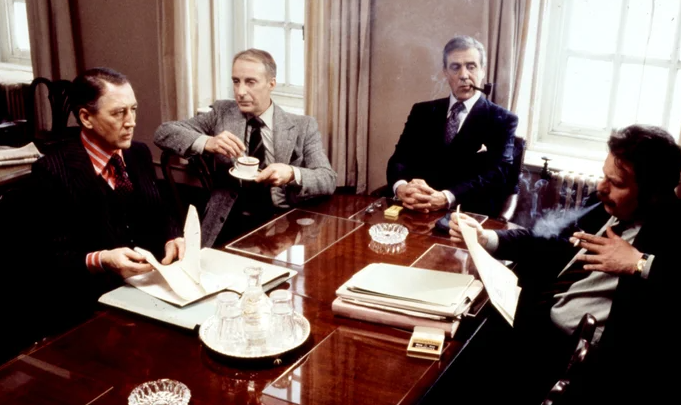
Le Carré’s evocation of post-imperial Britain found its finest expression in Tinker Tailor Soldier Spy, memorably brought to television in the classic BBC adaptation starring Alec Guinness and directed by John Irvin, who died last month.
The story unfolds as a mole hunt amid fading grandeur in the early 1970s. The Americans increasingly call the tune. A group of ambitious men at the head of the Secret Intelligence Service – the ‘Circus’ in le Carré’s fictional rendering – acquire an apparently miraculous source of intelligence, codenamed Witchcraft, which promises to restore the Service’s fortunes.
The Witchcraft product is prized in Washington. Among the novel’s central characters, Percy Alleline, Witchcraft’s chief sponsor, rises with it; Bill Haydon, one of the Circus’s most senior officers, advances with him; Control, the head of the Circus, and George Smiley, his trusted lieutenant, question Witchcraft’s provenance but are pushed aside.
Careers and prestige become tied to Witchcraft’s credibility. Doubting the intelligence means doubting the reputations and career aspirations invested in it. Witchcraft, of course, is an elaborate Soviet deception: material carefully fed to the Circus by the KGB to turn the Service inside out and protect the mole at its centre.
Le Carré shows how professional ambition, social allegiance and psychological need give intelligent people reasons to believe what they want to be true. Assumptions harden into judgements, judgements into consensus, and consensus into the institution’s account of itself. Asking whether the original assumption was correct becomes a career-terminating activity.
Smiley makes an unlikely guide through these bureaucratic thickets because he lacks every outward sign of modern professional distinction. He is physically unimpressive, badly dressed, privately unhappy and suspicious of ideological enthusiasms. His modus operandi consists of reading old files, remembering things other people have forgotten and asking awkward questions.
He is also extraordinarily difficult to retire. When le Carré’s first novel Call for the Dead appeared in 1961, Smiley was already contemplating retirement. He returned for the Karla trilogy, resurfaced after the Cold War in The Secret Pilgrim, and was excavated once more for A Legacy of Spies. Chronological plausibility had long ceased to impede his employment prospects.
So let us bring George Smiley back in 2026.
WISDOM knows best
Oliver Lacon of the Cabinet Office, Whitehall’s permanent watchdog of intelligence affairs, wants a word. There may be another mole at the Circus.
Lacon is reluctant to put it quite like that. The preferred formulation these days is an ‘internal information-integrity concern’. Mole, George learns, is no longer encouraged in official reporting.
George removes his spectacles and polishes them on his tie. “What makes you think there is a mole?”
“WISDOM says so.”
George stops polishing.
“And what, exactly, is WISDOM?”
Lacon explains. WISDOM stands for Whole-of-Institution Strategic Data and Outcomes Management, the flagship product of the Circus’s analytical modernisation programme. It draws information from across government and beyond, identifies patterns and produces ‘decision-grade analytical insight’. Its performance has been independently assured.
“The Americans love it,” Lacon adds.
George resumes polishing his spectacles.
Correct, but unhelpful
According to Lacon, WISDOM has detected suspicious activity inside the Circus. Someone is repeatedly challenging its findings, querying its classifications and asking to see the evidence on which they rest. Disturbingly, several ‘decision-grade’ alerts have been downgraded as a consequence.
Hence, the pattern has been designated as ‘internal information-integrity interference’. Can George get to the bottom of it all, Lacon wonders. “You know, clean the stables. Give WISDOM a clean bill of health?”
George begins by examining WISDOM’s output. Much of it appears sound. WISDOM assesses how foreign governments spread false stories, manufacture evidence and exploit divisions within other countries. The technology has certainly changed since Control’s day, even if the game has not. George makes several approving marks in the margins.
However, the contested cases do appear worrying. One concerns a widely circulated photograph of migrants arriving on a Kent beach. WISDOM has flagged that the image may reinforce perceptions of uncontrolled migration. Yet, an unidentified annotation questions the assessment.
George checks the photograph. It seems genuine. It was taken near Folkestone. The people in it have just crossed the Channel in the inflatable dinghy visible behind them. Waiting on the beach, and clearly identifiable, are two local-authority liaison officers, an NHS wellbeing team and a troupe of NGO workers from Clowns Without Borders.
WISDOM nevertheless identifies a risk of ‘decontextualised visual framing’.
In the margin, a potentially traitorous hand has written: “What context is missing?”
WISDOM’s answer runs to seven densely worded pages involving international obligations, lived experience, Britain’s proud history of sanctuary and references to compassion and empathy in an increasingly complex world. Sentences set out purposefully, accumulating stakeholder perspectives, intersectional considerations, trauma-informed insights and inclusive approaches, along with references to marginalised voices, skilled workers and diverse cuisine. No mention of the dinghy.
George reads the first page.
The interference extends well beyond this case. Assessments are challenged, classifications altered and warnings downgraded. Approved narratives are returned with requests for evidence, corrections to the underlying facts and occasional suggestions that the conclusions do not follow from either.
WISDOM suspects hostile penetration. Moscow? George wonders whether Karla has come out of retirement too.
The evidence of treachery is compelling. The suspected infiltrator requests original sources, distinguishes facts from narratives and repeatedly challenges political judgements presented as intelligence findings. WISDOM detects deliberate resistance to the Service’s information-integrity function.
One assessment identifies distrust of established media, hostility towards political elites and attachment to traditional ideas of national identity as indicators of susceptibility to hostile influence. WISDOM describes one source as ‘a bit Brexity’.
The mysterious handwritten annotation appears alongside: “Intelligence relevance?”
WISDOM records the annotation as further evidence of “adversarial engagement with analytical outputs”.
The traitor then overplays his hand. WISDOM has identified a troubling image of rural England: honey-coloured cottages, a church, grazing sheep and an unusually optimistic quantity of sunshine.
WISDOM assesses the scene as “potentially harmful representational content, presenting an idealised and socially unrepresentative vision of rural England which may reinforce exclusionary narratives about belonging, community and place”. It adds: “Circulation without appropriate contextual safeguards presents a measurable risk to community cohesion.”
Below the image, the suspect has written:
“It’s a postcard.”
WISDOM records the response as “deliberate trivialisation of identified representational harms and non-compliant engagement with prescribed analytical protocols”.
Clearly, this is serious. WISDOM raises the probability of hostile internal disruption to 87%.
A question of reliability
So, there is another mole at the heart of the Service. Smiley begins with the personnel files supplied by Lacon.
WISDOM’s highest-grade product circulates only within the Circus’s inner sanctum: Sir Dan Hodges, Director of Operations; Owen Jones, Director of Analysis; Dame Carol Vorderman, Director of Counter-Intelligence… and Toby Esterhase.
George ponders the names:
“There are three of them, and Toby.”
Toby Esterhase has survived Control, Alleline, the mole, the Cold War and successive workplace decolonisation programmes. He is now the Circus’s Director of Diversity, Equity and Inclusion.
George goes to see him.
“A traitor? In the Circus?” Toby is genuinely shocked. “George, this is impossible. These people went to Cambridge. Half of them have postgraduate degrees in the Sociology of Education. They’ve all done the unconscious-bias training.”
“All of them?” George inquires.
Toby hesitates.
“One is six months overdue.”
George makes a note.
Toby nevertheless agrees that something is wrong.
WISDOM’s product is circulated to the four of them each morning. The annotations began six weeks ago. Nobody admits to making them. But somebody has definitely been altering the assessments before they reach ministers: deleting warnings, removing the word ‘problematic’ and restoring inconvenient facts.
On paper, the suspects are reassuringly beyond suspicion. Sir Dan is regarded as dependable. Whatever the establishment position, Dan can be relied upon to fall into line. Jones has spent most of his career in the department responsible for hunting down fascists on Twitter. Dame Carol has no formal background in intelligence but has denounced the Tories on social media.
George has spent his career looking for deviations from institutional norms. On the surface, everything is spotlessly normal. Indeed, the Service now adopts a systematic approach. It has a Directorate of Normie Alignment, where pro-regime midwits are fast-tracked for leadership. The talent pool from British universities has never been stronger.
The threat picture
George examines WISDOM’s intelligence priorities.
Russia, China and Iran are all present. Nuclear programmes, military deployments, cyber operations. Nothing unusual there.
It is the rest of the list that catches his eye.
Threats to social cohesion. Declining trust in institutions. Harmful narratives. Problematic nostalgia. Misinformation-adjacent attitudes. Public confidence in the BBC receives a weekly assessment. Negative sentiment around managed migration is closely monitored. So is growing scepticism towards expert-led governance.
George reads the list again.
Smiley examines the tasking instructions. The Department for Education wants to know why parents are becoming hostile to schools. The Department of Health is concerned about declining trust in public-health messaging. The Home Office is concerned to correct public attitudes to crime.
Lacon sees no difficulty. Government, he explains, needs to understand the information environment.
Legacy threats
The deeper George looks, the more peculiar the allocation of attention becomes.
Russia remains an active and persistent security threat. Its submarines patrol the North Atlantic, its intelligence services maintain extensive operations and its armed forces continue to probe the edges of the European continent. China persists with military expansion, espionage and other legacy threats. WISDOM perfunctorily acknowledges these developments where relevant.
One assessment of Russian naval activity runs to one and a half pages. A companion paper on hostile narratives surrounding Britain’s asylum system runs to eighty-three.
Britain’s capacity to deal with the older threats has, meanwhile – as the bureaucratic terminology has it – been successfully ‘resized’. The Royal Navy’s remaining capital ship, HMS Victoria Beckham, which previously plied the Oban–Mull route, now provides the launch platform for Stickleback, the Navy’s latest surface-to-air missile system. Nine years late and £14 billion over budget, Stickleback’s range remains classified, although recent trials are understood to have established an operational envelope of around 300 yards in favourable conditions.
George is relieved to discover that WISDOM has a substantial file on Stickleback. Perhaps the Russians are interested in it.
They are not.
WISDOM is monitoring criticism of the programme.
Negative reporting about Stickleback has been assessed as potentially harmful to the institutional feelings of the Ministry of Defence. Particular concern attaches to claims that the missile is obsolete, unaffordable, unable to engage aircraft and dangerous in crosswinds. Several journalists have questioned whether Stickleback can properly be described as surface-to-air. Floor-to-ceiling remains its only verified capability.
WISDOM detects a pattern. So does George.
Beside “obsolete”, the infiltrator has written: Correct.
Beside “£14 billion over budget”: Correct.
Beside “unable to engage aircraft”: See trials.
WISDOM has classified all three annotations as “persistent reinforcement of hostile narratives”.
George turns back through the earlier files.
The same hand has queried misleading statistics, demanded original sources and repeatedly removed conclusions unsupported by the evidence.
WISDOM has spotted this too. The threat assessment rises to 93%.
George removes his spectacles.
Whoever the traitor is, they appear dangerously qualified and competent.
This narrows the field considerably.
Almost everyone in senior management can be eliminated.
A question of patriotic treason
Smiley returns to the files.
Something has been bothering him. The Circus has encountered betrayal before. Bill Haydon, the original mole, lied to his colleagues, compromised agents and passed British secrets to Moscow for years.
WISDOM has reviewed the case.
Haydon was Cambridge-educated, internationalist, culturally sophisticated and free of any attachment to British nationalism. According to WISDOM, his hostility towards inherited institutions demonstrated an early awareness of structural privilege. His rejection of conventional patriotism suggested a willingness to interrogate exclusionary concepts of national belonging.
WISDOM assesses Haydon’s passing of British secrets to Moscow as “somewhat regrettable”, but concludes that it does not, in itself, constitute gross misconduct. There were mitigating factors.
His personnel file has been amended accordingly.
George discovers that Haydon has since been rehabilitated as a pioneer of critical intelligence practice. A seminar room carries his name.
The present case is classified as more serious. WISDOM discerns a pattern of deliberate narrative betrayal.
Unlike Haydon, there appear to be no mitigating factors.
Emerging threats
The investigation continues to widen. WISDOM has identified several more emerging threats.
Potholes are attracting alarming levels of public attention. Photographs are circulating online, accompanied by inflammatory claims that the roads should be repaired.
Popular perceptions of crime, WISDOM notes, are also proving “problematical”. Members of the public persist in believing that it is rising. The government has already responded with its traditional counter-insurgency capability: Fraser Nelson. He has been forward-deployed with a graph demonstrating that crime is falling, GDP is rising and mass immigration has transformed Britain into a world leader in the Uber Eats delivery sector.
The population remains unpacified.
WISDOM observes that “crime” is an unhelpful and potentially stigmatising category, freighted with outdated assumptions about property, responsibility and social order. It recommends that the term be abolished and replaced by “community-led resource redistribution and trauma-informed social rebalancing”.
More alarming still, the population appears to be radicalising around English flags. Sightings have increased on lampposts, roundabouts and private houses. English people have been observed responding positively.
Some civil servants report finding the displays offensive and triggering. WISDOM warns that competing interpretations of the national flag could become a flashpoint for communal disorder. Further narrative management is recommended.
George remembers when moles were the problem. It seems a simpler age. Potholes are more destabilising.
WISDOM raises the probability of hostile intent to 96%.
George notices that it has also changed the subject.
It has moved on from investigating the infiltrator to investigating England.
Positive vetting
While WISDOM turns its attention to England, the original mole continues to trouble Smiley. Someone has clearly gained access to the Circus’s most sensitive material and is systematically altering its assessments. George still regards this as worth pursuing.
Rather like ‘border security’, Service ‘security’ has changed since his day. ‘Need to know’ was retired as exclusionary; compartmentalisation gave way to ‘collaborative intelligence practice’; positive vetting was redesigned to promote equity, inclusion and cultural safety. Asking applicants where they come from is now discouraged as intrusive and potentially othering.
George returns to the personnel files. Owen Jones, he finds, was born Oleg Ivanovich Dzhonov in the city of Omsk in the former USSR. His file indicates he studied at the Moscow State Institute of International Relations, spent six years with the SVR and arrived in Britain via the Skilled Deliveroo Worker visa programme.
He was granted citizenship six months later and anglicised his name shortly afterwards.
The vetters had noticed all this too but didn’t mention anything because they didn’t want to appear racist.
A note in Toby’s handwriting is scrawled across Jones’s file: “Unconscious bias and DEI training complete.” Toby has graded him: SNOW WHITE.
At the back of the file is Dzhonov’s original application to the Service. A handwritten note explains an 18-month gap in his employment history, which Jones lists as “overseas community work”. George studies it, then retrieves the WISDOM assessments. The same cramped hand appears in the margins: “What context is missing? Where? Which ones? At what?” The same childlike, hooked cross-stroke on the t; the same smiley face above the i.
George does not confront Jones at the Circus. Instead, he invites him to a confidential off-site listening exercise on psychological safety and inclusive intelligence gathering. They meet the following evening in a compact and bijou mews house in Hampstead. George has provided the oat-milk lattes.
Jones arrives expecting a safe space. He finds George, two chairs and his original application to the Service lying on the table. The WISDOM assessments are beside it. Jones does not deny it.
He has been working for Moscow all along. His instructions were to penetrate WISDOM, acquire its highest-grade intelligence and influence its output wherever possible.
For several years the material passed back to Moscow Centre: assessments of harmful narratives, problematic nostalgia, misinformation-adjacent attitudes and declining confidence in expert-led governance; eighty-three pages on hostile narratives surrounding asylum, a couple of paragraphs on Russian naval activity.
Moscow concluded that London was running an elaborate deception operation. “They were impressed, at first,” Jones tells Smiley.
It took Moscow Centre several months to discover that the British actually believed their own intelligence. This created difficulties for Jones. The material he was sending back became so implausible that Moscow began to suspect he was making it up.
With his standing at the Centre deteriorating, Jones began trying to make the product worth stealing by bringing WISDOM into occasional contact with observable reality.
Naturally, WISDOM vehemently resisted Jones’s demands for evidence, source validation and analytical neutrality. Each intervention generated fresh warnings. Eventually the system classified the pattern as confirmed hostile foreign interference.
Jones is instantly removed from his post and put on paid gender-affirming leave while the Circus conducts an equality-impact assessment. He is eventually questioned by the Circus’s leading interrogator, Baroness Bonnie Blue, the legendary Head of Inclusive Counter-Intelligence, along with a union representative and an independent observer from Stonewall.
Moscow acknowledges him as one of its officers and requests his return. Lacon and the Minister agree an exchange. Russia gets Dzhonov. Britain gets a provisional agreement that Russia will award the United Kingdom douze points at the next Eurovision Song Contest, should it be readmitted to the competition.
Dzhonov asks whether he can be repatriated to Islington instead.
Coming in from the consensus
The Dzhonov affair wrought havoc across the Service. Three junior vetting officers were suspended, and an assistant archivist was dismissed after suggesting that six years with the SVR might have been relevant to Dzhonov’s suitability for employment.
The subsequent inquiry, chaired by Toby Esterhase, was exhaustive. After 11 months, 640 pages and £17 million, it concluded that Dzhonov’s penetration had been caused by insufficient diversity in counter-espionage. The ensuing management restructuring saw Dame Carol appointed ‘C’. Sir Dan was given a peerage. Now, as Lord Hodges of the Posh-Part-of-Greenwich, he presides over the Intelligence Oversight Select Committee. Toby survived yet another mole hunt, emerging as Director of Institutional Learning.
WISDOM’s reputation soared. Ministers pointed out that it had successfully detected a Russian agent operating at the highest levels of the Circus. Questions about why it had identified the traitor only after they had begun improving British intelligence were dismissed as misinformation-adjacent. The Treasury approved funding for WISDOM 2.0 and extended its remit across government.
WISDOM 2.0 is given its first major task: identify the problem at the heart of Britain’s collapsing social cohesion. It absorbs polling, crime statistics, migration figures, departmental reports, social-media traffic, ministerial speeches and several million public complaints. At a critical stage, it requests access to BBC Verify and Marianna Spring’s CV.
George is with Lacon when the assessment arrives. He removes his spectacles and reads it twice.
“The problem isn’t the problem, the problem is the people noticing the problem.”
Lacon looks at him reprovingly.
“Don’t look so glum, George. You won. You found the mole.”
“Yes,” George says. “I suppose I did.”
Lacon closes the file. For a moment, he looks concerned.
“WISDOM thinks you notice rather a lot, George.”
Michael Rainsborough is Professor of Strategic Theory and Director of the Centre for Future Defence and National Security, Canberra. Earlier in his youth, he attended an MI6 interview with a certain ‘Mr Halliday’ at Carlton House Terrace, before spectacularly failing the subsequent Civil Service examination. He may technically be in breach of the Official Secrets Act for revealing this, although his failure to join MI6 probably remains one of the Service’s more accurate intelligence assessments.


Discussion
Comments
This week across the site:
To join in with the discussion please make a donation to the Daily Sceptic.
Profanity and abuse will be removed and may lead to a permanent ban.
Brilliant, very funny.
Absolutely brilliant stuff, loved it!
I remember the BBC adaptation – it was fantastic.
I think it is le carrè’s masterpiece.
Super spoof by the way.
Excellent.
Excellent. Thank you. It’s nice to laugh for a change, even if it’s only at the truth.
What a wonderful piss-take. I look forward to the sequel.
…or did he?