

One thing that’s all too obvious is that between now and the next General Election, be it in spring 2027 or autumn 2029, the Tory Party isn’t going to lose popularity. It still occasionally does the most stupid things, such as bringing Penny “transwomen are women” Mordaunt back into the fold. But in general, Kemi Badenoch is doing a pretty good job staking out a coherent Right-of-Centre proposition.
Tory and Reform policies aren’t so very different, though Badenoch’s recent conference announcements have targeted her offering more specifically at the property owners of the shires, while Farage’s is still distinctly ‘Red Wall’.
Unquestionably, the mainstream media has decided Badenoch is here to stay. They want a two-horse race, not the complication of an alternative Left or Right usurper, so Badenoch finds herself lionised while Nigel is, as ever, demonised.
Voter concerns tend to be focused on the short term. Many have already memory-holed the Tories’ disastrous Covid policies and things like the migrant crisis are rapidly becoming Labour’s, not the Tories’, problem. Even the ‘Boris Wave’ will become associated with Labour once Mahmood’s inevitable U-turn on her earlier promise to extend the qualifying period before a migrant can claim ‘indefinite leave to remain’ becomes widely understood.
The Liz Truss budget is being eclipsed as gilt rates surge under Reeves and the tax burden grows. Sure, the Tories took office when public sector debt was £1 trillion and managed, despite claims of ‘austerity’, to triple it – but now that £3 trillion of public debt belongs very much to Labour.
There’s no good news coming over the horizon for Labour, whereas the Tories’ catastrophes are receding rapidly out of the rear-view mirror. The Tories could themselves adopt Starmer’s ‘Ming vase’ strategy over the coming few years and still not lose support, while Reform will have to work much harder to get disillusioned Labour voters to travel past the Lib Dems and the Tories into their waiting arms.
Yet despite Labour inevitably reaping a bitter harvest from its destructive policies, a ‘progressive’ alliance of Labour, Lib Dems, SNP, Plaid Cymru, Greens and Muslim independents still, I would argue, stands a better-than-even chance of forming the next Government if the Right remains split down the middle.
In recent articles (see here and here) I’ve won few friends by pointing out that the Right is in danger of snatching defeat from the jaws of victory at the next General Election, if it can’t find a way to work together.
Elections are won and lost by swing voters. After the 2024 election, the Tories bumped along with about 20% support while Reform operated in the range of 20% to 30%. The truth is that if Reform – and the same goes for Restore – couldn’t drive Tory support below 20% immediately after their disastrous performance mismanaging the nation, they aren’t going to now. 2024 saw the Tories shed their swing voters; the 20% that were left are the bedrock.
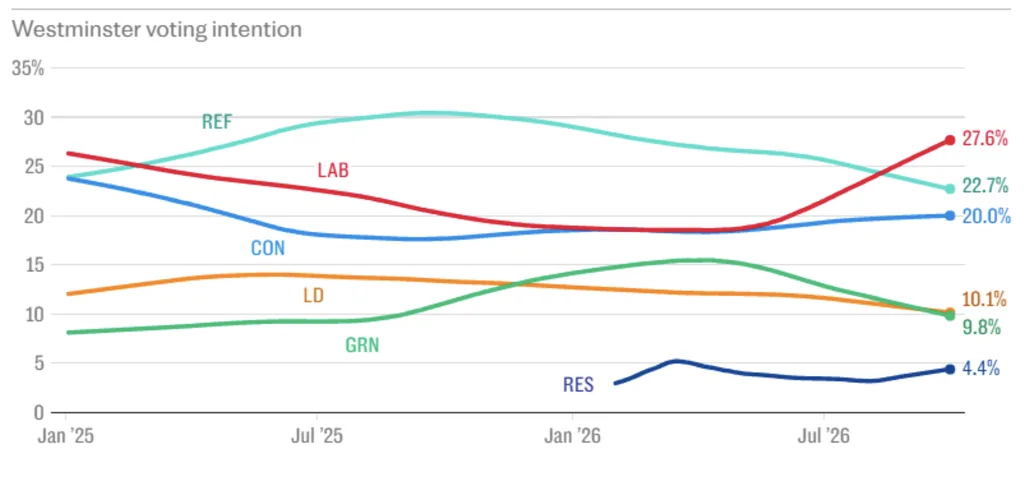
It seems inevitable that over the next few years, the Tories, Reform and Restore are destined to share the 50% or so of the electorate that is Right-of-Centre aligned. Labour and Green defectors moving rightwards are more likely to go Lib Dem, which means, come a hung parliament, they’re not lost to a progressive alliance at all.
It is against this background that we’ve seen Mark Littlewood’s recent claim to have divined a move from Right-of-Centre voters to begin voting tactically and the launch of unitetherightuk.com, a website that advises voters which would be the best Right-of-Centre party to vote for at the next election if they want to end the Left’s grip on power.
Of the two developments, I think Littlewood means well but displays more wishful thinking than hard-headed analysis – though perhaps divination is essential to the gambler.
However, unitetherightuk.com might just be on to something – perhaps not yet, but as the election draws near, if the leaders won’t act, and they show no sign of it, then we, the voters, need to take matters into our own hands.
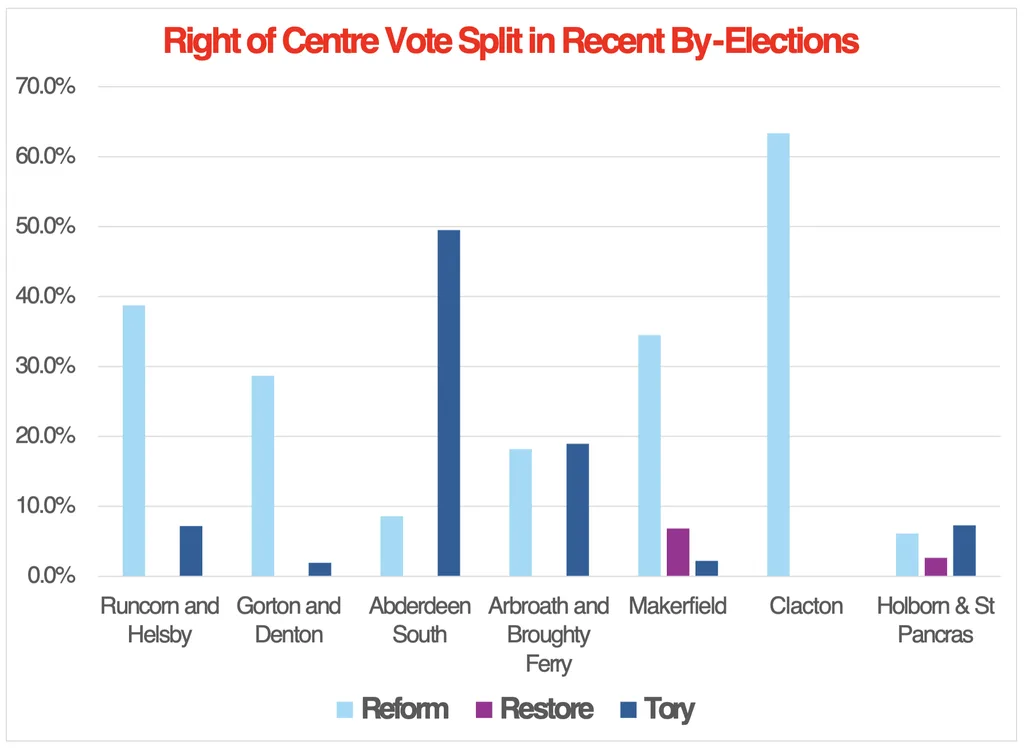
Littlewood briefly explained his thinking in one of his regular Daily Sceptic political betting articles. He argued that analysis of the recent by-elections shows voters rallying to the Right-of-Centre party that stood the best chance of winning. He largely discounts the Arbroath and Broughty Ferry by-elections, on the grounds that neither the Tories nor Reform stood a chance of winning, so there was no incentive for their voters to tactically switch. The same logic would apply to Holborn and St Pancras, where of the 39% of constituents that bothered to vote, only 16% voted for Right-of-Centre parties, with their votes split pretty evenly between Tory and Reform.
As yet, I detect no appetite for tactical voting. The only by-election where the Conservatives weren’t second best to Reform – or Reform plus Restore – was Aberdeen South, where the combination of it being in Scotland and the huge local issue of Labour’s scorched-earth policy towards the oil and gas industry meant that its result didn’t really play into a national trend.
For now, I’m not convinced that Littlewood is right, but it is certainly something to watch out for in the future as more representative and winnable by-elections come along. I think for now the Right-of-Centre electorate remains locked in its suicidal silos.
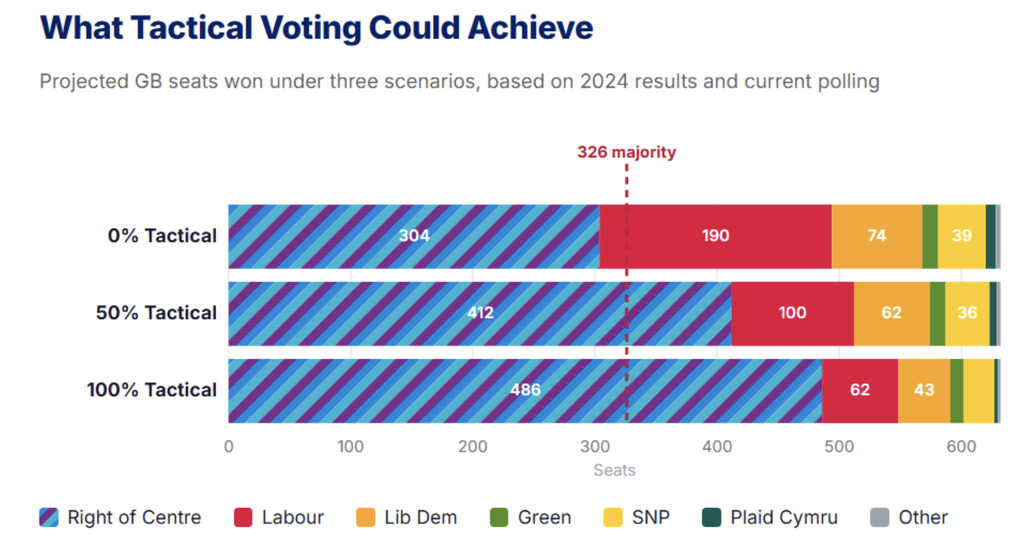
With respect to the unitetherightuk.com initiative, the site tells you that, presuming a local constituency moves in line with the prevailing polling position, which of the Right-of-Centre parties would be best placed to win the seat.
It should be remembered that the Conservatives were second to Labour in 208 seats while Reform were second to Labour in 89 seats at the last General Election. With respect to the Lib Dems’ 72 seats, the Conservatives were second in 38 of these seats, while Reform came second in 10 of them. A valid criticism that could be made is that the unitetherightuk.com data points voters to seats more susceptible to a Tory polling recovery, simply because they were second in more seats than Reform – but it remains useful information that can easily be disseminated.
Figure 3, which is lifted directly from unitetherightuk.com, illustrates just how sensitive the composition of the Commons is to tactical voting. From a current position where progressives look set to win a majority, if 50% of the Right voted tactically by going with the candidate best positioned to win, a progressive win could be turned into a relative landslide for the Right.
I’ve come to accept that Daily Sceptic readers – certainly the Sceptic’s commentariat – with justifiable cause, can never forgive the Tories for their utter betrayal of conservative principles under the succession of Prime Ministers from Cameron through to Sunak. However, the progressive Left represents an existential threat to the future of the UK.
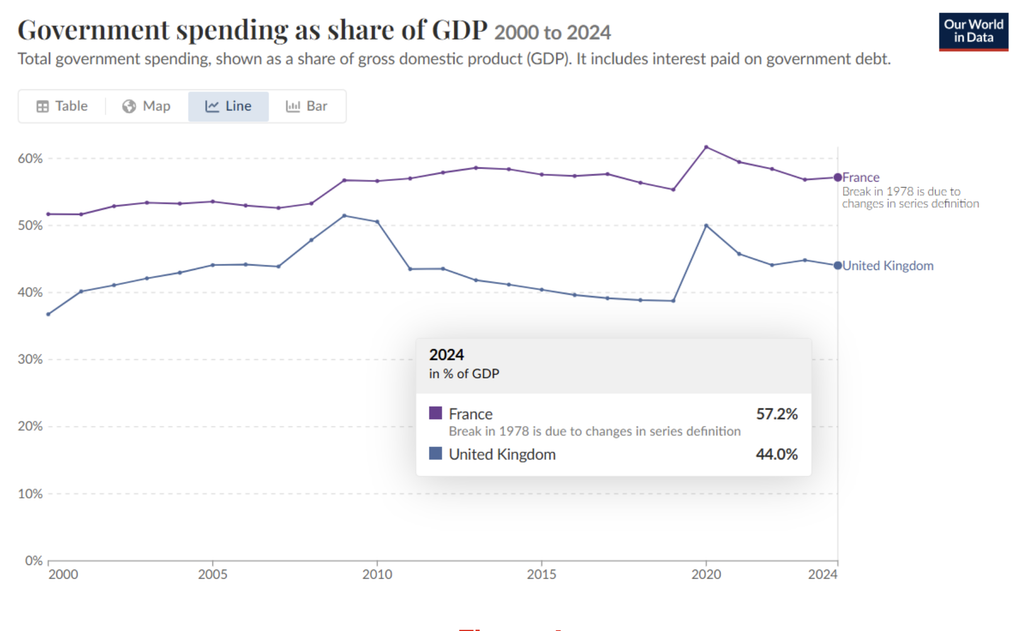
The argument from the Left is that with just a bit more public spending everything will be fine. But in France, despite an additional 13.2% of GDP coming from the taxpayer and borrowings, services don’t work there either. To reach French levels of public expenditure would require us to increase our level of public spending by 30%. It’s incredible – 30% more spending and the same result.
However, I remain something of an optimist. As always, it will be the swing voters of the Centre who will decide the next election. I feel confident that they’ll ignore the protestations of the Right-of-Centre party leaders that they won’t cooperate; they’ll force them into some form of pact by instinctively voting tactically.
These swing voters won’t give a hoot for betrayals they’ve long forgotten – they’ll simply act in their own best interest and ditch Labour for the other lot, whichever party that might be. And instinctively they’ll get it right, voting not on principle but for self-interest.
The electorate will have spoken and it will be up to the leaders to make it work.
Our democracy is another example of the ‘invisible hand’ at work. No one quite knows how it happens, but the herd invariably gets the result it wants – and if unitetherightuk.com can help a little along the way, then well done them.



Discussion
Comments
This week across the site:
To join in with the discussion please make a donation to the Daily Sceptic.
Profanity and abuse will be removed and may lead to a permanent ban.
And if Labour invoke Proportional Representation and/or votes for 16 year olds this would change the results of voting too.