

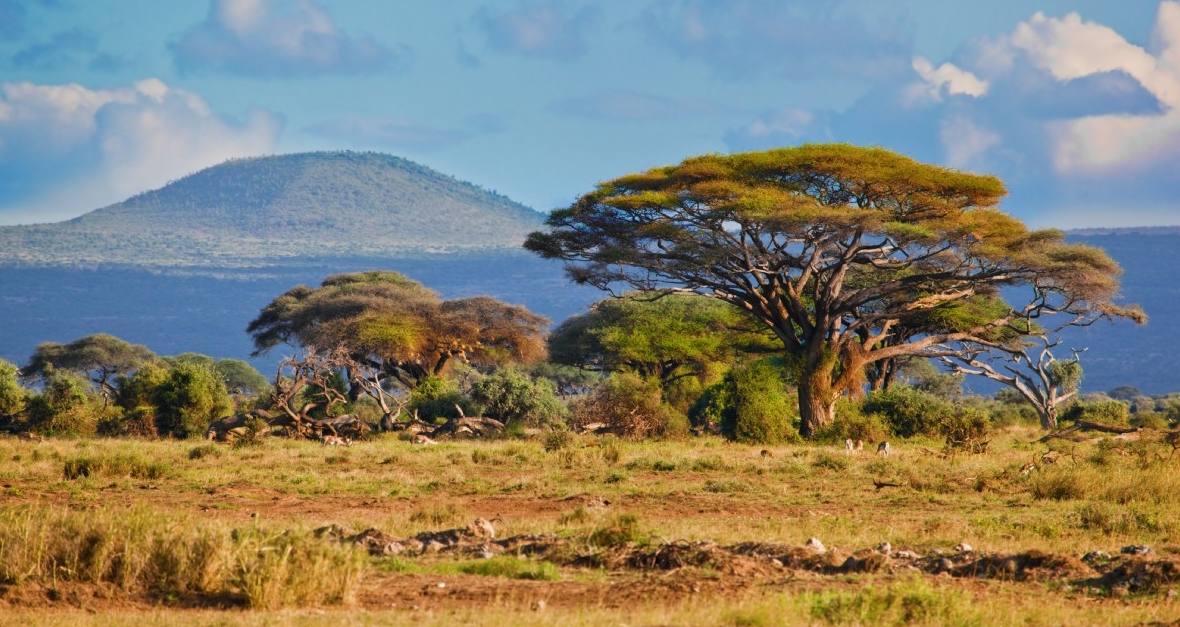
More evidence of global greening from carbon dioxide fertilisation has been published in the prestigious publication Nature. The research involved 70 experiments and three decades of field data from many locations in the savannah of South Africa’s Kruger National Park. The international scientific team was led by Dr Kimberley Simpson of the University of Sheffield, the paper entitled ‘Increasing CO2 levels fertilise C4 grass production‘. Phys.org reported the study as follows: ‘Rising carbon dioxide is supercharging grass growth in African savannas, study finds.’ The latest study challenges the previously held view that the dominant grasses in the savannah (known as ‘C4’) benefit little from rising levels of carbon dioxide.
African savannah covers approximately half of the great continent and sustains a vast habitat for wildlife across tropical and sub-tropical regions. Globally, savannah grassland covers about 20% of Earth’s land surface, and contributes nearly one-third of plant productivity. C4 grasses form a major part of these ecosystems in hot climates; they utilise a more complex form of photosynthesis which allows them to thrive in harsher conditions where hotter and sunnier conditions prevail. These grasses are able to retain water and capture carbon dioxide more efficiently than other types of plants. C4 grasses include both wild grasses and important crops such as maize and sugarcane.
Given higher levels of carbon dioxide, the C4 plants have been found to increase their growth by capturing more of the greenhouse gas while limiting water loss through leaf stomata. In the Kruger National Park, it was found that there was a 28% increase in plant growth from 1989 to 2021. After discounting other factors, such as changes to rainfall, temperature and nitrogen, the report concluded that increased carbon dioxide was the main factor in the extra plant growth. It was also noted that there was an increase in the number of herbivores in the park over the period, thus benefitting the wider ecosystem.
As with other recent findings, this study shows that there are some benefits to higher levels of atmospheric carbon dioxide. You would think that evidence of growth of grassland in drier parts of the world would be welcome news for environmentalists. But of course, the study put a dampener on the positive benefits and discussed a few possible downsides: it noted the risk of increased fuel for wildfires, possible changes to the distribution of foraging animals and that extra grass production may not feed into long-term carbon storage. Simpson commented that: “More grass does not automatically mean more carbon will be stored. The wider impact depends on where the extra grass ends up. If it is eaten by animals or burned in fires, much of the carbon is quickly released back into the atmosphere.” And: “Because savannahs cover such large areas, even modest changes could have major consequences for wildlife, livestock, fire and the global carbon cycle.”
Other recent studies have noted the benefit to plant growth from higher carbon dioxide levels; see: ‘Global Greening Hits New Record as Climate Emergency Fails to Materialise‘, and ‘Vegetation greenness in 2025‘. Evidence of global greening has been known for many years and reported in an IPCC Special Report on Climate Change and Land (A2.3) in 2019. A paper in Nature Climate Change in 2016 discussed the drivers for global greening, estimating from computer modelling that 70% of the change to plant growth was caused by higher levels of carbon dioxide, with an increase of between 25% and 50% in global vegetation coverage.
As well as evidence of increased plant growth and wildlife in parts of Africa, the benefits of carbon dioxide fertilisation include higher crop yields to feed a growing world population, now above eight billion people. Policy makers committed to achieving Net Zero in the UK need to take into account the benefit of higher levels of carbon dioxide for the ecosystem and global food provision. The Net Zero policy is looking increasingly archaic in light of the direction of scientific research and global developments. Instead of the very costly and futile subsidies, I would suggest that resources need to be directed towards the development of mitigation strategies to protect against natural disasters such as wildfires and flooding.
Andrew Sibley is a semi-retired chartered meteorologist with an MSc in Environmental Decision-Making and an MPhil in Theology.

Discussion
Comments
This week across the site:
To join in with the discussion please make a donation to the Daily Sceptic.
Profanity and abuse will be removed and may lead to a permanent ban.
The King used to be mocked for talking to his plants. In fact it makes perfect sense to talk to plants as you are breathing CO2 over them.
rr
I love the drama word ‘forcing’ climate loonies use when talking about CO2 in the atmosphere. Lert me explain ‘forcing’. Say you run a bath, and it’s not quite hot enough, so you add some hot water. That is ‘forcing’. Making something warmer or colder, as we used to say.
May I be the first subscriber to ‘Zebras for CO2’?
The article refers to CO2 as being a greenhouse gas. No it is not
It’s enough to convince one to stop breathing. Unless government policies achieve that first.
“It was also noted that there was an increase in the number of herbivores in the park over the period, thus benefitting the wider ecosystem.”
But what about the mass extinction event that we are in? Its an climate emergency!
Given that the management policy of the Kruger Park used to involve culling of different species, it would be difficult to assess what factors have contributed to this increase.
Perhaps they ran out of bullets, or are selling them to Ukraine?
Wow.What a brilliant insight – the snag is that lots of greenhouses have been doing that artificially for years, via gas fired heating. I think its supposed to be well understood that raising the levels can be beneficial.
Socialists often base their policies on completely flawed premises. The idea that CO2 is dangerous and needs to be limited to sone arbotrary “pre-industrial” level is one. A few others are:
Inequality is bad. No it isn’t.
Immigration is generally good. Not necessarily.
Abortion isn’t killing a baby. Yes it is.
Gender is a real thing. No it isn’t.
Race genes don’t determine IQ. Yes they do, and plenty of other characteristics too.
And on.
It’s easy to spot one of these flawed fundamental premises. If they don’t allow discussion of it and go absolutely mental when you do, then its a flawed premise on which their entire belief system is built.
Global greening is climate change as seen by the deserts retreating.