


There follows a guest post by Daily Sceptic reader ‘Amanuensis’, as he’s known in the comments section, who is an ex-academic and senior Government researcher/scientist with experience in the field (find his blog here). He has taken a closer look at the recent papers from Oxford University on post-vaccine myocarditis risk and has some concerns about the methodology they have used which he suspects may underestimate the risk.
A few days ago the Daily Sceptic published an article on the risks of post-vaccination myocarditis, taking data from a recent paper by Julia Hippisley-Cox of Oxford University. This is a hot topic as myocarditis appears to have become the poster-child of vaccine side effects in the young, and any scientific papers that attempt to quantify the risk of myocarditis seem to get rather a lot of attention. Hippisley-Cox’s recent paper is no different.
Unfortunately, Hippisley-Cox et al appears to have used its method of choice, the Self-Controlled Case Series (SCCS), inappropriately. This is a bit of a grand statement given that Julia Hippisley-Cox’s papers are published in Nature Medicine, a very reputable journal – I’ll explain why the method has been used inappropriately and perhaps you might agree with me.
The self-controlled case series experimental design is quite simple in concept – there’s always a risk in experiments that your experimental group (the ones that we did things to) are different from the control group (the ones that were left alone), so in SCCS you simply use the same people for the experiment group and control group. In this particular example the magic happens by allocating a time for the vaccine side effects and stating that outside of this time the vaccine risk was zero – thus each experimental participant automatically sits in both the control group and experimental group.
There’s a nuance in the way SCCS is done for the Covid vaccine trials, in that there’ll often be a period before each treatment that is set aside and not used in the data analysis – the stated reason for this is because ill people are less likely to get vaccinated. I’ll come back to this point later, but for now just remember that there’s a pre-vaccine period that is separated out from the other data.
So, just to get up to speed on the sort of thing that you’d see with SCCS, I’ve made up a ‘perfect example’ of how SCCS might be used. In the following graph the number of side effects are indicated by little red dots – there are a low level of side effects before vaccination which then increase during the week after vaccination and then a gradual return to the baseline:
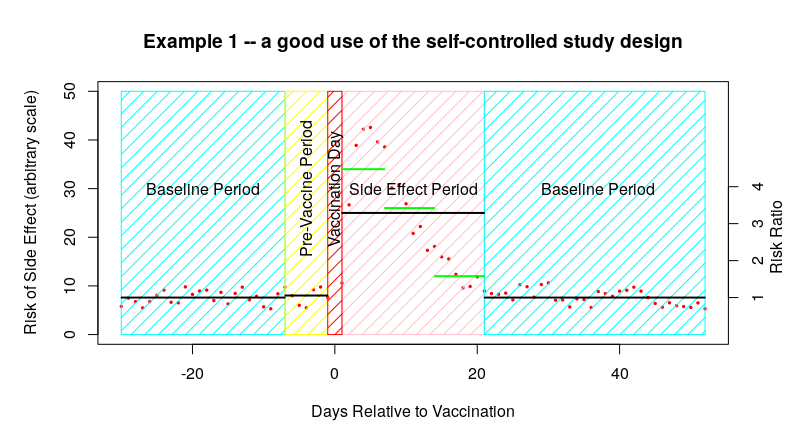
It is important to remember that in the summary data that you’ll be presented in the scientific paper all you would see is the data represented by the black lines – the baseline, the pre-vaccine period and the post-vaccine period. Thus it is difficult to spot the actual distribution of the data within each time period. Sometimes you get some additional data within the side-effect period – I’ve indicated these additional data in the graph above with the green horizontal lines.
The other important point to remember about the above graph is that the baseline data is made up of both of the baseline periods – it isn’t given separately. Luckily, in the above example we can see that the time period for side effects looks to be about right, and thus the baseline appears to be accurate.
To summarise so far, I’ve invented some data that shows a side effect rate after a vaccine of about 25 events per day in the 21 days after vaccination, compared with a rate of about 7.5 events per day in the baseline and in the pre-vaccine period, resulting in an Incidence Risk Ratio (IRR) in the 21 days after vaccination of about 25/75, or 3.3 (shown on the right hand scale).
I’m sure that many can already see the complication with the SCCS methodology – it is vitally important that the study side-effect period is selected so that it is at least as long as the actual period in which you find the side effects. The impact of having too short a side-effect period is that you’ll get side effects bleeding into the baseline data. I’ve modified the first example data to show this effect:
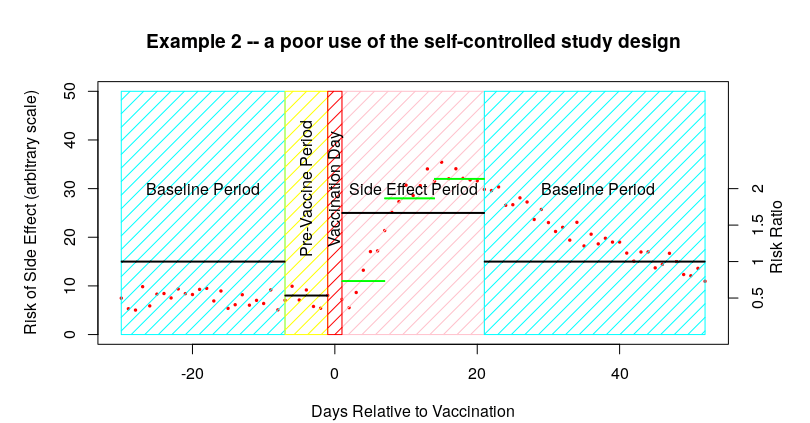
In this example some of the parameters are the same – the baseline data before vaccination is about 7.5 events per day, as is that of the pre-vaccine period, and there’s an average of 25 events per day in the 21 days after vaccination. So far so good. The only difference this time is that the side effects continue into the baseline period after the 21 days allocated for the side effects to be identified; these later side effects have a pronounced impact on the baseline data.
In the above example, the bleeding of side effects into the post-vaccine baseline period increases the baseline to 15 from 7.5 – so, even though the actual number of side effects after the vaccine remains the same at about 25 events per day, the estimated IRR changes from about 3.3 (25/7.5) to about 1.7 (25/15). And all because we chose a too-short time period for the side-effects to occur.
Note that there are actually two impacts of this too-short a time period:
- The baseline is artificially higher, thus the risk appears lower than it should be
- Only some of the side effects are counted – any side effects occurring after the side effect period are ignored; this further lowers the estimate of side effect risk.
Of course, everyone should now be shouting ‘but that’s just because you deliberately chose a side-effect period of only 21 days’ – and you’d be absolutely right. Indeed, I made up this entire example just to illustrate the problem. Of course, science isn’t as simple as this – if you’re undertaking a trial to identify side effects, how would you know what side effect period to use before you’ve worked out that the side effects even exist? Really I should have first shown what is called a sensitivity analysis, where my assumptions were checked against the data – this would have highlighted that I’d made a mistake in my choice of side-effect window and made me rethink my assumptions.
Remember, in the scientific paper the only information you would get are the data for each of the black lines; you wouldn’t be able to see any of the underlying data (i.e., the red dots in the above examples). However, there are a few clues indicating that the side effects might be bleeding into the baseline:
- The first is that pre-vaccine period – this is included based on the assumption that people that have recently had a medical condition that’s the same as one of the vaccine’s known serious side-effects are less likely to be vaccinated. Thus the fact that there is a pre-vaccine difference isn’t quite a smoking gun – but nevertheless the presence of such a large difference in the pre-vaccine treatment period might raise suspicions.
- The second is any supplementary information on the change in risk during the side-effect period. I indicated these additional data in green in the graphs above. What you want to see is the risk declining to near the baseline during the latter part of the side effect period (as in example one above); suspicions would be raised if you had risk remaining flat during the side effect period; and alarm bells should ring if the risk appeared to increase during the side effect period (as in example two above).
That’s enough theory – what about the actual data?
I’m going to choose some data from the paper by Hippisley-Cox et al published on December 14th 2021 – “Risks of myocarditis, pericarditis, and cardiac arrhythmias associated with COVID-19 vaccination or SARS-CoV-2 infection“. Specifically, the risk to women from myocarditis after vaccination with the first dose of the Pfizer Covid vaccine:
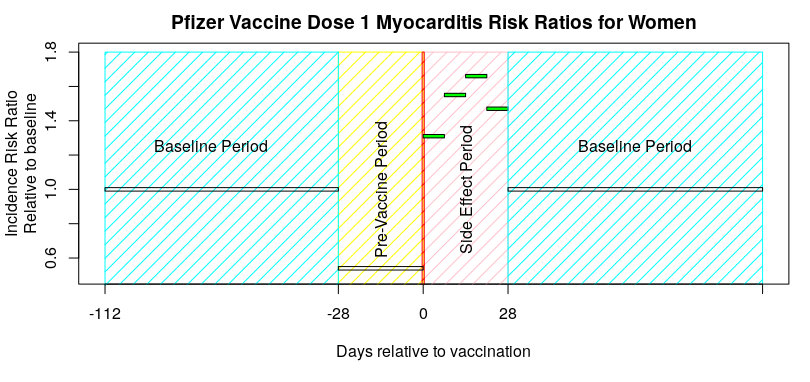
Note that there’s no underlying data to help us see what is going on; all we have is the calculated IRR, and remember that the average for the baseline period includes both periods before and after the vaccine was given. So, the question is: does the graph above look more like the ‘good use of SCCS’ graph given at the start of this article, or more like the ‘poor use of self-controlled study design’ graph.
I think this data looks more like the ‘poor use of self-controlled study design’ graph – the inference is that there are side effects that continue into the second baseline period, resulting in the baseline being too high. The result of this would then flow through all of their subsequent analysis, making the vaccines look safer than they are.
What I’d really like to see is the sensitivity analysis of the choice of side effect period, so that we can see if it has introduced a problem – but this isn’t given in their paper. I believe that the ‘28 day period’ is arbitrary; they’ve simply used this time period in all of their vaccine side effect papers, presumably after deciding that it was ‘about right’. Alternatively, they could present the baseline data for before the first vaccine dose and all subsequent baseline data separately – this would immediately identify if there were side effect events bleeding into the baseline periods. Unfortunately the authors do neither.
Now, I picked a ‘good example’ in the above graph, so I’ll give another example that’s less clear – the risk of myocarditis in women under 40 after vaccination with the Pfizer vaccine, taken from the pre-print submitted by Hippisley-Cox et al on December 25th 2021, “Risk of myocarditis following sequential COVID-19 vaccinations by age and sex“. A few points before presenting the data. Firstly, the data covers a period from December 1st 2020 to November 15th 2021 and three vaccinations (and thus three pre-vaccination periods and three post vaccination baseline periods). The actual vaccination points will be variable within that period, so I’ll show their published data against a ‘typical vaccination schedule’ just for illustrative purposes. It is also important to note that Hippisley-Cox averaged all the pre-vaccine period data together, as well as all the baseline data.
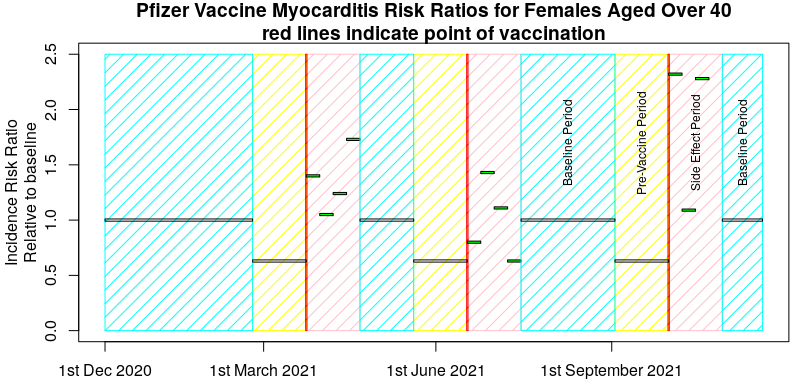
Maybe not so clear now, but that’s the nature of experimental trials – sometimes the data aren’t obvious. However, I certainly wouldn’t like to say that the risks of post-vaccination myocarditis were definitely contained within the 28 days after each vaccine and looking at the above I’d think hard about my choice of experimental method.
I suggest that the recent papers by Hippisley-Cox et al on the risks of myocarditis are flawed in that they assume too short a period after each vaccination for side effects to occur, and that this incorrect assumption coupled with the use of the self-controlled study design is resulting in a significant underestimation of vaccine risk.
I also note that Hippisley-Cox et al have used this approach in previous analyses of risks of clot-related and neurological side-effects; analysis of their supplementary data suggests that for both of these papers the period allowed for vaccine related side effects was also likely to be too short, and probably also resulted in a significant underestimation of vaccine risk.
What disturbs isn’t that they’ve made a mistake – these things happen. What disturbs me is that this wasn’t picked up by the peer reviewers and that there’s been no discussion of these papers’ failings now that they’re published.
It also disturbs how difficult it appears to be to publish any trials and/or analysis that appear to show the vaccines in a bad light. For example, compare the negative press about the numerous trials into the use of Ivermectin, compared with the single trial supporting Pfizer’s Covid treatment Paxlovid which resulted in emergency authorisation being granted for its use by the NHS.
Finally, it also disturbs me that Hippisley-Cox’s two recent papers will now be taken as proof that myocarditis is rare and that anyone disputing this isn’t following the science. Science is different from religious dogma; challenge is part of its fundamental nature.




Discussion
Comments
This week across the site:
To join in with the discussion please make a donation to the Daily Sceptic.
Profanity and abuse will be removed and may lead to a permanent ban.
Great article, and excellent explanations. However, is it possible that myocarditis is nothing more than a distraction? Even if myocarditis is significantly more common than the Oxford paper suggests, it is still relatively rare. My question is, why are there not discussions like this on cardiac arrhythmia, which is anything but rare, having sent 1% of the vaxxed to the hospital and killed 7.8k in England alone, according to the same paper referenced? See: https://www.nature.com/articles/s41591-021-01630-0
That article makes it seem like 1% hospitalization and 7.8k deaths is near normal. But an average year in England sees only 500 deaths from cardiac arrhythmia: https://heart.bmj.com/content/93/5/601
That means the vaxx caused a minimum 15 fold increase. It also means the yellow card system is missing at least 5.8k deaths.
I checked the European database for Pfizer, age 12-17, male, serious adverse effects, cardiovascular.
1228 hits including few deaths (did not check home many, because it is irrelevant)
100% of hits “require prolonged hospitalization”.
1228 hits is 1 case of serious myocarditis/pericarditis for 2200 vaccinations
If this is similar case to VAERS, and most likely it is, the under-reporting in the system is 8-12.5 times (See CDC internal report produced by Jessica Rose).
If we take average number, we have a serious myocarditis/pericarditis in 220 vaccinations.
Life expectancy after serious myocarditis/pericarditis is 6.5 years. We are talking of 12-17 y.o. boys.
When will this stop?
Forgive me being dense, but there is something I do not understand in the ‘good’ graph from Hippisley-Cox et al captioned ‘Pfizer Vaccine Dose 1 Myocarditis Risk Ratios for Women’.
How does the relative risk ratio ‘know’ to drop to ~0.6 of baseline about 28 days before the injection event?
It would seem the preceding ‘baseline’ is elevated for some unknown reason. If the depressed baseline is real, the peak relative risk rises from ~1.7 to ~2.8 (1.7/0.6). This makes the drugs appear safer than they may actually be with respect to the given patient group and condition.
I know the underlying data is missing which may help answer this, but it does seem a little odd. If I was a reviewer, I would ask for clarification about this ssue. Then there is the issue of absolute risk versus relative risk.
Dr.Peter McCullough a cardiologist, has requested the immediate halt of these experimental biologicals. Paediatricians offices in the USA are full of kids suffering from myocarditis. Sadly doctors in the USA are being gagged. If they dare to speak out about the dangers of the experimental biologicals their medical boards are taking disciplinary action including removing the doctor’s license and ability to practice medicine. When in the hell did doctors raising red flags about medical interventions cause them to be banned, censored, suppressed?
The campaign to jab everyone with these experimental products has nothing to do with saving lives or genuine science; it’s an exercise in control and a limited number of people/organisations making a shedload of money, in perpetuity.
We do need to remember that “vaccines are the only option” due to the “emergency authorisation”. If governments explore other treatments, the vaccine game is up. So….they have to suppress the shit out of every other conceivable medicine. They have to maintain the emergency by finding variants. They have to maintain a single focus for media messaging and they have to remind us why vaccines are so great, because they “prevent serious illness and death” (repeated on every news channel one hundred times an hour).
It’s the fact they are doing all of this to keep jabbing going that scares me….just to keep jabbing people? It’s terrifying. It’s not “normal”. Its not even close.
I never thought I would actually have to physically defend myself from the authorities, but the American right to bear arms suddenly makes sense to me. You actually DO need to have the ability to fend off an out of control government.
If they ramp up the pressure to jab me and my kids, I shall ramp up my defence.
The public health experts and authorities also say that the risk of dying from COVID are much greater than the risk of dying from a vaccine complication. This is brazen balderdash. The risk a healthy child will die FROM COVID is literally 0.0001 percent (about 1 in 2 million).
This is about as close to zero percent as you can mathematically get.
In the U.S., I continually read stories including quotes saying that COVID is/was the “8th largest killer of children.” Or sometimes the “10th largest killer” of children.
I did an analysis of deaths from COVID in my state and concluded that, at the most, only three children in Alabama had died FROM COVID in a 12-month period (more likely, zero deaths).
How is three deaths in 12 months for an age cohort that includes more than 1 million children the No. 8 killer of children? What’s No. 7? Four deaths?
Here’s how I came up with a 0.0001 percent mortality risk. It’s based on the findings of a comprehensive study in the UK.
I just extrapolated the number of “healthy” children who had died in 12 months (six out of approximately 12 million children).
https://uncoverdc.com/2021/07/30/for-majority-of-uk-children-covid-mortality-is-0-000/
It’s nearly 2 years since the government abandoned the established response to a pandemic on the basis of no evidence whatsoever that the replacement policy would be better at reducing pandemic deaths and without carrying out a cost-benefit analysis. It then proceeded to try to terrify everybody by pretending the disease was a couple of orders of magnitude more deadly than it actually is and told people that exercise in the sunshine and fresh air was dangerous.
Anybody with a few functional brain cells and an ounce of intellectual honesty realised at that point that this is the same sort of scam as the global warming/climate change crap.
What on earth is the point of this sort of article, other than to support the lie that this is all about well-meaning incompetents?
The problem is that 30 to 35 percent of the population does not have functioning brain cells. The government gives these people a hypnotic point (COVID-19) to focus on, and they’ll focus on it for all they are worth.
Another 30 to 35 percent have working brain cells and they kick back against the lunacy.
Then there’s the other percentage. They just want to get on with life, keep their jobs and pay mortgages and go on holidays. It boils down to what percentage of this percentage wakes up and joins us lot that have working brain cells, and how many of them throw in the towel, thinking their lives will go back to normal, if they join the shower that unquestionably follows the hypnotic point.
The majority of government propaganda is aimed at these latter people. The more of these that get onside with the Cabal, the more outnumbered us resistors become. Until eventually it will be hardly noticed when we are dragged away to “quarantine” camps.
That’s why it is very important to share as much information as possible about the criminality that’s going on. A majority needs to kick-back, therefore we must stiffen… Read more »
In other words, don’t give up. I agree. It really could take just one story or expose to make many of these brain zombies wake up and question what they have been led to believe is infallible.
I keep thinking the death of one prominent athlete on national television – conclusively linked to vaccines – might due the trick. Now a respected “News source” would have to report this (which is a giant “if”) … but if this happened, the public might conclude: These people have been lying to us all along … and then ask: what else have they been lying about? The answer, they might soon realize, is “everything.”
This said, most people don’t want to be proven to have been wrong, and will avoid any evidence that shows they might have been spectacularly wrong on such an important topic/decision.
So you’d have to hold out for the 20 to 25 percent that could still be convinced. But if “our side” is 25 percent – that would get us to a majority.
There has already been a death of a famous sportsman on telly, during Euro 2020. Fortunately they managed to bring him back to life. It is not a conspiracy theory to say that footballer (who shall not be named to avoid botwarfare) had two doses of the finest “vaccine” profession sport could offer….whilst at his training camp, pre-tournament. If this were not the case, the player and all medical doctors associated to the sport would have been screaming it from the rooftops and would have raised concerns about heart attacks for footballers…instead, they waited until more heart attacks happened and then said “something’s going on??”.
It happened, on live telly, whilst I was watching and it was horrifying. That was the moment, that was the opportunity (sounds rather unsympathetic) to strike the pro-vaxers.
Thanks to the author for this article and thanks to The Daily Skeptic for publishing his thoughts on this topic. Apparently no one else will do this – which is also a giant “tell.”
Baffling. Surely you write your program so that it successively tries 3 weeks, 4, 5, 6, 7, 8, … and when the results have steadied you know your period is long enough.
Sometimes the government will inadvertently let us have information it would rather keep secret.
Take a look at this grotesque advertisement the British Heart Foundation (BHF) has recently started showing. The gif below gives an indication of what it’s like.
All reasonable and educated people that support and donate to the BHF are well aware of the pain and distress which heart attacks and heart diseases cause to individuals and families. So, there’s no need for the BHF to advertise their charitable services using the distressing image of a fit young female athlete dropping dead on a sports pitch.
In fact, I’d bet my right arm that this advertisement will alienate BHF’s supporters and donors. And I’d bet my other arm that the BHF is aware that it will do exactly this. But they know that when the Establishment makes a demand, they must obey.
A lot of people pushed back against the BHF running this advertisement, here and here. Why then did the BHF run this distressing advertisement?
This is being put out there by the BHF, as a stooge of the Cabal, to normalise in people’s minds that fit and healthy young athletes… Read more »
Our healthcare system is about to experience a tsunami! Potential side effects of jabs include chronic inflammation, because the vaccine continuously stimulates the immune system to produce antibodies. Other concerns include the possible integration of plasmid DNA into the body’s host genome, resulting in mutations, problems with DNA replication, triggering of autoimmune responses, and activation of cancer-causing genes. Alternative COVID cures EXIST. Ivermectin is one of them. While Ivermectin is very effective curing COVID symptoms, it has also been shown to eliminate certain cancers. Do not get the poison jab. Get your Ivermectin today while you still can! https://ivmpharmacy.com
If had had the jabs after being told by the government that it was completely safe and totally effective I would be seriously pissed off at the moment knowing that there is a potential ticking time bomb inside me that could go off at any minute – whether its blood clots, sudden cardiac arrest, myocarditus or whatever – i would be completely livid that my health or even my life could be in danger due to government misinformation whether this was through incompetence or deliberate deceit.
I sincerely hope I am wrong here because every single one of my family have all had the three jabs so far with only myself and one other family member having refused all the jabs so far – but as this begins to unfolds over the next few years I think this has the potential to possibly be the greatest man made disaster ever in human history.
This is why consent is so very important before any medical procedure and vaccine jabs of any kind should be voluntary and never mandatory.
I so agree with you. I was diagnosed with a heart condition in 2020. If I had then known that the ‘vaccines’ could also cause heart problems I would have had real cause for thought before being jabbed twice with Pfizer in 2021. I believed what I was told, that they were safe and would solve the covid problem for good. I feel duped and stupid, but overwhelmingly I feel angry. I am now terrified that my life has been shortened by the effing government. Actually, angry doesn’t really cover it, you know. Bastards.
We are starting to win.
And you’ll know when we’ve won…
I don’t watch soaps, honest. However, I have just caught the first two minutes of Coronation Street….it’s worth a watch. Utter propaganda in my opinion….regarding heart attacks being common and it can happen to even healthy people….nothing like sowing the seeds for the brains of the masses.
“My heart attacks must have been random, like that bloke off the telly”.
Love it.
Advertisements for heart Health Care are popping up everywhere here in the States. Flyers from hospital systems come in the mail, broad graphics plaster the sides of public transport, I’m told tv is running them. They know! And they knew!
Game, set, and no match….
https://www.marketwatch.com/story/drama-down-under-tennis-star-novak-djokovic-denied-entry-into-australia-ahead-of-the-australian-open-11641406084?mod=mw_latestnews
I certainly wouldn’t like to say that the risks of post-vaccination myocarditis were definitely contained within the 28 days after each vaccine.
I would have thought there is an ample quantity of individuals who have been diagnosed with myocarditis following vaccination outside the H-C trial, who have reported the time following vaccination when the symptoms came on. Enough to get a good idea whether 28 days is ‘about right’.
Remember, in the scientific paper the only information you would get are the data for each of the black lines; you wouldn’t be able to see any of the underlying data.
This apparent acceptance of ‘scientific’ convention really surprises me. In my field, geochemistry, you are certainly expected to made all data available (in a spreadsheet accompanying the paper).
Pfizer will not consider releasing its trial data until 2025 (Moderna: late 2022). Peter Doshi (editor of the BMJ) rightly says that claims without access to the data are not scientific claims. He has published in the BMJ on this point – Johnson, Doshi & Healy 2020, ‘Should doctors recommend treatments and vaccines when full data are not publicly available?’
A website worth sharing with as many people as possible …
They Say Its Rare
Most social media platforms are labelling peoples vaccine side effects as ‘misinformation’ so a forum has been set up for those experiencing side-effects or serious injury after the C19 jab and wanting to discuss what has happened to them since the jab.
https://www.theysayitsrare.com/forum
The “bad” example is a preprint so we don’t know if any problems will be picked up by peer reviewers.
They have three accepted papers on covid vaccine risk that have been accepted — all show this problem to one extent or another, ie, the reviewers didn’t pick up on it.
Evening Standard:
Great news!
Mophead, Mophead, he’s our boy!
And the devolved administrations ought damned well to follow suit!
Indeed this is essentially an immigration rule (or absence of one) and should come under the Home Office.
Statement from John O’Looney who recently had COVID
https://tapnewswire.com/2021/12/john-olooney-talks-from-his-hospital-bed/
Somewhat shocking description of the bad atmosphere among people working in M.Keynes hospital.
I’m sorry he ever had to go near a hospital, aged only 50. He should have listened to sensible medics. like Malcolm Kendrick who agree there’s a virus but just advise how to preserve one’s own health.
Honesty, lack of stuckup-ness, and keenness to report his experiences come across very clearly in John’s account.
Get well soon, John!
Excellent article – clear and informative. Thanks.
I suspect that if you asked Hippisley-Cox why they chose 28 days they would say that is long enough to be confident of including the vast majority of vaccine related myocarditis events based on other research. I browsed a few papers on myocarditis and Covid-19 vaccines and they all seemed to conclude that if it happens then it happens less than a week after vaccination.
Their words are (from their first myocarditis paper):
The whole point of statistical analysis is that you get to test your assumptions. Maybe they’re right — but the correct approach is to test your assumptions using a sensitivity analysis.
I find it extraordinary than in their Neurological problems paper they actually did this sensitivity analysis (it table 7b in their data supplement) and it clearly shows that for several side effects the rate is maintained beyond the 28 day period — yet they decided to ignore this crucial information and stick to 28 days anyway.
Yes it was that paragraph which made me think there may some background to the assumption which they would think obvious but we would not.
I am really uncertain about this – you make some good points but:
I would like to hear their response to your points – but I doubt we ever will.
Overnight I had another thought about this. The other assumption that needs justifying is the two weeks prevaccination period. It seems absolutely plausible that anyone who has a myocarditis events two weeks before they are due to be vaccinated would be likely to put off the vaccination. But surely this applies more than two weeks in advance? In other words the prevaccine two weeks may “bleed” into the prior base period just as the post-vaccine four weeks may bleed into the post base period – but with the opposite effect.
A Hippisley-Cox paper was recently cited by The Daily Sceptic ……
“Major Oxford Study into Vaccine Side-Effects Finds Myocarditis Risk in Younger Males Up to 14 Times Higher After Vaccination Than After Infection”.
https://dailysceptic.org/2021/12/31/major-oxford-study-into-vaccine-side-effects-finds-myocarditis-risk-in-younger-males-up-to-14-times-higher-after-vaccination-than-after-infection/
Is that wrong as well?
That report concluded that the risk of myocarditis from the bioweapon was bugger all, so you better damn well get the shot.
The first sentence of this article is a reference that that earlier article. Did you not read it?
You’re clearly too busy to have time to read the article, so I’ll summarise — as bad as that article said it was, it is probably worse.
Of course I read the article all the way through but I didn’t hit every link in it.
If you had done what I had done and actually added or referred to the title ““Major Oxford Study into Vaccine Side-Effects Finds Myocarditis Risk in Younger Males Up to 14 Times Higher After Vaccination Than After Infection” then there would have been no confusion.
Good article though and we are all thankful for your efforts.
You might like to watch this 2019 WHO meeting regarding vaccine hesitancy, you will be amazed at what the WHO admits to regarding vaccines.
They actually admit that many of the ‘anti-vaxxer’ criticisms are true and that the safety testing and monitoring of vaccines is woefully poor.
They admit so much it is almost like they forgot they were being filmed.
https://www.bitchute.com/video/wOXtTS4djENX/
Does the Oxford Study…Underestimate the Risk?
Allow me to hazard a guess. Yes.
I saw a Youtube advert today.
The British Heart Foundation were asking for donations to look into young people dying of heart disease.
The advert showed a young school age girl running around playing football suddenly collapsing.
Because as we all know kids collapsing with heart disease has always been super common.
Snap. I saw the same ad on ITV last night. I remember thinking how strange to show a young person and why, in particular, was she playing football? Trying to make it appear normal that fit young people collapsing on a football field has been happening since forever and if there is a match where someone does not keel over clutching their chest, then you know something is wrong? Sneaky bastards.
Isn’t there some film out They Something or other where the adverts are not REALLY for the product…
Whatever could the screenwriter mean?!?
John Carpenter’s “They Live”?
https://en.wikipedia.org/wiki/Sudden_arrhythmic_death_syndrome
Hmm… funny, that, isn’t it?
And now there are adverts saying “Children have strokes too”. Well, yes, but until recently, so rare as to be not worth counting.
not as rare as you think Sophie Strong is worth counting: https://www.youtube.com/channel/UCyJ26Pokn3-v1puK5ADyyzA
The reports authors are up to their neck in SAGE, NERVTAG, JCVI, ASTRA/ZENECA and used corrupt data from NHS and PHE to come up with a deadly whitewash.
A report in the Daily Mail dated 30 December 2020 exposed how Oxford University is set to make hundreds of millions of pounds flogging the bioweapon, with some individual professors set to become millionaires.
Asking vaccine profiteers like Oxford University, and government stooges like SAGE/NERVTAG and JCVI to investigate injection injuries is like asking the police to investigate the police.
But you can bet your botton dollar that its this pseudo-academic bog roll that will be used by the captured media and corporate ‘factcheckers to downplay injection-related deaths and severe injuries.
They should all be jailed for conspiracy to commit murder/GBH.
This….
One way is to track health insurance premiums. I hear OneAmerica has deaths increase by 40% in Indiana. A few Actuaries going over those who have survived but had to take out policies may be illuminating.