

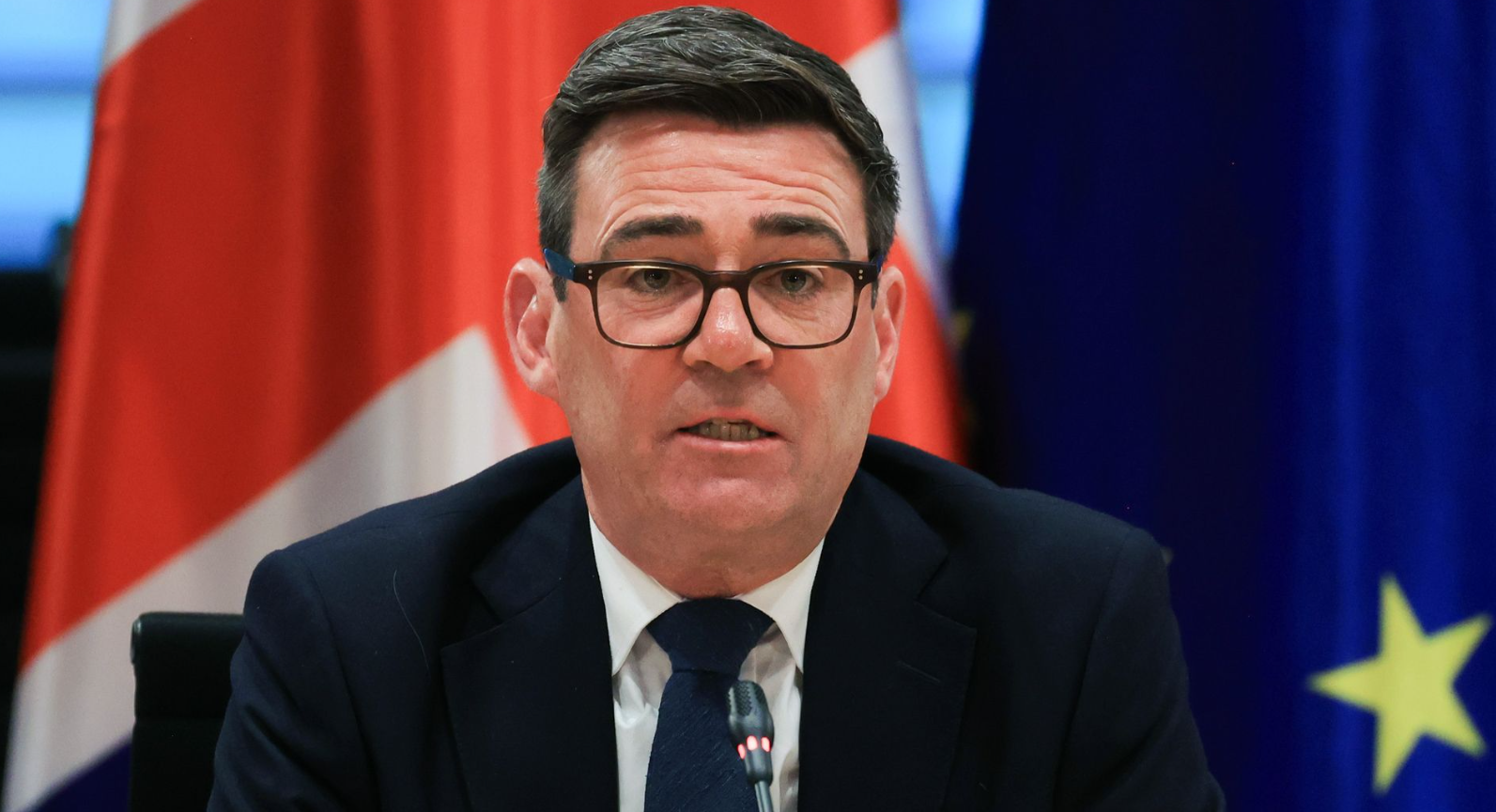
A century or more ago John Morley wrote: “Most mistakes in politics arise from flat and invincible disregard of the plain maxim that it is possible for the same thing to be and not to be.” And now that great figure, the Prime Minister, has come to demonstrate the truth of this with a flat assertion.
An older Prime Minister, 10 years ago, said:
Brexit means Brexit.
Which I translate using logical symbols as follows:
Brexit = Brexit
But now a later Prime Minister, 10 years on, shows us a wiser sensibility with his radical and paradoxical denial of Theresa May’s First Law of Brexit. (The ironies involved in all this should be dimly obvious. She said something in exaggerated manner to compensate for not having believed it in the slightest until it was necessary to appear to do so.) Now we have Andrew Burnham’s Second Law of Brexit, which, alas, replaces the First Law. This is:
Brexit ≠ Brexit
Or, if I allow him his own words, alas, spoken to the excessively benevolent The Rest is Politics podcast. (I quote all this from the Politics Live pages on the Guardian.)
I asked the question coming to Downing Street, “Was there interference in the 2016 referendum from Russia?” And I’ve had the clear answer that, “Yes, there was.”
These things are important now to put clearly on the record, and I believe, help voters in Germany and France understand that some of this politics is instigated via our enemies, namely Russia.
And, I think we’ve been too much on the back foot on that, actually. And we haven’t informed people sufficiently about the extent to which people are seeking to disrupt the political process from overseas.
Even the Guardian was shrewd enough to analyse that all this meant that
The Prime Minister is making a broader argument that Britain needs to reconsider its relationship with the EU, arguing that Brexit has not delivered what was promised.
Burnham came again to say something similar in the Commons:
If we are serious, if we are serious about promoting growth, controlling immigration, upholding our values and security, it is a conversation we must have.
The status quo is not good enough for Britain.
Worse, it would be a major dereliction of duty to turn away.
We need to take a calm, clear-eyed, rational look at the world as it is today to consider what is best for our country.
Our immediate priority is securing a successful outcome at the summit, and I believe we should then set up a serious dialogue about the different options for our relationship in the long term.
At every stage, the British public will be the boss, and I am clear that public opinion currently supports a pragmatic approach like the one I am suggesting.
Burnham seems to be using the following arguments:
- Brexit failed, i.e., failed to deliver what-was-promisedTM.
- Brexit was, hint, hint, a Russian conspiracy.
- Brexit made immigration worse.
Each of these can be answered bluntly:
- Brexit failed, i.e. failed to deliver what-was-promisedTM? (Never mind that the only thing that was promised was to attempt to cease to be a member of the European Union. Everything else was conjecture; and both sides, Leave and Remain, engaged heavily, and justifiably, in conjecture.)
- Brexit was, hint, hint, a Russian conspiracy? (Never mind that the Americans, in the shape of the President, conspired – admittedly openly – against Brexit. Burnham, a bit casually, as it seems to me, openly calls the Russians “our enemies”. I wonder what he calls the Americans behind closed doors. Oh, and everyone knows that “Russia” is just a sort of fairy story golem in Western politics: one to scare the kids.)
- Brexit made immigration worse? (Never mind that this is a post hoc propter hoc fallacy, i.e., ‘after x, therefore caused by x‘. In fact it is a fallacy even worse than that. It is a post hoc propter anti-hoc fallacy, which I just made up. This means ‘after x, therefore caused by opposition to x‘. Aye, immigration got worse: but I’ll wager it was because of revenge-for-Brexit.)
There seems to be more momentum behind Rejoin and Rethink and Recameron than there has been since Gina Miller. No. 10 was apparently consulting Think Tanks in September, to see what some imagined Public thought, and even that grave old statesman Blair chirped in to stipulate his conditions for a Rethirdway.
Ain’t it odd that everyone is a Re-er nowadays? We have Reform, Restore, Remain, Rejoin. In Burnham’s case Reoldlabour.
All this as it may be, my point is I think that Burnham is not serious. Or, rather, not speaking seriously. We should not exaggerate our response to this. What he is doing is playing politics in Trump’s Art of the Deal manner. You know: Stage 1: Say you’ll take Greenland. Stage 2: Amusedly watch the International Community get upset. 3. Responsibly come to some sort of arrangement, i.e., settle for much less than originally ventured. 4. Watch the world overcome its upset and accept what has happened.
I forgot. Burnham is making much of general dissatisfaction. The argument is:
- Brexit caused our woes.
- Therefore, let’s blame Brexit.
This is winding everyone up. For instance, I saw that Robert Tombs, that doughty old historian, had come to the Sunday Telegraph to defend Brexit. But, I hope that Burnham is playing politics.
Aye, Burnham, your politics is not point-scoring. But nay, Burnham, it is not problem-solving either. Your politics is using exaggerated language to create a meaningful gap between utterance and act that will enable something like a responsible policy to be carried out without causing a political backlash – in fact, by lashing around to create a minor political storm beneath which you, the Prime Minister, with your umbrella, will get on with business.
Look, all the sharpest political commentators have been telling us for 20 or 30 years that politics is not simple. David Runciman in Confronting Leviathan spoke of the “doubleness of modern politics”. Frank Ankersmit in Aesthetic Politics spoke of the “brokenness of political reality”. I was just reading today about how the rediscovery of Tacitus after the 1570s caused shockwaves of political enlightenment all around Europe as scholars realised that even someone much more respectable and antique than Machiavelli had noticed that politicians say one thing and do another. So all this should be old news. In the Commons, Badenoch earnestly asked Burnham to deny that Russia had any influence on Brexit. In other words, she was ticking him off for playing politics, for making a wild assertion. But I would defend him. I don’t think we should rush to confuse the wild assertion with serious policy. Politics still needs a bit of wild assertion.
Anyhow, Burnham said “the public will be the boss”. Actually, it is this sort of language that alarms me. Because then I know that the politician is lying. He is trying to run after some purported public opinion, but even this public opinion = what-politicians-can-get-away-with = the art of the possible. And Burnham is, I think, a possibilist. Though there is always the possibility that there will be an election to ask us whether we want to Recampbellise or Farage Off.
My sophisticated analysis of ‘Brexit’ is, of course, that ‘Brexit = Brexit’ and ‘Brexit ≠ Brexit’ are both, strictly, false. They were a binary once, and remain a sort of simple, brutal, binary for the Tweedledums and Tweedledees of the world. But the truth is that Brexit was always a strange reificatory word, that was, in itself, an attempt to turn an advisory vote into a fixed geopolitical result. This was something impossible. ‘Brexit’ is part of the political simplification by rhetoric of a complicated issue. But, as I have argued above, most of the problem was not the attempt-to-turn-an-advisory-vote-into-a-fixed-result but the continued resistance to this, not only manifest directly, in the prorogation business, but also manifest indirectly through massive Civil Service queering of the pitch, through continual Campbellian griping, through the survival of a repressed but bitter Remainer elite, and through expedients like COVID-19, which I, perhaps wrongly, still take to be in part, at least in the United Kingdom, revenge-for-2016. In fact, I may be wrong, but increased immigration might also be part of revenge-for-2016. Not caused by Brexit, but by the reaction. If so, Boris Johnson is a guilty man, for not seeing clearly enough: for getting carried away with slogans, and thus not being as able as I think Donald Trump is, and I hope Andy Burnham might be, to keep distinct in his mind the difference between a wild assertion and realistic policy.
James Alexander is a Professor in the Department of Political Science at Bilkent University in Turkey.


Discussion
Comments
This week across the site:
To join in with the discussion please make a donation to the Daily Sceptic.
Profanity and abuse will be removed and may lead to a permanent ban.
Cameron misjudged the mood of the country. The referendum freed people from voting according to party loyalty. The result was a constitutional crisis that a foreign power wouldn’t have had the acumen to devise themselves.
The whole thing being the typical sort of British bumbledom, no input needed from any foreign actor. Except to use to cover the home-grown bumbledom.
My guess is that Burnham is trying out potential policies to see if they would make a reasonable addition to the next Labour manifesto. The beauty of the Brexit rollback is not only does it win the votes of dissatisfied Remainers and poke Reform in the eye but it also proposes something that would take decades to achieve, even if it possible at all.
If Europe swings to the right politically, will the EU apparatus follow suit? We could end up with the Remainers wanting out too.