

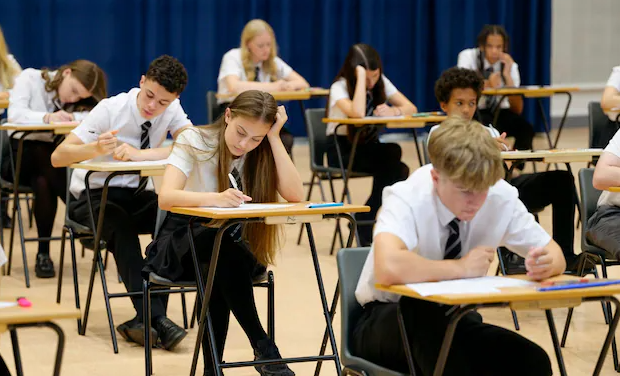
GCSE resits have their place. But young people also need a reason to care.
I hated maths. I always did. English was completely different. Give me An Inspector Calls and I could happily spend a lesson arguing about whether Mr Birling was awful. Give me an equation containing letters and numbers at the same time and I wanted to know who had allowed the alphabet into maths in the first place.
Being creative, writing stories and having debates was my thing. Algebra, shapes and equations were not. My philosophy throughout most of secondary school was fairly simple: if I didn’t like it, I wasn’t going to do it. I was also quite a naughty kid. Our maths class could be chaos. There was a lot of talking, messing around and a surprising number of glue sticks flying across the room. And I was hardly an innocent bystander. Trust me, I was very much involved.
Then, around the middle of Year 10, I remember thinking: God, I actually need to get myself together. I’d discovered politics and knew which Sixth Form I wanted to go to. Suddenly there was something I wanted at the end of school. There was just one fairly major problem: maths.
I needed a grade 4, roughly equivalent to the old C grade. In my December mocks I got a low 2. By my final mocks I’d dragged myself up to a high 2. If I didn’t get a 4, I wouldn’t get into the sixth form I wanted. And, almost as terrifyingly, I’d have to resit maths. Nothing motivates somebody who hates maths quite like the prospect of having to do even more maths.
So I bought revision books, stayed after school and was fortunate that my parents got me a maths tutor a few months before the exam. She worked me out quickly. I remember her telling my mum: “Ellie hates shapes. She hasn’t got a clue about them. There’ll be one question on them, so I’m focusing on everything else.”
Brutal, but effective. We weren’t trying to turn me into a mathematician. We were trying to get me a 4. And I passed, which is slightly inconvenient for the argument I’m about to make.
GCSE resits are back in the conversation after another miserable set of results this summer. Just 15.3% of post-16 GCSE maths resit entrants achieved a grade 4 or above. Fewer than one in six.
Since 2014, funding rules have required most young people who leave school without a grade 4 in English or maths to continue studying those subjects in post-16 education. The principle is sensible. We don’t want teenagers entering adult life unable to read, write or use basic maths. But more than a decade later, it seems reasonable to ask whether repeatedly returning young people to the same qualification is always the answer.
My own experience means I can’t simply say resits are pointless. The threat of one worked on me. But then there’s my friend Daniel.
Daniel was in the same maths set as me. When I rang him while writing this, we talked about how different the atmosphere could be between the top and bottom sets. Ours was one of the lower ones. Sometimes getting everyone to engage with the lesson was half the battle. In our class, the teacher could spend half the lesson trying to stop glue sticks from hitting somebody in the head. That obviously leaves a lot less time for actually teaching maths.
That doesn’t mean the kids in lower sets were stupid. Some struggled. Some didn’t care. Some probably had things going on outside school. And some, like me, were perfectly capable of doing better but weren’t particularly interested.
Daniel got a 3 in his GCSE. On paper, he’s exactly the sort of pupil for whom a resit should work. Except he resat it and got a 2. He’s now 18 and still studying maths at college, with a three-hour lesson once a week before sitting the exam again.
When I asked what he thought about it, he wasn’t furious. He just didn’t really care. His attitude was basically: “What’s the point in me doing this?” That almost says more than a five-minute rant would.
Daniel’s experience doesn’t prove resits don’t work any more than mine proves they do. Government figures show how difficult the problem is. Among the latest cohort, 35.4% of young people who got a grade 3 in maths at 16 had gone on to achieve the required standard, a grade 4 or equivalent, by 19. Among those who started with a grade 2, just 7.7% had reached that standard.
There is something slightly bizarre about the power we’ve given that magic number 4. You could be brilliant at English and history, hopeless at maths and science, and still be highly capable academically. Yet fail GCSE maths and you can find doors closing in subjects that have almost nothing to do with it.
If somebody wants to study engineering, economics or mathematics, obviously mathematical ability matters. But why should exactly the same qualification act as a universal gatekeeper for somebody whose abilities lie elsewhere?
Staffordshire University famously offered a module which included studying David Beckham and football culture. So we managed to construct an education system in which studying David Beckham could be academically legitimate, while an inability to pass GCSE maths could still close the door to studying something you were actually brilliant at.
I wanted to study politics. I needed to understand percentages, statistics and numbers. I did not need to love algebra or know my way around every shape known to mankind. I wasn’t planning to calculate the circumference of Keir Starmer’s head.
There’s another problem with treating GCSE results as a straightforward measure of ability: the environment in which those results are produced.
This summer, 88.4% of GCSE results at independent schools were grade 4 or above, compared with 66.1% across state-funded schools. That obviously doesn’t mean private-school teachers are simply better. It raises a more interesting question about how much opportunity teachers actually have to teach.
A teacher at my old state school told me there is now “barely any time to be an actual teacher anymore”. So much of the job can be taken up dealing with behaviour, pastoral problems and everything else going on in pupils’ lives. I knew exactly what she meant. I’d been one of the pupils creating the problem.
My friend Albert’s experience shows how much environment can matter. His secondary school experience, by his recollection, was chaotic. Teachers changed constantly, there were supply teachers, disrupted lessons and fights. For a lot of subjects, he basically taught himself the material at home.
Perhaps the most telling detail came when he collected his GCSE results. His head of year asked him his name. Five years. Didn’t know his name.
Albert left with mostly 4s and 5s. Then he went to a different sixth form, developed a passion for English and went on an Oxford taster day. He loved it. Suddenly Oxford wasn’t some abstract place full of people completely different from him. He could actually see himself there.
He started sixth form around D, C, C and finished with A*, A and B. He’s now going to Oxford to study English.
Albert didn’t suddenly become more intelligent at 17, just as I didn’t suddenly become more intelligent when I turned a 2 into a 4. What changed was our environment, our motivation and the fact that we had something we actually wanted to work towards.
Albert remembers an outside careers adviser coming into his school once. Pupils got around 15 minutes to talk about what they wanted to do. There was one slight problem: most of them had absolutely no idea. Of course they didn’t. They were 15.
It’s very difficult to be ambitious about a life you’ve never actually seen.
We spend years telling teenagers their GCSEs are important. Perhaps we need to get much better at showing them what they’re important for. Show them universities. Show them apprenticeships. Take them into workplaces. Show them vocational colleges and trades. Give them proper work experience. Let them meet people doing jobs they didn’t even know existed.
I went to Sixth Form and then left. I built my own route into politics and the media through work experience and actually doing the job. Albert is going to Oxford. Our routes couldn’t look much more different. But both of us found something we wanted badly enough to work for.
Daniel is still sitting in a three-hour maths lesson once a week asking: “What’s the point?”
And that, to me, is the real question behind the GCSE resit debate. I don’t want to lower standards. Every young person should leave education able to read, write and use basic maths confidently. I don’t want to abolish resits either. The threat of one helped get a girl who scored a low 2 in her December mocks to a 4 in the real exam.
But you cannot resit your way to ambition.
For some young people, another attempt at GCSE is exactly right. For others who repeatedly struggle, there should be respected alternative ways to demonstrate literacy and numeracy, rather than repeatedly sending them back to the same GCSE paper. And alongside all of that, we need to get much better at showing young people what they might actually be working towards.
Perhaps we’ve become so focused on asking how to make teenagers pass that we’ve neglected to ask what might make them want to.
Sometimes the difference between a teenager who doesn’t care and one who will work ridiculously hard isn’t intelligence. It’s having something worth working towards.




Discussion
Comments
This week across the site:
To join in with the discussion please make a donation to the Daily Sceptic.
Profanity and abuse will be removed and may lead to a permanent ban.
This is why we have a nation of sheeple who keep voting for impossible welfare payments, and who do not know the difference between a million migrants and a hundred thousand.
According to the Bell Curve theory, half the population are below average intelligence. Explains most of our problems and many of our MPs.
Education and learning are about motivation. We should make school voluntary. After about 5 years those who didn’t go would quickly learn they should.
But what are we to do about AI? Millions will have no work.
Oh really; who cares?
there are two forms of inspiration; one is finding something you love and not being able to resist going as far as you can with it.
The other is finding out that if you can’t read, write and add up, you may well starve and not have a roof over your head.
unfortunately the second option is taken care of by the state; so we are left with someone who won’t work until they are inspired, with the rest of the population paying for it.
The grades such as they are, supposedly show that someone can understand and use information to a certain level. God knows, current papers do all but answer the question for the candidate most of the time.
having said that, if I had young children today, I would definitely home school. State schools are not fit to send any child too and private education is out of reach for all but the richest; unless you get a scholarship or the parents employer contributes to the fees.
im not at all interested in some fifteen year olds opinion about not trying unless someone fills them with joy about the subject; the penny will… Read more »
I was a newly qualified teacher just starting out when the National Curriculum was introduced. I remember all the sudden emphasis on testing, and so much of it. I remember someone (possibly Ted Wragg, writing in the Times Educational Supplement) commenting “You don’t fatten a pig by weighing it”. Testing, of itself, doesn’t drive up standards. Of course, it’s essential when you need to gauge learning, or to compare students/job applicants, but it shouldn’t be the sole target. And you have to accept that some students will never do well in certain subjects.
So many students had no desire to be in school, and couldn’t see the point of learning. I often felt that it would have been really useful to send them out for a year’s work experience before they started their GCSEs – not after them – to find out for themselves what they needed to learn, and how education would enhance their career paths. That would have given them the motivation they lacked.
I have never seen a country so obsessed with the exams children take. To be honest, who cares? It is a shame that every parent who would like their child to succeed has to get this stressed out in order for the kid to be a success. It really should not be this hard. But that is britain in a nutshell. Meanwhile Rome is burning.
Excellent piece Ellie. You’ve intelligently articulated how the constant expectation of that magic grade 4 in maths is not serving all our children well.
And it’s about so much more than the child alone:
school culture, shared values between home and school (e.g. aspirations), teaching quality (sad to read the view of the teacher who felt they weren’t enabled to spend enough time actually teaching). It’s a shame so many families have to pay school fees in order to give their children the high quality schooling and learning environments they want for their children. Your thinking around the grade differences between private and state is useful. Thank you
Maths is hard, not all kids can do it. This proves that the blank slate theory is a lie. Hence why the excuses for thick kids.
I am one of these people who thinks numbers are important.
The Covid years were a prime example of people not understanding numbers.
I would really like to know how many of our current MPs understand numbers. The evidence would suggest not many.
Disagree
It was not about understanding or not understanding numbers.
It was about a complete lack of scepticism, a manifestation of trust in authority, of being trained since primary school that truth comes from authority.
I have (or rather HAD) many peers of similar academic achievement, “good with numbers” who refused to be good with numbers because they were told by authority that it was a pandemic… so why bother using numbers?! Why would they lie to us?! STOP BEING SO CYNICAL, MARCUS! DO THE RIGHT THING! Put on the mask, stay at home and follow orders!
My new circle of friends contains many who dropped out of the school system and are NOT “good with numbers” but who instead….
….wait for it….
THINK.
They were labelled “bad with numbers” by an arbitrary system precisely because they wanted to think, rather than be told which formula to use and when to use it. They didn’t conform to an arbitrary system of “education” and so the system denounced them. But they can think and most are willing to do basic arithmetic to prove basic points… despite the “education” they received.
Only partially agree with you.
There is a whole raft of people who have no clue about numbers full stop, so don’t have the ability to question the validity of statements with numbers in them.
Maybe the entire “education” edifice deserves to crumble…
Wow, look at the kids in that photo! All totally focused on answering the exam questions… except the 2 Ethnic African kids, one with “starter dreadlocks” in the back at the far right of the photo, looking furtively at his fellow Ethnic African two rows ahead, and the other relaxing back in his seat and looking furtively away, annoyed that there’s no one close enough to copy the answers from…
What are we doing to our children in the West? Our White Children, whose ancestors worked hard to build these lands into great nations? What kind of future are we giving them?
Meanwhile in India, that bastion of peaceful vegetarians…
Hundreds injured in stone-throwing festival fiasco
“The ritual is held in honour of the goddess Barahi, with worshippers believing that the traditional bloodshed fulfils an ancient religious offering.” [They all throw rocks at each other]
“Head priest Kirti Ballabh Joshi said: ‘The ritual lasted eight minutes. It began at 1:48 pm after a conch shell was blown and ended at 1:55 pm.’
“More than 140 were taken to hospital for treatment for wounds to their faces, heads and legs.”
🙄
Forcing kids to resit GCSE mathermatics until they get to a completely arbitrary standard in a completely arborary set of mathematical skills is just another instance of the state abusing its population.
It’s one more way in which that repulsive over credentialled class lord it over ordinary people and show their disdain for them.
Not that being numerically literate isn’t important. It’s the notion that some people.in our society think they have the right to demand and mandate a totally arbitrary level of numerical ability.
It’s once again a power trip masquerading as virtue.
Being able to add to do basic addition, subtraction, multiplication etc used to be important but now that everyone under the age of 30 has a calculator on their smart phone it’s far less so. Being able to solve simultaneous equations or work out the length of one side of a triangle if you know the length of another side and a couple of angles isn’t. I took G.C.S.E maths a year early, got an A (back when it meant something and there weren’t A* and A**) but never needed any of it after dropping out of a chemistry degree and the end of the first year. Along with pretty much everything else I learnt at school, apart from running headfirst into a metal pole isn’t a good idea but this was extra curricula learning, I’ve forgotten all of it. I’ve no idea if what I said about triangles is possible and I don’t care.
hear hear
‘Children are fires to be kindled, not vessels to be filled’