


Lower UK wind speeds and less powerful storms have always been a bit of a disappointment to activists whipping up a climate crisis frenzy to back the Net Zero fantasy. Going back over 50 years, the data is clearly showing a declining trend. Of course, despite its lamentable inability to step up to the Net Zero plate, wind is one of the UK’s “essential climate variables”, to quote the Met Office’s own words. Since it first started publishing its annual ‘state of the UK climate’ report, the climatic performance of wind and storms have had their own dedicated chapter. Alas, no more. The 2025 report, published last month, has abolished the chapter – wind it seems is now little more than a footnote. Should do better, some might comment.
However hard one tries to regard the Met Office as a sound independent science body, its obvious Net Zero promotion constantly gets in the way. “Embarrassingly duped by activists” was Matt Ridley’s recent verdict, and it is difficult to disagree. How it can justify abolishing wind is almost beyond comprehension. It doesn’t take a particularly cynical nature to suggest the ever-expanding chapter on temperatures is unlikely to disappear in future editions.
The Met Office has had trouble with wind and storms in the past. In January 2024, a spokesperson told a BBC radio programme that UK storms were “more intense” due to the effects of climate change. Paul Homewood asked for an explanation via a Freedom of Information (FOI) request, but was told no answer could be provided due to the fact that the information “is not held”.
It often seems that the Met Office does not hold a great deal of information when FOI requests are made. It has been asked many times to supply the names of ‘well-correlated and neighbouring’ stations that are apparently used to estimate temperatures at non-existent weather sites, but the answers always come back none.
You do not have to be particularly conspiratorial or uncharitably minded to find difficulty in understanding why the Met Office has got the hump about the heavenly breezes. As with temperatures, rainfall and sunshine hours, all given a large chapter every year, wind speeds and frequency are measured across a UK-wide network of dedicated weather stations. In its 2024 report, the Met Office described all these observations as “ground truth”, adding that its UK climate monitoring capability would not be possible without them. “When considering the variability in the UK’s climate, it is perhaps helpful to consider the observational series presented in this report as one realisation of an ensemble of possible outcomes which, taken together, represent the UK’s climate overall”, it notes.
Update to the latest report: “… represents the UK’s windless climate overall”.
The big take-out from recent Met Office reports is the graph below showing maximum wind gust speeds back to the 1970s. Noted the Met Office last year, this is a “useful measure” of storminess.
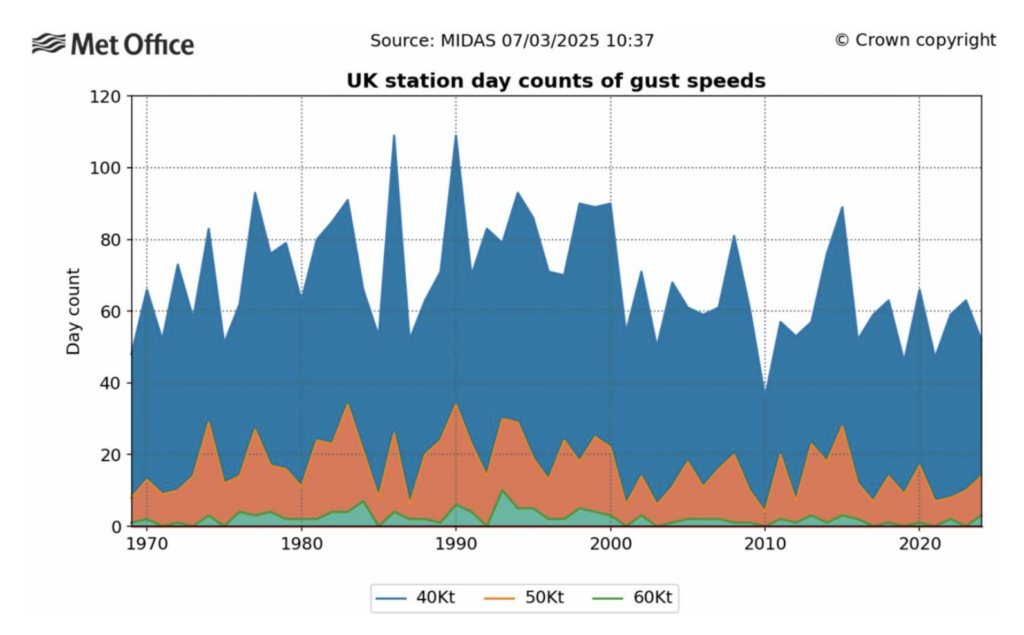
The graph plots the number of days each year on which at least 20 stations recorded gusts exceeding 40/50/60 Kt (46/58/69 mph). This useful storm measure shows an obvious decline over around 50 years in almost all the gust speeds tracked. Perhaps unsurprisingly, the Met Office has a habit of expressing caution about these inconvenient figures, suggesting data “limitations” might be due to changes in instrument types, the station network size and individual site exposure. Would that such doubts were raised by the State meteorologist about its temperature measuring operation with its 100 non-existent stations, ‘records’ declared from obvious heat spikes picked up by new improved measuring devices, and a hopelessly compromised, unnatural heat-ravaged UK-wide 380-site network.
Lower wind speeds, particularly if they are part of a long-term trend, are not exactly helpful to the current fanatical Net Zero UK Government that is keen to throw billions of pounds of subsidies at promoting renewable energy, including wind turbines. No doubt energy ministers will welcome a little reticence on such matters from other government departments.
Of course, the Met Office has not completely given up on the value of windstorm scares to push the Net Zero political project. In its separately published guidance notes on wind, it states: “In future, most climate projections indicate that winter windstorms will increase slightly in number and intensity over the UK i.e. more winter storms, including disproportionately more severe storms, are projected to cross the UK. However, this has medium confidence because a few climate models indicate differently.”
How the Met Office arrives at this conclusion is unclear, although like most Net Zero activists it is keen on the ‘evidence’ produced by selected computer models measuring an unmeasurable atmosphere. It is certainly not backed up by decades of past observations, now conveniently ditched in its recent cherry-pick of essential climate variables. Instead, the report notes individual wind gust extremes and covers major storms in detail, but fails to update vital wind data to provide the trends of most interest to scientists. Needless to say, the Met Office owes the paying public an explanation for its extraordinary behaviour in failing to update such important climate data.
Chris Morrison is the Daily Sceptic’s Environment Editor. Follow him on X.


Discussion
Comments
This week across the site:
To join in with the discussion please make a donation to the Daily Sceptic.
Profanity and abuse will be removed and may lead to a permanent ban.
Of course the Germans have been seeing winds weakening because somebody is sapping the energy from the wind.
Today (Wednesday) the MET said we would have blue skies and sun all day. What we are getting is CLOUDS all DAY. So if they cannot tell me what is to happen tomorrow why should I pay any attention to them when they tell me what is to happen in 10, 20 and 50 years from now? ——Ah but say the climate alarmists, “you are getting mixed up between weather and climate”—-But what it shows from the MET is incompetence, and if you cannot fix my car to be on the road tomorrow |I won’t trust you to fix it for the rest of the year either.
I don’t believe anything that is put out by the Met Office, and haven’t done for some time.
Different (but related) subject: unless I have been spoofed South Africa is having a cold spell and much of Free State province has snow. Not seen this in any MSM.
Chris Morrison is really onto something there with his exposure of the Met Office suddenly omitting winds completely. It seems that not only the wind speeds, but the wind direction, is related to the coming Ice Age, in which Easterlies are predominant, according to some researchers, while others have studied weather extremes such as drought in the historical records of the Little Ice Age. What is the Met Office trying to hide, we wonder?
Ancient Iceberg Scratch Marks In Great Lakes Solve Ice Age Wind Mystery
One British Archive: The Weather Extremes in England’s Little Ice Age Database | Journal of British Studies | Cambridge Core
I’d be more interested to see if the wind declining trend aligns with the ‘installed wind turbine capacity’… nothing in physics is free, you extract and transform wind in the North Sea or the channel and convert it to electricity you can move elsewhere in the country… you’ve reduced the wind, likely causing the land to be hotter as there is less breeze… and around we go again…
Prevailing winds in the UK are south westerly, this is especially true of high wind speeds due to Atlantic low pressure systems so loads of turbines in the North Sea won’t reduce wind speeds over the UK. If there’s any effect it’ll be downwind of the turbines, most likely over Scandanavia.
So those thousands of turbines in the North Sea / channel are primarily picking up wind heading towards Scandinavia – interesting
This is a known effect but has not been quantified over an area the size of the British Isles. Not sure how easy it is to do it, but it ought to be possible to measure this around a small group of wind turbines and extrapolate.
Of course it would be necessary to disentangle it from things like declining solar activity and the varying jetstream strength and path that is one result of that.
Climate is complex and chaotic.
Wouldn’t it be interesting though if on a day like today we could switch off all the wind turbines, and see what effect it had on temperatures inland… obviously we can’t actually do that as we don’t have enough proper generating capacity anyway to fill the gap…
…and as one of the two main drivers of winds is the rotation of the earth, on the principle of ‘Tha’ll not get owt for nowt lad’, all the windmills must surely be slowing the rotation and hence lengthening the day. Adapt or mitigate??
Well it’s not convenient to the narrative
Is the reduction in wind-gust speed good news for UK electricity consumers? Does it mean the turbines receive less curtailment bungs and therefore slightly lowers bills?
Plausible story from a former government insider:
The Met Office has not been free to tell the truth since 1997. As a former senior government ‘suit’ involved in the restructuring of research in the UK I explain why…
https://substack.com/@jdee/note/c-58425367
“…The Director General of the Met said something I’ll never forget, ‘It’s very simple: we give the customer exactly what they want.’ There and then the Met Office was going to cop out, yet it had to do so to survive. What you see today is a relic masquerading as the real thing. But they won’t admit this, of course; they dare not.
And what did the customer want? Well, back then behind closed doors we knew that anthropogenic warming wasn’t an issue, but the government wished to use it as a lever to push forward some radical policies. Overtly signalled as energy security policies they were, in fact, a raft of economic reforms designed to maintain the status quo for the privileged few under deteriorating market conditions.”
I think 1987 had a significant effect on their presentation policy. Defence against criticism became more important than accuracy, in effect, after the southern England storm that year, which demolished quite a few trees etc.
I’ll never forget that Hurricane of 1987! When the whole country had gone to sleep that night, assured by weatherman Michael Fish “Don’t worry, there isn’t going to be a hurricane”. Then suddenly in the middle of the night came a roaring blast of wind, howling through the old chimney above the open fireplace in my room, pounding like a giant fist against the wobbly old wooden sash windows of the Victorian terrace top floor bedsit where I lived. It was the raging, howling sound that was so terrifying, and I prayed that the old chimney wouldn’t come crashing down through the roof onto my bed, though I was sure all the windows were going to break at any second. It went on & on relentlessly, the awesome power of a natural force, unstoppable by any human. The next morning revealed the devastation, hundreds of big old trees ripped up by the roots and hurled to the ground in that area alone.
But the old sash windows held, which I could not understand until reading later that window gaps and open chimneys stabilized the inside pressure with the outside low storm pressure, and that’s why the sash windows held better… Read more »
Nowadays he’d just keep repeating that it wasn’t a hurricane, they only form in the tropics although the UK is often hit by ex-hurricanes, it was an extra-tropical storm so technically he was correct.
The technical difference is that extra-tropical storms have distinct warm and cold sections and weather fronts at the boundaries between the different airmasses where rainfall is concentrated. Hurricanes, typhoons etc don’t have these features.
Also the supposed “Barbecue Summer” that turned into a washout.
You can project the weather at best 10 days in advance, and even that can be wrong. Everything is POLITICS
Expect the wind chapter to be reinstated if we get an “outlier” year with a few severe storms.