


The media have jumped on a recent conference presentation about a breast cancer test. Its results were presented at the ASCO meeting last month and reported as a breakthrough that could spare millions of women chemotherapy.
The actual story is one of massive over-medication of women with toxic drugs and test failure.
The trial of the test
The claim is that the breast cancer test could predict who would benefit from chemotherapy. The truth was that it was good at predicting which women would have a cancer recurrence but it failed at the only useful claim of who would benefit.
The results came from a randomised controlled trial (OPTIMA) of a genomic test called Prosigna which looked at women with the most treatable kind of breast cancer – hormone receptor-positive, HER2-negative – to predict who needed chemotherapy. Crucially, these were women with high-risk features such as involved lymph nodes: exactly the women doctors currently do put through chemotherapy. And it is a subtype that, for years, evidence has been building that chemotherapy provides little or no benefit for many patients.
By 2018, TAILORx had already shown that large numbers of these women – those without involved lymph nodes – could avoid chemotherapy. By 2021, RxPONDER had shown no detectable benefit in large groups of postmenopausal women even when the lymph nodes were involved.
The conclusion from these trials is that among every hundred women with this kind of breast cancer, there are around two for whom chemotherapy makes the difference between a recurrence and a cure. By the trial’s own reckoning, chemotherapy prevents at most about two recurrences for every hundred women treated. The other 98 gain nothing from it. Most were never going to relapse. A few will relapse whatever you give them.
The real question was whether this test could identify the two who genuinely do benefit from chemotherapy.
To be clear, of a hundred women, about eight will suffer a recurrence whether or not they have chemotherapy which cannot help them; about 90 will never have a recurrence either way; and only about two have their fate changed by the drugs.
The dream of modern oncology is easy to state. Find those two women. Give them the chemotherapy that will save them. And let the other 98 walk away from months of toxic treatment they do not need.
Finding two women in a hundred
That leaves a stark choice. If a test could pick out the two, the other 98 could be spared chemotherapy entirely. If it cannot, we are left with two blunt options: give everyone the drugs, poisoning 98 to save two; or spare everyone, sparing 98 needless harm but letting two women suffer a recurrence the chemotherapy would have prevented.
What the trial would have had to prove
To prove the test could find those two women, there is one experiment that might seem obvious. Take the women the test flags as needing chemotherapy and randomly give half of them none. If the test is any good, the women denied the drugs should fare clearly worse. Specifically, for every hundred women given chemotherapy there would be eight recurrences and for those given placebo there would be 10. That would show the test had picked out the women who truly benefit.
But this is not an experiment anyone wanted to run. These are the women the test has singled out as the ones who need chemotherapy – the group with the two women who could benefit. Randomly withholding treatment from the very women you have just flagged as needing it is a hard thing to ask of doctors and patients alike, even though, on the numbers, only about two in a hundred would come to any harm from the deprivation of treatment.
Instead, they gave chemotherapy to all the women with a test result that said they needed chemotherapy. They randomised women to have or not have chemotherapy where the test result said it could be safely avoided. Ultimately, 68% of these high-risk women were cleared to skip chemotherapy. Half of them were not given any.
The results
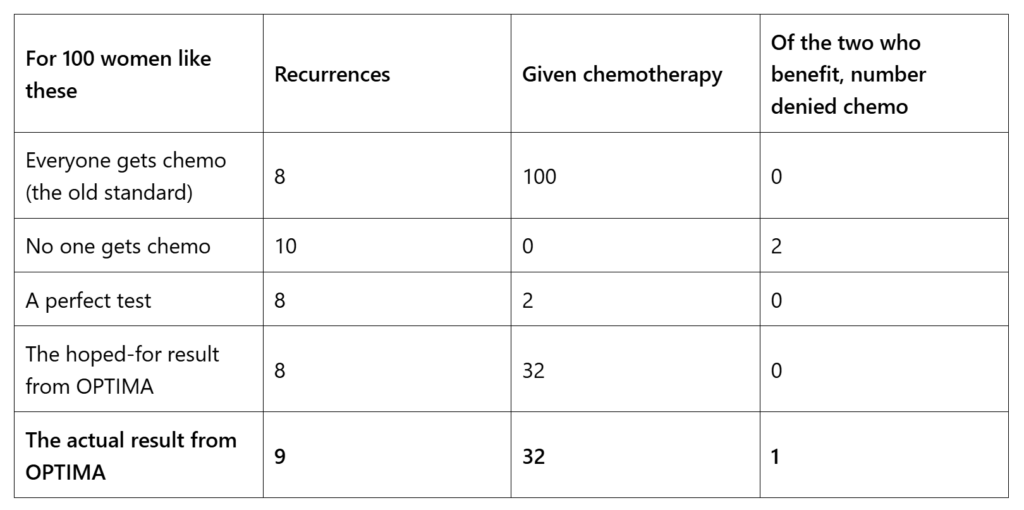
The OPTIMA researchers were hoping that in the group where the test suggested skipping chemotherapy that the outcome would be identical in those given and those who skipped it. They hoped that the two women who would benefit would both be in the 32% who were recommended to have chemotherapy. But the results show a 1.2% difference between the recurrence rate in the low risk group given chemotherapy compared to the low risk group denied it. That 1.2% was one of the two women in a hundred that they were meant to be able to identify and ensure they got the chemotherapy. You could suggest that at least they found one but even that would be optimistic.
There is one thing the test does well. It is good at identifying which women are likely to have a recurrence – it sorts them by risk. But that is a different question from the one that actually matters: which women would benefit from chemotherapy. Spotting who is likely to relapse is not the same as finding the two women for whom the drugs change the outcome and it was the second thing the test was sold as being able to do.
For a hundred women like those in the trial this shows what would happen in different circumstances:
Failure
If the researchers had had to state what a failed test would look like beforehand they would have said if two out of 100 benefit from chemotherapy then if the 68 (who avoided chemotherapy) were chosen randomly, we would expect 1.36% more of them to have a recurrence in the untreated group than the treated group. With a result of 1.2% it is astonishing this is being described as a breakthrough.
If chemotherapy changes the outcome for only about two women in a hundred in this group, the real story here is twofold.
1. Millions of women may have been put through toxic chemotherapy over the years despite mounting evidence that, for almost all of them, the benefit was negligible.
2. An expensive genetic test is now being pushed into routine use having failed the test that would show it was worth the money, namely whether the women it says do not need chemotherapy do not in fact need it.
The test failed. Its apparent success – that the women cleared to skip chemotherapy did about as well as those who were given it – would have looked exactly the same if not one woman in the trial had received chemotherapy at all. Chemotherapy changes the outcome for only about two women in a hundred; a result that holds whether the drugs are given or withheld is no proof that the test can tell who needs them.
N.B. As ever, the full paper has not been published. This is based on the ASCO presentation (Abstract 500) and news reports.
Dr Clare Craig is a diagnostic pathologist and Co-Chair of the HART group. She is the author of Expired – Covid the untold story and Spiked: A shot in the dark.




Discussion
Comments
This week across the site:
To join in with the discussion please make a donation to the Daily Sceptic.
Profanity and abuse will be removed and may lead to a permanent ban.
”Breast health” as part of the sacred “Well woman” campaign for decades has been known for at best, making no significant difference to deaths and outcomes: too many false positives and unnecessary interventions, too many missed signs and intervention too late, and at worst doing more harm then good – very expensively.
There is a certain insanity to having 7 million people waiting for hospital treatment – tens of thousands of whom will die waiting – and spending a significant portion of the budget and using other resources to find more people who need treatment to add to the 7 million, instead of using the money and resources to treat those already waiting.
As long as the State runs healthcare, exclusively now funded by debt, healthcare in this Country will continue its downward spiral, and a population of nitwits too idiotic to see it.
1948: 2 600 hospitals; 480 000 beds; waiting list 400 000.
2026: 1 600 hospitals; 145 000 beds; waiting list 7 million.
Bang those pans.
So what should one do when they get that terrible diagnosis? I’d love to hear from Clare on this one. My best friend is in remission post traumatic full chemo treatment, and also had a mastectomy. I think in her shoes I would have looked into opting for the latter and not the former treatment. As an aside, I strongly suspect this was brought on by the injectables.
Thank you! Always good to have the background analysis to claims made.
It has long been my impression that the vast majority of cancer diagnoses full stop are a case of “seek and ye shall find”…
Å gjøre noen en bjørnetjeneste, as my Danish Nana used to say (in Norwegian).
And as my father says, “If it isn’t hurting, leave it. Stay away from the hospitals.”
And “success” is considered to be if the cancer goes into remission because of treatment, not length of survival.
And the NHS spends a lot of money on something that does not improve outcomes in any measurable fashion.
Rinse and repeat and then ask for another £200bn a year.
Fantastic grift, isn’t it.
War
Sickness
The paper says ‘…Shows Noninferiority’. Only corrupt pharma could seek to sell drugs on the basis they are no worse than not using them ?
Perhaps I misunderstand ?
Wow. “Our product is not inferior to nothing”.
Reminds me of: Nothing acts faster than Panadol.