

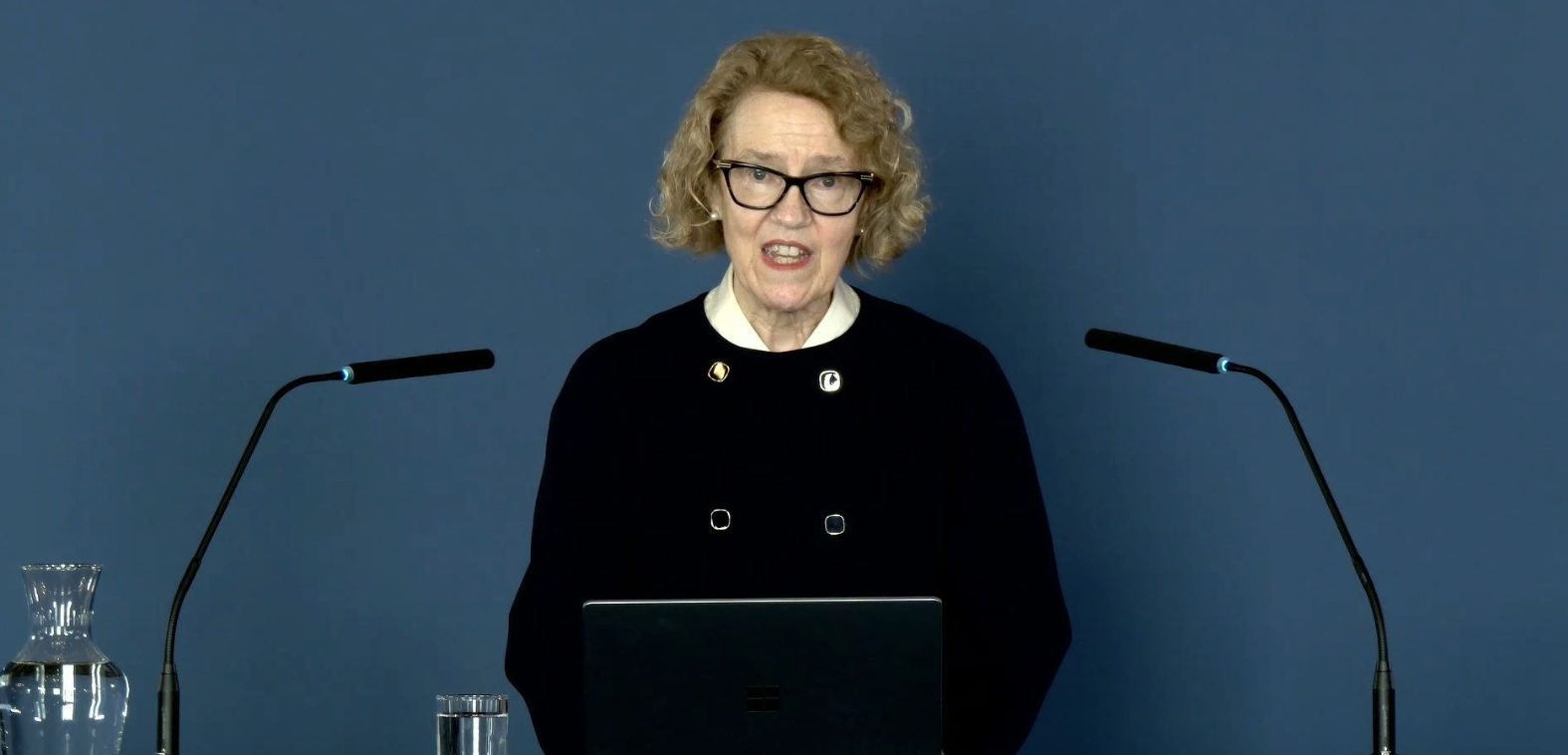
Last Tuesday, the news cycle was dominated by an array of vehement headlines related to the latest monumental squandering of public money which masquerades as a public inquiry. The Thirlwall Inquiry purported to examine conditions at the Countess of Chester Hospital between 2015-16, during which time the neonatal nurse Lucy Letby is alleged to have harmed infants. And yet this £18 million debacle has done no such thing.
It is firstly important to emphasise that most who read this article will have funded this inquiry. A cursory glance at the official costings released by Thirlwall reveals that over £12 million was accrued in legal costs, with £1.2 million spent on ‘salaries’. The vast majority of this will have been trousered by lawyers; I’m sure all readers will be delighted to learn of this.
It was not an auspicious indicator for the inquiry when veteran journalist Peter Hitchens noted that its Chair, Lady Justice Kathryn Thirlwall, appears to have been living on the moon for the past three years. Hitchens was referencing the elephant in the room, namely that the conviction of Lucy Letby is crumbling, and if there was any justice in this country then this wrongful verdict would already have been overturned.
Lady Thirlwall has gutlessly and guilelessly skated around this enormous pachyderm, refusing to entertain any possibility that the hundreds of experts calling for this inquiry to be paused deserved a fair hearing. In the surreal world of Thirlwall, this avalanche of qualified opinion is merely “noise”; an untenable position that she has yet to relinquish.
“If Lady Thirlwall had any self-awareness or decency, she would have apologised to the multiple experts who wrote to her,” Dr Keith Wilkinson told me. “She has had several opportunities to pause this inquiry. She knows nothing about healthcare. She has completely failed”. Dr Wilkinson worked as a consultant anaesthetist for 30 years, but is also a keen student of criminal proceedings, having attended countless court cases and written a book on a criminal case. “I have followed dozens of miscarriages of justice. But this is the worst one that I’ve ever seen,” Dr Wilkinson asserted. “It is blindingly obvious that Lucy Letby is innocent. I have no doubt whatsoever.”
Further contortions have been required from Lady Thirlwall in order to ignore the reams of evidence emanating from her eponymous inquiry that there were profound systemic problems at this hospital, and that the medical explanations for the collapses of infants given in court were glaringly contradicted by the contemporaneous record. There is a wealth of material in the documents submitted to Thirlwall pointing to abysmal sanitary conditions (as outlined by Professor David Livermore in this publication), the presence of pseudomonas aeruginosa, which seems to have been brushed under the carpet by the hospital, endemic sepsis in multiple infants likely resulting from this, and the presence of other potentially critical infections. Elsewhere, serious medical conditions such as lupus, an autoimmune condition, appear in internal documents and then melt away without further reference, as consultants on the unit become bizarrely fixated with Lucy Letby rather than their own failing hospital.
Additionally, there were highly evident staffing problems, there was a lack of competent consultant presence and no neonatologists at all, while the unit was too reliant on bank staff and untrained juniors. And, infamously, the consultant body was alarmingly absent, conducting just two ward rounds per week, rather than the requisite 14 – an indefensible dereliction of duty for which the unit was criticised by the Royal College of Paediatrics and Child Health.
In June 2026, the Ockenden Maternity Review, the largest inquiry of its kind in NHS history, found that 500 mothers and babies suffered potentially avoidable harm, or died due to failings, at the Nottingham University Hospitals NHS Trust. This calamity featured conditions that overlapped with the picture at the Countess of Chester Hospital to such an extent that they are practically carbon copies of one another, as was documented by the exemplary Sarah Knapton in the Daily Telegraph at the time.
The only meaningful difference between the two is that, while tragic, Nottingham has at least been recognised as a maternity scandal. The avoidable deaths at the Countess of Chester Hospital should also be viewed as a maternity scandal, as neonatal expert Dr Shoo Lee informed the nation in February 2025, asserting that if the Countess of Chester had been a hospital in his native Canada, it would have been closed down.
An interview that I conducted with Dr Lee made headlines in this country, particularly for the comment that reports compiled by an international panel of fourteen neonatal experts make a mockery of the incarceration of Lucy Letby. “Anyone who reads the reports and still thinks that Lucy Letby is guilty should have their head examined,” Dr Lee memorably informed me.
There are now over 30 experts in this international panel, which represents the biggest concentration of medical expertise ever assembled for an appeal. I have interviewed over 60 experts for my book, Reasonable Doubt: Examining the Case of Lucy Letby, and many more for my YouTube channel Lucy Letby Analysis. Since this book was published, around 15 doctors and dozens of nurses have contacted me, along with microbiologists, solicitors, barristers and many other concerned experts, all expressing their overwhelming concern about this conviction, and I’m in contact with many more.
Lady Justice Thirlwall has ignored all of this. She has effectively propped herself up in a darkened corner, fingers cemented in her ears, in complete denial of reality. What she has produced is a witless exercise in attempting to sustain the conviction of Lucy Letby. It is therefore hardly surprising that Thirlwall has singularly resisted any form of scrutiny, refusing to answer questions in Liverpool, and seemingly completely ignoring all correspondence directed to the inquiry. An associate of mine, a highly experienced medico-legal practitioner, has sent a raft of increasingly coruscating emails to the inquiry, without meaningful response.
Among the more delusional aspects of this report is the decision by Lady Thirlwall that she can decide whether or not deaths of infants on the unit were avoidable, something for which she is manifestly unqualified. But Thirlwall has also decided that she must ignore anything that contradicts the terms of reference, which constitutes a veritable ocean of material within her own documents. This immediately renders the whole process, and indeed the final report itself, utterly shambolic.
As a consequence of this, Lady Thirlwall, in her medical wisdom, has decided that Letby should have been prevented from attacking Children I, O and P from the court case (all infants were anonymised), while further comments she made prompted breathless claims from Daily Mail journalist Liz Hull with regard to Children C, D and E. Let’s briefly walk through the problems with this.
All of these infants were presented to the court as being essentially stable and well, and having suddenly collapsed for no reason. This is preposterous, when one examines the clinical picture of these babies. Children O and P were premature triplets. It is universally agreed, and even conceded by the hospital, that they should not have been resident on this neonatal unit.
The prosecution case for Child O has been utterly annihilated, based as it is on a series of ludicrous claims, involving Lucy Letby physically striking an infant in the stomach, rupturing a subcapsular haematoma (a collection of blood) in the process, but then asserting that an injection of air was fatal rather than the haematoma. There are clear disclosure issues with obstetric notes, which were requested by the defence but never shared. And an errant needle aspiration and more critical details were not disclosed to the coroner, but are present in Thirlwall documents.
The growth-restricted Child C was clearly suffering with a bowel obstruction – esteemed neonatologist Professor Colin Morley told me that symptoms in the infant were “absolutely classical of a baby who has got lower bowel obstruction”, while also citing poor efforts to resuscitate the infant. Child D was subjected to abysmal treatment, antibiotics were delayed for four hours, and this infant, suffering with respiratory distress, pneumonia and infection, should have survived.
In the case of Child E, there is universal agreement among every medical professional that I’ve spoken with that this infant, weighing less than 3lbs at birth, born at 29 weeks, which lost approximately 30-35% of his blood, died sadly due to a naturally occurring gastrointestinal bleed. Once again, the prosecution case here is untenable. And Child I, born at 27 weeks, weighing less than 1kg, was suffering with an array of serious health issues, which were complicated by infection with a pathogen.
Having decided that Lucy Letby is to blame for everything that happened on the unit, it would be intriguing to know on what basis Lady Thirlwall has discounted the above medical data, considering she has literally never set foot in any healthcare setting in a professional capacity, let alone a neonatal facility.
Emboldened by her newfound diagnostic ability, Lady Thirlwall has then moved on to making recommendations that will impact profoundly on the healthcare system if implemented. These include several suggestions that would seemingly have exonerated Lucy Letby, including monitors on cots and incubators, CCTV on fridges, and multi-disciplinary panels being asked to assess spikes in deaths. Although it must be said that recommendations for panels of neonatologists to examine deaths seem tone deaf, considering Thirlwall’s disregard for the opinion of critical neonatologists combined with the fact that there were no neonatologists working on the neonatal unit at the Countess of Chester.
However, the devil here is in the detail, and the word ‘devil’ is used advisedly. There are three words which hang portentously over the entire Thirlwall Inquiry: “Suspicion is enough.” Lady Thirlwall has decided that if anyone working with healthcare has any “suspicion” about another healthcare worker, that is enough to suspend them and initiate safeguarding measures. Indeed, Thirlwall merrily recounts that “in many cases, the police will become involved”.
This will be terrifying for nurses working with vulnerable patients. Those who have followed the Letby case will be aware of countless egregious errors made by Cheshire Police in investigating, which have resulted in stinging criticism from Sir David Davis in Parliament (who also kindly endorsed my book). Parliamentary comments from Davis were later ignorantly attacked by Chief Constable Mark Roberts, but, sadly for Roberts, literally nothing he said was accurate; he was rapidly eviscerated by Davis, and has since been publicly ushered towards the door marked ‘exit’.
Witnessing the dismal spectacle of the Cheshire Constabulary makes it rather difficult to believe that having the police more intimately involved in healthcare death spikes is a good thing. But that’s not the end of this matter, because Lady Thirlwall also asserts that the person making the allegations doesn’t need to be certain that they’re correct, and the person receiving the allegations doesn’t need to believe them. They just need to be made in “good faith”.
Anyone with two brain cells to rub together can see that this is catastrophic. How can “good faith” possibly be established? This report will make all healthcare staff, particularly those in junior positions, vulnerable to unproven or bad faith allegations. It is practically a blueprint to create more Lucy Letby-esque miscarriages, and will inevitably lead to many more healthcare professionals being suspended. Such is her total detachment, Lady Thirlwall was even insulting enough to describe removing a healthcare professional from their clinical duties as a “neutral act”, showing utter disregard for the personal, psychological and professional consequences that she is willing to liberally create.
This would all be bad enough had it emanated from a balanced and unjaundiced process. Nothing could be further from the truth. Thirlwall refers to comments from the public inquiry as being “in evidence”, indicating that this has become a quasi-legal process. Yet the inquiry came nowhere near the level of meeting this, not least because nothing was challenged or counteracted. Letby was not afforded any representation, and her barrister was denied core participant status. In fact, it’s highly probable that Lucy Letby doesn’t even know what has been written about her by Thirlwall.
“The foundation of any inquiry should be a search for the truth. The Thirlwall Inquiry has been the total opposite of that,” the journalist Cleuci de Oliveira, who attended 12 days of the inquiry in person, told me. “Inquiry lawyers would ask the most leading questions imaginable, and then try to steer the witness in that direction. And if the witness starts offering something that may veer from the path that the lawyer wants, they will cut the witness off.” De Oliveira had referred the Letby case to New Yorker journalist Rachel Aviv, resulting in what has become a famous article. And Aviv has recently followed this up with new work, in which she references the browbeating of witnesses at Thirlwall.
As mentioned previously, since the publication of my book, many experts have contacted me expressing serious concerns about the conviction of Letby. One such expert is consultant physician Dr Gordon Caldwell, who has already been an outspoken critic of Thirlwall. Dr Caldwell’s credentials and connections are considerable, and in an open letter the medic asserts that cameras would have limited evidential value unless footage were recorded and retained. Thirlwall only proposes that this should occur over a 28-day period, which would almost always be inadequate. He similarly questions whether restricting access to insulin, improving IT interoperability, strengthening bereavement care, regulating managers, and reforming the CQC would materially deter or expose a determined individual. He stresses the difficulty of distinguishing genuine abnormalities from statistical variation, and expresses particular concern about safeguarding procedures, emphasising that systems designed to act on suspicion must also guard against malicious, irrational or mistaken allegations.
Dr Caldwell also informed me of two examples from his career in which the diktats handed down by Thirlwall would have caused potentially fatal professional consequences. In the first case, a cardiologist with an exceptionally low complication rate experienced a recognised complication during a medical imaging test, yet was made to account for it despite colleagues defending his care. In the second case, a geriatrician respected a competent elderly patient’s refusal of a medical procedure to address blood clots, only for her later to develop a pulmonary embolism; although she had knowingly exercised her autonomy and made no complaint, the doctor was criticised for not persuading her more strongly. In Thirlwall’s new regime, both would be suspended, and the second would face a serious prospect of police investigation.
Perhaps the most notable critic of Thirlwall, though, has been Alastair McLellan, editor of the UK’s gold-standard healthcare publication, the Health Service Journal. Almost immediately, McLellan described the recommendations from Thirlwall as “painfully embarrassing”, and has since written that the inquiry’s “summary findings and recommendations are patronising, confusing and in some cases plain ignorant”.
The consequences of Thirlwall are extremely serious. In the short time since I have become known publicly, I have received hundreds of chilling messages from nurses, expressing serious concerns about what they deem to be a toxic culture in healthcare that makes nurses vulnerable. Dozens have recounted to me the cultural and practical issues that they face every day in their work. Since Thirlwall’s interminable report dropped with an ominous thud, many more have contacted me, citing major worries regarding the implementation of stringent safeguarding measures and potential bullying, the bizarre enthusiasm for the involvement of police in healthcare, the practicalities and consequences of CCTV, the alarm that constant monitoring may cause parents, and too many other issues to mention.
I have already heard from nurses and midwives ready to quit the profession. They will not be the last. “The Thirlwall report risks enabling further toxicity, suspicion and targeting of nurses,” Nineteen Nurses, a campaign group comprising 1,200 healthcare professionals who believe that the conviction of Lucy Letby is wrongful, informed me. “We are deeply concerned that removing nurses from duty on the slightest unsubstantiated suspicion creates a dangerous culture of fear. It leaves nurses vulnerable to witch hunts, scapegoating and professional targeting without properly established evidence. This is not conducive to patient care.”
No serious or credible person has come forward to defend the nonsensical medical evidence that was used to convict Lucy Letby. The primary witness, Dr Dewi Evans, has repeatedly embarrassed himself since the trial, and would be toxic for the prosecution at the Court of Appeal; an utter liability. The prosecution case has been annihilated, it lies in ruins, bereft of any foundation or even substance.
And yet decisions that will have wide-ranging consequences for the NHS and healthcare professionals are being made on the basis of this dog’s dinner of a report (no offence to my dog), which is little more than legal fiction, and makes no meaningful effort to even attempt to understand what actually occurred at the Countess of Chester Hospital.
During the composition of this article, another powerful voice emerged to question Letby’s conviction. This senior NHS leader, with 30 years’ experience, wrote in the Daily Telegraph that: “I do not believe Lucy Letby murdered those babies. I am not going to pull the evidence apart here. Others, better placed than me, have identified gaps in it that, at the very least, make the conviction unsafe, and the proper place for that argument is a courtroom. It needs to get there, and it needs to get there with haste”. Then a coroner wrote to Dr Philip Hammond of Private Eye, indicating his belief that none of the causes of death were adequately proven.
And today’s edition of the Sun newspaper features a bombshell front page and extensive coverage, pointing to a potential cover-up at the Countess of Chester Hospital. This precedes an important documentary that will be released this evening at 10pm UK time, cataloguing a year-long investigation by the Sun and Channel 5. Barely a day goes by without a new expert coming out, and yet Thirlwall still ploughs on spinelessly, seemingly oblivious to its own absurdity.
If Lady Thirlwall had an ounce of courage, this catastrophe could have been averted. All she had to do was go back to the government, explaining that she couldn’t in all conscience continue. This was the only logical course of action. Does it come as any surprise, in this crumbling nation, seemingly bereft of any public servant who understands the conjoined concepts of integrity and accountability, that she did not?
The continuing delusion in which Lady Thirlwall has voluntarily participated, namely that judges and courts are somehow infallible arbiters of truth, is not even remotely plausible. And at this point in our precipitous decline, this embarrassing public facade of the judiciary is only believed by those who tumbled to earth in the last shower of rainfall.
I hope this disaster can be averted. I hope the recommendations of Thirlwall will never be implemented. I hope the calamitous and wrongful conviction of Lucy Letby can be overturned before her life has been completely destroyed. I hope those that are responsible for it are held to account. I hope the multiple organisations that have spectacularly failed are restructured and reformed. I hope nothing as brutally unjust as this ever happens again.
I live in hope, not expectation.
Reasonable Doubt: Examining the Case of Lucy Letby by Christopher Morris is out now. Subscriber to Christopher’s YouTube channel, Lucy Letby Analysis.



Discussion
Comments
This week across the site:
To join in with the discussion please make a donation to the Daily Sceptic.
Profanity and abuse will be removed and may lead to a permanent ban.
The Hallett “so called” enquiry was a fiasco too at a mere £200 million!!
The link, cowardly liberal ‘know all’ women who prefer virtue signalling to hard evidence.
The first thing that jumped out at me was the credibility given to the utterings of Dewi Evans, who was never a neonatologist, and who volunteered himself as an “expert”. It is obvious that there were numerous problems in many areas of this unit. As a retired RN, I would also say that when there are problems, doctors band together, whilst nurses are easy to blame for failings. Nurses also eat their own young.
“If Lady Thirlwall had an ounce of courage…”
That really isn’t why these people are chosen to head this kind of thing, is it?
She is an establishment cabbage.
There is one small question, whether Letby is guilty or not. When senior medical staff reported their concerns and suggested suspension they were slapped down. In my view in any case where there is the slightest suspicion, suspension is appropriate. Let us suppose that was done, and the deaths stopped. I would certainly be very concerned by other aspects of Letby’s behaviour, which by any standards were abnormal.
And yet and yet, whilst I tend to conclusion that the conviction was at best unsafe commentators of he calibre of christopher snowden continue to be certain of her guilt.
Genuinely I would be interested to see a point by point debate between you.
I generally hold Christopher Snowdon in high regard, but this does seem to have become something of an idee fixe for him. Perhaps he is convinced of Letby’s guilt in part because his nemesis Peter Hitchens is convinced of her innocence?
Possibly.
Chris Snowdon proved to be an utter ar$$e during the Covid scam. He worshipped lockdowns and the ‘vaccines’, and attacked Toby Young repeatedly for suggesting an alternative view.
I wouldn’t trust the pompous and egotistical Snowdon to sit the right way on a toilet.
I suspect that the Criminal Cases Review Commission is desperately trying to slow down the consideration of the Letby verdicts so that the legal establishment can continue to lie and obfuscate until those responsible are retired or protected from prosecution for malfeasance.
Bravo, a very well written and hard hitting article.
The immediate priority is to get an innocent woman out of jail. Then we must dismantle the system that put her there, it is a long established system with multiple vested interests, so it will not be easy.
Every politician tempted to dispute the convictions will be mindful of the long line of grieving parents, led to believe that their babies were murdered.
In the meantime, if you are one, or know any nurses working in high mortality units, protect yourself and your colleagues by establishing the who/where/what/why of every death or crash call. You may need it in 5-10 years time, when the police arrive at dawn.
Yes, what a striking contrast between this three-year government inquiry costing British Taxpayers £18 million pounds and producing nothing of value over the question of blaming one English nurse for the deaths of 7 British infants…
and MP Rupert Lowe’s one-year inquiry costing voluntary contributors £600,000 and producing a published report of real value over the question of 250,000 British women & children gang-raped by mostly Pakistani Muslim Men.
The british government nowadays is totally unfit for purpose.