

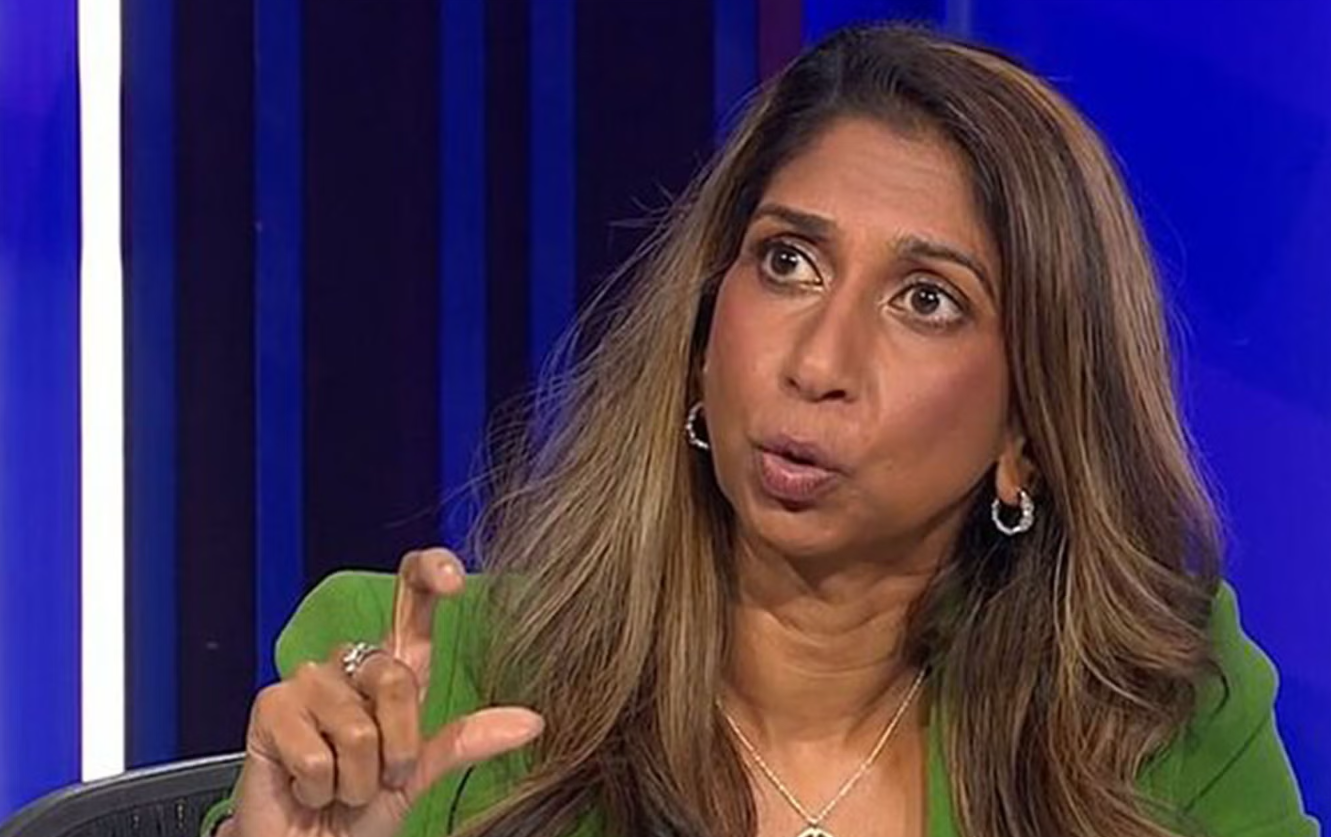
Suella Braverman wants immigrants to integrate. Excellent. So do I. Apparently, though, they must not get too carried away and become English. Learn the language. Embrace the country. Support the national teams. Raise your children here. Just remember that the family silver may never be yours.
On Question Time, Braverman described herself as British but not English because of her Asian origins. That is her choice. The problem comes when a personal identity becomes an admission policy. Englishness is as much cultural as ethnic. You cannot acquire English ancestors. You can acquire an English upbringing, outlook and sense of belonging. These are different things – unless your understanding of a nation begins and ends with a breeding certificate.
Braverman’s reference to “a few generations” leaves the obvious question unanswered. Generations of what? Living here? Sharing the culture? Marrying someone with the correct grandparents? Monty Panesar and Bukayo Saka might appreciate knowing whether representing England counts towards their probation.
Saka was born and raised in England to Nigerian parents. I was born and raised in Nigeria to English parents. I am a white Nigerian by birth, upbringing and cultural affinity. An Englishman by both ethnicity and culture. My Nigerian sensibility does not require African ancestry. Saka’s cultural Englishness need not require English forebears. Neither of us needs to evict one identity to make room for the other.
If we want assimilation, we must recognise the belonging it creates. Otherwise, we are asking people to learn the language, embrace the culture and love the country, then explaining that they have done splendidly but their grandparents have let them down.
There are three possibilities here. English by ethnicity. English by culture. Or both. These distinctions are perfectly intelligible, unless you choose to make a television argument out of them for the singular purpose of political point scoring. That is divisive and unbecoming of Reform or any party that aspires to govern every Brit: English, Welsh, Scottish or Northern Irish.
Unless, of course, you’re the Greens, who by declaring Zionism racist, demand inclusivity unless you happen to be a Jew who believes in a national homeland.
Nobody acquires English or Scottish grandparents by moving to Birmingham or Glasgow. People can, however, become culturally English or Scottish through upbringing, language, loyalties and participation. Indeed, in Scotland, Northern Ireland or Wales blaming the English is apparently accepted as evidence of assimilation.
Ancestry describes where your family came from. Culture helps determine the people among whom you belong.
What matters is whether newcomers adopt our language, respect our laws and share our values. Where their grandparents were born tells us none of that.
Cultural assimilation in England means embracing liberal democracy and the Judeo-Christian inheritance that helped shape it. The law outranks the cleric. Women are equals. You can worship, walk away or point out that the sermon is nonsense.
It also requires enough common language to argue about the bins and recognise that a parrot lying feet-up at the bottom of its cage is not “pining for the fjords”. You cannot demand the freedoms of a liberal society while insisting your community is exempt from its principles or its language.
A country is more than an airport lounge with a benefits desk.
John Stuart Mill understood that national belonging could be acquired. In 1861, he wrote: “Experience proves that it is possible for one nationality to merge and be absorbed in another.” Shared loyalties make that possible. Declaring someone permanently foreign because of their ancestry defeats the entire enterprise.
America has proved the power of cultural belonging, despite repeatedly betraying its promise. Irish Americans and African Americans share a nation without sharing an ancestry. Their histories differ profoundly. Their claim to be American does not.
A shared American identity can unite people whose family histories have little in common. That is a national achievement worth learning from.
We need not import every American argument to recognise the principle. Cultural belonging can cross ancestral boundaries. Braverman need not look across the Atlantic to see cultural belonging transcend ancestry. She need only look at the family on our stamps.
The present King’s father was born on Corfu as Prince Philip of Greece and Denmark. His grandfather was a Danish prince who became King of Greece. His mother was Princess Alice of Battenberg. If Englishness requires ancestral vetting, Buckingham Palace has some explaining to do.
Philip was Greek by birth and royal title, with mixed European ancestry. He served in the Royal Navy, became a British subject in 1947 and married the soon to be Queen Elizabeth II that year. His belonging rested on a life of service, rather than an approved collection of ancestors.
His Queen’s dynasty had already exchanged Saxe-Coburg-Gotha for Windsor in 1917. Calling yourself Saxe-Coburg-Gotha while asking the country to fight Germany was a bit much, even for a family accustomed to having everything as they like it. Windsor sounded like somewhere you’d buy jam. Saxe-Coburg-Gotha sounded like something you’d need an air raid shelter to survive.
Changing the name did not change the ancestry. The point is not that a royal proclamation made the family English. It is that German ancestry did not prevent them becoming part of the country’s cultural identity.
I favour controlled immigration because a country cannot absorb unlimited arrivals simply by issuing everyone a postcode. Schools, housing and public services have limits. So does the pace at which strangers can become neighbours. Ministers who ignore those limits are asking everyone else to conduct a vast social experiment, then calling them bigots when they query the instructions.
Our country must honour its side of the bargain.
The multicultural separatist says communities should remain apart. The ancestry purist makes shared culture insufficient for belonging. One discourages assimilation. The other leaves those who assimilate wondering when they will count. Both result in a fractured country.
Suella joined Reform by changing her allegiance, not her ancestors. Political membership and national identity are different things, but she plainly understands that belonging can be acquired.
Does her “few generations” mean shared culture or approved ancestry? She should tell us. You cannot sell assimilation as the answer while leaving the entrance requirements in invisible ink.
We should demand assimilation. Then reward it with belonging.
Clive Pinder is a Nigerian-born Englishman, recovering global executive, former elected ornament and largely unrepentant political provocateur. He writes and podcasts about culture, liberty and the curious people who appoint themselves custodians of both on his Substack page, In Search of Sanity.

Discussion
Comments
This week across the site:
To join in with the discussion please make a donation to the Daily Sceptic.
Profanity and abuse will be removed and may lead to a permanent ban.
The ‘family silver’ in this case being English-ness. It will never belong to an ethnically different migrant. But maybe several generations down the line…
British-ness is far quicker to acquire.
I differentiate between English and British. Putting it simply, Britishness is a matter of passport holding and integration: Englishness is a matter of bloodline traced and the amount of dilution to the original genetic signature.
For example, each new generation represents a sharing of genes. After 20 generations the liklihood of an original gene being present is about 1 in a million (2^20).
A generation averages 25 years. 20 generations span 500 years, so I would say for argument that after that period of time then someone can be considered English provided that there is free mixing, and no long term ghettoisation.
The left hate genetics as they want to erase races, which don’t exist, except when they do. It’s complicated. The left hate facts in general.
(Not saying Clive Pinder is a lefty, just a general comment on this whole topic).
Try moving from an English city to an English village! You might become ‘one of us’ after a few decades.
“The ancestry purist makes shared culture insufficient for belonging.”
Perhaps some do. I think this argument is something of a straw man, and it depends on what you mean by “belonging”. This “ancestry purist” likes words to mean something fairly commonly understood and not whatever anyone feels like saying they mean according to the prevailing politics. I am suspicious that many who say you can “become English” are quite keen on erasing both English culture and the English (and in general white) race. In so far as one can define “cultural Englishness” then yes some people who come to this country from elsewhere can certainly become culturally English. My German born mum certainly did, though of course Germans are our close European cousins so it’s much easier.
“The other leaves those who assimilate wondering when they will count. “
I tend to doubt this is a commonly held view, or if it is commonly held then it’s the product of constant propaganda from the “anti racism” industry that is intent on erasing our identity. Mrs ToF was born and raised in Italy and though she feels a great affinity for England and Englishness she would never say she was English, but… Read more »