

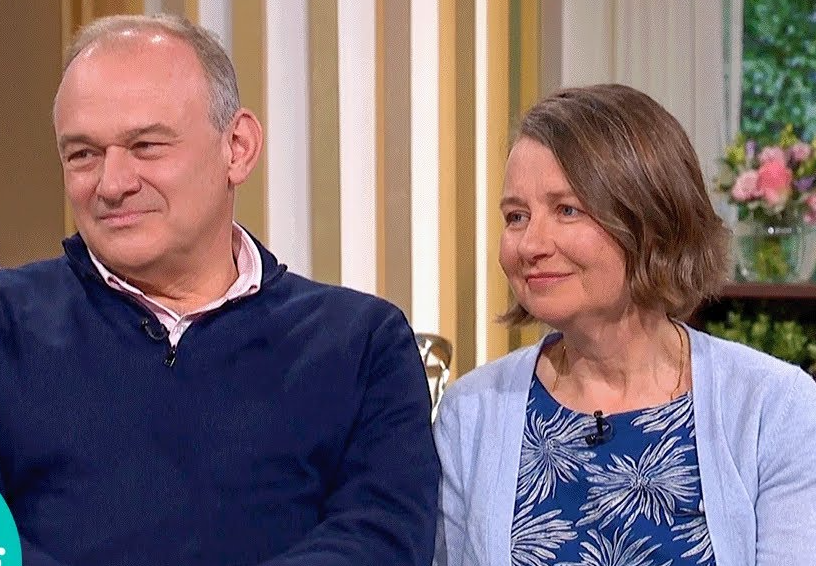
It’s a tough call having a go at Ed Davey who, if nothing else, is a loving father to his disabled son. However, ever since the announcement of the putative National Care Service I have been feeling intense disquiet around the displacement of the words parents, son, daughter, family in favour of “carer”, as Davey refers to himself. And the word care in general. It’s strikes me as a subtle and ultimately vicious attempt to eradicate family love in favour of state care – which is often anything but. Ed Davey lovingly cares for his son, because he is his father, not because he is his carer. We should not be duped into thinking these terms are interchangeable. They are not.
It was Ann Widdecombe who first alerted me to the pernicious use of the word care. Her mother lived with her since her father’s death in 1999 and Ann emphatically said that she was not her mother’s carer, but rather her daughter. In asserting the term daughter, rather than carer, Ann Widdecombe was reminding us that there are natural relationships that have loving care in built into them and sometimes also moral obligation. Such care given by a devoted daughter is instinctive, joyful and deeply fulfilling. It does not require a separate lexicon to explain its nature.
And I suppose that’s where the problem lies: the decades’ long drive to disconnect women initially – and now everyone – from their instinctive role as mothers and devoted sisters, daughters, nieces, helpful lady next door, in favour of out-sourced state run care. Simone de Beauvoir famously said:
No woman should be authorised to stay at home to raise her children. Society should be totally different. Women should not have that choice, precisely because if there is such a choice, too many women will make that one.
Well the society that Simon de Beauvoir ushered into being has reached its apotheosis: where fathers and sons refer to themselves as carers, (or bugger off completely), where the Conversative Party consistently encourages mothers and fathers to send their children to state subsidised care facilities, where the Prime Minister wants to commandeer what was once, until fairly recently, ordinary family life, into a National Care Service.
Everything about these stories chills me. It’s been obvious since the times of Sparta that the state is no substitute for a loving family. And yet there is a persistent attempt by parties of all colours to wrest familial caring relationships into such places as state-subsidised nurseries or private-equity-owned council-funded care homes. Family Allowance has been displaced by the Carer’s Allowance.
All the while this is happening, people in Britain are getting sadder and sadder. One in five children and young people have a probable mental health condition, 70,000 children and nine million adults are prescribed anti-depressants, a quarter of the population has a mental health condition. I am not sure that outsourcing care to the state will solve any of this. In fact, I predict it will make it a whole lot worse.
By insisting that care is a commodity, something that can just as well be done by a deracinated chap on a Health and Careworker visa as a loving family member, we are further compounding one of the greatest problems in our country today: namely fractured families. Yes of course there are difficulties in caring for both young and old in nappies, but, on balance for most people, the joys outweigh the challenges. It shouldn’t be controversial to say that if more people cared for their own children, parents and wider families, rather than accepting the state’s cold caring clutches, everyone – those caring and those cared for – would be infinitely happier.
In the recent Fonargy Report into the increasing diagnosis of ADHD and autism, the authors very quietly wrote:
Increasing participation in relationships, education, work, family and community life should be a central outcome and measure of success. These are core pillars of good mental health and wellbeing.
[Well durrrr.]
The authors accurately recognise the acute distress that far too many children are experiencing in Britain today, yet they inevitably call for more state care:
Make the financial case across government, not DHSC alone, [that] given investment in timely, evidence-based support, earlier intervention and prevention has the potential to deliver returns across different budgets and longer timescales, which should be measured through transparent evaluation of social and economic returns.
Where, though, is the call for families to spend time together, for fathers not to abandon their families, for children to be born with stable family structures (not the majority now born outside of marriage), for mothers rather than state-subsidised nurseries to raise children?
None of my desires for the shoring up of family life spring from a false sense of nostalgia or a wish to throw women back into the kitchen, but because caring for people in your family makes people deeply content and often deliriously happy. Those studies that dare to investigate such things report repeatedly that women who look after their children at home are happier than those that don’t and the same goes for the children. Ditto the elderly: living multi-generationally with family trumps a care home. Why are these obvious fact being ignored?
Instead there seems to exist a relentless campaign to highlight the erroneous misery of nurturing your own children. Self-confessed communist Aaron Bastani has also noticed the strangeness that surrounds the negative depiction of caring for children. He wrote recently:
After our second daughter was born Instagram was immediately showing me endless content of people slagging off family life and children.
Mummies are either slummy, scummy or drunk. A recent TikTok trends has women so frustrated with their life with their own children they rage and throw ice cubes into baths. None of this is an accurate portrayal of the genuine joys of parenthood. And we know what happens on the other end of the scale. Thank goodness that Assisted Dying has not yet entered the lexicon of state ‘care’.
So to return to Ed Davey. In order to stop the Government encroaching further into ‘care’ and duping us into thinking the state can do a better job of it than we can, let us stop talking about carers. Let us be accurate in our language: we are mothers, fathers, sons, daughters, cousins, aunts, uncles, grandparents and we must not be swapped in with state-sponsored carers for hire. As Ferdinand Mount wrote in his 1982 book The Subversive Family: “The family is the last ditch from which to resist the state.” We must not give up our roles as daughters, sons, mothers and fathers in favour of imposed state descriptors.
Joanna Gray is a writer and confidence coach.




Discussion
Comments
This week across the site:
To join in with the discussion please make a donation to the Daily Sceptic.
Profanity and abuse will be removed and may lead to a permanent ban.
Ummmm, a carer, I just thought he was a massive twat…..
Great article.
Technically he’s not wrong.
The state has passed a series of laws over the years which in effect give the state ultimate authority over our children.
So strictly speaking, we now care for our children on behalf of the state. And of course cover their costs.