

Following Prime Minister Andy Burnham’s tearful, promise-laden speech at the Labour Party’s annual conference, the Government announced this week the Great British Grid (GBG). “Families and businesses across the country will benefit” as the GBG will “speed up connections and cut bills”, explained a press release from the Department for Energy Security and Net Zero. GBG comes in the wake of the creation of Great British Energy, with a mission to “accelerate clean energy” and allow “workers and communities to reap the benefits of clean, secure, homegrown energy”. But while these state-owned companies make vague promises, within hours of the announcement the Ofgem price cap for October-December kicked in, boosting bills by 4%. So how are more publicly-owned companies going to help the Government that came to power on the promise of “lower bills” deliver?
As I pointed out in a recent article here, if we ignore Ofgem’s very obvious goalpost-moving, and the Government’s gimmicky temporary refunding of subsidies from general taxation and VAT removal, energy bills have risen by £547 since Labour took power. The difference between Labour’s promises and what it has delivered is therefore nearly £900. Its defenders might argue that these policies have taken £150 and £45 off bills. But the facts remain that these interventions are temporary, only move the costs onto taxpayers (to no net benefit), and bills are still going up.
So, unlike such gimmicks, is GBG going to be able to do more than performatively fiddle at the edges? Great British Energy, for example, seems to be little more than an outfit that fulfils Miliband’s eco-social democratic wet-dream of some Green Leap Forward, in which “communities” are financed by the state via the company to “own” energy infrastructure. Back in February, it was announced that GBE had made a billion pounds available for such projects. But the devil is in the detail. Last month, Burnham revealed that just £30 million was on the table for “People’s Power projects”, with the remaining £970 million presumably waiting for interested parties.
“Every council and community group awarded funding will have at least part-ownership in its renewable energy projects,” explained the PM. “They will own a stake in them and retain a share of the wealth they create,” which will “put money back in people’s pockets while giving them a direct role in tackling the climate crisis.”
The gloss of such “empowerment” through the GBE Community Energy Fund, however, rubs off quite quickly when we start thinking about it. Even were another 937 “communities” who are eager to take a million pound subsidy to be found by the scheme’s completion in 2030, there is the fact that a billion pounds doesn’t buy the country a great deal of extra capacity – and even less, given the uneconomics of scale, so to speak. Moreover, the benefits that accrue to the community-turned-energy-company can only do so at a higher price of power, taken from consumers. And even more moreover, those same poor saps are the taxpayers who already forked out for the grant!
GBE’s statement of its first year achievements are no more impressive. In May, it boasted that “225 schools and colleges and 162 NHS sites in England have completed solar installations” under its grants schemes. While that may sound impressive, it explains that a further “£25 million” has been granted to “40 more NHS sites”, from which we can assume that an average grant is at most worth £625,000. The “total number of solar scheme NHS sites” is now “over 300”, it claims. From which we can calculate an approximate total granting of £187.5 million. And the benefit: “an estimated £360 million in lifetime net bill savings.”
Wouldn’t it be better for hospitals not to have to appoint managers to projects with such slender returns, and for there to be affordable energy available via a functioning grid to hospitals, schools and our houses? Wouldn’t it be better for the £8.3 billion committed by the government to GBE to not be taken off the taxpayer at all, and not wasted on projects such as solar panels for schools and hospitals, “community energy” and experimental energy technology – another of the GBE schemes its strategic plan mentions? Indeed, what strategy can really be achieved by a “strategic plan” that aims to achieve nothing more than piecemeal gimmicks, here and there, that can make no serious contribution to energy supply or lower prices during what is a very clear supply and price crisis?
It’s no clearer what immediate need GBG is going to fulfil. “Britain’s electricity grid must be expanded and modernised at an unprecedented pace if it is to support growing demand from households and businesses,” states the Government’s press release. But UK electricity demand has not been growing. From a peak of 407 terawatt hours (TWh) in 2005, UK demand for power bottomed out in 2023 at 315 TWh. In 2025, it rose only slightly to 321 TWh. That’s a 21% fall in two decades. There is no mystery to these highs and lows. In real terms, and on an annual basis, power and gas were at their cheapest in 2004, and their most expensive in 2023 (DESNZ data in chart below). Reduced consumption is primarily a function of price, and therefore deindustrialisation.
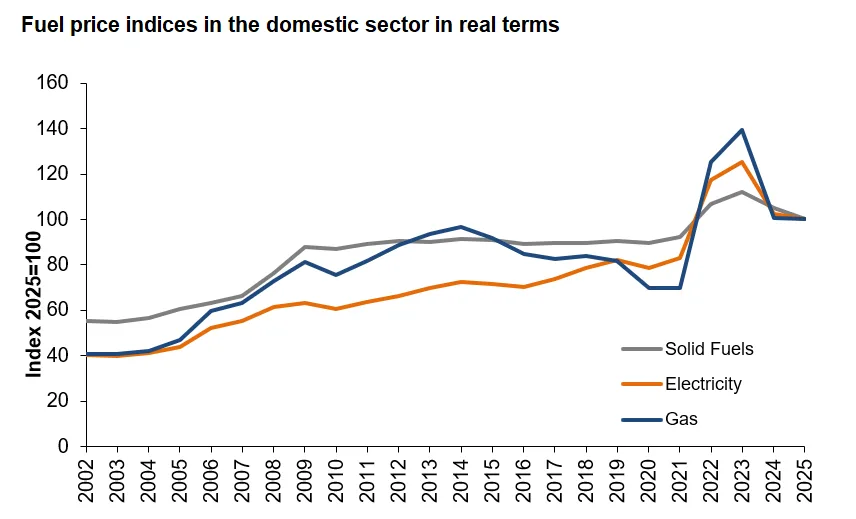
Prices have risen nearly threefold over the duration, and though they have calmed somewhat since the peaks of 2022-23, there is nothing from the Government that suggests any plan to allow them to fall. Indeed, estimates of the January Ofgem price cap are now coming in from industry analysts, and even the BBC is reporting the “biggest rise in four years” of 16% – and that’s on top of the 4% increase this month.
Yet nothing seems to sway the Government’s commitment to the policy agenda, or convince its advocates that energy price data show the consequences of decades of policy failure. Critics of the PM’s speech observed his messianic desire to relitigate the 1970s and Thatcher-era policies, such as privatisation. The privatisation of utilities comes under particular attack.
Guido reports that Martin McCluskey, DESNZ Parliamentary Under-Secretary of State, told a meeting at the conference that “we need to think about public control as a range of interventions and not just as one intervention, or maybe how we would have thought about 40 or 50 years ago of just a sort of straightforward nationalisation”.
Picking up on the Burnham Leftoid vibes, the Guardian reported that: “Creation of GB Grid will be major step towards putting Britain’s utility companies into public control.” Ahead of the conference, the paper quoted Burnham: “We have an energy system where prices are dictated in markets miles away, while families and businesses here shoulder the costs. Once again, the British public has lost control.”
Yet anyone whingeing about “40 years of neoliberalism” (Burnham’s expression), the whims of the market and the legacy of Margaret Thatcher needs to look at the historical data.
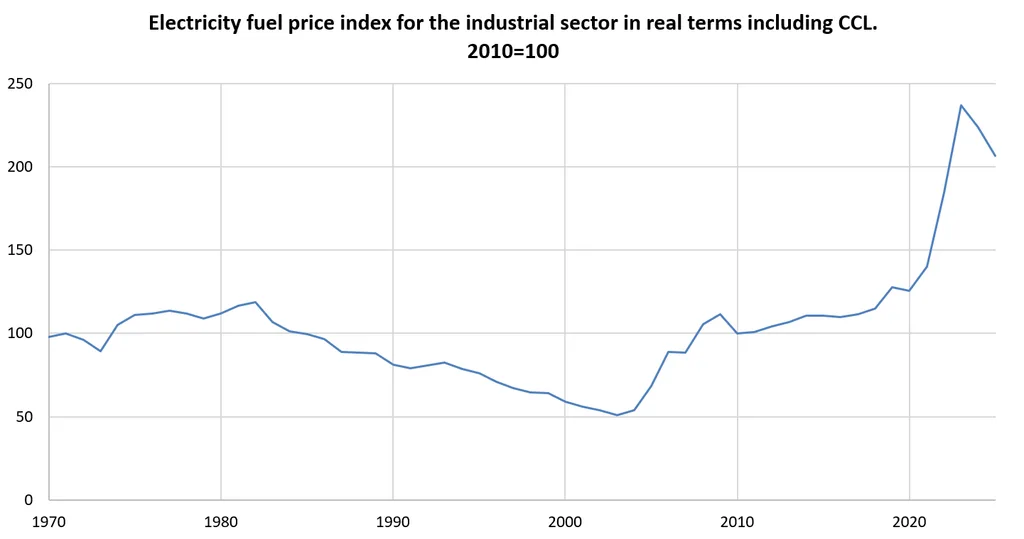
Thatcher and Lawson-era policies, including privatisation of electricity in the 1989 Energy Act, manifestly produced sustained reductions in energy prices. We can debate the details. But evidence is equally suggestive of a fact that the 2003 Sustainable Energy Act and the 2008 Climate Change Act (among other laws enacted under a Labour government and under EC Directives) reversed that progress. It’s not the whole story – energy is a complex field, encompassing everything between geology and geopolitics. However, it does utterly debunk the Labour-Left narrative – a constant shrill whine – about how much better things were in the 1970s, and how evil the subsequent Tory government was.
These raw facts – of two decades of sustained reduction in energy prices from the 1980s to 2000s – are no more likely to sway those committed to the agenda than the no less incontrovertible facts that there is less than zero evidence of a ‘climate crisis’, and that nobody would build a wind farm if they didn’t get subsidies such that the price of their commodity is higher than the price of power from gas.
And that’s the problem with vibes-based politics, epitomised by the Prime Minister, whose speeches are organised around Liverpudlian and Mancunian pop hits. “Altogether now,” he concluded – a nod to the 1990 track of the same name released by The Farm, itself a melancholic misty-eyed, anaemic and somewhat cloying reflection on the Great War, based on ‘Pachelbel’s Canon’. “Only hope remains,” bleat the lyrics. Indeed – but Burnham didn’t reveal that. Naff and deeply condescending pastiche of northern working-class political sentiments is not a basis for a robust energy policy.
Spiteful resentment about four decades of the Labour-Left’s own failures, pinned onto the legacy of Thatcher, is going to be recast as ‘hope’ and made concrete as policy that governs the grid. But it’s not Thatcher or her memory which is going to be harmed by such a political con. It is the very people for whom the Cambridge English Literature graduate earnestly evinces support that are lumbered with prices four times higher (and rising) than those inflicted by the Iron Lady.
The only actual hope that remains is that GBG, like it’s gimmick parent GBE with no real coherent mission to deliver substantial generating capacity, is also going to flounder from inception and fail to have much material effect. It may yet be merely an ancillary to GBE, connecting the dribbles of power from solar panels on community centres to the grid, rather than providing infrastructural backbone. The Telegraph is reporting that this may be the case, and that its funding will come from the “£4 billion previously allocated to state-owned GB Energy” – a significant reduction of the project’s earlier hype. National Grid, meanwhile, has committed to £70 billion by 2031, as required by the agenda set out by Ed Miliband for “Clean Power 2030”.
Whatever GBG is or will be, it’s certainly not yet a proposition as radical as the re-nationalisation of the National Grid (which I would only advocate as punishment for the corporation’s rent-seeking and support for Net Zero). But there is the danger that the Government will respond to its own continued policy failures by doubling down. Vibes will beget more radical vibes. And what songs will Burnham then choose to underscore his speeches on social media? How about Joy Division’s ‘Day of the Lords’: “Where will it end? Where will it end? Where will it end? Where will it end?”

Discussion
Comments
This week across the site:
To join in with the discussion please make a donation to the Daily Sceptic.
Profanity and abuse will be removed and may lead to a permanent ban.
The Prime Minister is in permanent campaigning mode, ready to go to the country the moment the polls look sufficiently propitious…but they never will because he is following the tracks in the sand left by the fratricidal Miliband:
‘Safety first won’t win this election: business as usual won’t win the election. The way we will win is with boldness.’ 2010
‘The idea was to have some optimism, energy and light and raise people’s sights beyond the parliament. It was not a bad idea, but it was badly executed’ 2015
You know the rest…
Andy Crapp
If my experience of how state-run organizations (the tax office, the NHS, the councils) work is anything to go by, I don’t see how anybody would think that nationalization would make them any better.
The inefficiency, bureaucracy, unaccountability, wastefulness shown by state-run institutions is astonishing, but, then again, why should any organization with a guaranteed income worry about these things?
We’ll end up like Cuba but without the sunshine.