

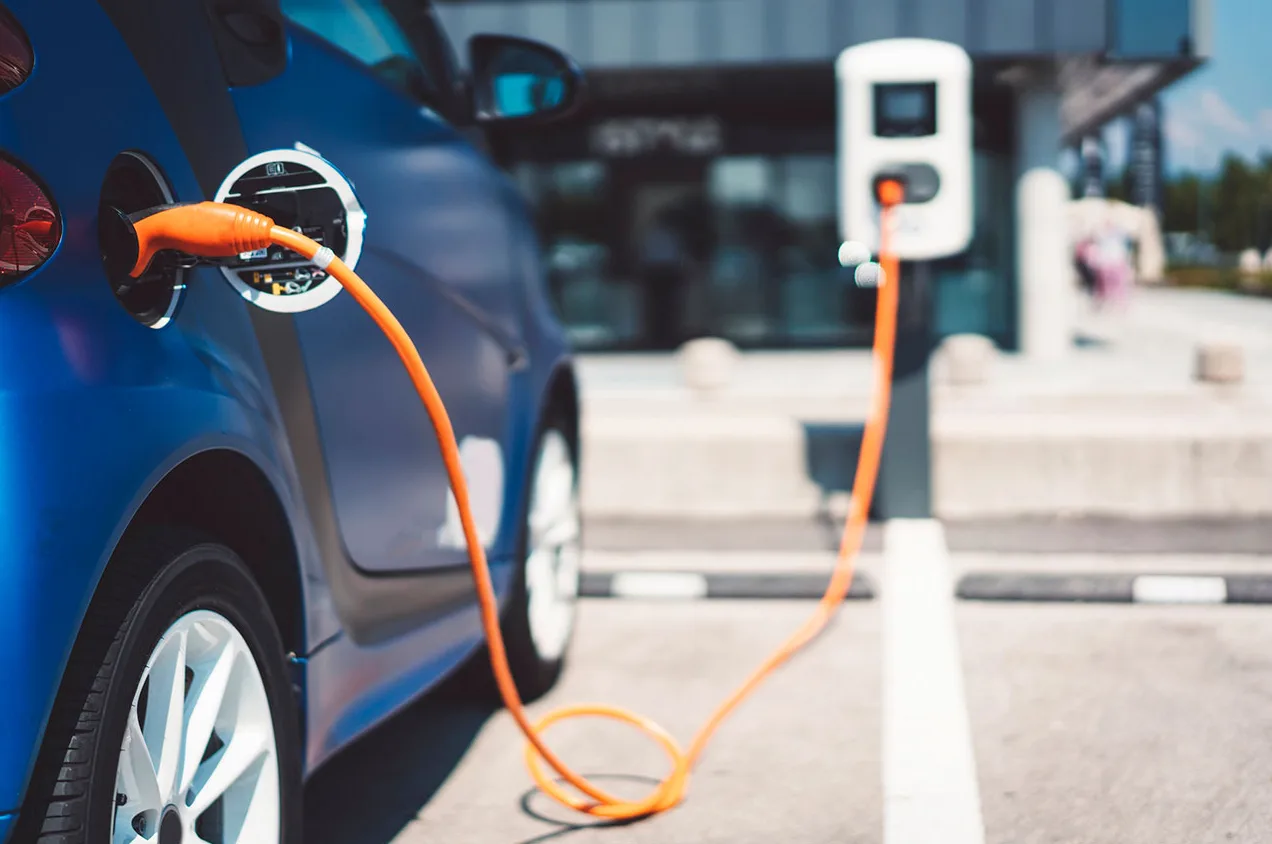
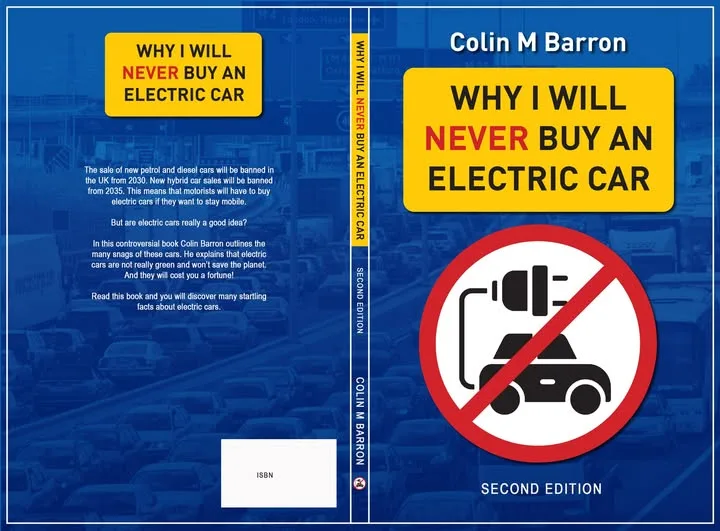
In summer 2023 I published a controversial book called why I Will Never Buy an Electric Car. This proved popular with 220 reviews on Amazon alone. The original edition covered the history of motor transport and then went on to discuss the many snags of electric car ownership. Short range. Limited charging infrastructure. The enormous expense of replacing lithium-ion batteries which only last a few years. Battery fires. Problems with charging in cold weather. And of course the fact that the production of electric cars – particularly the batteries – is associated with huge carbon emissions.
Now three years on, I have published an expanded Second Edition of the book which brings the reader up to date with everything that has been happening since 2023. Ed Miliband’s fanatical push for Net Zero has not resulted in electricity bills being reduced by £300 per year as he claimed as Britain now has the most expensive energy in the world.
Electric cars are an even poorer choice for the average motorist than they were three years ago. Government subsidies have now vanished and electric car owners have to pay Road Tax – from which they were formerly exempt – and there are plans to introduce a pay-per-mile charge for all EV drivers. Owners of petrol and diesel cars are also being squeezed and just before the book went to the publishers the Government announced proposed legislation – due to go through Parliament in the summer of 2027 – which requires owners of all internal combustion engine cars to submit to a yearly exhaust emission level check. The implication of this proposed legislation is that any cars which fail the new emission regulations – which may happen just because their catalytic convertor is a few years old – will have to be scrapped. I believe this is a cynical ploy to take many petrol and diesel cars off the road and force people into electric cars.
My new book also contains a chapter on how electric car ownership fits in with the United Nations Agenda 2030 plans, which see no future for private car ownership as the emphasis will be on limited public transport with many people travelling on foot or on a bicycle.
There is also a new chapter on bicycles e-bikes and e-scooters since these form an important part of the Government’s plans for the future of transport.
I have also included a section on the so-called ‘Arran Ferry Fiasco’, in which I explain how this has largely been caused by the SNP Government’s desire to meet CO2 emission targets. The main reason why the new car ferries MV Glen Sannox and MV Glen Rosa have proved so expensive and have been delayed for years is because of their complicated dual-fuel system which employs both LNG and diesel. This has pushed up the cost of the ferries and yet the new vessels have a higher carbon footprint than the ship they are supposed to be replacing, the MV Caledonian Isles.
Why I Will Never Buy an Electric Car (Second Edition) is available from Amazon in Kindle (just £1.77), paperback and hardback versions.
Colin M. Barron is a former NHS hospital doctor who is now retired. He is also a writer with 14 published books. His website is www.colinbarron.co.uk.




Discussion
Comments
This week across the site:
To join in with the discussion please make a donation to the Daily Sceptic.
Profanity and abuse will be removed and may lead to a permanent ban.
Bought mine! (the book, I mean, not an electric car)
Obviously…. Until there is some HUGE improvement in energy density of batteries (e.g. the regularly-hyped but somehow-never-materialising solid state batteries), then hydrocarbons will be the choice of fuel for the foreseeable future. The best batteries have only ONE FOURTEENTH the energy per kg of petrol and diesel, and they only STORE energy which is created by hydrocarbons, unlike petrol or diesel which is already… hydrocarbon. End of story.
So I wonder if your new edition takes account of the huge technological advances in battery technology about to be unleashed into the EV market ?
Sodium batteries and the like offering large cost reductions, large range increases, no lithium fires, faster charging, and longer battery life etc.
Never say never and keep an (somewhat) open mind. The answer is rarely one or the other and more often both, as I tell the mistress.
(And that is just a joke darling, and darling is a term of endearment and expression of love…ok I had better stop digging)
I, too, was an EV sceptic, until just recently.
That was when I reasoned that ‘range anxiety’ was not going to affect my choice of second ‘run-around’ car, because I drive only 12 to 15 miles per day (and the other car has an ICE for the occasional longer journey). My EV is 12 years old, has a battery state of health of 80% (which will give me 70 or so miles on a 100% charge) and costs me nothing to fuel (in summer) since it recharges from the solar array. In winter, when the sun doesn’t shine, I can recharge it for around 8 pence per kilowatt hour at night (11 pence when Labour’s EV per mile thing begins). That kWh will get me 4 miles, so the 32 miles that I get per gallon in the ICE car will be a princely 88 pence (at least until the government gets greedy again). The EV cost me a few thousand (somewhat less than most new cars depreciate in one year), a few hundred to insure, and road tax was £20 (although that’s likely to be revisited by a money-hungry Treasury).
My calculations suggest that, if it lasts me for… Read more »
and if you have an accident, can’t open the doors or windows and then the battery bursts into flames…I’m sure the deal won’t look quite so good.
No one is saying that electric cars do not have a place that is dependent on one’s circumstances. They clearly work for those that are relatively wealthy, can afford two cars and have a driveway and solar panels all which come with significant costs and resources. Some of those costs are to society in general in the form of subsidies as well as hidden costs.
I beg to differ. EVs are entirely retrogressive, a stupid solution to a non-problem.
When I was a child the only electric vehicles on the road were very slow milk floats. Whenever an electric car (with its smug driver feeling superior to the rest of us mortals who aren’t “saving the planet”) passes me these days I feel an urge to ask for 2 pints of semi and a yoghurt.
You’d be better off with full fat diesel – better for the tubes you know!
Thanks – bought your book look forward to reading it.
Will pass it around to the EV tards at work….just to p**s them off.
It’s almost like electric cars are designed to keep people off the road.
The comparative market trial of battery electric cars, internal combustion engine cars, steam powered cars was carried out in the early 20th Century by our ancestors so their descendants didn’t have to do it.
The clear winner was the internal combustion engine. Steam disappeared, battery electric cars stayed on in niche market sectors.
The main problems with electric cars then are the same as now: limited range, charging times and availability, battery life.
Running the experiment again with the expectation of a different outcome… well you know the rest.
Except that now since the early 20th century, the battery is now a highly dangerous chemical device that can prove lethal in a crash. An example has just happened in Germany where they have had to use DNA to try to identify the remains in a burnt out battery Skoda.
I’ve not heard that yet, where did you read it please?
I do remember a vid posted here a while back where an unfortunate Chinese man took his bike battery into a lift, where it ignited.
Are steam engines exempt?
It should not be beyond the whit of man to buils a multi-fuel steam powered vehicle. If they used hydrogen then the exhaust (condensed steam) could be used to top up the boiler.
Not sure that the laws of thermodynamics allow that to make much of a difference.
Is it true that once caught in even a fairly minor crash EVs will not be moved? I.e pushed or rolled. Got caught behind a minor prang near Penrith on the M6. Two cars moved to the hard shoulder while the battery car just stayed in the road. Luckily we were near the front and slipped passed in about 15 mins, but the unnecessary tailback would have been enormous.
I think they’re heavier. Tesla model 3 is around 1.8t. I’ve not looked into it but I wonder if it’s because a normal car has a neutral gear and can be pushed. Not sure it’s true for electric cars.
It’s definitely something to do with the gears, this is why broken down EVs can’t be towed and have to be loaded onto a recovery vehicle.
Electric cars have no gearbox or clutch, so if you need to push them you’re pushing against the motors, which are often set to auto-lock the wheels when off. Scalextric cars are also quite a bit heavier than ICE cars
They use that as an argument to sell you much more expensive ‘EV tyres’. I asked the bloke who sold me my Nissan EV whether he’d ever bothered with that. He said he’d always bought budget tyres and never had problems. My EV weighs 1600 kg. The corner loading for the four tyres is well below the maximum stated.
Given that I tootle around between home and my sports club, I don’t expect to encounter any problems, but my insurance covers recovery, should anything unfortunate interrupt my journey.
If I were commuting a considerable distance on a daily basis, I might entertain a completely different outlook.
(The weird thing is that the little EV has a better standing start performance that any sports car I’ve ever owned. Handy for pulling out of junctions, but never used in normal driving now my motor-lad days are behind me.)
How much is an infrastructure problem? There’s been a vast population increase but there’s been no significant increase in road and parking infrastructure. So pricing people off the roads in the interests of “climate change” gets politicians off the hook because they have not properly thought this through.
The infrastructure to worry about will be the grid, if we do ever move to majority EV cars. Of course, that’s supposing that the government is not bent on preventing the average bloke (or blokette) from getting about in private cars.
“I believe [yearly exhaust emission level checks are] a cynical ploy to take many petrol and diesel cars off the road
and force people into electric cars.“I fixed your sentence.
My golf club is 32 minutes away by car or 1 hour 30 minutes by tube and bus (5 on/off jaunts) and I’ve never tried a golf bag, shoes and trolley on public transport but I can imagine it being a total pain.
It costs me £5 in petrol and an Uber is £35 (hybrid or electric, my choice).
I guess golf has no place in the brave new world.
Golf never existed – it was a Far Right fantasy dreamed up by black Labradors.
But black labs matter!
🙂 very good!
In Scotland, at that!
So all those people whose jobs depend on your golf club will now be unemployed so instead of paying tax, they will be receiving taxpayers money from a reduced number of taxpayers. There will be no VAT from the golf club and no corporation tax.
But they’ll be able to rewild the golf course, which will help fuel the next wildfire.
Some direct government subsidies have gone but effectively there’s still a huge fuel subsidy. As of tomorrow when VAT is temporarily removed from electricity, there is zero tax of the kWhs powering an EV. Conversely, about 55% of the cost of petrol is tax.
What’s more, low cost electricity is effectively only available to those with a private driveway. No private drive & no EV charger & you’ll pay 10x more per kWh.
That’s quite a subsidy.
A subsidy is a payout. Tax relief is not a payout therefore it is not a subsidy.
If the battery is charged at a commercial charge point, the VAT will be 20%. VAT = Value Added Tax. The value added at a charging station is on the service provided, not the electricity the VAT on which on any case is included in the end-user price at the charge-point.
And what people don’t know is there is a carbon tax on electricity of 7p per kWh. This is because gas-fired power stations are charged a carbon tax for the CO2 emissions of £18 per tonne, about £6 to £7 per MWh. Since gas sets the wholesale price 90% of the time, this carbon tax filters through the supply chain to the consumer. Another little detail the lunatics in charge don’t mention when they try to deflect high electricity prices onto anything other than their own maniac policies.
Similarly large part of diesel cost is tax, rising price more tax for govt.
They’re bringing in channels across the pavement so that you can charge your car when parked in the road. Of course, the installation costs are down to you, and the council will want a couple of hundred (and rising) to ‘maintain’ the channel.
Electric cars aren’t anything to do with climate change or CO2. It’s about reducing oil/gas consumption which the UK and Europe as a whole have basically almost none of.
Hell, climate change is about that.
UK/European elites used to rule the world and control the oil and gas in it. They no longer control the oil and gas but still want to rule the world. And as oil and gas is what so far has conferred the power to rule the world, one solution is to destroy demand for oil and gas.
Another is to attack countries that have oil and gas but refuse to be controlled by us. Let’s see which countries have we been fighting with lately… Iran, Russia, Venezuela. Shockingly countries with some of the biggest reserves in the world and with ideas of their own.
We’re all just pawns in power games.
We have plenty oil and gas. We just have a government which has banned it penalised extraction. And there is, on historical evidence, plenty more of we would just explore.
We’ve not attacked Russia or Venezuela.
I think you’ve missed the point.
The government – which represents the ruling class and pursues its interests, not ours – doesn’t care about oil and gas as a source of fuel for us as much as it cares about it as a tool for geopolitical dominance.
If they were acting in our interests, sure, they’d promote fracking and North Sea exploration and all the rest of it. But their primary interest is their power, not just in Britain but on a global scale. For as long as oil and gas remains the pre-eminent economic and geopolitical power source, European nations have no chance of maintaining their global supremacy, because we have relatively little and its quite expensive to extract.
If destroying oil and gas markets means us minions paying higher fuel prices, switching to inferior electric cars, even if it means trashing the European car industry, they don’t give a shit. We’re all expendable. As we have always been. Did they blink sending millions to be slaughtered in WWI? Of course not. When has any government cared about sending its population to die (as long as it felt the population would put up with it?)
We are pawns.
As… Read more »
Comment of the week award
Fully agree. But it appears that someone doesn’t…
A long time ago …. back in George Bush II’s presidency after the twin towers …. an article was published in the DT which said that America/the west would have to insulate themselves from the negative effects of the warring oil states in the middle east.
How would they do it: by weaning themselves off oil consumption? That in turn would starve the despot-run oil states from revenue and, in turn, would force them to governmental reform. (I paraphrase).
At the time, it was just an interesting article but that is at least partly what has been going on for the last 20-odd years.
I’m surprised we’ve not attacked Scotland yet. (But, watch this space.)
An interesting idea though we already have far too much bureaucracy and regulation on such things. I’d bet many of the ‘popping’ exhaust systems which lately seem so fashionable would fail.
I’m sure that a number of vehicles I’m aware of have dodgy MOT certificates – why would we expect annual tests be any different? A local BMW which has had a massive crack across the screen for many years springs to mind. Either the MOT tester ignores it or the owner has been really unlucky and keeps getting a similar crack just after getting it fixed and a new MOT cert. I reckon it has a lot to do with whether your cousin works at an MOT testing station.
I’d have thought that roadside testing would be more effective. If a car seems noisy or smokey or smelly then stop it and test it – right then.
In Northern Ireland, we have government test centres, none of your local “bring it back tomorrow with the tail light fixed and we’ll give you a cert” garages. Far less of the variability – we used to own a Saab which one garage regularly gave an MOT to but which the local Saab dealership would not.
So we can’t get out of/fudge yearly emissions testing.
Wonder if the government is thinking about that for the rest of the country?
Yes, it’s amazing what you can do when you have got unlimited amounts of other people’s money to spend. It has been a hugely successful job creation scheme, given the infrastructure required and the maintenance for the infrastructure which despite the millions spent still isn’t able to provide an appointment when required 30 days in advance. But a great use of the “block grant” provided by the citizens of England. Thank you everyone.
“So we can’t get out of/fudge yearly emissions testing.”
Why not? VW seemed to manage it.