

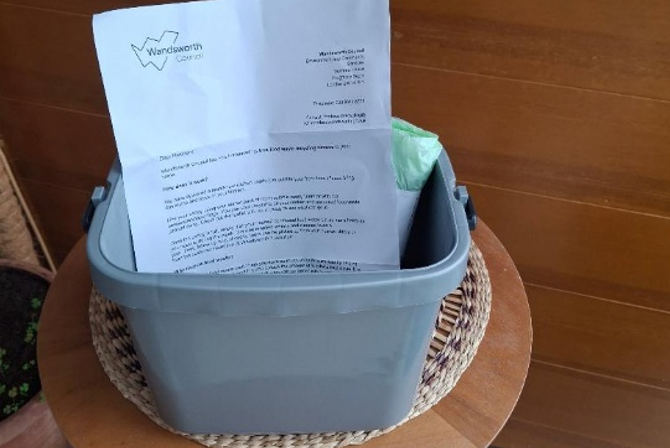
On Thursday I found a parcel waiting at the front door of my Wandsworth flat: a ‘free’ food waste caddy, a starter roll of compostable liners and a note from the council that deserves a place in the annals of municipal self-congratulation. Recycling my food waste, it explained, could save me “as much as £720 every year”. My leftovers would become “a sustainable power source and liquid fertiliser”. And because it is “much cheaper” for the council to recycle scraps than to bin them with the rubbish, the whole exercise “helps keep your Council Tax low”. Each of these claims turns out to be false, an evasion or a subsidy in disguise.
There is no such thing as a free lunch, as Milton Friedman never tired of pointing out. A local authority that pretends otherwise is not practising environmental stewardship. It is practising virtue signalling at other people’s expense. Let’s take the £720 first. It is not a recycling saving at all. It is a Love Food Hate Waste talking point about buying less food in the first place, describing what the average family could save by throwing away less edible food. That is a saving from wasting less, not from recycling more. WRAP, the climate NGO behind the campaign, now puts the annual cost of edible food binned by a family of four at £1,000. But the money is lost by typical household behaviour, not because food waste remains uncollected by the local council.
Separately collected food


Discussion
Comments
This week across the site:
To join in with the discussion please make a donation to the Daily Sceptic.
Profanity and abuse will be removed and may lead to a permanent ban.
We have had a food caddy for a while, but the only thing we ever put in it were stale bread and bones (but only when we’ve made stock from them).
Problem was the growth of mould and needing to wash them out, so now it’s only bread we put in.
We don’t cook more than we need and if there aere leftovers we use them the next day or freeze them. Any peelings or anything green goes on the compost heap.
Watch out for the pink bacteria growing like foam on the bags inside the larger caddy!
If your council tax in Wandsworth is going to be increased by 94%, the council will have to recycle a very large amount of food to reduce that bill.
As a caravanner who frequently stays on farms, we speak to the farmers. They are horrified by the recycled food they’re expected to use on their farms, because it has biodegradable plastic in it! Not healthy to sprinkle on fields for growing food at all!
Already been here. See https://andrewbamji.substack.com/p/what-a-waste.
Actually it’s not that bad, lorry wise, as they don’t appear to be electric. But there are already broken bins put out, the lids warp and in the hot weather I have seen swarms of flies in them. It surprises me that folk are so compliant. Worse still, we have a holiday let next door and the thought of instructing all our guests to use the bins, which will rapidly overflow, is a nightmare. Trouble is I don’t know how to get rid of the things.
So in essence the article suggests the landfill tax is a spurious tax that skews the market in favour of recycling, much as carbon taxes on petroleum gas and coal skew the market in favour of renewables ?
Councils are full of self-regarding donkeys. And it’s difficult to teach donkeys anything, or to reason with them.
The flies, rats, urban foxes, cockroaches will love it.
Glass: most recycled glass in the UK is exported. Whilst exporter make money, the overall cost to the economy of collecting, transporting, processing exceeds revenue gained.
Landfill: landfill in the Netherlands is not easy. Digging holes results in the Netherlands filling up with the North Sea. Waste processing costs were much higher there than in other Member States of the EU which gave them an unfair economic advantage over NL. EU doctrine is “harmonisation” – all must suffer equally. Hence all the nonsense about landfill
We have plenty in the UK. Additionally most of our waste could be incinerated to provide electricity, and the residue used for road or whatever foundations.
Waste food: a society which can afford to throw food away is a cause for celebration. It means food is so abundant and we are so wealthy we can afford to do so. Billions of people in the World would love this luxury.
And where is the waste exactly? Nobody buys food to throw it away, therefore good reasons why food might be discarded. Feeding food-fad a minute children with varying appetites is no easy… Read more »
Recycling is yet another idiotic left wing doctrine that so called right wing parties never challenge. Please let me know if Reform or Restore are going to scrap it and just go back to weekly bin collections.
G
R
I
F
T
If “the environment” includes the appearance of the streets where we live and the front and back gardens of those who have them the move from bagged waste to the large plastic wheeled boxes has been a disaster.
In my street most people have gardens or otherwise unused garages big enough for the three bins and a food caddy we are required to use. The garden green waste disposal became chargeable this year and thank you for telling us the geniuses who devised it were the Tories – no surprise I suppose.
In the roads where my children live in East London most people keep their bins on the front garden or leave them all week on the pavement forcing pedestrians to walk in the road to get past. Consider the less strong and fit among householders. It was ten years ago when an elderly lady complained to me while I was canvassing that her husband could no longer man handle the beast through their bungalow and down the steps to the kerb. She was far too slight to attempt it.
Now to learn that the whole recycling story is a scam adds insult to injury. Was it part of… Read more »
I’ve often wondered if the environmental cost of households washing out tins and plastic before recycling them as compared with centrally sorting and washing is taken into account. How much clean potable water is used and added to the grey water or sewage system? Possibly even heated water?
I’m probably worrying unduly as many households don’t seem to wash the recycling waste (it’s waste as far as the household is concerned) judging by the smell of those bins after a hot day.
Eco-loonies say not to wash things out for that reason. Better to encourage flies, maggots and bacteria, mould and fungus and cause a health hazard.
You should also factor in the waste food, and especially fats that are now being rinsed down the drain, and what happens when that clogs up.
Recycle whatever can be practically; incinerate efficiently with the ash being used to make building blocks and recycle any metal recovered. Result – minimal waste going to landfill.
Garbage disposal should be done by the competitive, private sector with each householder buying the service of the supplier of their choice and paying directly.
What is recycled would be what was economic.
I pay two private sector companies to take and recycle the dry waste from my business. They are expensive and unreliable, just like the council.
I suppose, too, that if we schooled ourselves to buy less crap, there’d be less to recycle, but then China would likely complain that we’re being racist.
I don’t know the economics of food waste collection well, but the system we’ve had in Oxfordshire for decades seems like a good practical solution. Food waste is put out in a separate caddy, which has the benefit of keeping other waste clean and dry, and presumably easier to handle. The food waste is put into anaerobic digesters which make gas which is burnt to make electricity, with the residue becoming fertiliser. In some parts of Oxfordshire some of this fertiliser is set aside in public places for rate payers to help themselves to, but most of it is sold to local farmers, who seem happy to use it.
What’s not to like about that system?
Nothing, as long as everyone’s happy to pay for it. Although domestic waste presumably makes up a small proportion of the total waste going to the anaerobic digester.
I would imagine a lot of households in places like Oxfordshire would have there own gardens/outdoor spaces? Why not just compost it for your own use? no caddies, no transport diesel, no landfill and you get to fill your own pots and flower beds!
Its a similar madness as melting down a glass bottle just to reform it into ..a glass bottle! Just wash it out and reuse it, masive savings in energy!
The problem is easily solved and coming soon.
Earth closets. Ash from the fire place, kitchen waste all go into the lavatory to be collected weekly by the night-shyte-shifters and spread on the fields to fertilise the crops.
This is how it was before flush lavatories, mains drainage, central heating. In the village where I was born, and in surrounding villages (1959s/60s) many properties had “long drops”, there being no sewer system.
Soon we shall no longer have these luxuries.
I remember the few earth closets there were left where I grew up. They weren’t pleasant to use, and a very callow me thought them primitive. Besides which, can you imagine the out-of-work folk queueing up to empty them at night? It would drive them further up the autism spectrum (or incline, or whatever).
All very well, but don’t get caught using a hosepipe to do your rinsing!
Because you’ll get rats.
It may be useful to read the article again as you missed some points raised. Even on the simplest evaluation of sending out a large diesel truck dedicated to picking up these silly small amounts of food waste can’t trip the CO2 scam in favour of the collection. Oh and by the way, removing a bit of food waste from off the general waste has no benefit to the sorting of the waste as there are automatic systems used to deal with the ever present ‘wet’ waste.
Oxfordshire food waste is collected by small open vans, probably petrol engined if that matters. Do you have any evidence to back up your third sentence please?
Still two vehicles instead of one. Labour, capital cost, maintenance, fuel consumption doubles the cost.
Profit and loss equation: A – B = C
Where:
A = revenue received; B = total expense; C = gain if positive/loss if negative.
We live in a World of economic illiteracy wherein its members use tye equation: A = C which lust always be positive.
Nobody calculates expense. Like the NHS – it costs nothing.
See my Substack at https://andrewbamji.substack.com/p/what-a-waste
Standard three questions:
Compared to what?
At what cost?
With what evidence?
Probably the fact that the collections (due to what is collected on which day) have multiplied. When I was a lad, you put out one (somewhat smaller) bin. Now, we have three wheelie bins, a smaller bin for glass, a food waste caddy, and they all seem to be collected separately. If only those trucks were powered by unicorn tears instead of diesel engines…
Surely, a natural concern is what the impact on the volume of landfill would be. Shouldn’t that be a consideration? Or is the author talking about the net difference just food waste makes, in which case less of a worry?
In some areas there is only very limited availability of landfill. The use of incinerators and digestors should be encouraged when space is running out.
There is plenty of landfill. Dig holes.
Under pay your council tax next year, and when challenged you can point to the council letter promising you a saving.
That’ll definitely work!
😀😀