


The other day I arrived at a motel just off I-10 about 60 miles southeast of Tucson, Arizona. It’s not much of a motel, but there’s little choice and it has been adequate in the past.
But this time round there had been a change. Instead of being greeted by a hapless but well-intentioned local teen at the front desk, a book that looked like a cross between a fruit machine and an airport check-in desk confronted me.
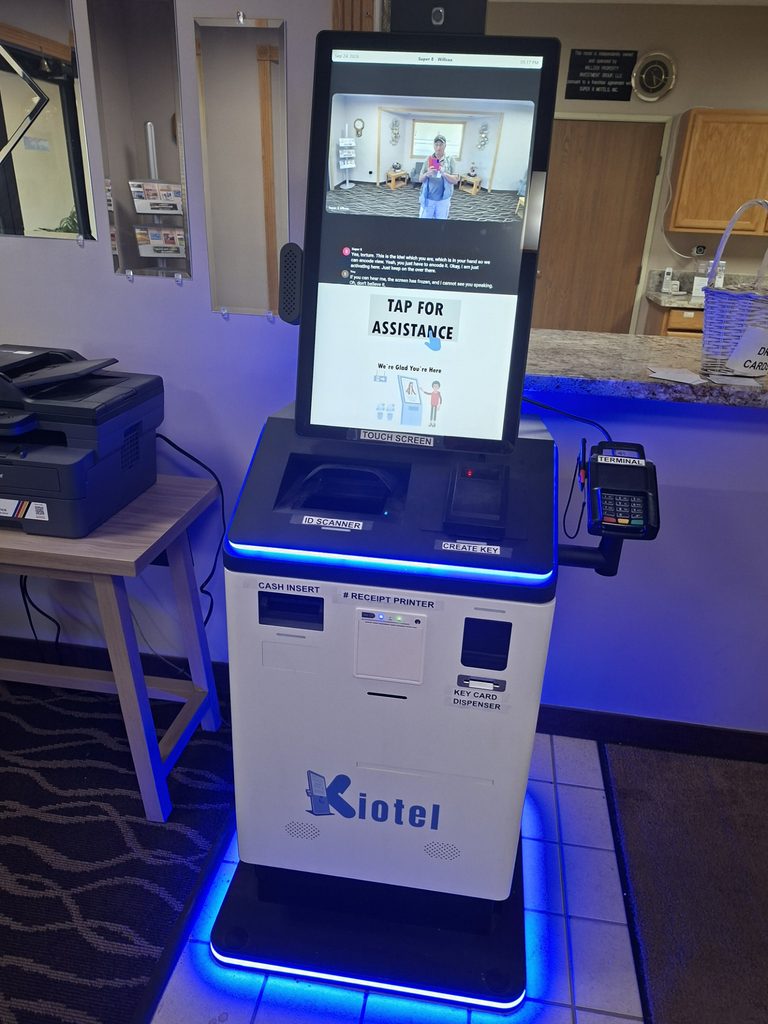
To begin with I thought the face of the bearded young man in the screen was an AI creation. After a few minutes I began to wish he had been. Turned out he was in Wisconsin, though it might as well have been Mars. Regardless of where he physically was, his English was barely comprehensible. He was, as it turned out, the epitome of cutting-edge lucidity compared to anyone else on-site.
He then proceeded to talk me through the check-in procedure, his incoherent instructions constantly thwarted as internet delays interrupted before the connection went down completely. The entire system rebooted. We started again. All the time, a transcript chuntered along the screen. It bore hardly any resemblance to either what I or he was saying and consisted of random words and meaningless phrases.
Eventually, the torture abated and I went to the assigned room with some of our bags. On my way back to get more of our luggage he called me as I passed to tell me he had given me the wrong room and forgotten to check my identity. Incredible. The process had already taken long enough to write a small book.
We went through the whole ghastly horror again, with the internet going down again. The new room, which I inspected, had a fridge missing its internal shelves. Back I went to the reception area and its phantom tollbooth.
He was still there. In a manner of speaking. He summoned the manager. After nearly 10 minutes a small man carrying a smartphone half his size turned up. Unable to speak English at all, he then engaged in a farcical conversation with the incoherent man in Wisconsin who acted as interpreter, they both (apparently) sharing the same native language – whatever it was. The manager refused either to look me in the face or engage with me directly.
The internet of course went down twice during this procedure too. The only consolation was no-one else tried to check-in at the same time.
To cut a long story short. I was assigned a third room, though he asked me to calm down. I pointed out that I had been driving for seven hours, the check-in process had now taken nearly an hour (on top of an online check-in I had been obliged to do the day before) and in fact I hadn’t either lost my temper or ranted at him. This third room had no working equipment in it all. In a state of total disbelief, I had to go back to reception and get Mr Wisconsin to sort me out another room. A reboot of the tollbooth later and we decided that, since I didn’t have enough time left before I died, I’d just go with the second room.
We piled into the room. The internet didn’t work. Well, it was there but it seemed to be radiated from the far side of the moon. Back to reception. More pointless interchange with the manager via the remote interpreter. We got nowhere. I gave up.
Back in the room I found a signal from a gas station 100 yards away. I created an account, though it’s lucky I have a US number because without it I wouldn’t have been able to do so, and got online.
That’s when I discovered the Santander app was down in a UK nationwide outage. Of course it was. I’d already discovered that I can no longer manage my BA booking to get home. Why not? Because the airline has changed the departure time by five minutes and the result has been to trip up both their app and the website which means it isn’t possible either to ‘accept’ the change or manage the booking.
I had to call BA – lucky again that I have a US SIM (more on that below) – and speak to an agent who accepted the change for me, saying (or claiming) that the NATS outage a couple of weeks ago had tripped the whole system up and they were “working on it”.
As for the phone, I don’t know what network you’re on, but I can assure you that Three doesn’t work for regular voice calls in the US and Australia, at least not since 3G was dumped and voice calls went to digital calls on 4G and above. Trust me, it doesn’t. Something to do with the US/Australia bandwidths Three’s partner networks use not being compatible with Three, despite Three continuing to insist that it does work for voice calls in both places. It only works for data and texts in the US and Australia, so WhatsApp calls work but not regular phone calls either to home or the US/Australia. Travel eSIMs are usually limited to data-only packages and thus are similarly limited. They aren’t linked to phone numbers. So, in our supposedly joined-up world, it’s now impossible on some networks to phone home from certain places. What would ET have done?
Don’t tell me it’s my phone. It isn’t (it’s a Samsung A56). And nor is it the SIM, which I had replaced. How do I know this? Because my US SIM works in the same phone for voice calls in (and to) the UK and Australia as well as, obviously, in the US and back to the US when I’m home. If you’re interested it’s on the Ultra Mobile network.
And don’t tell me to use a payphone in the US. They have all been removed. Seriously.
Is there any consolation to all this misery, this cavalcade of total incoherence, incompatibility and breakdown? Yes, there is. Any bad actor in the world or any Bond super-villain poised to take over the planet and destroy our way of life is just as likely to end up staring at a blank screen or a reboot doom loop before imploding in a frenzied rage at the thought of his or her dreams of world domination evaporating in an electronic hailstorm of despair.
Let’s face it, in Breaking Bad Walt and Jesse destroy incriminating evidence on Gus Fring’s computer held in the Albuquerque Police Department storage facility by powering up a scrapyard magnet outside.
Last week I showed someone walking in a National Park my completely functional 1945 US Army Air Force watch and said, “no battery, no software”. “Wonderful,” she said, “it doesn’t know how not to work,” while looking wanly at her smartwatch.
I’d love to see where we’ll be in a hundred years’ time, but one thing you can be certain of is that all this nonsense will have long since been swept away and dumped. What we replace it with is anyone’s guess.
Guy de la Bédoyère is a historian and writer with numerous books to his credit, most concerned with the ancient history. His latest is Brief Lives of the Ancient World (Yale 2026). He has used (and built) computers since the 1990s and regularly sorts out his neighbours’ digital meltdowns.



Discussion
Comments
This week across the site:
To join in with the discussion please make a donation to the Daily Sceptic.
Profanity and abuse will be removed and may lead to a permanent ban.
When the Russians can over-heat French supermarket freezers and drones can be programmed to find their own targets, it suggest that electronics could take over the world quite quickly.
It is incomprehensible how businesses of all kinds continue to digitise everything, it makes not economic or any other sense. People are not surprised when it goes wrong, but accept it, like late trains, as I am sure was the case in Communist Russia. At that time people living in the Soviet Bloc could glimpse how much more sensible and pleasant life was in the capitalist west, one reason the whole thing collapsed. Now we have nowhere alternative to see how things could be sensible, and better.
There’s an old science fiction story called “The Feeling of Power” which describes how Myron Aub rediscovers mental arithmetic in a computer age where everyone has forgotten how to do maths without a calculator. It was written by Isaac Asimov in 1957.
The time is coming when it becomes reality…
Inside the Patel Motel Cartel: How Gujaratis came to own more than half of America’s motels | World News – The Times of India
How Gujarati Patels Took Over America’s Motels | Madras Courier
” Patels own 80-90% of all hotels and motels in American small towns”
That’s ONE FAMILY FROM INDIA.
Meanwhile, everyone in the West is fretting about China. They need to wake up.
I’ve stayed at a motel in Tucson – but that was thirty years ago. We were warmly welcomed: the motel was run by a South-Asian family, who had emigrated from the UK in search of the American Dream. What they’d encountered was the US “motel class” – often extremely racist, violent (or threatening violence). They were glad to find guests who treated them with a little bit of humanity and civility. Perhaps that’s why the proprietors of the motel in the article go out of their way to avoid human contact?
You really need to wake up.
As the saying goes “to err is human, but to really c@c& things up you need a computer”.
Although it wont win me any friends, I have to say my interactions with call centres nowadays requires me to deal with people who are speaking English, but with such thick accents that I fall back to trying to deciphering the sentence from one or two words I think I’ve heard. I long for a Scouse or a Geordie to pick up the phone.
I still struggle with my Indian colleagues, even the ones that have been living in the U.K. for a while. Lots of our clients employ Indians and it’s a real barrier to efficient communication.
As soon as you hear “Clive” or “Jimmy” talking with an incomprehensible Indian accent, claiming to be from BT support desk, you KNOW it’s a scam. I string them along as much as possible.
You mean you don’t speak Tagaloc, Urdu or Creole Pigeon??? You heathen! Viva the soulless digital revolution….
I look forward to our government’s digital future that they keep promising, or is it threatening, us with.