

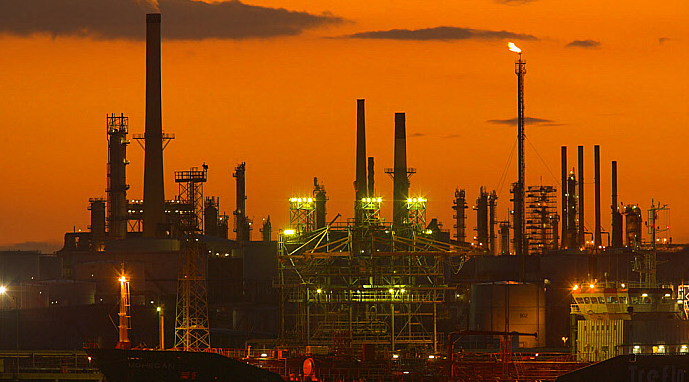
This week I published a new report into Britain’s oil refining sector, Fuel, Refineries and the UK ETS: What Policymakers Need to Know. Its conclusions are alarming.
Britain lost two oil refineries last year – Grangemouth closed in April and Lindsey followed in August, leaving just four operating sites: Fawley, Humber, Pembroke and Stanlow. My report finds that Government policy, and in particular the UK Emissions Trading Scheme (ETS), is making it increasingly hard for the remaining refineries to compete.
This matters because liquid fuels still provide 47% of UK final energy consumption. Diesel, petrol and jet kerosene remain essential to transport, aviation, agriculture, construction and industry, with no alternatives available at scale in the near term.
Yet Britain is increasingly dependent on imports. In 2025 we imported 15.5 million tonnes more petroleum products than we exported, the largest deficit since becoming a net importer in 2013. Closing domestic refining capacity doesn’t mean we stop consuming refined products, it just means we import more, effectively outsourcing their production. Bizarrely, Government policy is actively encouraging this.
My analysis finds that the four remaining UK refineries face a net ETS cash cost of around £200 million per year. Their gross carbon-cost disadvantage relative to refiners outside carbon-pricing regimes is around £540 million per year. That’s a significant handicap in an internationally competitive, relatively low-margin business.
British refineries compete against facilities in the US, Middle East and Asia, many of which are newer, larger and more sophisticated, while also benefiting from state support, preferential access to crude oil, cheaper labour and much cheaper energy.
ExxonMobil UK’s Managing Director Paul Greenwood recently told MPs that his company is paying £70-80 million a year in carbon dioxide costs, which he expects to rise to £150 million over the next four or five years. His competitors, he pointed out, aren’t paying them. He explicitly identified this cost differential as one of the factors causing UK refineries to close. This might be defensible if the ETS was causing refiners to reduce their emissions. But it isn’t.
Refining is highly energy intensive, so refiners have always had strong commercial incentives to improve efficiency: every unit of energy they save reduces costs. European refineries were making significant efficiency improvements long before emissions trading existed.
Beyond incremental efficiency gains, there are few meaningful investments UK refiners can make today to materially reduce their emissions. All four remaining refineries have explored major decarbonisation investments, but none has gone ahead. Carbon capture and hydrogen schemes are not commercially viable without substantial government support, which has been discussed for years but not actually delivered.
Increasing the carbon price doesn’t magically make new decarbonisation technologies available. It just makes refining in Britain more expensive.
The Government knows carbon pricing creates a competitiveness problem, which is why energy-intensive industries receive some ETS allowances for free and why it is introducing a Carbon Border Adjustment Mechanism (CBAM). The CBAM is supposed to protect British manufacturers by imposing an equivalent carbon cost on imported goods. Except refined petroleum products aren’t included.
A tanker of diesel or jet fuel can arrive from India, the Middle East or elsewhere without bearing the carbon cost imposed on the British refinery with which it competes. And refiners can’t simply pass their ETS costs through to consumers: refined products are internationally traded and largely fungible. If the British product becomes too expensive, buyers can buy imported alternatives.
When a British refinery closes, our demand for fuel doesn’t disappear – it’s met by imports instead. Imports that often have a higher carbon intensity because they are refined in countries with dirtier energy, with further emissions incurred in transportation. Closing the British refinery does not eliminate the associated emissions, it simply moves them somewhere else. That’s not decarbonisation, it’s offshoring.
In fact, it’s a form of greenwashing. Politicians celebrate reductions in Britain’s territorial emissions while ignoring emissions embodied in the increasing amounts of imported goods we use.
One of the most significant findings in my report comes from examining emissions trading compliance data. Of 1,702 UK installations on the EU ETS compliance register, 292 closed between 2008 and 2020. Since the UK ETS began in 2021, another 183 sites out of 1,415 registered installations have closed. Those figures don’t yet include Lindsey and Grangemouth.
Free allocations tell a similar story, falling from 37.8 million tonnes in 2021 to just 23.6 million tonnes in 2026, a drop of 38%. The largest recent reduction was 4.6 million allowances following the closure of the Port Talbot blast furnaces. Yet British demand for steel didn’t disappear with the blast furnaces. UK steel demand actually increased from 8.1 million tonnes in 2023 to 9.3 million tonnes in 2024 while the domestic share of supply fell dramatically.
Carbon dioxide molecules don’t care whether they were emitted in Port Talbot, Immingham, India or China. If climate change is the justification for these policies, global rather than domestic emissions are what matter.
This also casts a different light on falling European energy demand. EU industrial energy consumption fell 8.1% between 2014 and 2024 and has been in structural decline since 1990. Since the 2022 energy crisis there has been a particularly sharp contraction in energy-intensive industrial output as European businesses struggle with high energy costs.
This hits demand for refined products because factories consume diesel for on-site logistics, mobile machinery and backup generation, while their supply chains generate road-freight demand. Close the factory and all of that demand disappears. Falling energy consumption isn’t necessarily evidence of successful decarbonisation – it often just means we’re producing less.
This absurdity isn’t confined to industry. Since coal disappeared from Britain’s electricity system, gas has been the principal source of large-scale dispatchable generation. We still need it when wind and solar output is low, and there is currently no commercially viable investment that allows gas generators to significantly reduce or eliminate their emissions. Renewables aren’t incentivised by the ETS since they require huge subsidies to be built.
So what exactly is the ETS achieving in electricity? It makes electricity more expensive. And that’s it.
Gas generation sets the wholesale electricity price most of the time, with carbon costs now accounting for more than a fifth of wholesale electricity prices. Unlike refineries, generators can pass those costs through, so households and businesses pay more for their electricity.
Worse, we tax industries into near-oblivion and then, realising they’re actually important, are forced to consider subsidising them to help them stay open. That is utterly incoherent.
The original economic logic behind carbon pricing is superficially attractive: put a price on emissions and allow businesses to discover the cheapest means of reducing them. But that mechanism only works where real, viable decarbonisation choices exist.
Where economically sensible efficiency improvements are available, businesses already have strong incentives to pursue them. Where commercially viable substitutes exist, businesses already have incentives to adopt them. Where neither exists, increasing the carbon price doesn’t create them. It either makes British production uncompetitive against imports or raises costs for British consumers.
My report concludes that the UK should, at the very least, remove refineries from the ETS. Apply the same analysis to the rest of the economy and the justification for the entire scheme falls apart.
The UK needs to stop confusing lower territorial emissions with decarbonisation. An environmental policy which exports emissions, destroys domestic industry, increases import dependence and raises global emissions is deeply irrational.
It’s time to abolish the ETS.
Fuel, Refineries and the UK ETS: What Policymakers Need to Know can be downloaded here.
Kathryn Porter is an Independent Energy Consultant. She holds a Master’s degree in Physics and an MBA, and is an associate member of the All-Party Parliamentary Group for Energy Studies executive council. Subscribe to her blog.

Discussion
Comments
This week across the site:
To join in with the discussion please make a donation to the Daily Sceptic.
Profanity and abuse will be removed and may lead to a permanent ban.
Green taxes decimating britain? All taxes decimating britain. Why do you people put up with it? Why do you even try to justify it?
Net Zero = sell the UK so-called pollution.
(Even though the politicians know it is really plant food)
In order to make the politicians feel virtuous about saving the planet by bowing before the
Great God of ‘pseudo climate catastrophe’
Meanwhile the nation grows poorer by the day.
A pitiful parable in easy to understand words:
https://kookykidsworld.com/fairy-tales/the-emperors-new-clothes/
🤔
One suspects that if one put these Nut-Job Zero obsessed politicians and allied activists anonymously in front of top-drawer consultant psychiatrists, then they would all be found to be clinically insane. There is no logical explanation for their actions.
Politician and logic. Two words that rarely, if ever, appear in the same sentence.
The logic is the pursuit of power.
Power over what? An empire of ashes? We’ll be an agrarian society on our current trajectory.
Power over what indeed. It seems like despots don’t much care how shit their country is, as long as they are in charge. Idi Amin springs to mind.
Don’t forget that needs animals to provide fertiliser, and the nut jobs don’t want any of those either.
Money and power are the logical explanation, power for them and also other people’s money.
It’s difficult to describe our rulers’ economically-suicidal Net Zero policies without using the forbidden ‘profanity’ and ‘abuse’. So, I won’t comment.
Agreed.
Don’t worry, I can hear you thinking it very loudly. Or are those my thoughts?
Closing the industry is the point, not sure why anyone thinks otherwise, they are going to kill the Golden Goose then move onto the next target, hell I wouldn’t be surprised if they offered a token price to buy the plant and nationalise what’s left. All in the name of the communist Net Zero utopia Comrade!
They’re not after a Net Zero utopia, I think they’re out to kill off the human race but without realising that they’re signing their own death warrants.
So instead of a competitive, well oiled, free market economy, we are literally drowning in horse shit. We are the Nu-Soviet Union.