

The Nepal flash floods were caused by collapsing bedrock, not a melting glacier, scientists who have studied the satellite images have said. The Week has the story.
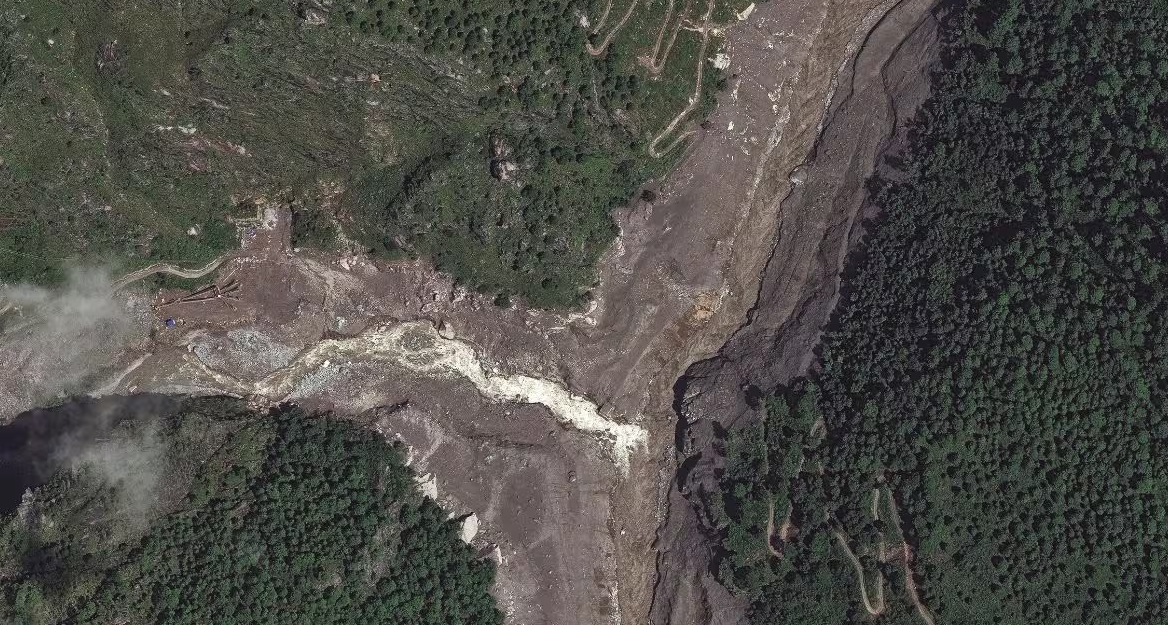
Earth scientists have finally shed light on how the tragic Nepal flood that claimed thousands of lives happened, with the latest satellite images revealing not just the glacier, but also that the bedrock under the glacier had collapsed.
Geomorphologists Kristen Cook and Dan Shugar claimed that further analysis of the satellite images from Nepal revealed there was a “big bedrock failure that took part of the glacier with it”.
The glacier broke off in a northwest direction and then fell westward into the river flow.
They told AP that clouds and debris obscured initial images from Nepal on Wednesday, so they could only see that part of a glacier had broken off from the Langtang Lirung peak, near the border with Tibet. However, the images taken on Thursday revealed that the bedrock underneath the glacier had collapsed, taking the massive chunk of ice down with it and sending boulders and ice into the valley.
“It shows the whole area without anything hidden, and we could see that, yes, it looked like there was not only this glacier that had failed, but a much larger chunk of the bedrock of the mountainside itself that had given way,” said Shugar, associate professor at the University of Calgary. “You have this big bedrock failure that took part of the glacier with it.”
This would seem to rule out climate change as a cause. However, one scientist, Alton Byers, a mountain geographer at the University of Colorado at Boulder, says he nonetheless “believes Wednesday’s flooding is related to climate change. He said the permafrost that for millennia has helped to hold together high-altitude rock and ice and soil and glaciers is now weakening and becoming unstable.”
The Week notes, however, that Cook and Shugar “are yet to establish Earth warming as the reason”.
Worth reading in full.



Discussion
Comments
This week across the site:
To join in with the discussion please make a donation to the Daily Sceptic.
Profanity and abuse will be removed and may lead to a permanent ban.
The area of Thailand, Myanmar, Laos and other nearby countries had their coldest winter for 40 years in winter 2025/6. So, rather than glaciers melting due to supposed Global Warming, it’s possible that there was so much snow and ice in Nepal that the underlying mountain could not support the weight of the glacier and so part of the mountain collapsed.
Well, that is good to know. For a minute us conspiracy theorists thought HAARP, DARPA, Geoengineering of some type may have caused the bedrock to collapse. But again, we have another explanation of how this catastrophe occurred, and again it is the “experts” who have figured it out. Well, that is good to know.
To me the permafrost thing seems plausible.
But cannot in any way be connected to CO2, obviously.
The climate is warming mostly naturally, truth is nobody actually KNOWS.
I wonder how much influence the mining operations in the area contributed to the collapse?
Asking for a friend.
Further info. The same bedrock affected by earthquake a few years ago..
https://fb.watch/JmGSZ226E2/?
So erosion by glacier was the cause. Just like when that Antarctic ice sheet slipped into the sea a few years ago.
« He said the permafrost that for millennia has helped to hold together high-altitude rock and ice and soil and glaciers is now weakening and becoming unstable. »
How does he think mountains and mountain ranges get the shape they have? By staying ‘stable’ for millennia? Like all climate alarmists, he seems to think nothing ever happened until we showed up. These landscapes are changing the whole time. As a geographer, he should know.
Geologist speaking here.
If a tree falls in a forest and no one is around to hear it, does it make a sound?
Maybe one day mankind will learn not to build towns in places previously carved out by enormous floods or lava flows.
Some of the geologists might have an insight as to why there are so many rather tall mountains in that part of the world. No insurance against associated risks of establishing civilisations in that area.
Yes – it’s strange how people are so surprised by an event that has likely happened thousands of times over millennia, forming the landscape as it is…
Brilliant! Well done to those researchers for discovering the truth.
You are being sarcastic, I hope.
Grok: “ Much of today’s thick permafrost (especially the deepest Siberian and Arctic examples) is relict. It formed or thickened during colder Pleistocene glacial periods and has persisted through warmer intervals because of thermal inertia.”
So global warming doesn’t have any effect on thick permafrost.
One aspect that could be relevant is the cold in the area over the last year has led to increased snow mass and thus more stress on the bedrock below the glacier.
Low temperature records for the time of year have been set all over central Asia and Siberia for much of 2026, this has an effect on snow and ice deposition.
Must be some mistake. We were told years ago there would be no more snow.
It’s different snow, caused by climate change.
Finally?
The disaster happened less than a week ago and initial satellite images were not clear. Proper scientists gather evidence before claiming they know the cause of something. Anyone who claimed to know the reason before the evidence was available is a charlatan.
Because The Science has failed to produce any evidence of climate change – and spitefully is providing evidence refuting it – beyond normal variation, we have moved from the age of Climate Change into the age of Climate Attribution.
Now any extreme weather or environmental event – wildfires, heatwave, land slip, etc – is attributed to climate change – Climate Attribution.
The beauty of Climate Attribution is it requires no empirical evidence to prove it, and anything which cannot be proven cannot be falsified.
All the signs of a cult