

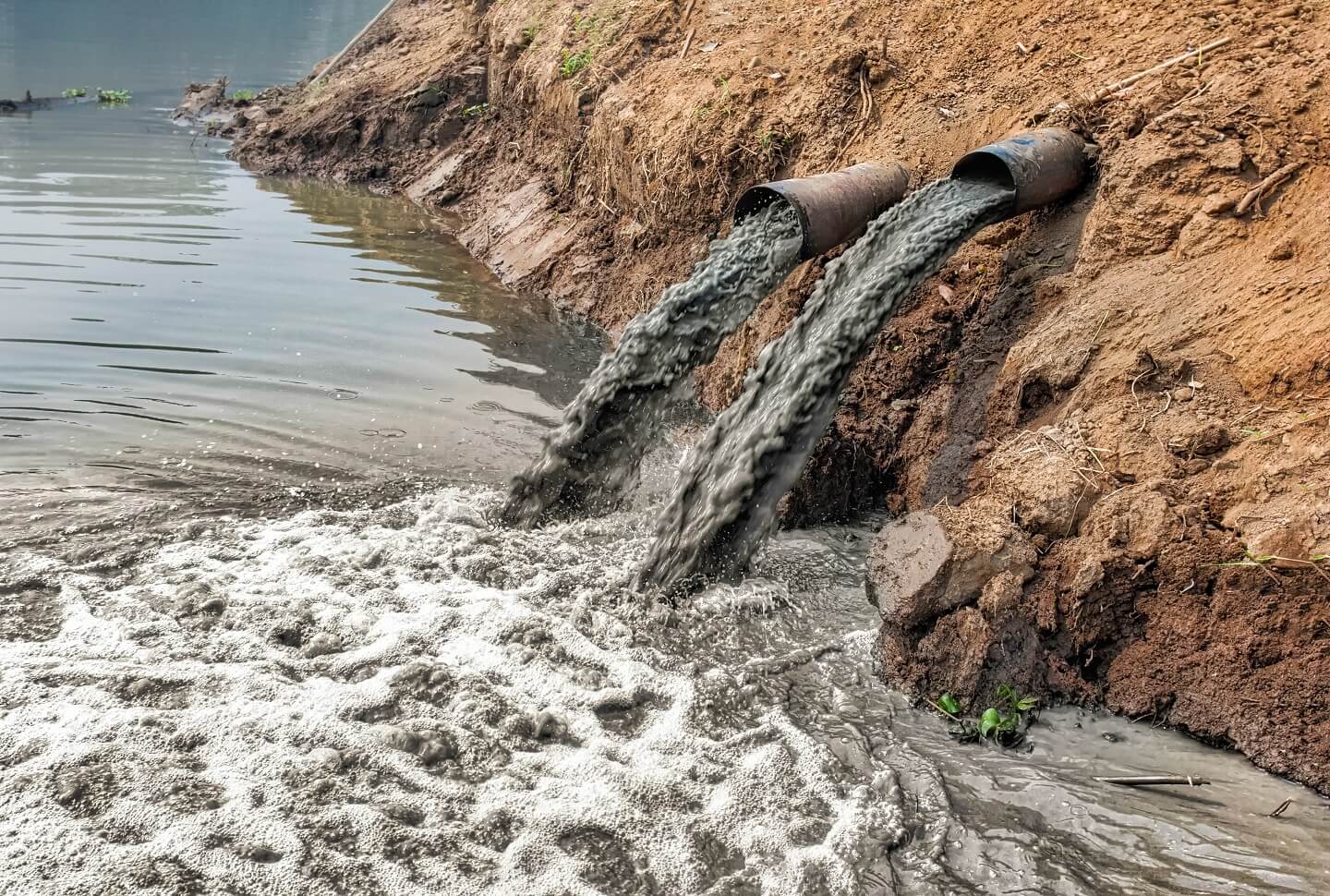
The Environment Agency (EA) has spoken: Package Treatment Plants (PTPs, or private sewage works) are absolutely not an acceptable alternative to connecting to a main sewer for new developments.
Last month I wrote about a scheme for 25 houses just west of Biggleswade, where Anglian Water in 2024 declared its sewage works (or WRC) had reached capacity. No more connections, beyond those which already had planning permission.
As I revealed, the developer has just applied to build a PTP instead, though the main sewer is only six metres from the site. Last week EA, which is a statutory consultee on schemes for 10 or more homes – which would require an environmental permit – wrote to the planning authority, Central Beds Council (CBC) and rejected the idea, firmly passing the buck back to the council.
I’ve seen EA’s letter, which will be published on CBC’s planning portal shortly under CB/25/01,511/OUT, and for developers everywhere who thought PTPs may be their get-out-of-jail card, wherever a water company has objected to a sewer connection, it won’t be cheerful reading.
EA says (in part):
The Building Regulations 2010 and Government Guidance contained within the PPG for Water Supply, Wastewater and Water Quality (paragraph 020 ID: 34-020-20140306) sets out a hierarchy of drainage options that must be considered and discounted in the following order:
- Connection to the public sewer
- Connection to a private sewer that drains to a public sewer
- Package sewage treatment plant or septic tank
- Cesspool
Foul drainage should be connected to the main sewer whenever it is feasible to do so. Private sewage treatment facilities should only be used where it is not feasible for a development to be connected to a public sewer, because of the greater risk of failures leading to pollution of the water environment … compared to public sewerage systems.
Lack of capacity is not adequate justification [of] a non-mains foul drainage strategy where utilities lie within reasonable distance for connection (number of dwellings x 30 million)….
If [the] applicant decides to apply for a water discharge permit for private treatment facilities, on the basis of the information currently available within the planning application, it appears unlikely that we would be able to grant a permit.
Developers like to claim the planning system is sclerotic (indeed, ‘reforms’ which will take effect in November will supposedly speed up the process). But then they deluge planning officers and unpaid councillors with lengthy documents from expensive consultants, ‘proving’ this or that. In the case above, a close reading of the drainage engineer’s report shows test pits, ‘proving’ that semi-treated PTP effluent will disperse according to regulations, were nowhere near as deep as they needed to be.
Amazingly, in the same village a different developer – also refused a sewer connection by Anglian – has also just proposed a PTP for his site, though the main sewer actually runs through it. A horticultural centre, with shop, cafe, up to 17 employees and parking for over 50 visitors, will supposedly manage with one small PTP; once again, it would drain to a field because there’s no watercourse.
Of course, the crisis is not confined to Biggleswade. A cursory search shows that at least 10 water companies in England and Wales have declared dozens of their sewage works to be at maximum capacity, no new connections possible, and Biggleswade didn’t even make that list of Anglian’s problem sites. There must be many, many more.
Government and the water companies love to tell us how transparent they are: citizens can now check, in real time, what sewage spills if any are happening in their area – such as at Water UK. Rivers Trust reports what a particular outlet is doing now, and the total and duration of spills last year.
Floodmapper.co.uk will show you what’s happening now, plus any spills up to 14 days ago. Anglian Water (for example) lets you download unedited monthly spreadsheets of all its spill reports.
The problem is, this data is junk. At the end of each year utilities get together with EA and agree which spills really happened, and which can be blamed on false alarms. In extreme cases, there’s no data available: Anglian’s monitor was switched off at Bedford for three-quarters of 2024, but the company still admitted spilling sewage for 1,291 hours of the remainder. Nobody will ever know what happened in the missing months.
Each March this EA-agreed Event Duration Monitoring (EDM) report is published, claiming to give the true picture of what happened at every outfall the previous year: how many spills, for how long in total. From May to December 2025, Anglian’s real-time alerts reported spilling sewage into the river Ivel at Biggleswade 65 times. But the 2025 EDM this March reduced those spills to zero (never happened, nothing to see here, move along now).
This year Floodmapper reported 63 discharges at Biggleswade between July 10th and July 30th (remember those terrible rainstorms we had last month?) culminating in a 359-minute spill on the 30th. Alarmed town councillors demanded answers, so on the 31st Anglian pulled the plug and disconnected the monitor. It’s been offline ever since, reporting nothing. (Need a problem solved? Kill the messenger.)
On August 13th Anglian’s PR department (company motto: Love Every Drop) reassured councillors:
We can confirm that Biggleswade Water Recycling Centre is currently operating as expected and there are no identified operational issues affecting the site’s treatment performance or environmental compliance. The site continues to be monitored and maintained in accordance with regulatory requirements, and routine operational inspections are undertaken to ensure the treatment processes remain effective.
Nothing to see here, move along now folks. Indeed, those July spill alerts – in a raging drought – really should have been false alarms.
So if the data is rubbish, who do we believe? BedsGOVET’s public-spirited volunteers continue to dip-test 19 sites on the Great Ouse every month and their water samples are analysed and certified by Birmingham University. The inland ‘safe bathing’ limit for E. coli is 900 cfu/100ml. But the lab can only measure up to 10,000 cfu. This March not one of the 19 Ouse test sites was safe, and 11 overtopped the scale, reading well in excess of 10,000 (two sites for which March E. coli data is missing both broke 10,000 the following month).
Why in March? Everyone agrees that in wet weather too much rainwater gets into main sewers. Not from modern developments, obviously, but across the country millions of gutter downpipes and driveway drains connect to the sewer: entirely legal, when they were built, but this extra load is why water companies have licences to spill from some outlets in storms – but only in storms. Dry-weather spills are illegal, which is why they go to such lengths to deny them.
You can claim ongoing discounts, around £50 and upwards depending on the water company, from your property’s ‘Surface Water Charge’. Digging a soakaway is a simple enough DIY job if you have a garden; it doesn’t need a skilled builder or planning permission, but it’s more of a problem for a terraced house in a town. And you must be able to prove not a drop of rainwater finds its way from your property to the main sewer. The discount is under-publicised – it’s revenue the companies would just as soon keep, thanks – and for many it’s unattractive if converting will be complicated. Meanwhile, stopping every street drain from ending in the sewer will be close to impossible.
The Government’s ‘blockage-busting’ (or headline-chasing?) Water Delivery Task Force is working with developers to get a handful of sewage works upgraded, but those are for schemes of well over 3,000 houses each. Nor does it bring any new money: not before time, Whitehall is trying to force water companies, developers and LPAs to sit down together and get major developments greenlit.
What about the smaller fry? If in one Bedfordshire village two substantial developments are held up for lack of sewer connection, the amount of stalled housing around the UK has to be enormous: nobody’s estimated the total. The crisis of sewer capacity is real, and so is river pollution: anyone who’s not seen Channel 4’s three-part docudrama Dirty Business, broadcast this February, should catch up – and brace themselves, it’s an ugly story, and just as well told as 2024’s Mr Bates vs The Post Office.
Where do we go from here? Two things obviously can’t happen. First, for a so-called developed country to carpet itself with potentially polluting PTPs, even where sewer networks exist, is unthinkable, as EA will be happy to explain to any doubters.
Second, nationalising the water companies won’t work. There aren’t the multi-billions needed to buy out their shareholders, and simply expropriating the businesses would render the UK uninvestable, not to mention crashing the bond market. Completely banning dividends is unworkable for the same reason, and bans on executive bonuses are simple to swerve – they get “retention payments” instead, sometimes from the companies’ foreign owners.
Illegal immigration is not going to stop, housing has to be built, sooner or later it will rain a lot, and people are not going to stop flushing their toilets. So this is what seems likely to happen:
Water bills will go up, a lot. Last Friday five companies (Anglian not included) were allowed to increase their charges a little, in the name of upgrading infrastructure. But this will raise trifling amounts compared to the cost of bringing the nation’s sewage works into the 21st Century. Nor can that work happen overnight: even at Bedford, acknowledged to be in crisis and with a lot of development on the way – not least the enormous Universal Studios theme park – Anglian doesn’t expect to increase capacity before 2030.
And water companies will magically discover their works can cope with more sewage after all, for a while: Northumbrian Water already did exactly this at Stockton-on-Tees. The Government has the companies over a barrel: it’s not hard to prove that even their acknowledged sewage spills have been happening in dry weather as well as wet, which is illegal. Corporate fines have been increasing, but personal prosecutions of their directors would concentrate minds. Sure, the sewage works will then spill more into rivers, but there are no penalties for killing the messenger (i.e., disconnecting the data feed).
LPAs – the councils which give planning permission – depend on central government funding to avoid going bust, so can be leant on. No prizes for guessing that planning officers will discover problematic developments will be acceptable after all, and can be connected to the sewer whether the local sewage works likes it or not. This will become easier after October 31st, when ‘reform’ of the planning system will remove almost all local democratic scrutiny.
And the big losers? Our rivers: but they don’t have a vote.



Discussion
Comments
This week across the site:
To join in with the discussion please make a donation to the Daily Sceptic.
Profanity and abuse will be removed and may lead to a permanent ban.
There are a lot of existing dwellings (in the wrong place according to Angela Rayner) which could be refurbished and updated in our towns which are already connected to the sewerage system. Developers have hitherto preferred green field sites and newbuilds for larger profits than renovating older buildings. This could/should be changed and existing connections prioritised for a start.
This is where decades of socialist government gets you. The solution requires some imaginative thought which of course excludes our clownshow politicians. Where is a modern day Bazelgette?
It’s everywhere. Beware of buying a house connected to one of these. Initial outlay may seem OK but anything goes wrong and a connected homeowner could be on the hook for thousands plus they have a limited lifespan.
It’s the same scenario as electricity. That just comes out of a hole in the wall, and poo goes into the toilet and away to never-never land. Most have no idea about the supporting infrastructure or the source/destination of the commodity.
“… it’s not hard to prove that even their acknowledged sewage spills have been happening in dry weather…”
Of come off it! That’s because storms follow hot spells, dry ground increases run off rate, and people use more water, eg showers, in hot weather.
And it is not universally a hot spell throughout Britain – despite Met Office, BBC alarmist climate change propaganda – many places getting heavy rainfall even if others do not.
“Water bills will go up, a lot. Last Friday five companies (Anglian not included) were allowed to increase their charges a little, in the name of upgrading infrastructure. “
So it isn’t a free market. Companies cannot adjust prices to demand and increase revenue to maintain, repair, expand infrastructure. They need to be “allowed”.
And that’s because the cry-babies in Britain think everything should be free, paid for by somebody else because that’s the mentality produced by loads of free stuff welfare-statism.
Howls of protests now because of “surge pricing” – Oh the greedy profiteers!
Pricing is the free market rationing mechanism. Prices increase, demand falls. But the idiots would rather have “cheap” no water, than some more expensive water.
Water and sewage services… Read more »
Water is essential there demand is far less responsive to price than with non-essentials or where there’s competition. This is G.C.S.E. level economics, and should be common sense to most people. If the price of a loaf of bread increases demand will decrease because people can switch to buying a different brand or eat less bread and more of something else. If water companies are allowed to introduce surge pricing, whose going to pay for everyone to have a water meter installed?, are you going to delay flushing your toilet, not shower etc. for a couple of months until there’s been a decent amount of rain and the cost of water goes down again?
The market will bear a very high price for water because people have to have it, and we already pay for it and waste water disposal but seem to keep getting less quality for a higher price. Something like 30% of water is lost through leakages by the worst water companies because they keep taking our money but don’t fix the pipes unless water is visibly pouring onto the street.
People understand that they pay for healthcare through taxation and quite rightly expect to get a… Read more »
It is indisputable that water demond increases during hot weather. Think paddling pools, hot tubs garden watering and two showers per day. Much of the garden watering is plant pots which people install after they have covered up their earth with slabs, pebbles pavoirs etc.
Demand pricing based on a “free” allowance for the essentials then gradually increasing as consumption increases is an entirely sensible solution for stopping waste. Refer to High School economics lessons.
Given that successive governments have had an open door policy to people from 3rd world shit holes who normally have a shit attitude towards women it’s no wonder sewers can no longer cope with the amount of shit in the UK.
More evidence, as if it’s needed, of a country going down the toilet.
Maybe it is all part of the plan to make the Turdworld invaders feel at home.
Much is said about the lack of investment in reservoirs to match the increase in population over the last decade, but there is little mention on the national news of the subject of waste. In my area, we have a small treatment plant already over capacity for the town of fifteen thousand plus surrounding countryside. The only watercourse was originally a brook, but has been redesignated a river, to allow untreated sewerage to be released on an almost daily basis. The brook is already polluted to a level that makes it hazardous to human health if you were to go into it. Yet, despite this, planners have approved the growth of the town by twenty percent with more to follow and no consideration to how the waste is processed. The only satisfaction for us is the brook feeds the river, which a few miles downstream, passes their lovely riverside offices, so they will be able to see my turds bobbing by their windows.
More than enough water IS actually produced but when you consider the English water companies lose enough every DAY to supply Birmingham, Leeds, Liverpool, London and Manchester for a YEAR.
Infrastructure like this is always interesting – capacity management in the real world, vs the fantasy land our various governments have lived in for the last 23-30 years, means you have to build out the infra for the people that actually exist, and will use capacity, vs the government saying there are still only 68 million people in the country…
I think you lean 56 million – mid 1980s.
Not sure why they are mentioning drainage field depth in this not being deep enough, they need to be within I think 1m of the surface so they are oxygenated.
Frankly the state and its assigned monopolies don’t work, why wouldn’t you want to get off the grid and do it yourself to the highest standards, avoiding the rising bills which give worse and worse service. Ah because you are legally obliged to use and pay the monopoly for a service it can’t provide, right…
A couple of related places that might be interesting: https://www.thameswater.co.uk/developers/larger-scale-developments/planning-your-development/water-and-wastewater-capacity Thames Water’s approach to it all. Also, https://hansard.parliament.uk/commons/2025-03-12/debates/FFD422E7-AE7F-4F42-A841-E60623BB82A8/HousingDevelopmentPlanningWaterCompanies In the HoL, over a year ago.
Water companies should publish multi-decadal investment plans, with costings. There will have to be a separate plan for for each demand (population) scenario e.g. current demand, +10%, +50%, +100% etc. Then put the responsibility on the government to choose which they want and provide the funding, either from taxation or from increases in water bills. So, should the demand exceed what was planned for resulting in water shortages or sewage spills, the appropriate government minister can be held accountable.
“… on the government to choose which they want and provide the funding, either from taxation…”
Because we are not overtaxed enough.
Government shouldn’t have anything to do with it.