

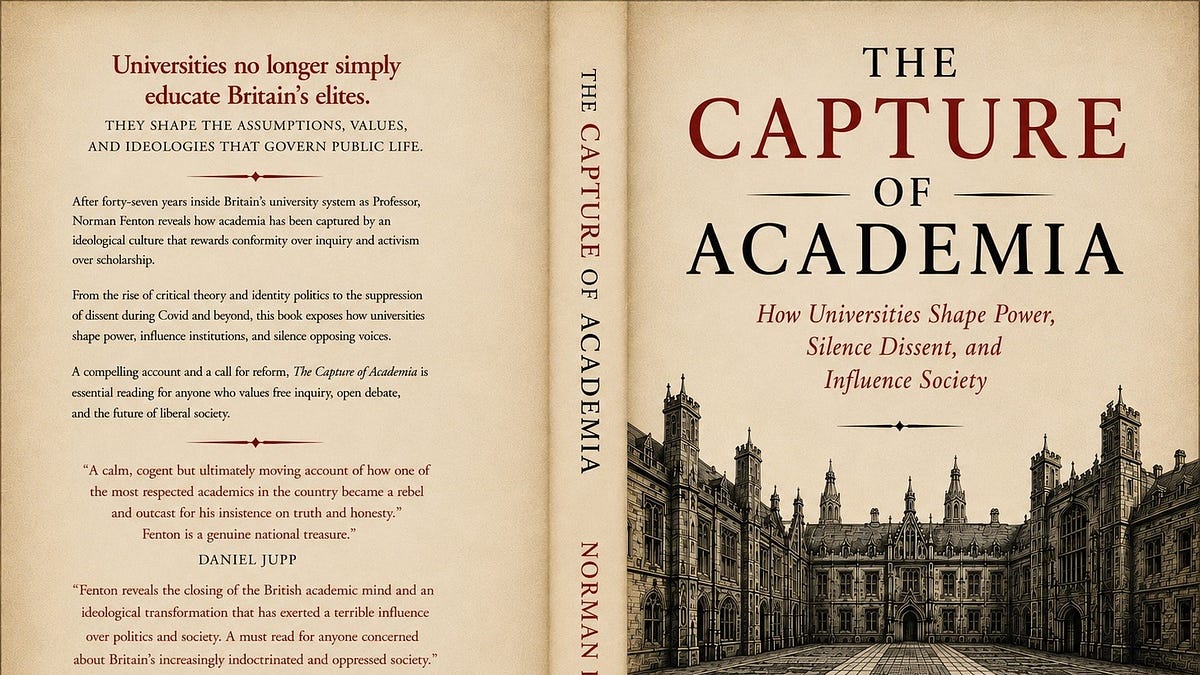
When Allan Bloom published the widely acclaimed the Closing of the American Mind in 1987, he offered an early and influential warning that leading universities had abandoned the pursuit of truth and the Western intellectual tradition in favour of moral relativism and identity politics. Almost four decades later, Professor Norman Fenton has delivered one of the most granular, blow-by-blow insider accounts yet written of that same Gramscian “long march through the institutions”. His book, The Capture of Academia: How Universities Shape Power, Silence Dissent, and Influence Society, traces a 47-year career inside British universities with forensic precision. In the words of Kathy Gyngell, the veteran commentator and editor of TCW Defending Freedom, Fenton details “an ideological, illiberal transformation that is both ‘anti-science’ and ‘anti-knowledge,’ confuses activism with enquiry, that has exerted a terrible influence over politics and society”.
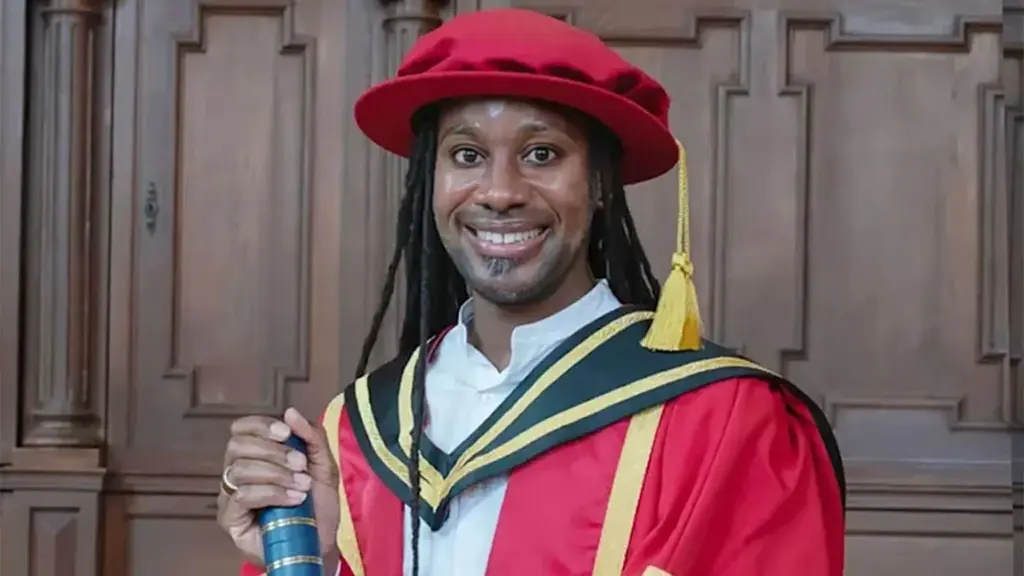
Fenton’s account stands out precisely because it is not abstract theorising. It is the detailed testimony of a mathematician who rose to the highest ranks of his profession – a world-class expert in Bayesian statistics applied to risk analysis and decision-making – only to find himself isolated, cancelled and driven out once his evidence-based dissent on climate change and Covid policy became known. The timing of the book’s appearance is almost providential: it coincided with the scandal surrounding Cambridge’s youngest black full professor of sociology, Jason Arday, a case that illustrates Fenton’s argument to the letter – that EDI (equality, diversity and inclusion) ideology prioritises diversity, equity and inclusiveness over scrutiny, merit and scholarly integrity.
The book’s value lies not merely in recounting one academic’s experience, but in offering, through that career, an insider’s case study of how institutional orthodoxy can take hold without requiring any conspiracy or formal act of censorship.
Working-class socialist to academic outsider
Fenton grew up in a working-class family, his father a Polish Holocaust survivor. He belonged to one of the last generations fortunate enough to benefit from a grammar-school education and free university tuition. He majored in mathematics with a focus on statistics and economics, and in his youth was a committed socialist and an active member of the International Socialists, later the Socialist Workers Party. It was private-sector jobs during university breaks that began to unsettle those convictions. As he puts it, “there is no faster lesson in political economy than earning your own wage and watching others suggest how it should be spent”.
The parallel with the eminent economist Thomas Sowell, who also came from humble beginnings, is instructive. Sowell described his own break from the Marxist beliefs he held through his twenties – even while studying under Milton Friedman – as driven above all by empirical observation. His decisive turn came during a 1960 internship at the US Department of Labor, where fieldwork on minimum-wage laws in Puerto Rico’s sugar industry showed him the gap between government’s stated intentions and its actual effects. Sowell, in other words, turned away from the Left by seeing government from the inside; Fenton turned away from it by seeing academia from the inside. Neither conversion was ideological in the first instance – both were empirical.
Throughout the earlier part of his career Fenton remained Left-leaning and, by his own admission, “benefitted from the very system that I later came to criticise”. He describes a “champagne socialist, Guardian-reading culture” in which overt hostility to Margaret Thatcher was a compulsory marker of intellectual belonging, anti-Americanism was reflexive and many academics were political activists first and scholars second. The classical liberal ideal of the university as a place of open inquiry and scholarly rigour – rooted in the European Enlightenment – had already been eroding. By 2016 the ideological capture of academia was unmistakable. Brexit and the election of Donald Trump produced disbelief and disdain inside the academy, with voters routinely portrayed as ignorant or misled – “deplorables” in Hillary Clinton’s ill-fated phrase. Surveys showed academics overwhelmingly rejected Brexit, by a margin of around 90%.
EDI as the engine of conformity
Ideological control, Fenton shows, is exercised not primarily through formal censorship but through hiring decisions, professional networks, reputational pressure and the slow consolidation of orthodoxy. Administration has expanded massively even as teaching staff has relatively declined. Theories of power, race, gender and oppression are treated as unquestioned truths; ‘studies’ departments – Black Studies, Women’s Studies, Decolonisation Studies and the like – have proliferated, while classical subjects receive correspondingly less emphasis.
Chapter after chapter lays out the mechanism with calm, documentary detail. Universities reward ideological conformity over intellectual merit. Assessment has shifted toward coursework and take-home assignments – a lowering of standards, driven by the need to protect revenue from student fees, in which emergency measures adopted during Covid have often become permanent practice. Preferred pronouns, mandatory inclusive-language rules that ban even ordinary terms such as “blacklist” or “master’s degree”, unconscious-bias training and ‘decolonisation’ modules have all become routine administrative requirements. Curriculum changes require years of committee scrutiny; removing an underperforming member of staff is extraordinarily difficult. What is tolerated is underperformance; what is not tolerated is intellectual nonconformity.
EDI – DEI, in its American usage – functions as the central governance framework of the modern university. It is no longer mere compliance; it has become part of the institution’s DNA. Supporting EDI is mandatory at every level, including funded research projects across all disciplines, and the mandatory training sessions meant to instil it are frequently delivered by trainers who embody the very biases they claim to combat, while the substantial literature exposing the empirical emptiness of unconscious-bias training is simply ignored. Advancement, in this environment, lies not in original thought but in alignment with the prevailing ideology. Fenton traces the deeper roots of this culture to Fabianism, the indigenous British intellectual current dating back to the Webbs in the late 19th Century. The rapid expansion of universities that followed the 1963 Robbins Report brought with it government funding that fed directly into the cultural-Marxist frameworks then spreading through hiring, curriculum design and research priorities – a realignment so thoroughly embedded that it no longer required deliberate coordination; it simply became accepted wisdom.
The international dimension matters just as much. Universities now operate within an ecosystem dominated by agencies such as the UN, the WHO and the World Economic Forum. The WEF’s Expert Network and Young Scientists programmes, together with its research partnerships, effectively groom aspiring academics from an early stage, so that success in the profession increasingly depends on alignment with a global-governance agenda set well outside the university itself.
Climate, Covid and the machinery of suppression
Fenton’s own turning point arrived with Covid. A respected career at the pinnacle of his profession became, in short order, a cascade of cancellations, disinvitations and professional ostracism. Liberal academics proved among the most vocal supporters of the harshest lockdowns, widespread censorship, deference to unelected technocrats and mandatory vaccination – and the period revealed just how fragile the academy’s professed commitment to open inquiry and free speech had always been. Fenton’s own Bayesian analyses, conducted with colleagues, challenged exaggerated infection-fatality rates, the reliability of PCR testing and the statistical claims underpinning government policy. Journals that had once accepted his work began rejecting it; publication, funding and media visibility became contingent on alignment with the official government and WHO narrative of a “deadly pandemic” met by “safe and effective vaccines”.
During Covid, fear itself became an institutional resource. Behavioural ‘nudges’ and psychological pressure applied by UK government departments on its own population were shaped in part by figures such as Professor Susan Michie, a member of the Government’s SAGE advisory group and a 40-year member of the Communist Party of Britain. The parallels between the Covid and climate narratives, Fenton observes, are striking: both were shaped and enforced by the mainstream media and key institutions, with dissent routinely labelled ‘misinformation’ and met with mass reporting, smears and doxxing.
The machinery of suppression that closed in on Fenton was comprehensive. Colleagues distanced themselves; anonymous complaints reached HR; student activists demanded to be excused from his modules. An invitation to speak at an NHS Health and Care Analytics Conference was rescinded at the last minute over “reputation risk”. Freedom-of-information and subject-access requests pointed to the possible involvement of the British Army’s 77th Brigade, a unit originally tasked with countering foreign disinformation but which, on the evidence Fenton cites, had by then turned some of its attention toward domestic critics.
He was even smeared with associations to “white supremacy” for using a common ‘clown world’ emoji – an especially grotesque charge given that his own father was a Holocaust survivor whose family had been murdered by the Nazis. Queen Mary University of London offered little support. Fenton felt compelled to retire in 2022; emeritus status was granted only after he agreed to supervise his remaining PhD students without pay, and fellowships and invitations evaporated almost overnight. A full account of this cancellation was published in these pages in June 2025.
Dr Tilak K. Doshi is the Daily Sceptic‘s Energy Editor. He is an economist, a member of the CO₂ Coalition and a former contributor to Forbes. Follow him on Substack and X.




Discussion
Comments
This week across the site:
To join in with the discussion please make a donation to the Daily Sceptic.
Profanity and abuse will be removed and may lead to a permanent ban.
To confuse Norman Fenton’s name with this young man’s, who committed suicide, is a great disservice to Dr. Fenton. This young man made an error and it should have been dealt with by a disciplinary committee within Cambridge. Instead the story was leaked to the cowardly press and it cost this young man his life. To drag Professor Norman Fenton’s name into the story is baffling.
Norman Fenton’s completely justified reward for his integrity will not come in this life.
The Political Left comes as a PACKAGE—–You cannot just select bits of it you like, you must accept it all. —Diversity Equality Race Gender and Climate is a PACKAGE DEAL. You must buy into all of it.
Can someone explain to me why slow but steady ideological capture must be accidental? Why does it have to be a ‘conspiracy’ to consider that it is not accidental but deliberate? Why is it so difficult to understand that something can look organic but is not? Let’s take Covid: there are now only a relatively small number of dullards that don’t accept that something that looked organic was actually coordinated. And coordination can take place over decades. Anyone that’s managed the small degree of patience required to read the Toronto Protocols would draw very different conclusions. Unfortunately, few seem to have the patience to read 40 odd pages these days. Really does get my goat.
One question I would like to ask my Cambridge alma mater, or my NHS former paymaster, or the media, corporations, police and courts that have made this DEI/critical theory stuff compulsory, is simply “On what basis. other than fashion, is this stuff real?”
Universities started off independent of church and state, but governed first by the acknowledged authority of the Catholic Church, then of ancient authorities from Plato to Aristotle, then the Bible, then Enlightenment reason (which was essentially Christian moral and natural logic divorced from God). All of those could be, and were, challenged, sometimes at personal cost but more often freely, when the arguments were good.
But the new ruling ideology, more strictly enforced than any of the others, seems to have no better intellectual basis than “Some of us like Michel Foucault’s and Judith Butler’s ramblings, so everyone must accept them axiomatically.”
That folks like Norman Fenton, right on through to non-academic Tommy Robinson, can argue a better basis for their views explains why the whole edifice depends on grift, psyops and force (whether by sackings or Antifa thugs). Consequently, I have no reason to accept it other than animal fear.
I watched Laurence Fox’s sterling performance in the recent Oxford Debate …. and he verbally and logically knocked 7 bells out of the oh-so-carefully-expressed-admission-of-Muslim-violence/threats-of-violence from the Muslim female who now heads the Oxford Debating Society.
It is going to be a long hard haul back from this mindset but there is glimmer of hope with the rise of Restore Britain which wants to rid society as a whole of “Diversity, Equality and Inclusion”. It is a vile cancer eating away at the heart of our country.
Our universities have stopped being universities – they go through the motions of being universities, but they’ve been hollowed out of intellectual substance. In essentials, they’re institutes of the New Dark Age. This is all part of the accelerating collapse of our civilisation. The question we face is what comes next. My guess is that the institutes of the New Dark Age (there’s no point in calling them universities) haven’t reached the bottom of the pit of darkness they’ve voluntarily entered. The next major stage they’ll go through is the elimination of the hard sciences on the grounds – probably – that facts and objectivity are inventions of “the white patriarchy”, and that Western science is an “inferior way of knowing”.
Your first sentence is worth expanding on. In a similar vein, the BBC goes through the motions of being a media empire but is in fact a political campaigning organisation. Many firms and individuals, especially at the corporate level, seem to think their primary purpose is not to provide goods and services that people want, but to make the world a better place in some general way. Their core business is seen as a way of financing social justice campaigning. I think a lot of people are frustrated politicians, so this stuff harnesses the do-gooding urge that people seem to need to indulge to give them a satisfying purpose in life (but I bet that taking tea with the old, lonely pensioner down the road isn’t what turns them on).
Except all the Universities parasites will still insist on flying around the world in white men’s aircraft. And they will still want white men’s medicine and high tech scans when it suits them. And not forgetting the odd EV to virtue signalling with.
Perhaps the new dark age you refer to will take the form of ‘Brits’ (rather, the residents of the United Kingdom, however you wish to define a collection of disparate, Balkanised populations) becoming a new peasant class under an expanding Chinese empire. The WEF has been pretty good at giving the impression of being Xi Jing Ping-Pong’s gimp, especially when Shwaab was in charge.