

In a recent editorial, the Guardian laments that, through its mishandling of the Jason Arday affair, Cambridge University has “set back the efforts of all the people and groups who have worked in good faith, over many years, to boost the presence of underrepresented groups in influential positions”.
The paper goes on to say that “such imbalances, which remain pronounced in many areas of public life, including academia, are the consequence of prejudices and discrimination, as well as unequal access to resources and opportunities”.
A reasonable interpretation of this statement is that certain groups are underrepresented at institutions like Cambridge partly because of “prejudices and discrimination”. In other words, hiring and admissions committees within the university are prejudiced against certain groups and therefore discriminate against them.
Is there any evidence of this, aside from the simple fact that certain groups are underrepresented? An accusation of “prejudices and discrimination” is a serious thing – or at least it ought to be.
The chart below compares the ethnic distribution of students accepted at Cambridge to the ethnic distribution of people aged 15 in England and Wales. The population aged 15 was used because it corresponds to the year 2021, whereas the other data correspond to the year 2025. The first set of figures was taken from ‘Undergraduate Admissions Statistics: 2025 cycle’. It represents home applicants only. The second set of figures was taken from the Office for National Statistics.
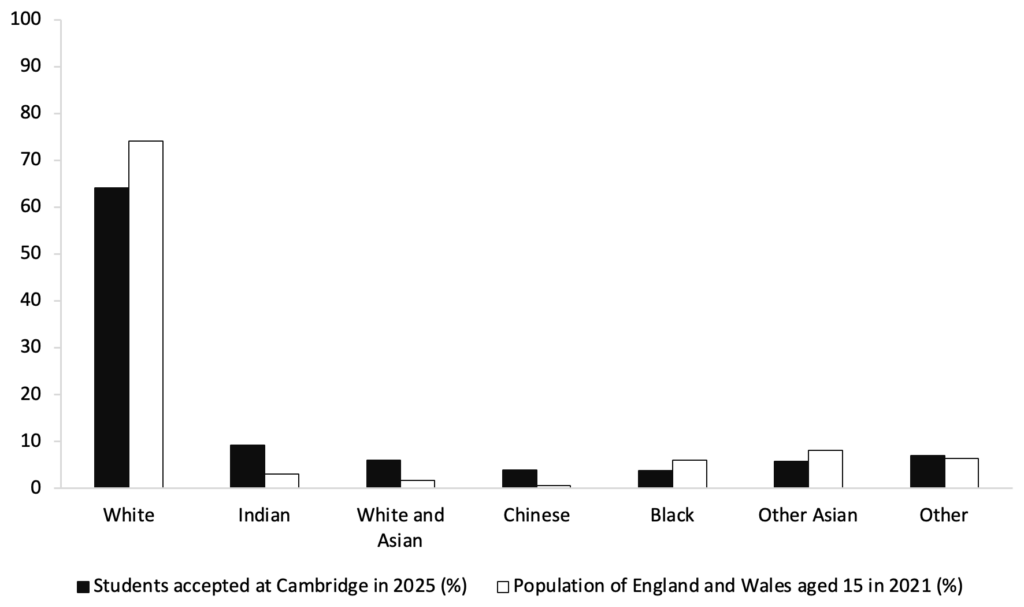
It’s true that Black people are underrepresented by 37%. However, White people are underrepresented by 14%. Meanwhile, Indian people are overrepresented by more than 200%, White-and-Asian people by more than 250% and Chinese people by more than 500%. At the same time, Other-Asian people are underrepresented by 29%.
In order to explain this pattern with reference to “prejudices and discrimination”, you would have to assume that admissions committees hold a prejudice against Black and White people, but hold a prejudice in favour of Indian and Chinese people, while also holding one against Asian people who are not Indian or Chinese.
Does this make any sense at all?
A far more plausible explanation is that ethnic groups systematically differ in the criteria that admissions committees base their decisions on, such as A-Level results, admissions test scores and performance at interview.
I would argue that these gaps ultimately reflect differences in average IQ and the emphasis cultures place on educational achievement. Others have their own theories. The point is that “prejudices and discrimination” is not a plausible explanation.
There may even be some anti-White discrimination going on. White students at Cambridge are much more likely to earn first-class degrees, possibly because they are held to higher standards at admission. However, this is speculative.
Turning to sport, there are currently no players of South Asian heritage in the England men’s football squad. Yet there are 16 players of Afro-Caribbean heritage, more than half the total. Does the FA hold a prejudice against South Asians? Or is it, rather, that there is simply far more interest and talent in the Black population?
South Asians seem to be more interested in cricket, and there are indeed several South Asian players in the England men’s cricket squad.
The idea that academia, which has a massive Left-wing skew, is rife with anti-Black prejudice is absurd. It would be like suggesting that Restore Britain is a hotbed of anti-White prejudice. Repeat after me: underrepresentation does not equal discrimination.




Discussion
Comments
This week across the site:
To join in with the discussion please make a donation to the Daily Sceptic.
Profanity and abuse will be removed and may lead to a permanent ban.
The emphasis different cultures place on academic achievement is definitely a big factor but socio-economic background is also likely to be significant. In general kids from less well off backgrounds do less well at school and are therefore less likely to get the grades needed to get a place at a top university.
Black kids are more likely than white kids to come from less well off backgrounds. This might once of been partly due to racism/discrimination but is now far more likely to be due to the fact their parents came from disadvantaged backgrounds, didn’t do particularly well at school and didn’t get the qualifications needed for well paid jobs. Hence coming from a disadvantaged background and not doing well academically is self perpetuating down many generations.
If studies have shown differences in average IQ between different ethnic groups are these mainly due to genetics are life experience? My feeling is that life experience is far more important than genetics, unless there’s been major studies that try to account for life experience.
How would you account for the fact that sub-Saharan Africa has never produced a great civilisation or much in the way of notable achievements advancing the cause of humanity in any sphere, and despite great natural resources and trillions in aid, still lags behind on any measure you care to name, which is why tens of millions of people try to leave it every year to live somewhere else? Sorry but you’ll never convince me that there is an explanation other than evolutionary pressure on humans caused by colder weather/interbreeding with neanderthals.
I can’t think of a really convincing explanation for why sub-Saharan Africa never produced a great civilization. Possibly a lack of metal ores or the number of infectious diseases found in the tropics that put people living in large settlements at a disadvantage. It needs lots of people living together and quite a few being able to specialise in certain tasks to create a great civilisation. However it could be genetics.
To my mind it has to be genetics which were shaped by the environment. Seasons and cold pushed humans to plan ahead.
Forgetting genetics, which has a role, the big differentiator is absent fathers.
Are not absent fathers a symptom of “genetics”. By the way, I’m not a fatalist who doesn’t believe in human agency and I’m not a racist who imposes blanket definitions on arbitrary groups. Just observing. It’s the other lot who want to put people into categories, when it suits them.
Absent fathers are a symptom of upbringing, kids who grew up without a permanent father figure are far less likely to realise the importance of their kids having a father figure. Therefore absent fathers gets passed on from generation to generation but it’s social selection rather than genetics.
Culture, shaped by genetics.
Such studies are not permitted; surely you know that? Ask Nathan Cofnas, formerly of Cambridge University, who dared propose the genetic heresy and suffered accordingly. By way of revenge, he played a major role in exposing Arday the fraud.
I notice that no pearl clutcher ever gives numbers for what the proportion of a particular group should be. Plus they rarely notice when particularly favoured groups have a greater proportion than might reasonably be expected.
The slightly bonkers pearl clutchers would say the proportion from any particular group should be the same as the proportion of the population that comes from that group.
The completely insane would say the proportion from non white groups should be much higher than the proportion of the population that’s non white to make up for “historical injustices”.
The Grauniad claims “such imbalances … are the consequence of prejudices and discrimination”.
The Grauniad knows this isn’t true, and only inserts this lie into the debate in order to justify its own anti-whitism and anglophobia.