

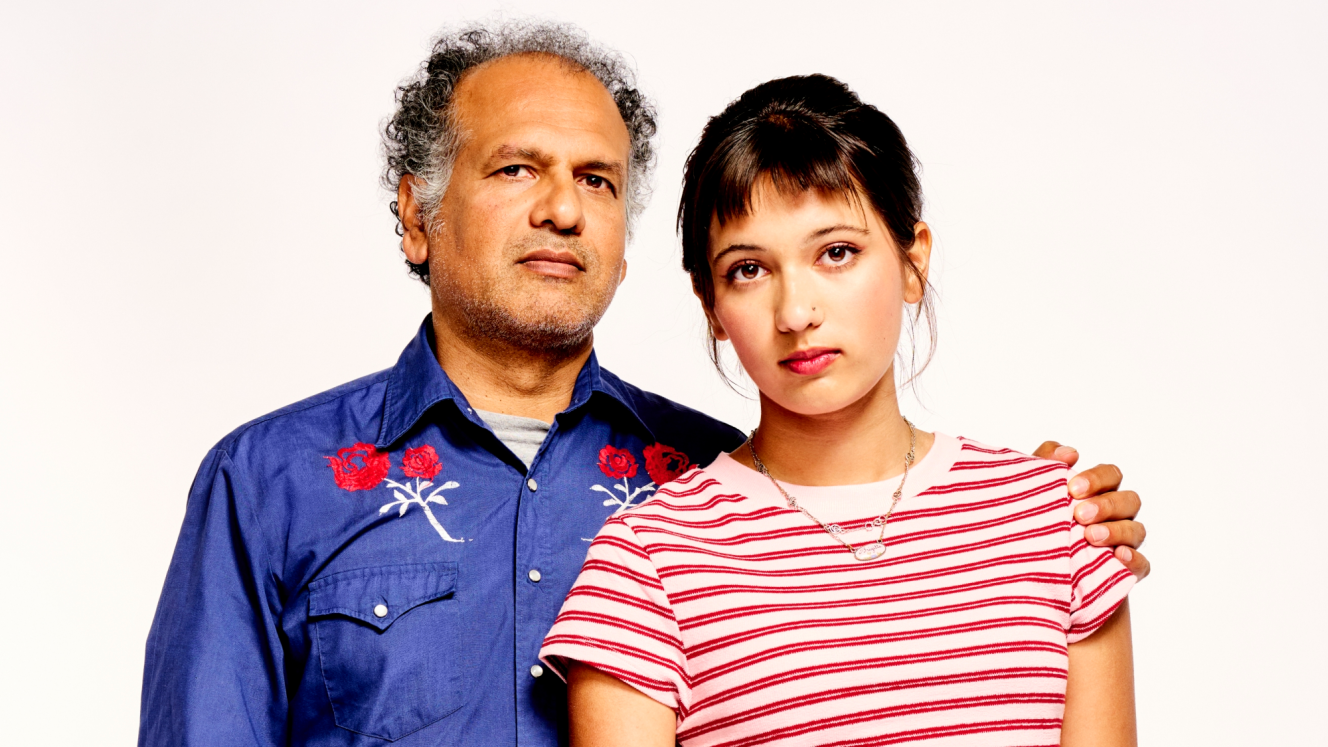
Praise is due Guardian contributor Sarfraz Manzoor and his daughter Laila, 14, for revealing the feminine-coded response to teenage anxiety, and its unsettling culpability in compounding mental health problems. Though not intended as such, the piece acts as a stark warning to other fathers about what not to do when wives, daughters and other females conspire around approaches to teenage mental health issues.
I was hesitant about writing this piece given it concerns an obviously fragile and hurting teenage girl. However, Laila’s brilliantly written article appeared this week in the Times; she entered her personal upset into the public record. Moreover, her revelations about anxiety, school avoidance, autism diagnosis, depression medication, panic attacks and pathological demand avoidance are in no way unique. Laila typifies the experience of over 200,000 under-17-year-old girls referred to mental health services with anxiety today, the 80,000-plus teenage girls currently avoiding school and the 70,000 children prescribed anti-depressants.
In successfully describing her nightmare, Laila sheds light on a widescale societal issue. She writes:
I couldn’t be in the house on my own for half a nanosecond. If we ran out of toilet paper or milk I’d trail behind my Dad to the shops in my pyjamas. My parents couldn’t see friends or go on date nights. My younger brother saw me as an attention vacuum. I sucked away his peaceful life with panic attacks and meltdowns.
Laila’s story maps almost exactly with a number of my students whom I visit at home to support educationally. After being diagnosed with anxiety, autism and pathological demand disorder, Laila was prescribed the anti-depressant sertraline. As happened with one of my students, Laila later attempted an overdose. She writes:
A few weeks after starting it, I remember locking myself in my bathroom and screaming, “Help me, I need a doctor, I’m broken. I need hospital.”
Such a response is completely logical: Laila had been diagnosed with a range of disorders. Why is anyone surprised that she felt “broken”? Adults had told her there was plenty wrong with her. There is gathering criticism from a broad range of doctors about the self-fulfilling prophetic nature of mental health labelling.
What the piece inadvertently reveals is the feminine-coded response to normal teenage upsets: talking, therapy and medication that, in my experience, once embarked upon, produce a compounding negative rather than healing effect. In the majority of cases I have supported, the father has often left the family home, but in some cases – like Sarfraz – the father has outsourced attempts at support to his wife and a female-dominated mental health sector. I witness fathers acting as supplicants to a theory of mental health approaches that, at best they don’t understand, and at worst they know to be nonsense but are too timid to say so. Fathers who start out suspicious or wary of the process are treated by their female folk as antediluvian blockheads. In attempting to restore family harmony, the bewildered fathers fall into line and make degrading attempts to master the lingo in order to demonstrate how enlightened they are. As Manzoor demonstrates:
To be the parent of someone with PDA (pathological demand avoidance) means unlearning all you thought you knew about parenting. It means ignoring all the well-intentioned advice from friends who suggest everything could be improved with a dose of tough love.
Too many fathers leave the field. Manzoor writes:
I would see my daughter in bed staring at her phone for hours on end and wonder what life would look like for her in a year… Laila is one of the lucky ones. She has a mother who works as an autism specialist… she is fortunate to have an EHCP, which has ensured, among other things, that her school was able to find the funding for home tutors… her last school was extraordinarily understanding… she was lucky to have help from CAMHS, who provided 12 weeks of at-home therapy, twice a week following her overdose… It is only due to an army of therapists and the support of her old and new school that Laila is now able to imagine a hopeful future.
I don’t think any of this is lucky. I think it amounts to shameful paternal failure. That Sarfraz Manzoor and thousands of other fathers like him have been gulled into thinking this is a good outcome for a teenage daughter – medicated, an overdose, a year out of school, loss of friends, 12 weeks of therapy, restarting education an hour a day – demonstrates how badly teenage girls are served by the mental health industry today.
The roll call of so-called ‘help’ on offer is dominated by females: 65% of secondary school teachers are women; between 75% and 80% of autism diagnostic and support service workers are women; 83% of educational psychologists are women; 85–86% of CAMHS staff are women; 84% of therapists are women; and, like me, 75% of home tutors are women. If this female-dominated, feminine-coded medication-and-therapy approach worked, then fine. But it doesn’t. The numbers of anxiety-riven young women are rising and the intensity is getting worse.
Hounded out of the discourse as ‘harsh’, ‘repressive’ or ‘cold’, male approaches to mental upset ought to be reappraised. Men are generally less likely to explain away self-absorbed navel-gazing as the result of “dysregulation owing to pathological demand disorder”. Perhaps fathers of such daughters don’t need to go as far as my colleague’s father, who dropped her outside school in her pyjamas when she began refusing to attend – but the male, no-nonsense presence can be inordinately helpful. I look back in shame at ‘kicking off’ at some family event and my beloved father telling me very firmly indeed to stop embarrassing myself.
Imagine how different things would be if, at the start of a daughter’s unsettled behaviour, sensible fathers confiscated her phone and insisted that every day they took a walk together, made dinner together, went to the cinema, for a swim, to see friends and relatives, for another walk, to a concert – all the while shooting the breeze together. “Come on, Sausage,” Dad would say. “You’re OK. Don’t upset your Mum – we don’t want her to think you’re bonkers.”
Mary Gilleece is an education support worker and her name is a pseudonym.


Discussion
Comments
This week across the site:
To join in with the discussion please make a donation to the Daily Sceptic.
Profanity and abuse will be removed and may lead to a permanent ban.
Females are biologically primed,, once past puberty, to be mothers and wives. More women would get much pleasure out of life by being a traditional woman. Tradwoms are the future.
Pathological Demand Disorder AKA being an adolescent/teenage girl. Whatever happened to that becoming the fun stuff of musicals like Bye Bye Birdie, movie comedies like Clueless or books by novelists like JD Salinger?
What this article points to is that the feminisation of psychological support for young people has spawned a growth ‘industry’. All the people providing support through the schools, NHS agencies etc are being paid. What’s more, they are being paid to provide ‘care and support’. For those involved in the industry – or racket, if you prefer – what’s not to like? When the politicians are presented with an ever-increasing bill it goes through on the nod. Nobody dare question the need for fear of being labelled callous and uncaring. There is, sadly, no prospect of them being forced to consider the proposition that such services are doing more harm than good.
I heartedly agree with the suggestions in the final paragraph. Doing stuff is so much better than talking. (Well meant advice is useless and annoying as the giver does not have to live with the consequences of the actions they are advocating). So many fathers think they have an “opt-out” card (and act upon it) when they really shouldn’t.
Anxiety and autism are two very different things. Either people should not procreate if they are not up to the job. The state is not your mom and dad. Kids not attending school is not the state’s responsibility. It is the parents. Please stop wasting our taxes on raising other people’s children. Thanks.
This article is brilliant. It touches close to home, and also on the male female differences. As my good wife says – we need men, they have a simple way of looking at matters, they are black and white, whereas women are complicated.
Not long ago my daughter fell upon hard times – relationship split, job loss etc. She came home broke and with mental issues. She had therapy (via a woman), and used the NHS, who suggested medication, as eventually did the therapist. It was all too easy, she could easily have fallen onto a life of state support, and it seemed to me that is what the powers that be wanted.
We parents had a look online, and looked at the advice – if your kid has mental issues, anxiety, listen to them, understand them etc.
I thought — BS, I refuse to accept that my daughter is an anxious wreck, so tough love was the order of the day. Hard labour in the garden and around the house, with me, day after day, after day.
It worked, and my daughter is a success story, no thanks to the authorities.
When I was 14 I turned to Christ, accepting Him as my personal saviour. Over 50 years later, I can tell you it is the rock on which my life has been built. Countless testimonies of healing, deliverance, miracles, promotion, testing, training.
It works.
Kids need Jesus.
Wokism seeks to eradicate the Gospel and Christian culture.
This is the war.
I know Who wins.
If sensible mothers as well as sensible fathers adopted this attitude, their daughters would very quickly learn that “poor little me, me, me” doesn’t work.
Fantastic article. Had to keep looking around to make sure no one saw me reading it. One could extend it to the feminisation of society and its loss of resilience.
PS yes my pronouns are HE!
What Mary is touching on, but doesn’t quite say, is the downward spiral of an entire civilisation caused by the deliberate emasculation of it. Father’s don’t just have their daughter and their wife to contend with, they have every waking moment filled with being told how utterly useless they are and how society would be so much better if only men could be more like women (all the time whilst women are doing everything in their power to be more like men). It’s everywhere – the state, the press, the media, education, the judiciary… in the oxygen we breathe.
It’s not just father’s who needs to step up – the pressure’s simply too overwhelming for most – an entire society needs to admit that this Marxist driven experiment has failed society spectacularly. And that’s not going to happen anytime soon.
Yep. If ypy want to know what a feminised society looks like, just look around you ate the destruction ans disfunction. You’re living in it
Look how the European Union has backed itself into a corner where none of the major world powers takes it seriously. It is run by two gormless women – Ursula Von der Leyen and “Foreign Minister” Kaja Kallas, the latter an extreme Russophobe deliberately picked from extremely Russophobic Estonia.
Leyen’s achievement is her notoriety when as Germany’s Defence Minister she insisted that Germany’s battle tanks needed modifying “to accommodate pregnant women”.
Kallas of all people in the EU needs statesmanlike diplomatic skills in dealing with the world, yet she speaks in cliches, like a parrot, especially in the need for negotiations with Russia over Ukraine. She is so despised outside the EU that she has become persona non grata in Moscow, Beijing & New Delhi. Nobody wants to be in the same room as her.
Hallelujah
From this and previous articles, I think Mary Gilleece is one of those truly compassionate Ethnic Europeans whose compassion is used against them by wily Third World Ethnics, like this Ethnic Indian Subcontinental’s daughter angling for a lifetime on “disability benefits” and never having to get a job.
We never had any of these “mental health problems” and “syndromes” or “autism” when I was in school more than half a century ago! The few with “Spoilt Brat Syndrome” were soon quelled by their peers, with homely advice such as “Don’t be Bratulent!”, which is the advice Mary Gilleece ought to be giving to the Spoilt Brat in the article.
Who can blame her dad for trying to escape from this monster most probably created by his overly indulgent wife? And her younger brother, who sees more clearly than all of the adults around him, calling her “an attention vacuum”.
“Come on, Sausage … we don’t want your mum to think you’re bonkers” should be rolled out nationally.