

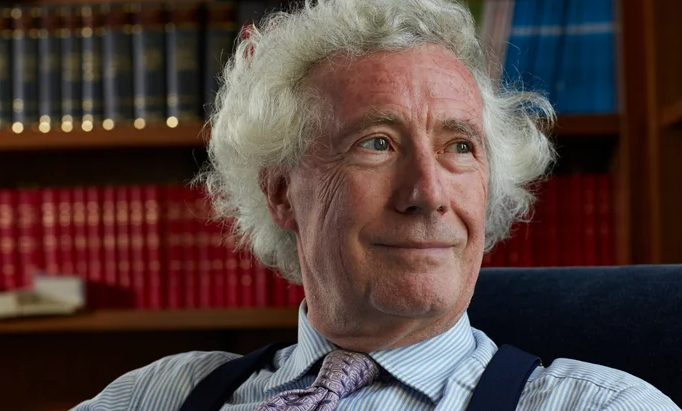
At the end of July, in the pages of UnHerd, Jonathan Sumption published what can fairly be described as an attack on, verging on a diatribe about, what he believes to be the dire state of American democracy. Yes, President Trump comes in for severe criticism. Indeed, Sumption describes Trump as exhibiting “the three classic symptoms of the totalitarian mind” as well as claiming Trump has “dismantled the checks and balances of the world’s oldest and most formal constitution in an astonishingly short time”; has initiated a “war on dissent”; has overseen a “ruthless use of voter suppression and gerrymandering”; the criticisms go on and on but readers get the general idea. The US Supreme Court comes in for a good roasting as well, largely because Sumption believes Trump’s picks for that court have turned it into the “most partisan Supreme Court since the 1930s, arguably the 1850s”.
Yet this attack on the US President is made in the service of a bigger agenda or wider thesis. Sumption, you see, despairs about the future of democracy in the Anglosphere and, too, in the wider democratic world. A subsidiary target of Sumption’s is populism. True, he tries here and there to be broad-minded and tell us why he believes these populist leaders and parties are currently doing so well in the polls (and in Trump’s case why he won two Presidential elections). Accordingly, his Cassandra-like pessimism extends beyond the US. He thinks Britain, with its unwritten constitutional arrangements, is currently better placed than the US but is nevertheless on the same dangerous trajectory. Brexit gets more than a mention by Sumption and readers will have no difficulty inferring that the writer’s sympathies lie whole-heartedly with the Remain side. There is even, perhaps inevitably with these sort of pieces, a mention of Hitler and the 37% of the popular vote the Nazis won in the 1932 German election. (Sumption tells us this fact about Hitler is “worth remembering”, though nowhere is there any sustained argument by him for why it is worth remembering in order to help buttress his argument. Or why any sane person would believe that a future majority Nigel Farage-led Reform government – because this is plainly the barely disguised target of Sumption’s worries or ire – would embark on anything in the same solar system or galaxy as what Hitler and the Nazis did.)
At any rate, that is just by way of introduction to give readers who have not yet read this Sumption diatribe a brief taste of what it was like. It was haughty. It was virulently anti-Trump. It tried, but failed, to hide a visceral disdain for tens of millions of voters across the Anglosphere. There was no proper context to many of the criticisms. Some examples were cherry-picked, ignoring ones that point the other way. At no point did the piece assign any blame for the current state of British democracy to the unelected top judges, Sumption’s former caste and colleagues. Though Sumption blamed Hilary Clinton for using the term “deplorables” before the 2016 US election, there was a powerful sense in reading this Sumption article that in unguarded moments, with like-minded friends, his own description of many, many of those voters who support Trump and Farage and populist parties more generally – conceding that Sumption does make a case for their having justifiable economic grievances – would be that they are indeed deplorables.
In blunt terms, then, I think Lord Sumption paints a seriously distorted picture of the state of Anglosphere democracies. His criticisms of Trump are largely unbalanced, often wrong-headed, made in the sort of BBC groupthink vacuum that simply ignores what came before the Don under preceding Democrat administrations, and are ones that will convince absolutely no one who did not already share Sumption’s views about Trump and Farage and populist parties more generally. Sumption calls in aid the concept of the “rule of law” without anywhere acknowledging what a contestable concept it is; that it can and is used sometimes in a thin, procedural sense and sometimes in a fat, substantive, morally laden sense and in the latter case the moral underpinnings the user opts to employ – the substantive values stuffed into any morally pregnant conception of this Rule of Law notion – are incredibly open to reasonable disagreement. Moreover, in the entire piece only twice do we read the word “immigration”. And when we do it is when Sumption is lamenting Brexit and Leavers’ views about Remainers, in some unspecified way suggesting these views parallel the views of MAGA voters and their disdain for Democrats’ views on immigration. Yet nowhere does Sumption mention out of control mass immigration (be it legal or illegal or the type in the grey area in between those two that seems consistently to receive such friendly treatment by near-on all of today’s non-US Anglosphere judges). Or that it was established political parties on both sides of the aisle – including Tories in Britain and Liberals in Australia and a good few Republicans in the US before Trump – who repeatedly for years and years made explicit pre-election promises to the voters to restrict mass immigration and then broke those explicit promises, sometimes massively so, again and again and again. That does not once come up as, you know, perhaps being a pretty noteworthy reason for many voters’ abandonment of the legacy political parties. Put more bluntly, nowhere does Sumption state the bleeding obvious, that mass inwards immigration (often made more difficult to stop by the flabby, ‘living tree’ interpretation top judges adopt when giving meaning to constitutional and international legal texts) is the main cause for the rise of these populist political parties that Sumption dislikes and that he suggests threaten the future of democracy. Well, that and the fact that many voters today simply do not believe that multiculturalism, and all that is forced on voters under that name, has been a net positive. They do not believe in the sort of cultural relativist claims that undergird the heavy-handed orthodoxies of this secular multicultural religion. But they see that the legacy political parties do nothing to alter course.
I suppose what I am getting at is that this Sumption critique appears to me to be a house of cards whose foundations are so weak and at times so out-of-kilter and misleading that they simply cannot support his desired conclusions. To say that, however, requires me to run through this Sumption article and point out where he misleads and misdirects the reader and where his substantive moral views are highly contestable and in no way self-evident. I will do so in the order these matters come up in Sumption’s article and then I will offer up a few general conclusions.
The Sumption article starts in a way that is not unusual when discussing the US, namely with a short mention of de Tocqueville. It then correctly notes the enormous increase in the size and reach of the administrative state, and with that of executive power. Sumption is perfectly correct in noting this huge increase in the numbers of civil servants. That said, in an article attacking Trump he might have mentioned that in Trump’s second term – barely more than a year and a half since inauguration – Trump has reduced the size of the US federal civil service in a way few previously thought possible. The absolute numbers are disputed, true, with the administration claiming some 11% of jobs (about 350,000) are gone, taking the total size of the federal civil service back to 1966 numbers, while others say the reduction is only half that. Either way, no other recent President has done that, or even tried to reduce numbers. Given his overall argument, presumably Sumption would welcome that sort of significant decrease in civil service numbers. Yet nowhere does he mention this fact or credit Trump.
Here is another factor I think relevant but that goes unmentioned in this Sumption piece. I say this as the son of a very senior Ontario government civil servant who finished his career in the early 1990s. My dad as a deputy minister (basically the top layer of the Ontario civil service reporting directly to the elected minister in one ministry or another) served under Conservative governments. He served too under soft-Left Liberal governments (that Brits can think of as Lib Dem type outfits). And he served under more Left-wing still NDP governments (which would be like a Labour Starmer outfit, only with a bit of competence thrown in). Back then the civil service in the non-American anglosphere prided itself on its apolitical nature. Was this ‘more honoured in the breach than the observance’? No doubt. But it was a wholly different world than today and civil servants at least generally tried to be wholly impartial. So I will state this baldly for Lord Sumption. Today, the entire administrative state, or if you like the vast preponderance of senior civil servants, leans Left politically. In Australia some 15 years ago the most senior Treasury civil servant finished his civil service job and almost immediately went to work for the Labour Prime Minister. My dad would have let himself be burned at the stake before doing anything so overtly political. Years and years of gradual ideological capture mean that it is just a fact that Right-of-centre governments will find it harder to implement their policies than Left-wing (soft or hard) governments. If Sumption questions or doubts that claim by me, fine. I don’t think he could cash out those doubts. I think any British or Australian or Canadian Tory Cabinet Minister would tell him as much and I rather think Sumption knows this himself. Regardless, though, of whether he agrees with me on that, if I am right then it makes a big difference to how any conservative government has to operate to be even remotely effective. This is true in Australia, in Britain, in New Zealand, and yes even in the US which has a very different, non-Westminster tradition that never fully bought into the supposedly apolitical nature of its federal civil service and how it ought to operate. Put more mundanely, when Trump comes into office and fires top bureaucrats from the former administration, how you characterise those dismissals depends to a great extent on whether you believe they are Thatcher-era top civil servants who understand their role the way my dad did. Or, whether they are politicised operators with a hefty dose of social justice warrior leanings who, yes, may ultimately help implement policies they detest but then may not do so. Anyone reading what the outgoing Obama and Biden administrations did to make life difficult for the incoming Trump administrations may well think being fired was the least some of these people deserved. Certainly it is very difficult for me to see how “the rule of law and substance of democratic accountability” [sic] are enervated or undermined in any way at all when a new government wants to put in place top bureaucrats it can trust, which means firing the ones it inherits.
Then Lord Sumption moves to Trump himself and his attempts to paint the current President as a despot with a totalitarian bent. Yet there is not a word, anywhere, of what Democrat administrations had done to Trump. No mention of the FBI spying on his campaign before the 2016 election. Or that surveillance was put on some of his advisers. Or that the FBI lied to the FISA court. There is likewise no mention that before the 2024 election Biden’s FBI wiretapped Trump’s Chief of Staff Susie Wiles’s phone on a privileged call to her lawyer without her consent and knowledge and – according to her lawyer – without his consent, though some dispute the lawyer’s take. The Biden administration tried to hide this fact by marking the file “prohibited”. Likewise, Sumption omits to remind us that the Democrats tried to take the opposition candidate, Trump, off the ballot in a number of states before the 2024 election. That they tried to imprison him for hundreds of years and bankrupt him with four indictments (two federal and two at the state level) that were in my view ridiculously weak and would never ever have been brought against an opposition leader in Canada or Australia or Britain. Sumption ignores the 51 ex-intelligence officers who wrote that letter (one that seems to have been proposed to them by the then Biden campaign before the 2020 election) that claimed that the Hunter Biden laptop had all the hallmarks of a Russian disinformation campaign, though we now know that was a lie and they knew – as Joe Biden knew – that the laptop was real. Sure, the letter had a lawyerly quibble, but one that Biden and the press wholly ignored in the TV debates and elsewhere, as was anticipated. And there is even evidence that knowledge the laptop was real might have swung the 2020 election. Who knows? I mention these few examples simply to say that if a writer is going to try to paint a democratically elected President as some sort of latter-day Mussolini then he ought to be scrupulously fair in indicating why that person is trying to fire senior people in the FBI and CIA. And why he might hold a grudge against the people who tried to bankrupt him (in a different civil case that, again, I think was obviously politically motivated, required the existing law to be changed, and could only win in a jurisdiction where 90% of voters – and hence most jurors – vote Democrat). And imprison him. And take him off the ballot. And spy on his campaign chief. And run legacy media-aided raids on Mar-a-Lago. Etcetera. What is Sumption’s view on the rule of law credentials of all of these actions taken against Trump?
Now I know that there is a respectable view that Trump should have turned the other cheek and ignored these actions. Fine. But game theory, not to mention evolutionary psychology theories, say that reciprocity – giving them some of what they gave you – is the better path.
Anyway, despite that complete omission of any sort of context as regards what was done to Trump, Sumption moves next to listing why he thinks Trump displays a “totalitarian mind”. Some of these seem to me to be just insults or highly contestable evaluative calls (such as his supposedly “total[ly] identif[ying] the state with himself”). Others are factual claims that I think are patently wrong. For instance, Sumption alleges that Trump “has dismantled the checks and balances of the world’s oldest and most formal constitution in an astonishingly short time”. This must be news to those Senators, some Republicans, who have refused to pass the SAVE Act which would effectively make US elections like Canadian ones and require voter ID and not allow unsolicited mail-in ballots nor third party ballot harvesting (both malign and highly gameable in my view). Or to the Republican Senators and Senate leaders who in this second Trump term have completely blocked him from making any recess appointments. (President Obama made 32. President George W. Bush made far more than that.) Trump has had to live with that fact, not something that obviously aligns with a despotic, totalitarian Presidency. This claim that Trump has dismantled the Madisonian checks-and-balances constitution is no doubt also news to the Trump-appointed Supreme Court justices who decided against him in the tariff case and in the birthright citizenship case and in the Federal Reserve case.
Here is another particularly egregious characterisation. Sumption talks of “the deployment of ICE’s paramilitaries on the streets of American cities”. This is a risible way to describe a federal law enforcement agency that is enforcing federal immigration law. I know that Sumption appears to have a complete blindspot as regards the issue of illegal immigration, but in the first months of the Biden administration over 200 then-existing Executive Orders were relaxed or removed to make it easier for people to enter the United States, often illegally. Readers can speculate for themselves why this wide-open loosening happened. But the fact is, depending on which of many estimates you buy, these Biden actions resulted in somewhere between eight and 18 million illegal aliens (that is the legal, statutory term in the US) entering the US in under four years. Lord Sumption may be relaxed about that inflow. The majority of Americans were not. And why should they be? And quite remarkably, in under 12 months from his 2025 inauguration, President Trump has basically completely shut the southern border. No illegal aliens are coming into the US. Trump promised to do that but he also promised to deport or entice to leave voluntarily all those who had come in illegally under Biden. What, precisely, is despotic about that? And in what way does attempting to deliver what you had explicitly and repeatedly campaigned to do infringe even a morally bloated understanding of the rule of law? (My view is that it is British and Australian conservative parties’ making similar repeated promises to massively cut back on legal and illegal immigration when campaigning, but then doing the exact opposite in government, that has done much damage to citizens’ trust in elites and politicians. And if we are playing the morally bloated ‘rule of law’ game that Sumption likes playing, then this also has undermined the rule of law.) More particularly, ICE is not a paramilitary organisation. Of course these federal officers are operating on American streets. Where else would you find tens of millions of people who had entered illegally? No doubt there will be a few examples of policing gone wrong – yet would Lord Sumption like to compare that error rate to the British one where police conduct carries with it enforcing risible hate speech notices or detaining and threatening to arrest Allison Pearson or ignoring for years and years Muslim grooming gang rapists or the recent Henry Nowak murder? And yes, all policing deserves to be open to criticism. But this Sumption characterisation of ICE amounts to siding with those who wish not to enforce our borders. Or, at least, to those who wish to be on the side of amnesty once anyone gets in illegally, which in the long term is the same thing as not enforcing our borders. I will say it again. One big reason Trump won two elections was that he took the average voter’s concerns over open borders and large-scale mass immigration seriously. And unlike politicians in the UK who have done nothing about it, Trump has delivered for those who voted to have him do something. Sumption may disagree all he wants but the way he puts his disagreement is risible.
There are many other supposed vices Sumption lists, lots of which I think his Lordship grossly mischaracterises. Here is one close to home for me. Sumption alleges that Trump has conducted a “war on dissent which [has] led to vindictive attacks on any prominent voice which opposes him, attacks which directly violate the basic principles of the rule of law…. [including against] various universities whose teaching staff do not see the world as he does”. First off, readers might like to know that legacy media coverage of Trump on all broadcast and cable networks save Fox, and in virtually all major newspapers (save for the New York Post and sort of, a bit, the Wall Street Journal) in his first term and when running against Biden-then-Harris has been estimated to have been around 95% negative. He got worse coverage, in effect, than that given to the North Korean dictator. I think we can say that Trump is operating an odd sort of totalitarianism, or at least that it should be made of sterner stuff, point one. Point two, it is a remarkable fact that Trump nevertheless won in 2024 and won not just against this wall-to-wall legacy media hostility but in the face of being hugely outspent by Kamala Harris. (Some guesses put it at more than 3:1. Trump also had only one billionaire funding him, Elon Musk, Kamala had four or five.)
But all that aside, Sumption refers to universities and their faculties, something I know a bit about having spent the last 27 years as a legal academic across the anglosphere world. (Full disclosure: before that I was a corporate litigator at a big Toronto law firm and then was fortunate enough to win a scholarship to spend a year in top chambers in London as a visiting barrister, which as coincidence would have it was in a chambers (One Brick Court) at which the then Jonathan Sumption QC worked. We met maybe two or three times as I was assigned to Lord Alexander and others. He will not remember me, though I remember him. I can say this unreservedly. Jonathan Sumption QC was an outstandingly good barrister.) Yet he betrays a total lack of knowledge about today’s universities in the English-speaking world. Political donations are public information in the US. One study tried to go through all US law professors at all the country’s law schools who gave any donations over a recent period and came up with a ratio of 36:1, Democrat-donating law professors to Republicans. And that was before Trump. And myriad studies show the same general thing. Whole chunks of our universities have virtually zero ‘viewpoint diversity’ (to use the Left’s favoured jargon). Relatedly, I spent a sabbatical semester at a top British law school some seven years ago. I made plain in seminars and over coffee that I was in favour of Brexit and supported the outcome as a strong democrat who believes the way the European Union operates is so democratically deficient it makes colonial Hong Kong (where my wife and I lived and worked in the early 1990s) look good. Not a single, solitary legal academic of the scores in the faculty at this top British law school was prepared openly to say he or she in any way agreed with me and supported Brexit. It was Remainers only, apparently. Well, later over lunch one academic did quietly come up to me and say he agreed with me but that his professional life would not be worth living were it to become public. So Sumption’s bland categorisation of the woeful state of our universities’ lack of conservative views on campus as “do not see the world as he [ie Trump] does” could just as easily be described as “do not include more than a handful of non-progressive, Left-leaning academics on the entire campus”.
Then there is the missing context. Trump took on these American universities largely over DEI – a barely disguised form of anti-merit affirmative action policies that travel under the moniker of ‘diversity, equity and inclusion’. My view is that in practice these terms deliver the exact opposite of what they purport to signal, namely no diversity of opinion, no equality of opportunity rather an identity politics, group-based ‘equity’ attempt to achieve equality of outcome for groups (not individuals), and absolutely no inclusion for dissenters or apostates. It was that DEI university orthodoxy that Trump has tried to fight against (and to some extent has succeeded in pushing back, somewhat) when he took cases against discrimination against Asians and Whites to the Supreme Court, and won. And when he threatened all federal Government research funding should universities not unwind their DEI bureaucracies. I can attest that almost all conservative academics (and, probably more than a few on the Left, cowering in the closet) welcomed Trump’s fight against the universities on this. To call this a “private vendetta against those [who] have crossed him [Trump]” bears no resemblance at all to what this fight was about. And I haven’t even mentioned how so many top university administrators in Canada, in Australia, in Britain and yes, in the US sat on their hands while the Palestinian encampments went up and stayed up. Or, in the US, who showed no understanding at all of First Amendment jurisprudence because nothing in that case law allows you to trespass, bring a loudspeaker with you and shout on someone’s front door what you think about Israel and Palestine while terrifying young Jewish students. Or in Australia, where I have lived for two decades, do not forget that the top university administrators overwhelmingly opted to take sides on a 2023 constitutional referendum that divided the two main political parties (nothing like that having ever happened before, and I think readers can guess whether the vice-chancellors overwhelmingly sided with the progressive Left side of that constitutional referendum question or not). Virtually the entirety of Australian academia sided one way and yet the voters delivered a 60% result the other way. How, precisely, does Lord Sumption think that anything like the far more balanced (if still Left-leaning) university system of his youth can be recreated without the sort of actions President Trump has taken? Or does he think this sort of skewed education system does not matter? Sumption should take a look at the Cambridge University poster child for DEI, Jason Arday.
Then we move on to Sumption’s pleas for treating the other side of the political divide with at least a modicum of respect. Again, as I mentioned above, nowhere does Sumption indicate to the reader that Trump’s actions were in response to what had been done to him. Nor that Trump opted not to have Hilary Clinton prosecuted at the start of his first term when it became clear that by having emails on her personal server she had blatantly violated federal law.
Sumption does point to the fact that the progressive Left (the Democrats) controls the cultural institutions and “treated alternative opinions as lacking legitimacy”. Well, I suppose that’s one way to put it. He then claims that “the Right-wing backlash… has been a great deal worse than the liberal arrogance which provoked it”. I doubt a single Republican voter would agree with that highly debatable evaluation. Sumption tries to defend it by pointing to Republicans’ “ruthless use of voter suppression and gerrymandering to disenfranchise Democrats”. Wrong way around I’m afraid. The New England states get about 40% Republican votes yet for years there has not been a single Republican elected to the House of Representatives, not one, and only Susan Collins from Maine elected to the Senate. Democrats gerrymandered, and mastered its dark arts, well before Republicans. It was Trump, who no doubt is a fighter, who pushed for reciprocating and for eliminating race-based House districts. Even today, after the tit-for-tat Texas and California and Virginia et al. attempts to devise party-friendly gerrymandered districts, it is still probably the case that in the US overall gerrymandered districts still favour the Democrats – put differently, under a British or Canadian system where boundaries were drawn by non-politicians, the outcome of that would be an improved tally of seats for the Republicans compared to now. This is all missing from his Lordship’s diatribe. Sumption also talks of Trump’s nominees as “stooges and crackpots”. I wonder what that makes some of Biden’s (not just nominees but confirmed) appointees? Look them up and you’ll see what I mean.
The unbalanced, no-context diatribe goes on and on. Sumption buys in fully to the BBC/Guardian type view that the Republicans are in the game of voter suppression. Yet nothing they want to do, if successful, would make elections look anything different to how they are run right now in Canada (my once home and native land). You show up with ID. You vote in your constituency. If you want to vote by post you have to request one with some sort of perfunctory reason. By contrast the US right now runs a voting system that in parts of the country seem to make cheating as easy as possible – leave wholly to one side whether you think it happens or not. Some US States allow unsolicited mail-in ballots. Some allow third party ballot harvesting. Some count postal votes (think California) for weeks after election day and relax any signature requirements and the like to near nothing. If Sumption thinks those practices are good ones, or remotely defensible, he should say so explicitly. I do not. And characterising the proposals to move more-or-less to Canada’s voting rules as voter suppression is, in my view, ludicrous.
Then Sumption shifts to a wider lament about populism more generally (and implicitly about the supposed failings of the many voters who support these parties). I have already mentioned Sumption’s blind spot as regards mass third world immigration. Here are two other failings.
The first is climate change. Sumption asserts that “it is the young who will suffer most if we fail to deal with climate change” and that the “electoral cost [of addressing climate change] is too high”. But that assumes three things. Firstly, that the changed climate is largely caused by man. And secondly, and if so, that any Western country can do anything about increasing carbon dioxide emissions where near-on all increased emissions come from China and India. And then thirdly, even in a world where Britain and Canada and Australia and the US could make some sort of decisive difference to global emissions, that this is the best way to spend our limited resources to deal with the claimed problem. It is easy to be sceptical about all three of those assumptions in my view. But before detailing why, I should take a moment to digress and mention the Covid lockdown thuggery. Because in print in the pages of the Spectator Australia and in American and British outlets, from day one in March 2020, I was a sceptic about that heavy-handedness. I read the data. I realised the so-called experts were wrong (leave aside your rare few Great Barrington Declaration author types, the three authors of that plan all being in the world’s top 10 epidemiologists and yet all censored and shadow-banned by social media companies). Why bring this up? Because Lord Sumption deserves immense credit on this front for bravely voicing his scepticism about the authoritarian response to Covid. Now back when it started I did criticise Trump (who was in his last year of his first term) for caving in to the lockdown pushers. But we need to put that criticism into context. Any comparison of Trump to Boris or to Justin Trudeau or to Australia’s Scott Morrison or to near-on all of Europe’s leaders (save Sweden and its wonderful Anders Tegnell) puts Trump in a fabulous light. He ultimately opted to go down the federalism route (another example of the ridiculousness of Sumption’s claim that Trump has dismantled the checks and balances of the US Constitution) and leave each state to decide how to proceed on its own. Sure, that gave us New York and California but it also gave us Florida’s Sweden-like approach. And South Dakota’s. And Tennessee’s. And a fair few others’. It seems to me that any despotic leader with a “totalitarian mind” who cared nothing for the rule of law might have noticed that the Covid panic was a convenient time to grab power all over the place. You know. The thuggish, illiberal way Britain’s Tories did. And Canada’s Justin Trudeau Lefty crowd. (Want to bet whose approach Canada’s truckers preferred?) And Australia’s supposedly conservative government which oversaw and countenanced police thuggery, made-up out of thin air heavy-handed rules and world’s longest border closures. And France. And Germany. Stop me when you’re bored. But Trump did nothing of those sorts. Was he as good as Sweden on lockdowns, getting as much as that country did right? No. Was he better, far less illiberal, and more concerned about freedom, than the vast preponderance of other democracies that lost their minds and opted to copy the approach of the Chinese communist politburo? You bet he was. You won’t read that fact, either, in Sumption’s diatribe because it does not sit well with his claims about Trump the totalitarian.
But the main reason I bring up the Covid illiberalism is because the exact same sceptical mind about that could make many of the same points about climate alarmism. Yet Sumption does not do that. President Obama’s science adviser Steve Koonin recently wrote a very powerful book coming down on the side of the sceptics (though he admits that before he looked at all the evidence he was a true believer alarmist). On top of that, the data are plain that Western democracies now are bit players, comparatively insignificant, as far as increased carbon dioxide emissions are concerned. The whole Net Zero mania has resulted, in effect, in deindustrialisation in Europe due to high energy costs. That means many well-paid jobs have been lost that the young cannot now fill. And ironically, the evidence is clear that the very same products come now from Asia. But that means overall higher emissions to build and ship them. And then there is the whole Bjorn Lomborg argument, remembering that Lomborg is fully in the camp that says man is the main cause of global temperature increases. Even so, Lomborg argues that it is plain ridiculous to spend our resources trying to stop or slow these trends when the money would be vastly better spent adapting to increased temperatures. There are those and a good few other grounds for bringing some scepticism to the climate alarmism. Sumption gives no hint that he shares any them or that his lockdown scepticism (including of the elites who pushed those woeful policies) in any way has carried over to what I might call the package of Net Zero policies in most of the non-US democratic world that is driving up energy prices, taking away jobs from young people via deindustrialisation and destroying huge swathes of the countryside to bring in unreliable renewables.
I said above that immigration was probably the number one cause of the rise of populist parties and politicians. Want to know what gets my number two spot? It is all these Net Zero policies that effectively achieve nothing in a world where China and India may mouth the expected and hackneyed clichés but continue to build coal-fired power stations monthly. Many voters in Britain and Europe and, yes, the US have decided these Net Zero policies were a terrible mistake. Donald Trump promised to get rid of them completely before the 2024 election. He won. He has done so, including leaving Paris and other international agreements. The unresponsiveness of legacy political parties elsewhere, their unwillingness to push for cheap energy, is for me – just behind mass immigration worries – the second biggest cause of voter discontent and the rise of populist parties.
Here is the last failing I will mention about this Sumption diatribe. I think his take on Britain is wrong too. Now I have written academic legal articles explicitly saying that the unwritten British constitutional set-up is my preferred set-up. You will find very few other public law legal academics in that camp. So far, so much in line with Sumption. But Sumption seems to buy into approving of a good few of the Tony Blair changes to that Parliamentary sovereignty unwritten constitutional arrangement, the one that – along with the Madisonian checks-and-balances US written arrangement – has stood the test of time. I think Blair’s changes were uniformly bad. The statutory bill of rights travelling under name of the Human Rights Act has significantly increased the gainsaying and second-guessing power of the unelected judges. (An Oxford law professor argues that in many ways it has put British judges, in practice, up there with US ones. She likes this fact. I detest it.) It has also brought into play a European Convention on Human Rights that judges use (while also, over time, redrafting at the point of application) to make enforcing immigration laws explicitly more difficult. You simply cannot read some of the Article 8 decisions without thinking it is some sort of Mel Brooks spoof.
Sumption also in this diatribe explicitly defends the Judicial Appointments Commission Blair change that took the appointment of senior judges out of the hands of Cabinet or the Executive. Sumption defends this explicitly. I think it was a disaster. It results in the lawyerly caste and unelected judges choosing their own successors. Sure, it has been dressed up to be a bit more palatable. You have six members of the legal great and good, the Lord Chief Justice, the Master of the Rolls, the President of the Law Society and so on. And then seven members of the public. But no one believes that when a name comes up a secretary or plumber will say to the Master of the Rolls ‘nope, bad choice your Lordship, we seven members of the public want that other guy instead’. What are the costs of this self-selection set-up? Well, Israel’s top judges (who are without doubt the most activist and power-usurping in the democratic world) simply gave themselves a similar power to what Blair gave Britain’s judges. Sumption laments that in the UK “judicial appointments commissions could be swept away by legislation by a majority of one”. Yes. But be clear, he means in exactly the same way it was brought in by Blair. Unwritten set-ups do not entrench anything. And nowhere does Sumption note that the pre-Blair way of appointing judges is still in operation in Canada, in Australia, in New Zealand. Are they despotic hell holes? The old system delivered a broader cross-section of judicial outlook because when parties in power changed, the sort of sought-after judicial interpretive approach changed because the appointers changed. Sumption is defending here, in my opinion, the near indefensible. Just change ‘top judges’ to ‘top generals and admirals’ and ask yourself if anyone would defend letting them pick their own successors.
And where does this come up in practice? How about the two big Miller Brexit cases? Both involved 11 Justices, one to do with the prerogative power and one with proroguing Parliament. My view, shared by many, is that both were wrongly decided. Certainly they played fast and loose with centuries of custom. But, yes, reasonable people can disagree on these decisions. What cannot be denied is that all 11 judges in both cases were overtly known to be, or were thought to be, Remainers. There has not been any indication that a single one of them sided with the Leave camp. That fact alone does more to undermine Sumption’s morally laden notion of the rule of law than just about anything going. In administrative law terms this fact could well trigger an ‘appearance of bias’ finding – remembering that the test is never actual bias but just its appearance. Take the proroguing case. In Canada, and just in the recent past, Parliament has been prorogued in 2003 (Left-wing Prime Minister); in 2008 (conservative PM); 2009 (conservative); 2020 (Trudeau Jr. and in a very politically charged context); and 2025 (Trudeau again and also in a charged context). Even one of the democratic world’s most activist court’s, my native Canada’s Supreme Court, did not touch any of these decisions, because this has always rested with Parliament. In Britain, the UK Supreme Court twisted itself in knots to claim the Boris decision to prorogue was not a proceeding in Parliament. Unstated in the background was the fact that a rogue Speaker was making life difficult for a Brexiteer Prime Minister. And that were the judges to disallow proroguing Parliament it might enervate or even stop Brexit. Now I am sure that sort of consideration never entered the minds of the 11 top judges. But you know what the pre-Blair judicial appointment process would have delivered – the one that had served Britain well, and had given it some of the greatest judges in the common law world for centuries up to Blair? It just might have delivered a top judge who actually was in favour of Brexit and who brought a mindset outside the groupthink Remainer one to the table. And who might have written a powerful dissent.
Anyway, I simply say that for someone who so often throws around the claim that some undefined notion of the rule of law has been infringed (not unlike the way the Israeli top court now uses claims about rule of law breaches with stunning frequency to dress up its repeated gainsaying of the Knesset), he might like to consider the extent to which the unelected top judges have themselves brought the rule of law into disrepair.
I will finish simply by saying two things. This Sumption attack on Trump and populist parties more generally is laughably overstated and hence will be unconvincing to anyone not already in the Sumption camp. Secondly, and in my view, if you want to look for the main causes of the exponential rise in popularity of these populist politicians and parties start with the mass immigration that no one explicitly voted for and that legacy parties refuse to sort out and indeed lied to the voters about for years. And then, secondly, look at the whole climate alarmism saga that has given us the impoverishing Net Zero secular religion. Again, these policies are never put to the voters in terms, costed and upfront. You could not devise two better ways to produce voter cynicism and distrust.
And so in my view what we are today seeing is democracy working as it should. You count heads and let the numbers count and if so-called populist parties are, you know, popular, so be it. As Lord Devlin once said:
It is a commonplace that in our sort of society matters of great moment are settled in accordance with the opinion of the ordinary citizen who acts no more and no less rationally in matters of policy than in matters of morals. Such is the consequence of democracy and universal suffrage. Those who have had the benefit of a higher education and feel themselves better equipped to solve the nation’s problems than the average may find it distasteful to submit to herd opinion. History tells them that democracies are far from perfect and have in the past done many foolish even wicked things. But they do not dispute that in the end the will of the people must prevail nor do they seek to appeal from it to the throne of reason.
Devlin’s lack of exposure to international public lawyers, self-styled human rights experts, today’s 21st century top judges, members of the supranational elite and more may have led him to put that last sentence in terms of an is rather than an ought. But otherwise, I think Devlin was right where much of what Sumption said was not.
Dr James Allan is the Garrick Professor of Law at Queensland University.
Stop Press: Read Jonathan Sumption in the Sunday Times on why a written constitution for the UK is a terrible idea.


Discussion
Comments
This week across the site:
To join in with the discussion please make a donation to the Daily Sceptic.
Profanity and abuse will be removed and may lead to a permanent ban.
Spot on in all respects, but often difficult to understand because poorly written. A very useful checklist, though, when responding to utter tosh such as the video a ‘friend’ sent me a couple of days ago, showing a badly animated set of Mt Rushmore presidents singing an extremely naff song apparently written by an awkward and unintelligent teenager, about just how horrid Mr Trump is. I copy & pasted this article to my ‘friend’, and challenged him to produce a counter-argument. I won’t hear anything back.
This is exactly the type of article that makes the Daily Sceptic subscription and contributions worthwhile.
Sumption has always been a pompous ass and his brief period of sanity during Covid doesn’t make up for a lifetime of arrogance and malign intent.
Dear Lord Sumption, I followed you like a hawk during the scamdemic. But suddenly you went quiet. Now this critique, of a paper you wrote. Disappointingly, your paper is about my president, who I voted for. Right there, should be the most important point. We vote for our president. In the last two yrs I have watched our president flip flop. I have questioned my decision to vote for Trump on more than one occasion. And the war on behalf of Israel with Iran, has completely defeated my confidence in President Trump. But the point is that American’s get a vote. They only have themselves to blame with the outcome.
This must be a different Jonathan Sumption to the Covid scam days i hope.
Magnificent. If only those suffering from Trump Derangement Syndrome would read it, but of course they never will.
Trump has done a lot wrong and deserves a lot of opprobrium. But he’s done a lot right too, and on the whole is far better than the Democratic alternative imo.
He has stopped illegal immigration, is making inroads into deporting existing illegals and has binned net zero. How I envy the US for his achievements.
However he still has to reform an education system which for decades has brainwashed kids with far left dogma – kids who now have the vote and are electing far left Democrats like the Mayor of New York. Unsurprisingly, we find ourselves in the same boat on that one too.
Sumption deserves full credit for the stance he took during the lockdowns, and is certainly a clever man – but also a pompous fool. The two are not mutually exclusive.
The main theme of his Reith Lectures titled “The Empire of the law” was to argue against the expansion of judge-made law and judicial interference, and to contend that this was inherently anti-democratic.
They are excellent lectures and well worth listening to.
However despite this, Sumption is very pro-EU and very hostile to theBrexit referendum and Brexit. His sensibilities and prejudices mean that he is unable to understand that probably the prime example of anti-democratic supreme law was EU law, in which nobody in Britain had any real say, which automatically overroad any law passed by our democratically elected Parliament, and was also very expansively and oppressively interpreted by a foreign court (the European Court of Justice).
For some reason, and in bizarre dissonance to his other stated beliefs, Sumption remains very in favour of this highly anti-democratic system.
It is therefore not a surprise to find him suffering from a severe case of Trump Derangement Syndrome.
I expected more of Lord Sumption than to fall for a dose of TDS.
Time for him to be taken to a care home for the rest of his life.
Sumption is simply a lawyer. He will argue well, the brief prepared for him but has the usual limited capability to research to verify the basis of argument for himself. He is seen as a sceptic for questioning the state’s authority to impose fundamental restrictions on the liberty of the citizen. But this was largely justified by the accepted view that IFR was around 1% and not the reported 40% that Ebola might bring.
While I was sympathetic to his view at the time, seen from today, he is a member of the overmighty judiciary who delude themselves that they are so much better than the average Joe.
See https://www.telegraph.co.uk/news/2021/06/04/lord-sumptioni-have-observed-lockdown-scepticism-goes-high-levels/
” ………….along with most law-abiding citizens who are unhappy with the measures, he wears a mask when required and has no problem with the vaccines, having had both shots. He is ambivalent about Covid status passports. If he had to pick between continuing the lockdowns and passports, he would plump for the latter, but says it is wrong of the Government to offer a choice between two evils, since the lesser is still evil.”
Lord Hee Haw. Descried the Medical Nazism of the Rona plandemic. That was a true Communist Tyranny. Apparently it never happened and without the poisons 18 Trillion Billion Million would have died.
Trump is forthright but a Presidental position is nothing approaching that of a Dictator – US Presidents have far less power than a British PM with his 3 whipped line in Pharmament (assuming the PM has a majority).
So Lord Hee Haw look at your own country:
-Burn the Hamlet down is PM without an election; and after winning 25K in one city area….
-Open Borders – no vote
-Muslimification – no vote
-Netard Zero – no vote
-Uke war and endless funding – no vote
-WHO agreement – no vote
etc etc.
So here is some advice. Shut up and worry about your own disunited, falling apart, upside down country.
Just another person who thinks he has Wise And Numinous Knowledge, to steal a phrase from one of our fellow posters.
His judgement on the “partisan” Supreme Court in the US is a joke – the post war courts up to very recently just invented rights out of thin air that nobody ever thought they were adopting when the original constitution and the subsequent amendments were ratified. “Substantive due process” was/is such obvious baloney, yet another bunch of people deciding they know better than the people and the elected politicians.
Obama and Biden the real despots.
Trump deals with the world as it is.
The rest (with a few honourable exceptions) deal with the world as THEY think it should be. So make a horrible mess.
Starmer and Burnham perfect examples of this dumb Utopianism.
A very good article which reveals just how much the minority view are worried about the growing majority view.
I fear it will not end well.
Excellent article.