

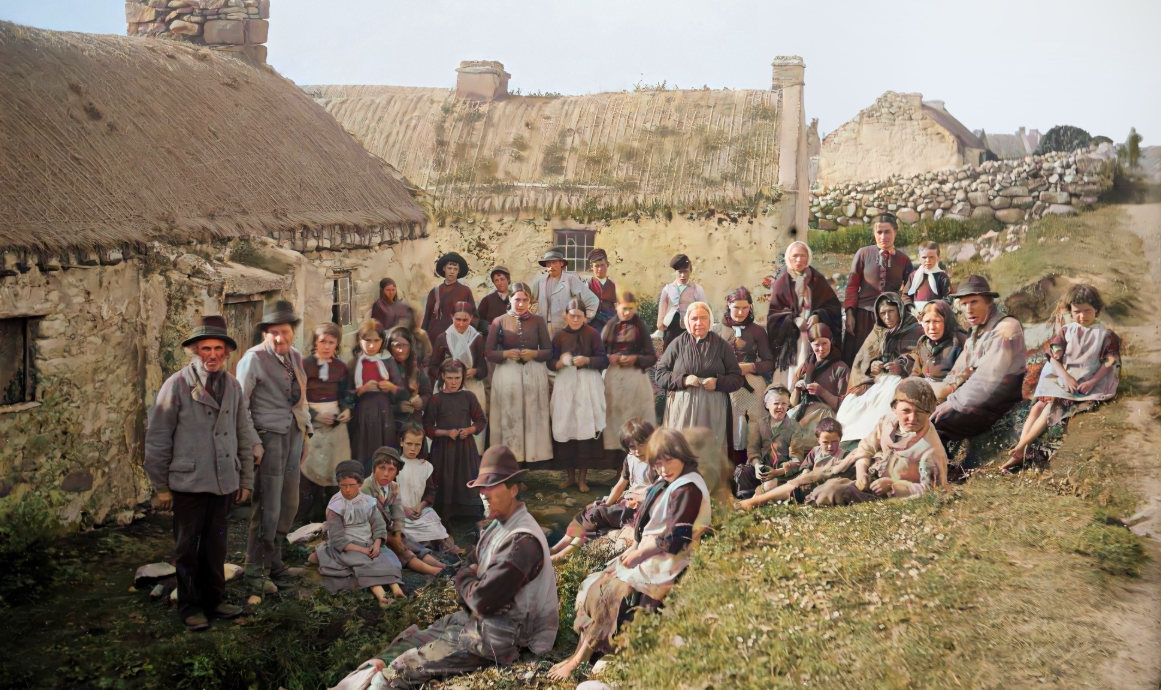
Forty years ago, my father returned from Dublin talking of having seen there a woman driving a bus.
“Imagine that,” he said. “Herself, at the wheel of a double-decker.”
My father grew up with women who did hard physical work. His mother milked six cows on the morning of the day he was born. At 45 years old and about to give birth to her sixth child, she sat on a low stool in a small shed squeezing milk from half-a-dozen beasts.
But a woman driving a double-decker – now there was a sight to behold.
What was it about her? Was it the size of the bus? Was it the posture required to steer it? Was it exposure to the public? Was it taking money from men as they boarded? Was it being charged with their safe passage in the metropolis?
We can only guess at the mysterious certainties of a way of life so established that everyone my father told about the woman in Dublin driving a bus shared his wonderment.
Certainties such as my father’s used to abound.
“From afar,” wrote Ivan Illich in 1982, “the native can tell whether women or men are at work, even if he cannot distinguish their figures. The time of year and day, the crop and the tools reveal to him who they are. … If he notices geese loose in the harvested field, he knows a girl must be nearby to tend them. If he comes across sheep, he knows he will find a boy. To belong means to know what befits our kind of woman, our kind of man. If someone does what we consider the other’s work, that person must be a stranger. Or a slave, deprived of all dignity.”
A change to guidance on the use of single-sex facilities is being widely reported this week in the UK media. The Equality Act of 2010 will from now on support the use of single-sex facilities only on grounds of biological sex and not on the basis of gender identity.
It’s a victory for the plain fact of sex over the disruptive proliferations of gender. Though the plain fact will have its quota of pomp and ceremony as 13,000 toilet facilities and at least as many changing rooms are refashioned across the land.
But the choice between sex and gender is a false choice.
Both sex and gender are artificial constructions aimed at the dissolution of fulsome ways of life, which are the only obstacle to technocracy.
Technocratic systems operate on uniform humans – undifferentiated humans. They do not care whether uniformity is produced by the elaborate genericism of gender or by the pared-back equivalence of sex.
The gender ideology would denigrate the designators ‘man’ and ‘woman’ as old-fashioned and restrictive. The sex ideology would cleave to the designators ‘man’ and ‘woman’ as referring to biological realities. What neither ideology admits are men and women, through whose regionally variable make-up all ways of life have been refracted.
Men and women have about them the hard reality that those who promote the sex ideology are looking for as a stay upon the fluidity-utopia of the gender ideology.
But the hard reality of men and women does not derive from abstract determinations of the biochemical sciences. It derives from every tool they use, every garment they wear, every gesture, every posture, every task, every morsel, every word – every detail that made them for and by their culture.
It is men and women who have been the subjects of human history – not males and females, whose essence lies between their legs.
The gender ideology and the sex ideology each reduces men and women to standardised beings – defined either by identities so unconvincing as to leave everyone equally poorly-drawn, or by biological characteristics so base-layer as to imply very little that is human.
Both ideologies level out the regional distinctiveness of men and women. From this levelling follows the all-consuming project of equality – equality between the genders or equality between the sexes.
The project of equality is inconceivable in a way of life because the subjects of ways of life – men and women – are in complement not competition. Between them, there can be no metric for determining equality in any sphere.
The project of equality is the mechanism for the exercise of technocratic control, which requires only that everyone is made equivalent, all the better for their endless administration by anonymous systems.
Men and women must be dismantled for technocracy to get going. This dismantling is achieved equally well by attributing to men and women an identity-soul to trump their native formation, or by defining men and women as scientifically-described body-parts that are the only essential thing about them.
As the gender and the sex camps fight it out between themselves, men and women die away and the only obstacle to technocracy dies with them.
It is called ‘Social Constructionism’ to argue that men and women are learned constellations of thoughts and actions, and not primarily biological. ‘Social Constructionism’ is held in contempt by those who promote the sex ideology.
But there is all the difference in the world between men and women constructed by a slowly evolved culture so that they are as steadfast as could be and not to be interfered with, and people constructed by wilful social engineering so that they fit into recently devised systems and can be interfered with without end.
When you are constructed by a way of life to be our kind of man or our kind of woman, you are more essentially who you are than ever you can be when you are constructed by government and corporate campaigns as either gendered or sexed.
And you are infinitely more resistant to control.
Biological males and females can do anything, we are told. It’s what is called ‘sexist’ to be told otherwise.
But if you can do anything, you can be made to do anything. Especially now, with advertising so sophisticated and ubiquitous.
The women in the way of life in which my father was raised could not do just anything. They could not drive a double-decker bus. They could not give up their babies to impersonal state care. They could not win a weekend away. They could not submit their old people to the neglect and abuse of strangers. They could not social distance from their neighbours. They could not cook an aubergine sprayed to be shiny. They could not give birth in hospital wards. They could not go to mass with their head uncovered. They could not wear a device to monitor their sleep. They could not apply to the government to teach their children at home.
What they could do was bake bread on an open fire. Put an invisible hem on a woollen coat. Cook sausages for all who came through the door. Sing ‘Shenandoah’ late at night. Give advice on whether to stay or go. Light a fire with damp turf and old nylons. Make a bed for a roadman by the stove. Milk six cows by hand. Remake a dress to be two sizes smaller. Work three years in America to pay off their dowry. Kill a chicken. Heal a break. Play ‘45’ ‘til sunset. Grow turnips. Tend a neighbour’s child.
As for the men:
What I couldn’t do. Eat a meal lacking potatoes. Trust banks. Wear a watch. Ask a woman to go for a walk. Work with drains or with objects smaller than a nail. Drive a motor car. Eat tomatoes. Remember the routes of buses. Wear a collar in comfort. Win at cards. Acknowledge the Queen. Abide loud voices. Perform the manners of greeting and leaving. Save money. Take pleasure in work carried out in a factory. Drink coffee. Look into a wound. Follow cricket. Understand the speech of a man from west Kerry. Wear shoes or boots made from rubber. Best P.J. in an argument. Speak with men wearing collars. Stay afloat in water. Understand their jokes. Face the dentist. Kill a Sunday. Stop remembering.
What I could do. I could mend nets. Thatch a roof. Build stairs. Make a basket from reeds. Splint the leg of a cow. Cut turf. Build a wall. Go three rounds with Joe in the ring Dad put up in the barn. I could dance sets. Read the sky. Make a barrel for mackerel. Mend roads. Make a boat. Stuff a saddle. Put a wheel on a cart. Strike a deal. Make a field. Work the swath turner, the float and the thresher. I could read the sea. Shoot straight. Make a shoe. Shear sheep. Remember poems. Set potatoes. Plough and harrow. Read the wind. Tend bees. Bind wyndes. Make a coffin. Take a drink. I could frighten you with stories. I knew the song to sing to a cow when milking. I could play 27 tunes on my accordion.
Timothy O’Grady, 1997
The men and women in the way of life my father was raised to were our kind of man, our kind of woman.
Not strangers to themselves and others.
Not slaves, deprived of all dignity.
This article is dedicated to the memory of David Cayley, who died in June of this year. Much of David’s lifework was given to disseminating the ideas of Ivan Illich, one of the most important and least popular of which was the vital importance of men and women, made for and by ways of life, for any hope of resistance to the advance of technocracy.
Dr Sinéad Murphy is an Associate Researcher in Philosophy at Newcastle University.


Discussion
Comments
This week across the site:
To join in with the discussion please make a donation to the Daily Sceptic.
Profanity and abuse will be removed and may lead to a permanent ban.
A thoughtful article. Thank you.
Is this gibberish the DS’s sly way of celebrating the resignation of Jason Arday? If not, what are we to make of a sentence like “Men and women have about them the hard reality that those who promote the sex ideology are looking for as a stay upon the fluidity-utopia of the gender ideology.”?
Well done for taking the trouble to quote this mangled syntax. I couldn’t be bothered.
“The men and women in the way of life my father was raised to were our kind of man, our kind of woman.”
In other words, they conformed to the behavioural conduct which was expected of them.
And if they transgressed …..? You ended up with the Magdalene Laundries.
I’m not so sure that isn’t a different form of slavery, deprived of all dignity.
Well done Dr Murphy, you have proved Orwell’s claim that there are some ideas so ridiculous that only intellectuals could believe them.
Sex is a biological reality, gender is a social construct. I found this out as a young child when my twin sister and I were given matching coats and I was puzzled by the fact that the buttons were on different sides. Simple, really.
Sex is not a construct, and to a very great extent gender, as in the expression of largely masculine or feminine traits, is determined by that sex. I’m not sure if this is what the writer is getting at (it seemed to be for a while but then the examples given strayed from that view), but it seems to me that while sex is an obvious reality, so is human behavioural choice.
When I was growing up in the ’80s and ’90s, we had quite a few people, both prominent and not, who chose to adopt aspects of the other sex’s traits or attempt androgyny. As far as I can remember, this behaviour was tolerated as long as it was harmless, and no one pretended either that these people were no longer the sex they were born as or that society was obliged to accommodate their chosen identity beyond granting them basic good manners. This strikes me as a better approach than either a purely gender-based or a purely sex-based policy.
Back in the 80’s I was well into the gothic punk scene. Make up, fishnets, long back combed hair etc, and that was the boys! Even in the village I lived in, nobody ever suggested that I was gay or a they/them type. At most, some of the adults just thought I was a bit weird. A good amount of my friends were actually jealous, because (a) I had the balls to walk down the high street dressed in this manner, and (b) I had parents that would let me.
Back in the 80’s it was simply called fashion, and as my dad used to say “he’ll grow out of it”. And strangely enough I did.
Both sex and gender are artificial constructions…
I’d still argue that I’ve enjoyed the former much more, over the years.
Yes. Hanky panky or grammar exercises – tricky that one.
I’ve possibly missed the point of this as I’m a bear of very little brain. But I have no idea what this “sex ideology” thing being talked about is, as some kind of binary alternative to “gender ideology”. Gender as applied to humans is obvious poppycock, sex is just a fact, a reality, not an ideology. The reality of differences between men and women has shaped, does shape and will shape how men and women act, are perceived, the choices they make – one can observe this, one can see connections between the biological differences and how life and roles turn out. But we are all individuals, and I’m not an idiot so I know that observing some general tendencies is not the same as believing that “men are like this” and “women are like that”. The gender lot are mad and sometimes evil, let’s just keep
telling them they are silly and then get on with our lives trying to make the best of them. I’m a man, and I am happy as such, but that is the end of it – I’m me. I have things in common with other men, some more than others, ditto women.
Perhaps… Read more »
I must also be a bear of little brain, because I had no idea of what she was banging on about.
It’s great to finally see another article by Dr Murphy, who was one of the very best contributors during the dark days of lockdown.
I don’t disagree, but if you’re responsible for a building where people spend time & you have 2 doors, behind each are to be found toilet cubicles, you still need to decide what sign to put on the 2 doors.
Some decisions have to be binary.
“But the hard reality of men and women does not derive from abstract determinations of the biochemical sciences” No. The hard reality is a pen1s (sorry) or a vag1na. The ability to impregnate or to carry and give birth to a child. With the associated secondary characteristics. All the rest is possibly interesting from a philosophical point of view, but mainly b0ll0cks, And her mother could/should have told her that, because she clearly knew after milking all of those cows.
Dr Murphy is obviously extremely learned. I have a question. If a white woman, a mother, reconstructed (disguised) herself as a black man (two factors), pronoun ‘he’, using makeup and a costume, would both aspects of that be considered cultural misappropriation by some members of our technocratic contemporary society or only one? If only one, which part would that be and what would be the reasoning for the objection?
I’m a biologist. Sentences like ‘Both sex and gender are artificial constructions’ make me want to hit my head against a brick wall. Is it any wonder that the Ardays of this world get away with it in the humanities?
#metoo
I understand where you’re coming from and I agree.
This whole gender-thing is just simply bollocks. Nonsense.
Something obviously crazy. Only people who think they are more intelligent than they actually are or insane can come up with the idea that there is something called “gender” which is a “social construct” and therefore people are free to choose one.
No, there isn’t.
If you are born a man, you are a man. You can’t do anything about it. You can chop off your testicles, put a dress on, whatever and you are still a man and anything else is just desperate, delusional and demented and we shouldn’t really treat it in any other way.
And that’s all there is to it.
That one got me, too.
From Men in Black –
“Gentlemen, congratulations. You’re everything we’ve come to expect from years of government training. “
Just change the words government training to western education.
I agree and I’m also a biologist. For the sake of everyone’s sanity I think it’s both timely and in the best interests for all of us if we do away with ‘man’, ‘woman’, ‘boy’ and ‘girl’ and resort to male or female, a biological principle that works for most living things.
As I’ve commented on another thread, the Royal College of Obstetricians and Gynaecologists apparently disagree: “ We recognise maternity and gynaecological services will be accessed by women, gender diverse individuals and people whose gender identity does not align with the sex they were assigned at birth.” Never mind that gender is determined at conception. Never mind that the root of the word gynaecology is derived from the Greek for “woman”. Never mind that they are talking utter rubbish. Will future generations look back on this time as one of lunacy, or will such lies be so entrenched that they will be considered to be normal?