


In 2018, the Met Office published its ‘UK Climate Projections’ report (UKCP18) forecasting several weather extremes including a suggestion that summer temperatures could be 5.1°C higher by 2070. Needless to say, the forecast captured mainstream media headlines at the time, and to this day the report is a foundational source for most UK governmental and private company climate change regulation and spending. Just one problem – it is now officially junk. The Met Office only ran a RCP8.5 set of assumptions through its super-computer, the results of which it then proceeded to highlight. To retain scientific integrity, the Met Office must remove this deeply flawed work with a notification that any policies arising from its discredited figures should be re-examined.
The recent dismissal of the RCP8.5 pathway assumptions by the UN’s Intergovernmental Panel on Climate Change (IPCC) as “implausible” has sent shock waves through mainstream media and science. It has effectively destroyed trust in mainstream climate reporting since journalists for nearly two decades have been faithfully promoting BS arising from RCP8.5 findings. But it also casts doubt on much of the underlying science work that has whipped up a convenient Net Zero climate crisis psychosis. Among the ridiculous RCP8.5 assumptions was global population hitting 12 billion by 2100 (it is currently forecast to stabilise at around 9-10 billion) and more coal used than current proven reserves.
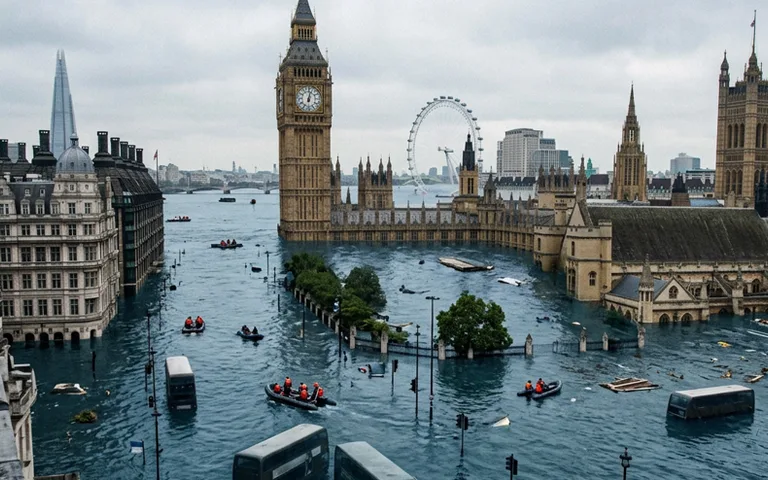
The Met Office’s UKCP18 is a real shocker. Bold type was used to highlight all the extreme findings based on RCP8.5 including massive rises in temperature within 50 years (5.1°C in summer and 3.8°C in winter) and significant drops and increases in summer and winter rainfall respectively. Sea-level rises in London up to 1.15 metres were forecast by 2100, and this compares with a current annual uplift of three thousandths of a metre today – less than a quarter of the rate. Given the recent “implausible” finding, it is ironic that the Met Office terms its bold-type numbers as “plausible”. That alone should be grounds to remove these hopeless guesses immediately.
There are a number of RCP pathways suggesting lower greenhouse gas emissions, but the Met Office used just RCP8.5 for its computer modelling. The high-resolution global modelling down to 60 km, the regional down to 12 km and local to 2.2 km used only RCP8.5 directly due to computational costs. Other results were available – not in bold type of course – and these were said to be statistically derived from the RCP8.5 runs. The phrase ‘garbage in, garbage out’ comes immediately to mind.
At the time, the Met Office noted: “The Government will make use of UKCP18 to inform its adaptation and mitigation planning and decision-making.” Of course, this is precisely what happened. Net Zero-crazed politicians leapt on the findings to pump new rules, requirements and regulations across both the productive (private) economy and the already inefficient public sector. In fact, it is not an exaggeration to say that since its publication, UKCP18 has become one of the most important climate tools shaping UK climate adaptation policy. It is often used by local government to assess risks on urban and rural infrastructure. It is of course wise to take future weather conditions into account, but exaggerated weather claims lead to higher than necessary expenditure. Money diverted to protecting new homes from 5°C higher temperatures is a colossal waste based on nothing more than a guess.
Infrastructure and engineering standards have been reshaped by UKCP18 findings. The Institution of Civil Engineers (ICE) has highlighted how the projections are changing the way civil engineers approach long-term infrastructure design. They increasingly factor projected rainfall extremes, heat stresses and sea-level rise into the design of roads, railways, drainage systems and buildings. ICE has described UKCP18 as using “cutting-edge climate science” and promoting “a new way of thinking” in civil engineering practice. If all this is true, one can barely imagine the money being wasted on over-engineered projects awaiting an imagined British climate that exists only on the computer drives of the Met Office.
Private sector insurers and financial institutions have also integrated UKCP18 into risk modelling. Insurance companies increasingly use climate projection data when assessing future exposure to flood damage and bad weather losses. This affects pricing, investment decisions and corporate climate disclosures. Next time an insurance company jacks up your premiums, do remember to thank the Met Office for its help in boosting insurance company profits. It is perhaps no accident that general, or non-life, insurance in the UK has recently become more profitable.
One of the clearest links between UKCP18 and government regulation is through the UK statutory Climate Change Risk Assessment (CCRA). Under the Climate Change Act, the Government must periodically assess climate risks and produce adaptation policies. The third CCRA, published in 2022, relied heavily on UKCP18 climate projections to evaluate future risks from heat, flooding, drought and sea-level requirements across infrastructure, housing and transport. The resulting National Adaptation Programme (NAP3) uses UKCP18 findings to justify stronger resilience measures for what is usually described as climate resilience. Again, one can only despair at the vast sums of public money likely to have been thrown at a computer-invented problem drummed up by activist Met Office wonks.
Not to put too fine a point on it, the Met Office is heavily screwed up by its attempts to promote the Net Zero fantasy. UKCP18 might be regarded as a foundational source of climate ‘evidence’ by influencers and governing elites, but the IPCC “implausible” ruling renders it largely junk. It must be withdrawn as soon as possible before it causes more financial damage in the wider economy. Junk, of course, is a word that also comes to mind when assessing the Met Office’s unnaturally heat-ravaged nationwide temperature measuring network. This is getting worse, not better, and the network is obviously overestimating the rate of current warming. Similar concerns surrounded the US weather service NOAA while Democrats held government sway. However, a recent Trump-inspired budget cut of 25% seems to have concentrated minds and persuaded employees to forget the Net Zero wind-up and return to basic meteorological science.
Chris Morrison is the Daily Sceptic’s Environment Editor. Follow him on X.



Discussion
Comments
This week across the site:
To join in with the discussion please make a donation to the Daily Sceptic.
Profanity and abuse will be removed and may lead to a permanent ban.
The MET office have flew too close to the narrative sun.
The good news of course is BBC Verify will be on to this like a shot to ensure humanity isn’t diverted down the wrong path – thank the Lord.
No one with half a brain can believe all the climate change nonsense that is put about.
It would appear that a very significant part of the population either doesn’t think at all or alternatively that this part does not even possess half a brain.
That’s quite troubling really, but waking people up is a complex problem, you can’t just but a few hundred volts across their earlobes without upsetting them somewhat.
“It is perhaps no accident that general, or non-life, insurance in the UK has recently become more profitable.”
I think you just nailed the core reason for all of this.
Religions do not deal in facts.
Congratulations on keeping people up to date with the preposterous record of the Met Office, like all the other Mets in the world, to give a straight feed on weather and climate information.
The root of the problem is the WMO, the World Meteorological Organization, which was one of the prime movers inside the UN environmental program to get the ball rolling on climate alarmism and the establishment of the IPCC.
Part of their plan was to be silent on wind droughts and Dunkelflautes because any warning of these events might have forestalled the attempt to transition to wind and solar power, which has cost trillions of dollars around the western world to no good effect.
https://rafechampion.substack.com/p/how-much-would-you-be-prepared-to
The problem with wind and solar, they ain’t there on windless nights and Dunkelflautes😊
https://rafechampion.substack.com/p/wind-and-solar-aint-capacity
For me the time I started to take an interest in “global warming”, as it was then known, was just before Climategate. (I was required to teach schoolchildren that Fossil Fuels Are Evil; I queried that.) What leapt out at me were the “adjustments” that NASA/GISS made to the raw temperatures measured by thermometers at weather stations. In those days, GISS kindly supplied both the raw data and the adjusted data as fed into the computer models. By subtracting the former from the latter one can trivially see what the adjustment (the “delta”) was for thousands of stations, and how it varied over timescale of a century. The outcome provided baffling reading. Typically, the adjustments “cooled the past and warmed the present”, creating an impression of warming. Some were more complex. For example, the recordings from the site of Dublin Airport show how a progressive modest *cooling* was introduced from 1880 to 1980, but then the adjustments abruptly changed sign and became a much greater warming, right up to the end of the record. If any bad actor wished to use Dublin Airport as an example of “rapid global warming” they might have been tempted to hide the graph before… Read more »
They have been at it for a long time. It’s called Noble Cause Corruption.
https://edmhdotme.wpcomstaging.com/climate-driven-noble-cause-corruption-goes-back-a-way/
Just one example
They have been at it for a long time. It’s called Noble Cause Corruption.
https://edmhdotme.wpcomstaging.com/climate-driven-noble-cause-corruption-goes-back-a-way/
Just one example Story tip
Yes, the past has become much colder during my lifetime.
Although I remember having to ride a butcher’s delivery bike was not much fun in the winter of 1963. Would probably class as child abuse nowadays.
The fundamental question is whether there is any science which demonstrates the likelihood of a causal link between co2 density and climate – given the political thrust this ‘science’ has created I’d expect the science to be freely available but, so far, I’ve failed to find any data at all.
If there was one paper that proved conclusively that CO2 controls our climate then we would all know its name. There isn’t – so we don’t.
To be fair, a rise of 5C by 2100 may be of considerable benefit to all those idiots who thought a heat pump as their primary source of heating was a really good idea!
Also, in what sane world would an insurer continue to provide policies to properties which would be under water if the sea level predictions were true, at any cost? IF its a dead cert, they will be paying out vast claims.
Nah. A heat pump will not last 74 years. Also, I’d expect some technical innovations will make present-day heat pumps obsolete well before 74 years are up.
Tell me where – I want to live there.
Even before the recent volte face the IPCC never said RPC8.5 was the most likely scenario, and I’ve known that for years from general reading.
It’s bad enough for researchers trying to boost their careers to use it in their alarmist predictions for peanut crops or floods, but for a government Meterological Office to do so in a policy guide bespeaks either crass inability to read the literature, or blind ideological bias.
The IPCC always provided a range of 4 scenarios, based on the admitted impossibility of predicting climate, and so any scientifically responsible body would do the same, not simply pick the worst case possibility as a prediction for politicians to believe.
But then, any Minister formulating policy has at least as much ability as you and me to look up “RCP8.5” for context. Surely even Oxford politics courses teach you how look stuff up.
No, no, no! That’s what you have advisers for.
And you are also taught to ignore advisers that are politically unacceptable to you, so the advisers’ advice is ignored if it isn’t biased in the direction you need it to be.
The remaining IPCC scenarios are unrealistic, if the Met Office produced a replacement for UKCP18 using the new worst case scenario it would simply be slightly less wrong. They’d still be all the problems highlighted in the article re money being wasted to make infrastructure resilient to climate scenarios that aren’t going to happen. The only difference is they’ll be slightly less over-engineering and slightly less money wasted.
The best assumption to make when designing infrastructure is to design it to be resilient to the climate and extreme weather that has happened over the last 50 years in the area it’s going to be built. Maybe if it’s really important and is projected to last 100 years look at extreme weather events in the past 100 years so it’s resilient to extreme weather events that are highly unlikely to happen but could do so.
Asking a so called “climate scientist” whether we are heading for extreme weather based on their models is a bit like asking a Catholic bishop should we go to church on Sunday. It’s their job to say this – no imminent climate catastrophe based on their models, no job, and they need to pay their mortgages and put food on the table. Seeing that in spite of dire predictions there hasn’t been’t been any significant change in the weather since I was a youngster 60 years ago, the safest prediction is not much will change in the future. Gut feel and intuition of old folk is far more accurate than computer models.
True. There’s a lot to be said for the decades of just staring out of your window at the back garden. Sometimes spring is earlier, sometimes a little later, but fundamentally it’s still looking like the spring (and summer, and autumn) I witnessed in the 60s. However, nobody wants to pay me for my scientific ‘modelling’.
I did read many years ago that, in the UK, if you stuck your head out of the window, looked at the weather and forecast the same for tomorrow – you’d be correct 80% of the time; this neatly matched the Met Office’s accuracy which was also about 80%.
I’m sure that with all their hugely expensive computing power and teams of social science graduates, the accuracy figure will be much improved these days.
Someone in Germany did an experiment a couple of years ago comparing German weather forecasting models with his own simple model that predicted that the weather on any given day would be the same as it was on the day the prediction was made. He compared the daily output of the two models for at least 6 months and found that when making a prediction for up to 7-10 days in advance, I can’t remember the exact details, the official model was better than the simple model, beyond 7-10 days in advance the simple model performed better.
It’s been quite a cool May. That ever ‘increasing heat’ burden from all that CO2 (4.2 molecules per 10,000 molecules of air) isn’t having the effect global warming cultists expect (want). It certainly doesn’t feel ‘existential’.
I guess they are all waiting for that Sqn of Typhoon jets to take off on a hot day near the thermometer for their 2026 story. Global boling Guterres has gone a bit quiet recently as well.
Guterres needs to be done away with along with all the rest of the UN’s works and itself.
Agree totally. Bill Bryson always pulled a clipping from a UK newspaper when asked what the weather is going to be, it said ‘Outlook: Dry and warm, but cooler with some rain later.’ He produced this the entire length of the UK and it was never wrong. Notes from a small island. Brilliant read.
As a generality models can be useful in representing complex systems. They are not evidence in and of themselves, which journalists and politicians seem to think.
Models based on inaccurate measurements are worse than a waste of time. The models themselves are unhelpful if they cannot explain a significant part of past facts which climate models have not been able to do.
Slightly Off-T.
Dutch Police are apparently warning demonstrators – against illegals being dumped in their communities – that if they are arrested their children will be taken from them. A short but depressing film.
https://disq.us/url?url=https%3A%2F%2Fx.com%2Fjohannesmkx%2Fstatus%2F2056463618095386631%3Fs%3D20%3Ae-e4zLYCDBfQamsyW3gC-mIVG8M&cuid=7594221
“civil engineers approach long-term infrastructure design [and] increasingly factor projected rainfall extremes, heat stresses and sea-level rise into the design of roads, railways, drainage systems and buildings.”
Not in any area of thne country I have visiuted. In my area and also in Cambridgeshire which I visit regularly, the street drains are often blocks, road cambers leave hollow areas where rainwater surprisingly gathers as it refuses to flow up hill to a drain. Houses and offices are built with large areas of flat roofs, car parks become l;arge puddles in summer and ice rinks in winter (we continue to have frosts).
What has been done is to demand ridiculous home insulation standards. When I was younger (and it was allegedly colder (ie less warm) than today) I lived in a house with no cavity, no central heating, no loft insulation, brick on earth and suspended wooden floors and single glazed windows. Now the building regulations demand 150mm cavities filled with insulation, double glazing, deep loft insulation, under floor insulation and more.
There has clearly been individual fault as well as institutional error in the actions of the Met Office over the past decades. They are incapable of operating a reliable… Read more »
Excellent piece, thank you.
Do all governments lie to their people? We need a few more Chris Morrisons to explain to us “idiots” the truth about salt in the diet, safe alcohol consumption, the cholesterol scam, BMI, and many more categories of BS.
I did read that the NOAA’s Carbon Dioxide measuring station is on Hawaii, you know, the volcanic island, probably because it is difficult to read the results from the device in the middle of the LA Raiders car park.