

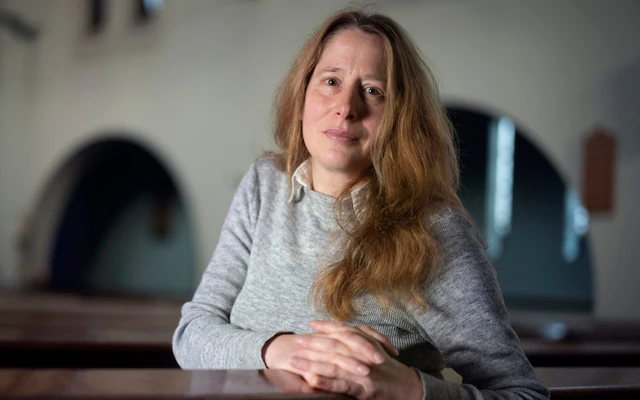
The prosecution of Isabel Vaughan-Spruce should trouble you whatever you think about abortion. A state which begins policing silent prayer has crossed a line no pluralistic democracy should approach.
Britain has reached a peculiar and rather sinister point in its political development when a middle-aged Catholic woman can stand silently on a public street, say nothing, obstruct nobody, threaten nobody and nevertheless find herself hauled before a criminal court because of what the authorities believe she may have been doing inside her own head. Isabel Vaughan-Spruce appeared before Birmingham Magistrates’ Court this week and pleaded not guilty to five charges arising from five occasions on which she is alleged to have breached the abortion ‘buffer zone’ around a clinic in Kings Norton. The prosecution alleges that, by standing within the zone and silently praying, she intended to influence, or was reckless as to whether she might influence, someone accessing abortion services. Her case is expected to go to trial in January.
The Public Order Act now creates a 150-metre zone around abortion facilities in England and Wales in which it is a criminal offence intentionally or recklessly to influence somebody’s decision to access abortion services, obstruct access or cause harassment, alarm or distress in connection with that decision. The Government’s own guidance accepts that prayer, including silent prayer, can fall within the legislation, and in September the Home Office confirmed again that whether silent prayer amounts to an offence can depend upon intention and circumstances.
There is something deeply absurd in constructing a criminal law whose enforcement can require police officers, prosecutors and ultimately magistrates to determine what a silent person standing on a pavement is thinking. We have somehow contrived to create an offence in which the absence of words does not necessarily save you, the absence of obstruction does not necessarily save you and the absence of any approach to another person does not necessarily save you. Your interior intention may become part of the prosecution case and once government enters this territory the practical questions become obvious. What happens to the elderly Catholic woman walking through a city centre with a rosary in her hand who has no idea that she has entered one of these zones? What happens to somebody who stops for a few minutes and says a decade of the Rosary while waiting for a bus? What happens to someone who crosses himself? What happens when a member of the public complains that the presence of a visibly Christian person is upsetting, intimidating or designed to “influence” them?
A subsequent acquittal does not make the encounter disappear. Being approached by police, questioned, searched, arrested, taken to a station, interviewed under caution, charged and required to obtain legal representation is itself a serious intrusion by the state, yet we seem increasingly casual about this distinction. “Let the courts decide” is scant comfort when a person has already been subjected to the machinery of criminal investigation for conduct which would have been regarded within living memory as entirely unremarkable.
Scotland has gone further. (Of course it has!). Its zones extend 200 metres around abortion providers, and the legislation can reach conduct taking place on private property where it can be seen or heard from the public zone. Scottish Government guidance explicitly says that an offence can potentially arise from conduct in a private residence if it is visible or audible outside and has the required intention or effect. In the Rose Docherty case this year, Sheriff Stuart Reid noted while analysing the legislation that even silently praying at a window could potentially fall within section 5 where the statutory conditions were met. That does not mean the Scottish Government has literally outlawed somebody kneeling unseen beside their bed and praying privately inside their own mind, and claims to that effect go too far, but the reality is disturbing enough without embellishment: Parliament has created a law under which what you do at the window of your own home can enter the criminal jurisdiction because somebody passing through a government-designated zone might see you.
How did anyone involved in drafting this think that sounded remotely normal? There is a perfectly legitimate case for protecting women entering clinics from obstruction, threats, intimidation, abuse or aggressive confrontation. We already possess laws against threatening behaviour, harassment, obstruction, assault and public disorder, and few reasonable people would object to their use. If somebody blocks a doorway, screams abuse at a frightened young woman or pursues her down a street, deal with them. The disturbing development is the expansion of the state’s concern from conduct of that kind into peaceful presence, consensual conversation and prayer.
This sits within a wider and increasingly uncomfortable pattern in Britain. Christians preaching Christian teaching in public have repeatedly found themselves on the wrong side of police intervention, often unlawfully. I recently covered this and highlighted the many many cases where street preachers have been unlawfully harassed and wrongfully arrested by the police who seem intent on their role as paramilitary social workers. In Scotland, former Baptist pastor Angus Cameron received compensation after Police Scotland wrongfully arrested and handcuffed him while preaching in Glasgow; internal material subsequently disclosed in his case showed there had been no basis for suspecting that he had committed an offence. Isabel Vaughan-Spruce herself had previously been cleared after earlier proceedings and later received a police settlement following another arrest connected with silent prayer.
I use the word persecution with care. Britain is plainly not Elizabethan England, revolutionary France, the Soviet Union or modern North Korea. Priests are not being dragged from presbyteries in the middle of the night, churches remain open and millions worship freely, but persecution does not spring fully formed from the ground. A culture develops first: an assumption among parts of the administrative state that Christian beliefs are somehow troublesome, potentially harmful, vaguely extremist or incompatible with the approved moral consensus of the age. Police officers begin approaching peaceful street preachers as though the Gospel itself requires official supervision, public prayer becomes something requiring a legal opinion, a rosary becomes potentially evidential, and the ancient moral teaching of the religion which formed these islands for well over a millennium is increasingly treated as though it were an exotic and faintly disreputable ideology newly imported into the country.
We are even told endlessly about “British values”, while institutions created within a civilisation profoundly shaped by Christianity increasingly behave as though Christianity itself sits somewhere beyond their boundaries. There is an extraordinary historical illiteracy in this. Christianity did not arrive in Britain after the Equality Act. The Gospel was being preached here long before the Kingdoms of England and Scotland even existed and while much of what we now recognise as Europe was still taking shape, and our ideas about conscience, the dignity of the individual, charity, sanctuary, the moral restraint of power and the obligations owed by the strong to the weak were developed within that civilisation. One may reject Christianity entirely and still recognise the absurdity of public bodies behaving as though Christian belief constitutes an awkward exception to an otherwise religiously neutral national tradition.
The rest of the free world looks on aghast. These laws have already achieved precisely the international attention their architects presumably never imagined. In 2025 the US State Department’s Bureau of Democracy, Human Rights and Labor publicly announced that it was monitoring the prosecution of Livia Tossici-Bolt over an abortion buffer-zone case and expressed concern about freedom of expression in the United Kingdom. Later that year the State Department described British buffer-zone enforcement as an “egregious violation” of freedom of speech and religious liberty, while the issue was also raised publicly by Vice-President J.D. Vance. Britain, the country whose political tradition gave the English-speaking world so much of its language of liberty, conscience and restraint of government, now finds itself being publicly lectured by an allied democracy because British citizens are being prosecuted over silent prayer. There is an almost comic lack of self-awareness here, were the consequences not so serious.
My own position on abortion will surprise nobody who has read me for long. It is the position of the Catholic Church. I believe human life possesses inherent dignity from conception until natural death, and that an unborn child does not acquire or lose that dignity according to whether he or she is wanted. The scale of abortion therefore horrifies me. The latest official figures for England and Wales recorded 277,970 abortions among residents in 2023, the highest annual number since the Abortion Act came into force. The Office for National Statistics calculated that 32.1% of recorded conceptions ended in abortion, also the highest proportion on record, while 42% of those undergoing an abortion reported having had at least one previous abortion. Those figures make it difficult to maintain the comforting fiction that abortion occupies some tiny and exceptional corner of modern life. It has become deeply embedded within our sexual and contraceptive culture.
There has also been considerable discussion in the United States about the demographic effect upon Generation Z. One widely circulated pro-life analysis, using abortion estimates derived from sources including the Guttmacher Institute, placed the proportion of potential American Generation Z births lost through abortion at roughly 28% – approaching three in 10. Nearly a third of Gen Z in the USA. Now these figures are from an advocacy group, but the point still stands: did those who originally legalised abortion envisage such numbers? From a Catholic understanding of human life, these are not abstract demographic units. They were human lives ended in the womb.
But you do not have to agree with me about any of that to be alarmed by this prosecution. You can believe abortion should remain legal, believe the Catholic Church is completely wrong, believe Isabel Vaughan-Spruce is mistaken in everything she believes about abortion and find public pro-life activism irritating, unwelcome or offensive. Pluralism only means anything when it protects people whose views we dislike. There is no great achievement in allowing people to express opinions already endorsed by government departments, universities, broadcasters and fashionable opinion. The test comes when somebody peacefully holds a conviction the governing culture finds objectionable.
The answer of a liberal democracy should be simple enough: provided you do not threaten, obstruct or harass another person, you are free to believe it, speak it, pray about it and peacefully attempt to persuade others of it. That principle protects the atheist outside a cathedral, the socialist outside a bank, the environmentalist outside an oil company, the Muslim preacher, the trade unionist, the feminist, the republican, the eccentric, the heretic and the Catholic holding a rosary. Once the state begins carving ideological holes into that protection, everybody should become nervous.
What we are watching is part of a much broader slide in Britain over the past 20 years towards a peculiar form of liberal authoritarianism: government and public institutions remain committed rhetorically to tolerance, diversity and individual freedom, while simultaneously developing an ever-growing apparatus for regulating expression, belief, association and dissent whenever they conflict with the prevailing moral consensus. Its practitioners rarely recognise themselves as authoritarian because they believe their objectives are benevolent. They are protecting people. They are preventing harm. They are making spaces safe. Each individual restriction therefore appears modest and reasonable when considered alone – and then one morning a woman is standing before a British magistrate facing criminal charges arising from the allegation that she stood silently on a pavement and prayed.
At some point we have to look at the destination as well as every supposedly reasonable step along the road. A law which requires the state to concern itself with silent prayer has no place in a pluralistic democracy. Whatever your views on abortion, this is grotesque overreach – another stage in a drift towards a liberal authoritarian state which increasingly confuses dissent with harm and traditional Christian belief with something requiring official supervision.
And it is not British.
C.J. Strachan is the pseudonym of a concerned Scot who worked for 30 years as a Human Resources executive in some of the UK’s leading organisations. Subscribe to his Substack page.

Discussion
Comments
This week across the site:
To join in with the discussion please make a donation to the Daily Sceptic.
Profanity and abuse will be removed and may lead to a permanent ban.