

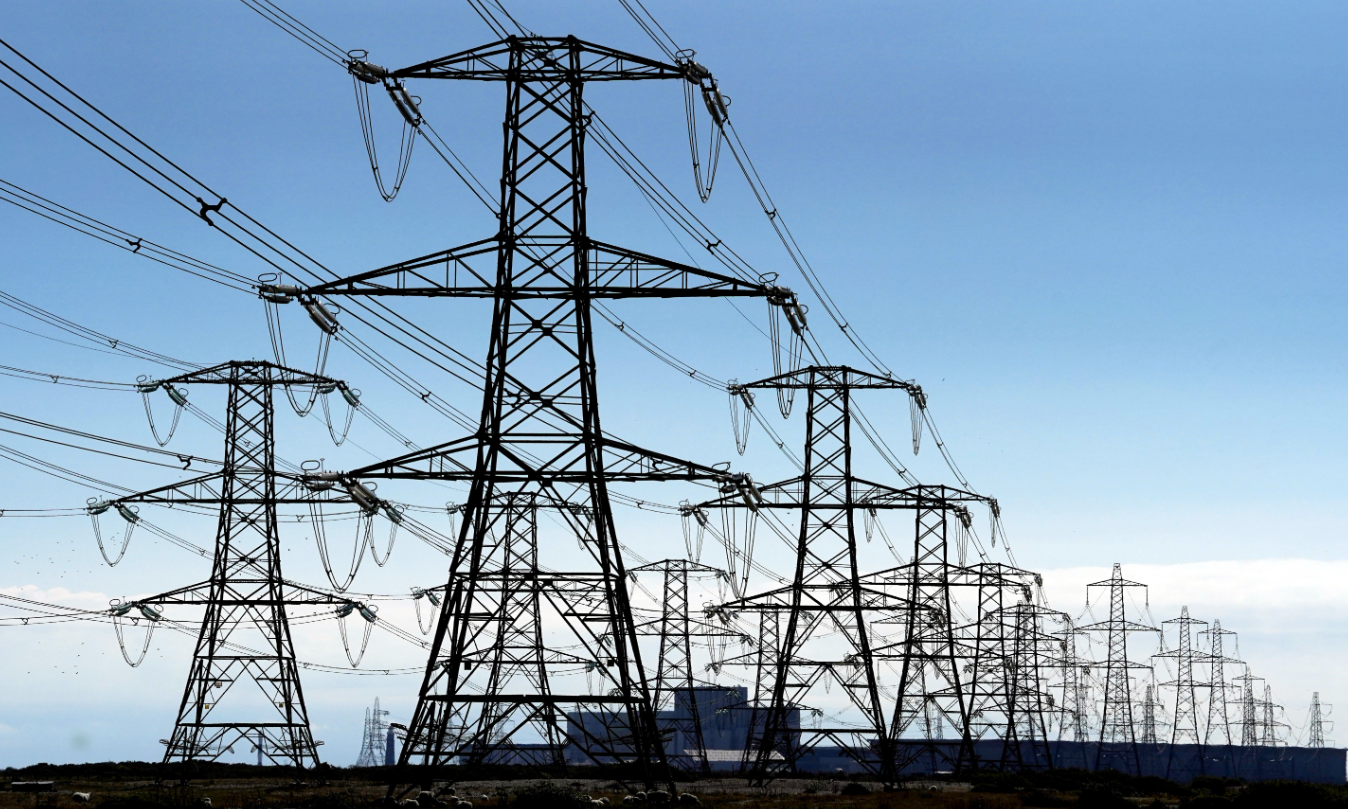
This week the Scotsman published a piece of mine asking whether Britain’s power grid would pass the safety test every North Sea oil platform must pass before it can operate. This is the background to that article: how a grid works, how it fails and why an engineer from a safety-critical industry is uneasy about ours.
A machine the size of a country
A grid must make exactly as much electricity as it uses, every instant, because wires store almost nothing. Engineers watch two dials to see whether it is healthy.
The first is frequency: the beat of the alternating current, 50 times a second in Britain. It is the same everywhere on the connected grid. That shared beat is what defines a grid: not everything wired together, but everything running in step. Produce less than customers use and the whole grid slows; produce more and it speeds up.
The second is voltage, which works like pressure in a water pipe. It differs from place to place, and only equipment nearby can correct it.
Both dials must stay inside tight limits to protect the machinery. Power-station turbines are built to spin at one speed, and running at a different speed wears them out. Too much voltage breaks down the insulation in cables and equipment, and too little makes motors overheat. Outside the limits, machines disconnect to save themselves, usually just when the grid needs them most.
Three jobs that came free
For a century, the big spinning generators in coal, gas, nuclear and hydro stations have held both dials. Besides making energy, each does three other jobs, bundled into the price.
Its heavy spinning mass works as a flywheel: when another station trips, it resists the slowdown and buys seconds for backup to arrive. Engineers call this inertia.
When lightning or a fallen tree causes a short circuit, a spinning generator pours out a surge of current several times its normal rating, straight from physics. That surge is the alarm that tells the grid’s automatic switches which damaged line to cut out.
And its controls push local voltage up or down to keep it in its band.
Wind, solar, batteries and the cables to Europe connect instead through power electronics called inverters. Most in service today add no inertia. Their electronics cap their fault current close to normal output, because more would burn them out. And they help hold voltage only if designed and instructed to. Swap a gas station for a solar farm of the same rating and the alarm falls to a fraction, and the switches may struggle to tell which line to cut out before the fault spreads.
How grids fail
Grids are run to a rule engineers call N-1, said ‘N minus one’: the grid must be able to lose any single power station or line without anyone losing power. Britain appears to have broken it on June 23rd, in a heatwave. And even when the rule holds, trouble comes when several things fail together.
Each machine that disconnects hands its load to whatever is left. If the survivors are near their limits, they trip too. The inquiry into North America’s 2003 blackout put it bluntly: a cascade “cannot be stopped by human intervention once started”.
The last defence is to cut off blocks of customers automatically, sacrificing some to save the rest. On August 9th 2019 in Britain, lightning struck a line, and an offshore wind farm and a gas station dropped out. About a million customers lost power, and all were back within 45 minutes. The grid held. That was a controlled cut, not a blackout.
Spain on April 28th 2025 was a blackout. It was a quiet, sunny day with low demand, and lightly loaded lines push voltage up. Too few conventional plants were running to pull it down, and some of those failed to. As voltage rose, generators tripped one after another, each trip pushing it higher. Cutting customers made it worse, because less load meant higher voltage still. About 27 seconds after the first big trip, Spain and Portugal were dark.
Why Net Zero makes this harder
Net Zero closes the machines that did all three jobs and replaces them with machines that do few or none. Every function that came with a coal, gas or nuclear station must now be bought back, or done without.
Britain is doing both. NESO, which runs the grid, now pays for stability as a standalone function: mostly spinning machines that burn no fuel and sell no energy, there to provide weight and fault current. Two of its stability tenders cost £328 million and £323 million. That cost reaches your bill as a balancing charge, and part of the “Balancing costs” line on our Subsidy Clock. Meanwhile, the minimum spinning weight it keeps on the system has been cut by 15%, approved by the regulator, Ofgem, in May. The review behind that cut is charged with weighing the cost of a safety margin against the risk of losing it. This year, the margin lost.
The danger has also moved. A cold, still week in winter is a shortage you can see coming, and the answer is planned rota cuts: unpleasant, but controlled. The blackout risk now gathers on light, sunny days, when demand is low and few spinning plants are running. Those were Spain’s conditions. British demand fell to 12.8 gigawatts last year, against a winter peak of about 46.
A mild day sounds a safe one to lose power. It is not, because a blackout stops everything that runs on electricity at once: phones and the internet, home-based medical equipment, water pumping and sewage, petrol pumps, card payments and cash machines, and with them the shops. The Government’s worst-case plan has everyone reconnected only after five or six days. But that’s a guess: Britain has never had a total blackout, so it has never had to restart the whole grid for real.
And that last defence – rota cuts – is weakening. It works by cutting off whole neighbourhoods to reduce demand. But at midday on a sunny day, many of those homes are also making power from rooftop solar panels, so each cut removes supply as well as demand and does less good. With less spinning weight on the grid, frequency also falls faster, leaving less time for the cuts to work. NESO’s own research says the scheme was not designed for either problem, and that this “reduces the effectiveness”.
The other side
Defenders of the detransition say all this is solvable. Fuel-less spinning machines and newer inverters that imitate a flywheel can do much of the work, and NESO is already buying them.
But solvable is not solved, and it is not free. None of these costs appears in the wholesale price quoted to show that renewables are cheap. They are bought piecemeal, after the plant that once provided the functions rolled in has closed, while margins are trimmed to keep the bill down.
Nor has it been done before. No large grid anywhere has yet run mostly on wind, solar and batteries with so little spinning plant behind it. NESO’s Chief Executive calls its stability programme “world-first“, and means it as praise. Britain is running a colossal experiment on a system that cannot be allowed to fail.
None of this means the lights are about to go out. It means the grid’s safety is shifting from physics, which came free, to contracts, settings, judgement and experiments which do not. Spain went from trouble to darkness in 27 seconds. The judgement that mattered had been made months before.
Richard Lyon is a former senior oil and gas operations manager with 35 years of international experience, and academic qualifications in electrical engineering and power systems, petroleum engineering and energy economics. His book The Energy Trap: Why the Renewable Energy Transition Can’t Work — And What Can is published by Swift Press. Subscribe to his Substack page, the State of Britain, where this article first appeared.



Discussion
Comments
This week across the site:
To join in with the discussion please make a donation to the Daily Sceptic.
Profanity and abuse will be removed and may lead to a permanent ban.
Does any reader or the author know if domestic gas supply would continue during an electrical power cut or the early part of it. I ask because I am considering purchase of a generator and I could install wiring to restart my boiler and heating system.
Also can anyone comment on the reliability of domestic scale UPS devices.
It’s basic physics and I don’t understand why the politians are sticking their heads in the sand.
1. Because they are remarkably stupid. and
2 Everyone thinks that it’s someone elses responsibility.
Money. Money Laundering.
Climate Con.
Climate Racket.
Climate Mafia.
When you want to find the science fiction – locate the cash.
A national grid failure is not a ‘blackout’ it’s a catastrophe. UN Agendas will cost lives.
Terrific piece. As someone who, with young family, experienced the multi-day summer blackout in 2003 in North America … not someone anyone should have to experience in this day and age.