

Geological records show that warming and cooling periods go through extended cycles with no clear pattern to the intensity, severity and timing of the cycles. Natural disasters have always been with us and climate change is another constant. The relationship between climate and natural disasters is anything but clear. An IPCC assessment found only weak links between human-induced climate change and droughts, wildfires, floods and hurricanes.
Notwithstanding this, legacy media just cannot seem to help themselves when it comes to shoehorning climate alarmism into current events. On July 23rd, writing about the worst dengue fever outbreak in a decade in Sri Lanka, a BBC report commented that “as temperatures rise worldwide, these disease-carrying mosquitos are now moving into new areas, including Europe and the Mediterranean”. They cited a WHO report that the number of cases had surged globally from around 500,000 in 2000 to 14.4 million in 2024.
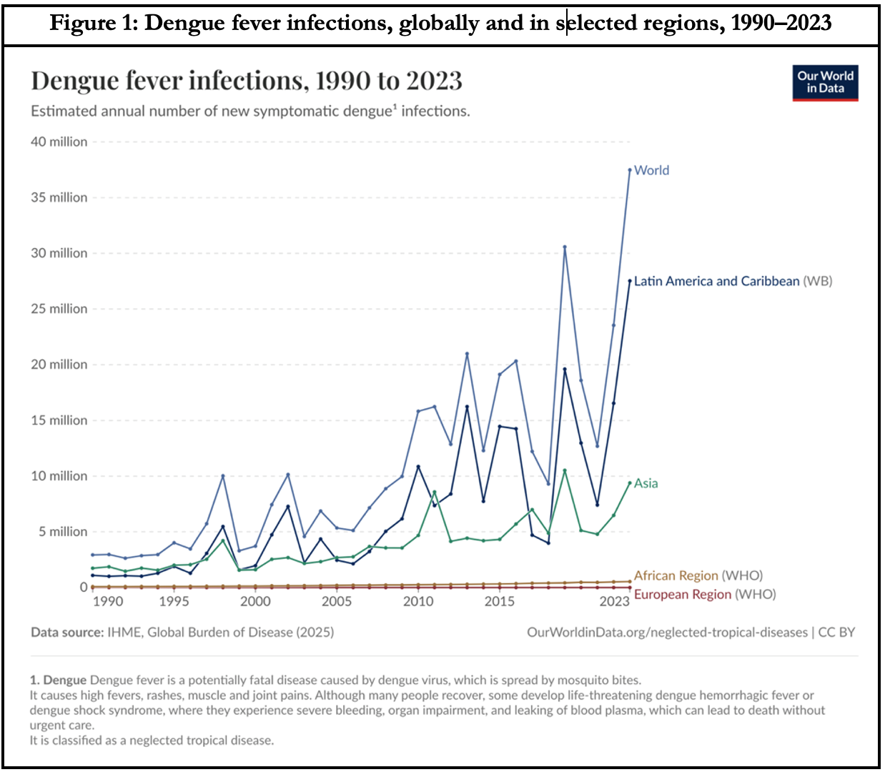
The global number of dengue fever infections (not cases) fell from 10 million in 1998 to 3.7 million in 2000 and stood at 37.5 million in 2023. But the slope of the global rise almost precisely parallels the rise in Latin America and the Caribbean, from two million in 2000 to 27.5 million in 2023 (Figure 1). The Asian situation is nowhere near as dramatic. Unless the BBC is prepared to inform us ignorant folks just why the temperature rise is global but the fast-spreading dengue infections are restricted mainly to this one region, BBC Verify should call it out on this. But don’t hold your breath. Climate change is the narrative that must not be challenged.
Consider another example. On November 2nd 2025, BBC News published an article with the headline: ‘Devastation on repeat: How climate change is worsening Pakistan’s deadly floods.’ Having grown up in a part of India subject to annual flooding as the overflowing rivers descend into the plains from the Himalayan ranges, I am inured to local news reports that every year faithfully described the floods as ‘unprecedented’. I thus read the BBC report with particular interest. Alas, it brought back irritable memories of the old media reports. There were graphic before-and-after images to show the damage but no charts to map their long-term frequency, intensity and variability.
True to form, like all reporting of natural disaster events by climate zealots, there was no contextualisation of the history of cycles of droughts and floods, no acknowledgment of the inconvenient facts that these were not the worst floods in the region’s history and that they can affect crop yields for both better and worse, nor any investigation of the possibility that the death tolls from flooding might be due to rising population pressures and the resulting increase in human settlements in flood plains. It is as if before industrialisation, climate had been absolutely invariable.
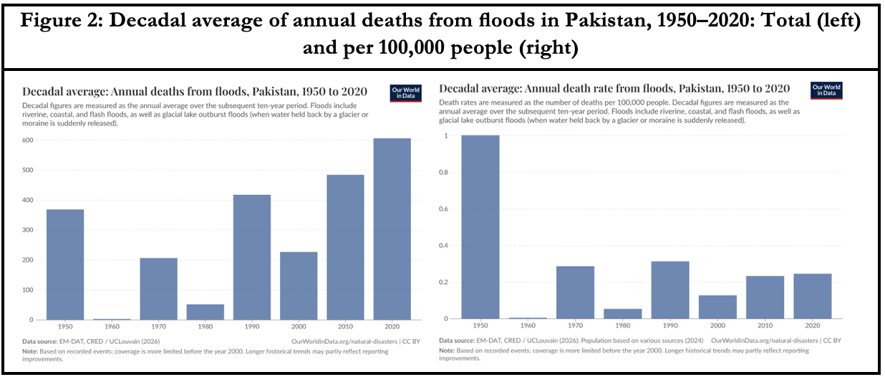
Once again, I consulted the trusty Our World in Data site. On raw numbers, there has been a steady jump in Pakistan’s flood-related deaths since the 1950s. But the picture is reversed when we chart the number of deaths as a share of the total population (Figure 2). To me this suggests that building resilient disaster prevention and management infrastructure – to be paid for through economic growth, for which fossil fuel energy consumption remains a prerequisite – might be rather more helpful in enabling the people of Pakistan to cope with flood risks than obsessing over an alleged climate crisis.
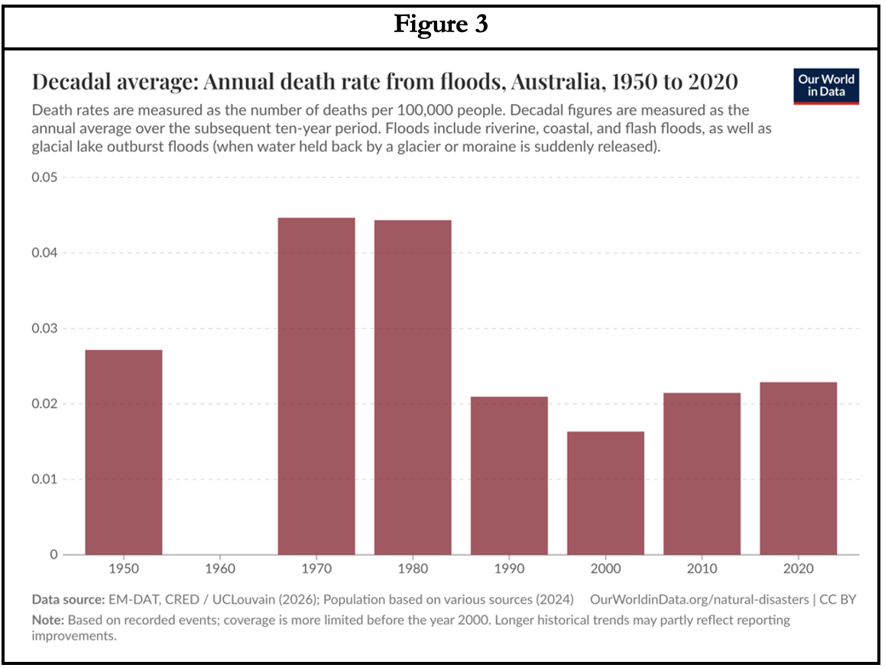
As it happens, I live in the flood-prone Northern Rivers region of New South Wales and the topic is of more than academic interest. In Australia too, every flooding produces breathless media coverage with fresh warnings and wake-up calls on the climate emergency. All sense of perspective is abandoned. Yet, compared to the country’s total population, proportionately fewer people have died from floods in the last four decades since the 1980s than in the preceding four decades (Figure 3).
The debate over whether or how much wildfire emergencies are caused by climate change is also a good example of the inherent scientific uncertainty involving future modelling-based projected impacts versus present weather-related events, global versus national action to decelerate climate change, and the many different variables determining the start, severity and duration of bushfires and the harms they cause.
Bushfires are common across Australia every summer. This too produces many dire warnings of the dangers of the all-too visible evidence of the climate emergency that poses an existential threat. Currently the same argument is made in relation to the spate of wildfires across Europe and North America.
An article by Tom Hultquist on the website of the US National Oceanic and Atmospheric Administration notes that from October 8th-10th 1871, “wildfires claimed thousands of lives and consumed three million acres across the Upper Midwest” (Chicago, Michigan, Wisconsin). Fires in and around Peshtigo, Wisconsin alone claimed between 1,200 to 2,400 lives and up to 1.5 million acres. Just as a reminder, this was essentially in the pre-industrial age.
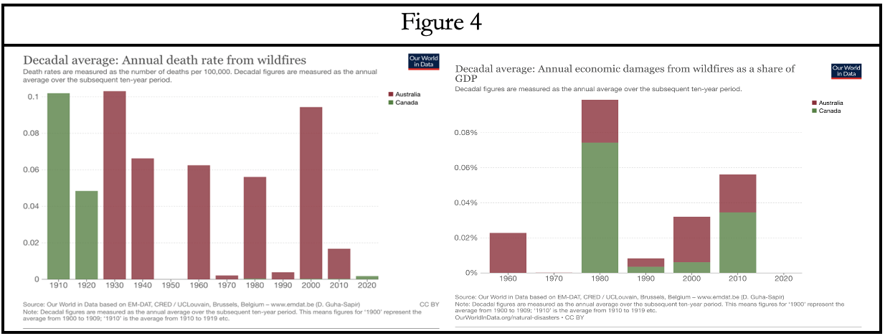
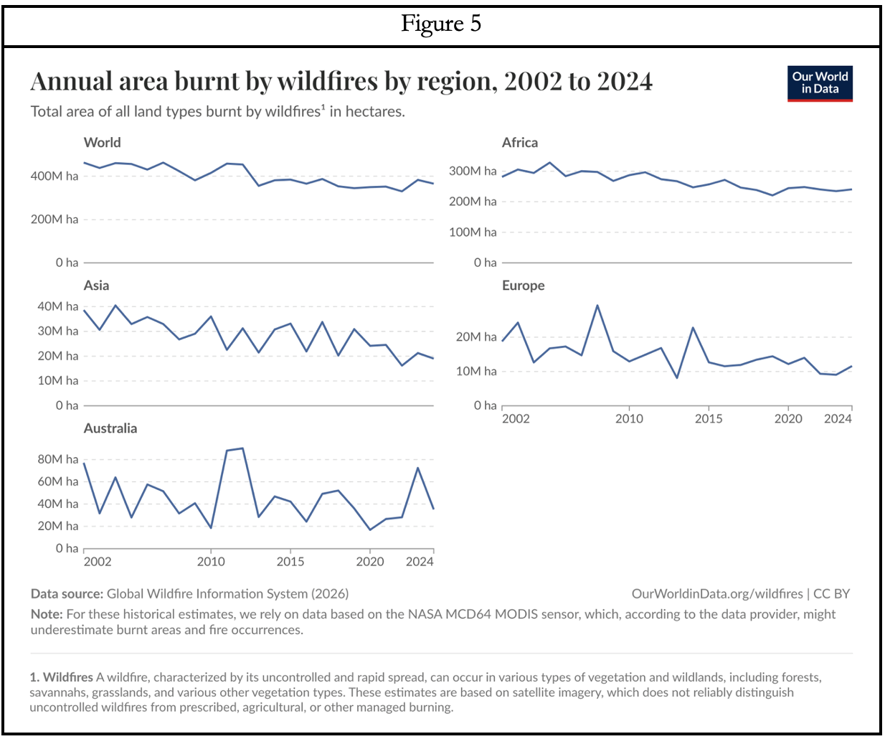
Canada is often the culprit in North America’s wildfires. The trendline on wildfires since the 19th century for both Australia and Canada is more reassuring than alarming on the decadal average of annual death rates and economic damage (Figure 4), as well as on the area burnt by wildfires in this century thus far (Figure 5).
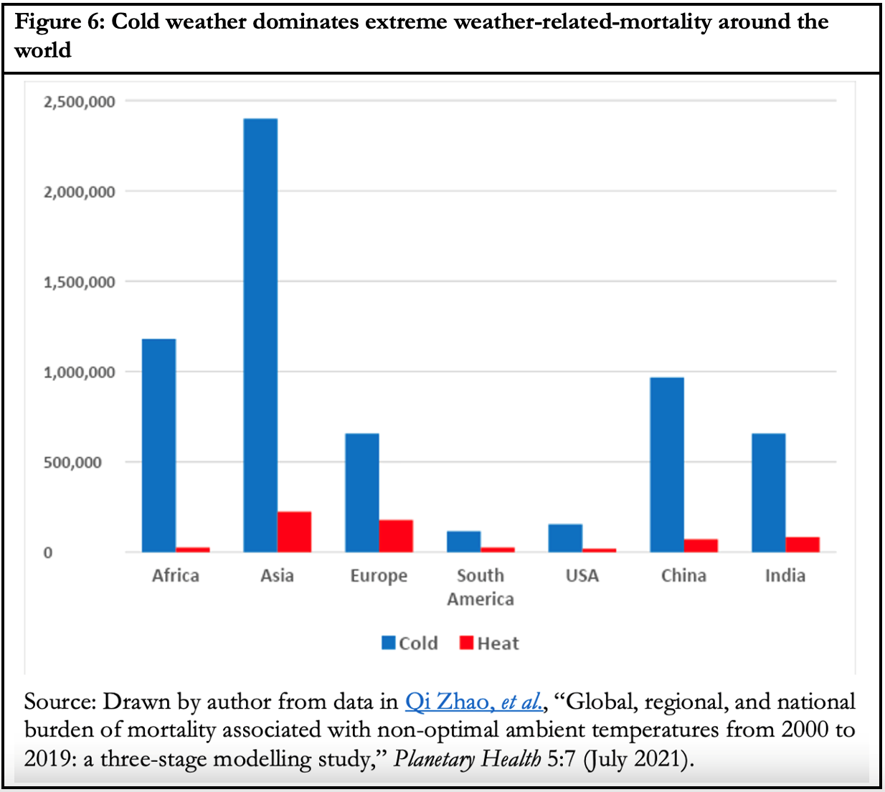
Furthermore, climate alarmists refuse to acknowledge the rise in global food security thanks to the increased greening of the Earth from higher CO2 levels and the reduction in global mortality with increased state capacity to mitigate peoples’ vulnerability to diseases and natural disasters through fossil fuel-driven economic development. Focusing only on the life-threatening risks of higher temperatures, they also ignore the substantially greater reduction of extreme-weather-related mortality from very cold temperatures (Figure 6).
As national policy, Net Zero is environmentally irrelevant at the global level, physically impossible to achieve, economically ruinous and politically performative: an unserious approach to governance that undermines sensible policy discussion. But it does allow politicians to shift the blame from their own failures to institute precautionary measures against the certainty and ravages of natural disasters to the all-encompassing ‘climate emergency’ and to mock and demonise critics.
Ramesh Thakur is Emeritus Professor in the Crawford School of Public Policy, Australian National University, and a former United Nations assistant secretary-general.



Discussion
Comments
This week across the site:
To join in with the discussion please make a donation to the Daily Sceptic.
Profanity and abuse will be removed and may lead to a permanent ban.
These posts give a graphical comparison on the performance and costs of Power Generation technologies.
https://edmhdotme.wpcomstaging.com/comparing-power-generation-technologies/
https://edmhdotme.wpcomstaging.com/the-costs-of-weather-dependent-renewables-against-conventional-power-generation/
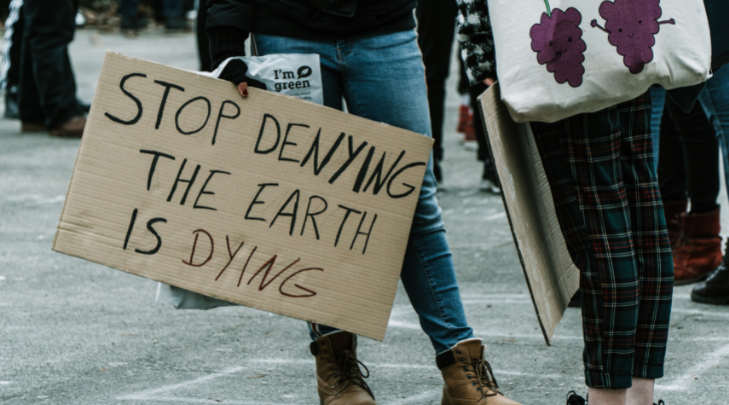
“The Earth is Dying”—–That is a pretty strong statement. So the main organisation supposedly dealing with Climate Change is the IPCC. So let’s see what they recently said—“Worst case scenario’s from our climate models are very unlikely to occur”.
So it seems they think the Earth is “very unlikely to be dying”
Pakistan is a mountainous country. In 1947 it was something like 40% forested. Now it’s 5%. Hence the floods.
The alarm bells started ringing for me when I read on the graph that the numbers of infections shown were estimates.
No doubt part of the reason for the rise in dengue fever is eco-nutters persuading governments not to use DDT or other insecticides to help control mosquito numbers. Just one more example of well off Westerners harming poor people in the name of “saving the planet”.
The sharp increase after 2021, it’s a shame there’s no data for 2024-5, could well be due to WHO focusing far too much on Covid then “the next global pandemic/disease X” and massively cutting funding for health schemes that actually help save lives.
The Earth is a big rock – rocks cannot die.