

His performance as a senior politician aside, I’ve no personal dislike of Rishi Sunak, a decent, bright man. In 2025 he told Nick Robinson: “I mean, of course I’m English. Born here, brought up here, yeah, of course I’m English”. I think he and I could reasonably discuss that.
His claim is imprecise. He can say he’s English by birth and address, a relatively novel civic concept. He can say he’s acquired English culture, but the “tea and cricket” version he cites is simply a veneer, and one that is not universally adopted anyway. He can’t say he’s ethnically English and equivalent to those that are.
I believe that to insist that civic/cultural layers of “English” are the whole of it, and to suppress discussion of an ethnic layer, is not only wrong, but self-defeating. It swipes aside the English culture it lays claim to, and creates the resentment it seeks to avoid. I conclude with a better, and recognisably English, proposal.
First, the argument itself
The axiom of an “inclusive” telling is that “English” – civic, cultural – can’t exclude. Englishness is a wet dog on the sofa, a cup of tea, where you live or were born. It’s just a “club” or “status”, according to a “woman of colour” writing in the Independent who wants a “grown-up conversation about race”. Not her race, of course, only mine.
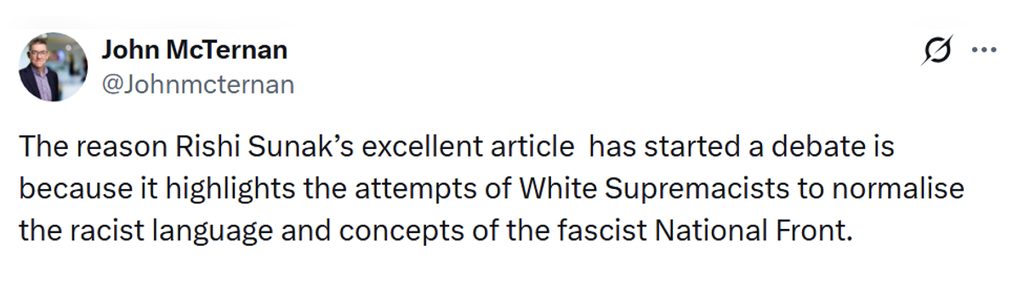
She criticises the “exclusive” definition she ascribes to Konstantin Kisin and Suella Braverman: “For Englishness to mean something substantial, it must be rooted in ancestry, heritage, and, yes, ethnicity – not just residence or fluency.” Kisin and Braverman insist they are not, and cannot be, English. John McTernan calls them fascists (Braverman, a White Supremacist?):
In 2021, 77% of white English people agreed that: “Being English is open to people of different ethnic backgrounds who identify as English.” So there is clearly a modern usage of “English” – inclusive, acquired rather than inherited. But ‘open to’ is not the same proposition as ‘identical’. It does not follow that every relationship to Englishness is equally deep, nor does it obviously apply to one generation of Indians that married each other.
Here, the word English or Englisc has ethnic origin “of the Angles”; and here’s Wikipedia’s version:
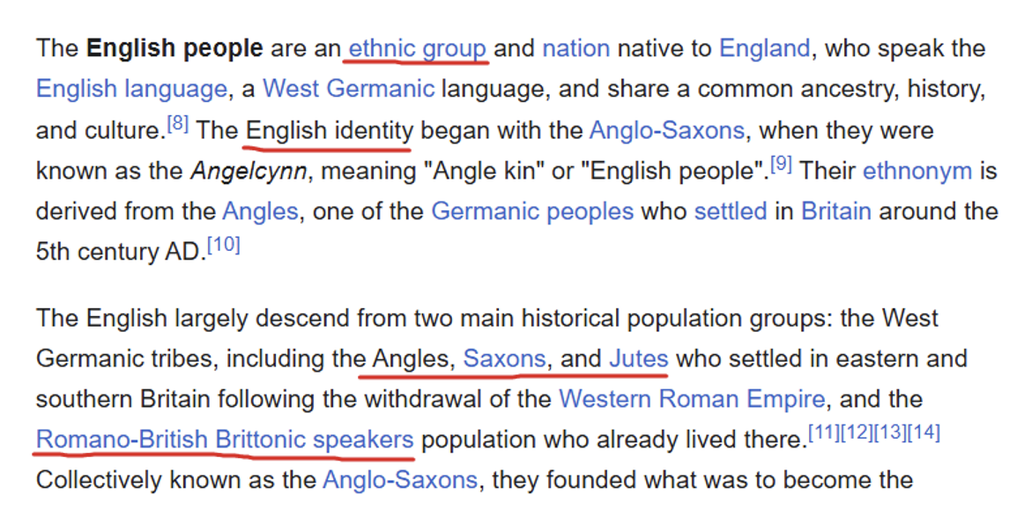
Ethnicity is not an opinion, but a fact of history, intermarriage and statistics of known populations: Romano-British, Anglo-Saxon, a few Scandinavian and, later, Normans. If you care to look up ethnogenesis, pedigree collapse and “identical ancestry” you can learn that, over several hundred years and assuming intermarriage, these groups have by now mixed almost entirely.
The population statistics of England are particularly favourable to this analysis because there wasn’t much immigration, from anywhere, from the 11th up to the mid-20th century. If your family were all here in 1900, it’s reasonably probable, with the exception of a relatively small influx of Huguenots and Irish, that they were all here in 1100 and that most of them were here much earlier than that.
English ethnicity, at the end of those several centuries, is more clearly defined than most. To deny an English ethnicity is to say ethnicity does not exist, which would pose quite the shock to parts of our current political establishment.
This ethnic, and original, usage of “English” has stood for around 1,500 years during which, and particularly with the unification of England under Alfred, it also acquired civic and cultural meaning. Until very recently those layers of meaning overlapped closely – that is to say, the people who were ethnically, culturally, geographically, civically and historically “English” were nearasdammit the same people, with the conspicuous exception of the Norman Conquest. Again, English history is particularly favourable to this interpretation, compared to most countries, because of unusually stable borders and polity.
Because of that stability, we do not need to boil our heads about “what fraction qualifies as English, then?” Something more than one generation of Indians that married each other. Something between a few generations of intermarriage, and several dozen.
Sunak uses the Normans as a case study. Jacob Rees-Mogg’s objection is similar, reciting a ditty from William of Orange, which concluded with the Normans – the English are all mongrels anyway! But the Normans did not become English at Pevensey. Assimilation happened over generations, via integration and intermarriage rather than by semantic decree, and the centuries since then prove my point, not theirs.
Language can evolve and perhaps there is, now, a purely civic/cultural layer of “Englishness”, the Sunak layer. But it’s a young usage, and doesn’t mean the ancient ethnic usage can be cancelled.
Ethnicity matters – both to others, and to the English
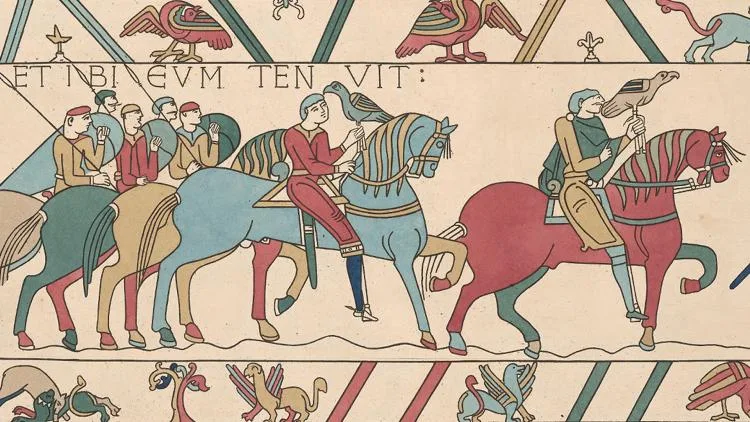
There are aspects of identity that you can don like clothes. Your flesh and blood, your forebears – or rather, mine – are not among them. I am descended from the people that gave their name to this land. To Sunak, the Bayeux Tapestry is a historical artefact of an adopted country. To me, it is a family photo album. English families fought Agincourt, Waterloo, the abolition of slavery. They manned the factories, and worked the Agrarian Revolution.
I’m not expressing disdain, calling for discrimination or apartheid. This ethnic identity is important to me, because I say so.
Family heritage and ethnic identity are, of course, important to others. Sunak is proudly Indian. Black Lives Matter, and don’t we know they’re all descended from slaves? David Lammy, Diane Abbott and Sadiq Khan are proud of their origins. I’m pretty sure it would be “cultural appropriation” if I claimed their ethnic identity.
They can’t appropriate mine.
Why “culturally English” is self-defeating
Did you notice that I drew on classical Liberalism, which Locke, Hume, Smith and Mill gave the world, and on the English Common Law? These, too, are my heritage, the “English culture and values” that our elites ignore when they pretend it’s all about tolerance and tea.
When John McTernan cancels my ethnicity by calling me “fascist”, he seeks to close down inquiry. Where I’ve (quite generously, really) allowed that language can evolve, bottom-up, he demands to abolish traditional usage of an ancient word, top down. Striking the very heart of Liberalism, he says the political community can prescribe my identity, that I may not choose what I value and how I express it.
To dismiss the discussion of ethnic Englishness in the name of cultural Englishness is entirely self-defeating, because it ruthlessly and selectively tramples on Liberal identity, language, the individual, heritage, inquiry, ideas and their expression, and the Common Law. It swipes away English culture itself, leaving only an address.
Why it’s dangerous, and how to do it better
What is also English, is to strain against an unjust yoke. Telling the English, uniquely, that our ethnicity doesn’t exist, we’re not allowed to argue it exists, it’s not allowed to matter if it exists, and we can’t demand any – let alone equal – treatment, in the Common Law country built by our forebears, is not a recipe for harmony.
I never thought my ethnicity and culture were threatened…but now, I do. I never thought they needed protection or any deliberate – let alone special – treatment…but now, I do. I have always distanced myself from the “far-Right” or whatever…but if you label me as such, well, labels make imprints as all good progressives know. If McTernan wants to rile up the English, he’s going about it brilliantly.
A multi-ethnic culturally English/British society might yet work, squarely built on Liberalism and Common Law. Why can’t the inclusionists say, all of them: “Let’s really embrace your culture. Tell us more about Common Law, the Glorious Revolution and JS Mill and how they’ll shape our lives here. In a few generations, like the Normans, our descendants will study how we integrated and intermarried.” Where do I co-sign?
That’s the outlook Rees-Mogg calls for, but he thinks the English should passively assume it will happen. What he ignores is not only the vacuity of the prevalent “tea and cricket” veneer, but how some recent arrivals prefer their own culture to ours, while intra-marrying rather than intermarrying. Erasing English ethnicity while pandering to theirs seems unlikely to help.
While Andy Burnham shares riveting cultural insights about buses and pork scratchings, Shabana Mahmood has spoken with great passion about Magna Carta, the Bill of Rights and the Common Law tradition she encountered as the child of immigrants. Credit where due. Here is an immigrant family engaging deeply with the inheritance of the country they joined.
If the English (under any definition) want a civilised society, we need to get back to reading it, understanding it, discussing it and loving it, in order that we may consider it worth protecting. That means being honest about both ethnicity and culture. We need to embrace our individual and family responsibility for what stimulates us, and choose “the best that has been written and said”, so that our history, satire, philosophy and literature makes its mark.
That is how we build English identity, and how we protect ourselves entirely from vibes-merchants like McTernan, promote the better sentiments of Mahmood, and set higher intellectual demands of decent men like Rees-Mogg and Sunak.


Discussion
Comments
This week across the site:
To join in with the discussion please make a donation to the Daily Sceptic.
Profanity and abuse will be removed and may lead to a permanent ban.
English is both a noun and an adjective. As a noun it defines a thing – what Alfred the Great called the Angelcynn (English folk/kin) to unite Angels, Saxons, Jutes as a single People, at a time when the Viking Danes had invaded and colonised a large slice of territory North of the Humber and who were threatening to conquer all five kingdoms. Alfred’s ambition was a single English kingdom.
As an adjective English qualifies a noun, English mustard, English muffin, English language.
“To destroy a people, you must first sever their roots.”
Aleksandr Solzenhytsin (1918-2008)
The Enemy Within has been sowing the seeds of destruction ever since Britain opened its borders to Marx and Engels in 1848.
Now in fashion “ Ethnonationalism”, “Ethnonationalist” to be used where Far Right, Fascist, Neo-Nazi just won’t do.
None of this really matters. Rushi Sunak behaves like an educated Englishman, probably because he, or his parents, had our civilisation imposed on them while living in India. Consequently, I will allow him the status of Englishman. Abdul, the child rapist from Pakistan, does not qualify: no matter how many bits of paper he signs to “prove” he is “British”, I will not allow him the status of Englishman – he doesn’t behave like one. You may say that there are English men of ancient lineage who are equally as bad as Abdul. Agreed, but they didn’t migrate here recently and they know what is morally right and what is wrong. Very possibly, Abdul doesn’t, or maybe he regards his own alien morals as superior, in which case he proves himself not to be English.
Debating what is Englishness and whether it exists or not is pointless.
You could construct rational arguments in all sorts of directions everyone of them leaving you absolutely nowhere.
The issue is the country is being flooded with people from other places and being given lots of free things. This is the practical issue that needs to be resolved and intellectual debates about the nature of Englishness isn’t going to resolve it.
The way it is resolved is cutting all benefits and all support for anyone who doesn’t hold British nationality. You come to this country to contribute. If not, you’re not welcome and you’re out
That solves it. Everything else is pure distraction.
That would be a big step forward but I think you also need people coming here whose culture and behaviour is compatible with ours, what little is left of it. Most races throughout history and many today are pretty ethnonationalist, in my view with good reason. I think there’s nothing wrong with that provided that it doesn’t lead to immoral behaviour towards others just because of their race. But wanting a homeland for ethnically English people where they remain a majority seems reasonable to me. But it’s not going to happen. Already too late and lots of English people disagree with me on this (and most other things).
That’s another good reason to focus on shutting down all the free stuff to immigrants. It’s much more likely to get support and get somewhere then the ethnonationalist route – however justified it may be.
White Brtis are still a majority. The situation can still be saved if the influx is stopped now. So all efforts should go towards that.
A very good article IMO.
Deserves a wider audience.
No other people in history would tolerate the deliberate erasure of their glorious nation by their own political class.
Time to push back hard, and a key element of making that possible will be erudite and intelligent articles, like this laying the groundwork.