

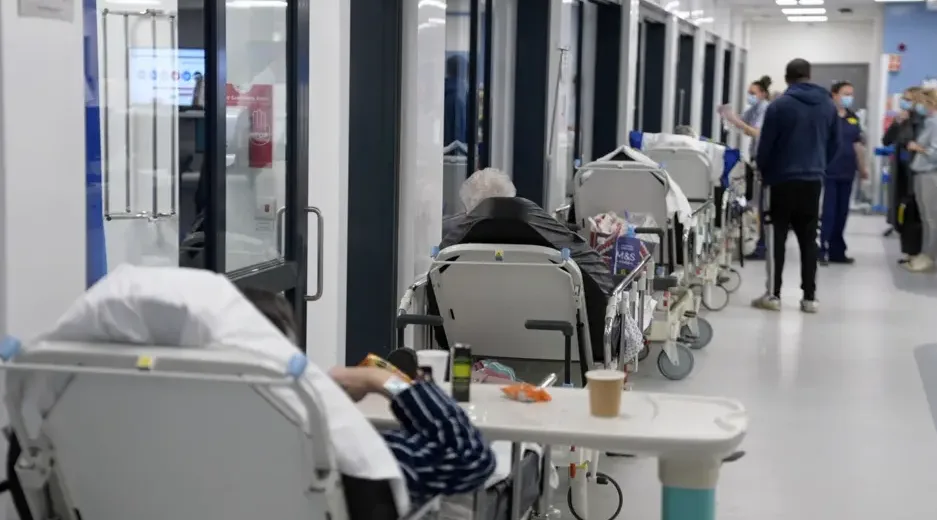
Overcrowding and corridor care in A&E may be killing around 550 patients in the UK every week, a damning study has revealed. The Mail has the story.
The scale of the problem is an “absolute scandal” with the fatalities the equivalent of a “fatal jumbo jet crash every single week”, doctors said.
The review of more than 19,000 patients in NHS hospitals found the chance of dying in the following 28 days rose by 1% for every 10% increase in emergency department occupancy.
Alarmingly, the 134 A&Es involved in the study had an average occupancy rate of 175%, meaning they contained almost twice as many patients as they were designed to hold.
The Royal College of Nursing has previously warned that a shortage of A&E beds means patients are often left languishing on trolleys in corridors without proper access to oxygen and other emergency equipment, while staff become more stretched and can easily miss critical signs of deterioration.
Dr Ryan McHenry, an emergency medicine doctor in the west of Scotland and researcher at the University of Glasgow, analysed data from around 70% of the A&Es in England, Wales and Northern Ireland over a two-week period.
He said: “We found that increased crowding in emergency departments is associated with increased mortality for patients admitted to hospital.
“This is important because we know that emergency departments are now often very crowded, and reducing that crowding has the real potential to save lives.”
He estimated around 550 deaths every week may be caused by this overcrowding but said the relatively small size of his study – presented at the European Emergency Medicine Congress in France – meant the range could be anywhere from 33 to 1,083 excess deaths.
For the research, occupancy was calculated by how many spaces, such as cubicles, the A&E department had compared with how many patients were being treated.
Dr McHenry and his colleagues also looked at the impact of ‘corridor care’ where patients receive treatment in non-standard clinical spaces such as corridors.
This was also linked to an increase in the risk of deaths at a similar rate as overcrowding, although the team said occupancy rate was much easier to measure and record.
Official NHS figures show an average of more than 3,000 patients were treated in corridors or other makeshift areas every day in England in July alone.
Worth reading in full.


Discussion
Comments
This week across the site:
To join in with the discussion please make a donation to the Daily Sceptic.
Profanity and abuse will be removed and may lead to a permanent ban.
Solution. £125 charge at the door for all non-accident and emergency attendances; £75 charge for accident and emergency.
I assure you attendances will drop by about 75%.
Anything that is free will be over-used and abused.
Elderly relative at the hospital again today. Eventually released after 8 hours as they warned things were going to get very very busy. Presumably a wave of sports injuries expected from sunday leagues etc.
Isn’t it time sports injuries were chargeable ?
Although those of us at the sharp end of the NHS didn’t predict so called “corridor care“, when bed numbers in DGH’s were being slashed, from the early 1980’s onwards, we knew that more beds would be required, not fewer. It’s not as if the population numbers and the demographic of an ageing population was not known. We used to say that we had given our all to the NHS, but that when we needed it, it wouldn’t be there for us. We never expected this to happen so quickly.
04 July 1948: 1 100 hospitals with 90 000 beds in the voluntary sector, 1 500 municipal hospitals with 390 000 beds.
There already was a national health service serving the population of just under 50 million, it just wasn’t State run. On 05 July the NHS was launched and just took over those 2 600 hospitals and 480 000 beds.
All those hospitals bar a handful dated from before the 20th Century. The NHS hadn’t created a single new hospital. In Victorian times there was a national health service too, with 75% of the population covered by private health insurance.
I’ll bet those of you at the “sharp end” don’t know any of that, because gee whiz the propaganda machine has told you without the NHS, ordinary people wouldn’t get health care and “the poor” would be left writhing in the gutters, dying for lack of it.
And “private” insurance! Gasp – dirty word.
Today:1 600 hospitals;145 000 beds serving 70 million. 1948 waiting list 400 000, today 7 million. Well done those who have given their all.
What a brilliant idea it was after the end of the cold war for the geniuses in Whitehall to close so many local hospitals. The staff were often local people with real commitment to service.
Added to which, this meant that those visiting loved ones didn’t have to travel miles in order to do so. Not that that counted to those making the rules, of course.
The NHS was/is unaffordable. Hospitals were/are being closed to save money.
We have a population who doesn’t understand economics and that all the “free” public services have to be paid for and the money can only come from them.
They complain about high taxes on motor fuels – it’s 55% with VAT on top they shriek – but thay want “free” healthcare. Either you get cheap petrol and pay for your own healthcare – which you should – or expensive petrol and go on a waiting list of 7 million to get your “free” hesithcare.
“Stay at home, protect the NHS, save lives.” Maybe not what they intended but seems applicable.
“Stay at home, protect the NHS, save your lives.”
our mp’s are against ‘voluntary euthanasia’ but are very happy to allow people to die in corridors.
It really is this simple. If you can, do whatever it takes to stay out of A&E,same for gp surgeries. They can be dangerous to your health.💖
If I still had a BBC tv licence I would ask them why we were not seeing the rolling death toll on the news bulletins each night, like we endured during Covid.
Alas, we know they don’t even read listeners’ comments but employ a handling company to filter unwelcome feedback.
Is there something of a dichotomy between the performance of our wonderful NHS and the 3 or 4 million on PIP, 2 or 3 million on long-term sick pay and 8 or 9 million with Statutory Sick Pay benefits?
Sadly the dead can’t vote and every dead person successfully reduces NHS demand. So all good then.
Family waited 11 hours for an ambulance recently and was told if you take them yourself they will refuse to admit them. All good then.
The dead also don’t get pensions. Wonder why Governments across the west are so desperate to legalise euthanasia ……?
If they want euthenasia we should have a matching system. One citizen for one current or former MP or Peer or Quango Director.
How does this compare with deaths by “heat”?
Socialism always required queueing.
The political class are supplier oriented not voter or patient oriented, regardless of their spin.
… queueing – and going without.
Well that’s that then! We need more of the dinghy doctors! And more money for all the admin positions in the NHS!
Has anyone thought to ask why Casualty is so ‘popular’? Something to do, maybe, with not being able to get to see a GP?
Far too many people being snowflakes and going to A&E with very minor injuries that only need a bit of basic first aid at home, or being paranoid about germs and thinking they need a tetanus jab/antibiotics if they get a small cut is almost certainly part of the problem.
We have 2 gp’s at our surgery. one of them only works 3 days per week although he is only in his 50’s. He only does diabetic clinics. All gp’s are quacks,they are snake oil salesmen.
I worked in the NHS in the early 1970s and it was just the same then. People would come into A&E on their way home from work or the pub because they were passing and it was more convenient than seeing a GP and they didn’t have to take time off work.
We used to get the nightshift workers around 7am on their way home – get seen in A&E, usually quiet then – so they could go home and sleep undisturbed.
In one large northern hospital where I trained, A&E would fill up on rainy Saturdays with dads and their kids. Mum was in town doing the shopping and to avoid traipsing miserable, wet kids round in the rain, dad would bring them into the nice dry, warm infirmary to sit and see the doctor. Often mum returned before their turn with the doctor came, so they just left.
Charge people to use A&E. The abuse will stop.