

In her UnHerd column last week, Kathleen Stock writes from a “horrifically well-insulated sweatbox”, the fan beside her registering 29°C while the air outside hits 33. Every day is the same: clear blue, suffocatingly hot, uncannily still. The parks are brown, gardens turning to dust. Stressed trees drop huge boughs. At night, foxes prowl, thirstily searching for water. Brambles appear far too early; the pond at the end of the road is silting up. She feels discombobulated – sweaty, exhausted, her mind as vacant as the cloudless sky.
This opening of her UnHerd essay, ‘Why I’ve got the hots for localism’, is an existential register of fatigue, rendered through direct observation and an aesthetic sensibility rather than charts or organised empirical data. Ms Stock has absorbed the idea of a “new kind of summer” as lived experience. The cider-apple harvest is failing, harebells and wasps are disappearing, parts of the New Forest are blackened, elderly neighbours wilt in oven-like flats and local farmers watch stunted wheat and barley. She asks how we feel about this “new normal” and answers with sadness and “discombobulation” that require no grand theoretical defence – much as grief for people or pets needs none.
Dr Stock OBE, a gender-critical feminist and philosopher, is right about the larger strategic point that follows. Whatever the causes and consequences of global warming, a small country like Britain cannot do anything about it alone. Provisional UK territorial greenhouse-gas emissions for 2025 stand at 367 MtCO₂e, less than 1% of the global total according to the Department for Energy Security and Net Zero. Any meaningful reduction is swamped by emissions growth in China, India and other large developing economies. The coordination and free-rider problems among major emitters in any proposed global deal are near-impossible. Gathering the world’s nations at the UN annual climate summits – the next one, COP31, to be held in Antalya, Türkiye, from November 9th to 20th 2026 – has made little difference to global emissions over the past three decades.
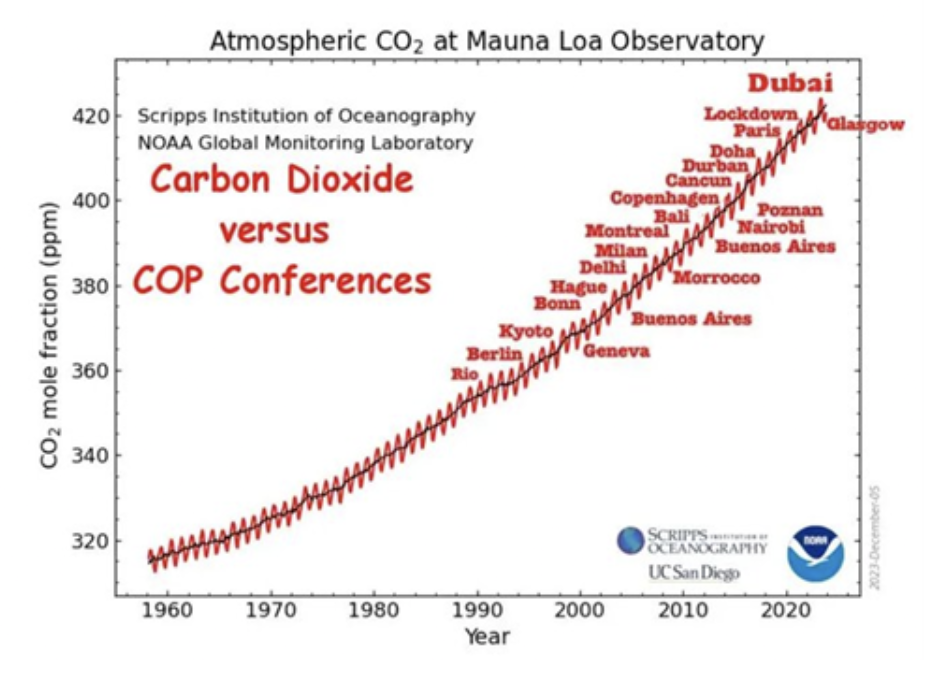
Instead of clashing endlessly over the global warming narrative, she proposes detaching the local from the global. Chasing impossible global solutions hampers useful consensus-building on urgent local and regional problems to save vanishing landscapes and help the elderly in oven-like flats, manage failing harvests and buckling rails and form practical adaptation plans “without any grand theory about carbon dioxide.”
An unprecedented hot summer, raging wildfires, failing agriculture: not by the numbers
Start with the weather itself. Stock treats the current summer as a novel meteorological regime – “the new kind of summer”, a heat so unfamiliar that “no one can remember what rain feels like”. The parks are brown, trees drop boughs, foxes search for water. Yet British summers have been hot and dry before, and worse. The 1976 heatwave and drought produced 16 consecutive days above 30°C at Heathrow, a peak of 35.9°C at Cheltenham and a drought so severe that a Cabinet minister was appointed specifically to manage it; some parts of southern England received under 55% of average rainfall over more than a year. The 1995 drought is now regarded by meteorologists as drier still. Neither event required elevated atmospheric CO₂ to be explained; both were driven by persistent blocking high-pressure systems, the same phenomenon operating today. The insistence that 2026 is meteorologically unprecedented functions less as observation than as mood music for the argument that follows. Note that the UK Met Office itself, relying on junk weather stations and purveying “homogenised” – read massaged – temperature trends, has lost credibility as a reliable organisation, as my colleague Paul Homewood has documented rigorously over the years.
The same selective framing appears in Stock’s treatment of local crises. She notes a nearby train derailment that observers speculate was caused by heat-buckled rails. Stock’s catalogue of local issues includes early brambles, a silting pond, New Forest fires, a failing cider-apple harvest, disappearing harebells and wasps and stunted wheat and barley. Some of these can cause real hardships. But the causal story she tells is incomplete, and conveniently so. The “heat buckling” of rail tracks is being investigated by rail officials but, until it is confirmed, the likely culprits are poor maintenance of tracks and other infrastructure.
Wildfire investigators have long found that the overwhelming majority of UK wildfires are started by people, not lightning – the House of Lords Library concludes that almost all UK wildfires result from accidental or deliberate human acts, while Natural Wales estimates roughly 30% are arson and 70% accidental or careless. Ignition, in other words, is a human-behaviour problem before it is a climate problem.
What has changed is fuel load. The fashion for ‘wilding’, and the accompanying retreat from controlled winter burning, has left England’s uplands carrying more combustible vegetation than at any point in living memory. Labour’s extension of restrictions on controlled heather burning across 1.6 million acres of peatland has removed one of the oldest and most effective tools for breaking up continuous fuel and creating firebreaks; gamekeepers, moorland managers and land-owning bodies have warned for years that the policy was building toward exactly the kind of record wildfire season Britain has now had. The fashion for ‘rewilding’ and the abandonment of controlled burns are not neutral acts of nature; they are policy choices, promoted under green banners, made by identifiable people in Whitehall and Cardiff. When Stock attributes the blackened New Forest simply to “the heat” of “a new kind of summer”, she erases the agency of those who decided that traditional land management was environmentally incorrect.
Water stress and agricultural shortfalls raise similar questions. Reservoir capacity, leakage rates and abstraction rules – rules for extracting water from natural resources – are not dictated by atmospheric CO2. They are set by decades of underinvestment and regulatory choices. Fertiliser costs inflated by energy taxes and carbon-pricing on natural gas pass through to farmers agonising over stunted wheat and barley yields.
It is remarkable that Ms Stock agonises over elderly people wilting in poorly insulated flats or sweltering in Britain’s many hospitals without once mentioning the glaring lack of air-conditioning – the one technology already proven, unambiguously, to reduce heat mortality wherever it has been allowed to spread. Yet the Luddite ruling class in the UK and EU would rather have their citizens face the risk of a grisly, painful death from heatstroke than provide cheap electricity and allow them to install a $400 air conditioner. Air conditioning is nearly universal in American and Japanese homes (approximately 90%) but remains the exception rather than the rule across Europe (approximately 23% average) and is especially uncommon in the UK (estimated at low-teens to single-digit percentages).
Dr Stock is absolutely right that politicians can address these problems without first settling the precise role of carbon dioxide in the climate system. But she is wrong to imply that practical, local and national policymaking can proceed while bracketing out the overarching policy choices – Net Zero mandates, land-use dogma and energy-price interventions – that have already made adaptation more expensive and less effective than it needs to be.
A caricature of the sceptical position
Ms Stock’s portrait of the wider climate debate is equally skewed. She sees a sterile symmetry: apocalyptic greens on one side, “stubborn scepticism” on the other offering “little acknowledgment of local social and environmental losses” and “no nuanced plan of action, except to keep buggering on as before”. The renewables discussion, she says, is “absurdly polarised”, with one side talking only of benefits and the other only of harms.
This is a caricature. Serious analysts of renewable energy – David Turver, Kathryn Porter and Dieter Helm among them – have performed the elementary work of cost-benefit analysis that Stock claims is missing. They examine intermittency, system balancing costs, backup requirements, grid reinforcement and the displacement of firm generation. Turver’s own submission to Parliament’s cost-of-energy inquiry laid out, in granular detail, why levelised-cost comparisons that ignore firming and network costs systematically understate the true price of wind and solar. None of these analysts deny that turbines and panels generate electricity when the weather cooperates; they ask whether the full system, backup included, delivers net benefit at the reliability a modern economy actually requires.
Global integrated-assessment models, including the DICE model of Nobel laureate William Nordhaus, abstract from local detail precisely because their purpose is aggregate, long-run quantification of costs and benefits under uncertainty; that is methodological necessity, not indifference. Local and regional studies exist alongside them. To accuse sceptics of ignoring local losses is to ignore a literature that has spent years documenting deindustrialisation, the uglification of the countryside by wind turbines, acres of solar farms, and pylons and the household cost of subsidising intermittency.
The Peterson–Self exchange, and the lean toward Self
Stock briefly referees a skirmish between Jordan Peterson and Will Self. Peterson notes the Medieval Warm Period and the greening effect of elevated CO2; Self dismisses the former as unmeasurable and non-global, and the latter as irrelevant because biodiversity is allegedly still collapsing. Stock leans toward Self. This is misplaced on both counts.
Proxy reconstructions – tree rings, ice cores, sediments, documentary records – have long been used to estimate historical temperatures; the irony is that the same proxy method underpins the “hockey stick” reconstruction that climate campaigners have treated as gospel for a quarter of a century. Evidence of the Medieval Warm Period appears well beyond the North Atlantic, in the Sierra Nevada, the Andes, China, Tasmania and New Zealand, even as researchers continue to debate its precise global synchrony.
On biodiversity, the crude claim of relentless, undifferentiated decline sits awkwardly with the finding that only a small fraction of assessed species – roughly 1.5% of birds and 1.4% of mammals – have actually gone extinct since 1500, well below the figures earlier apocalyptic projections implied. Greening, meanwhile, is not a talking point; it is measured from space. NASA satellite data show that a quarter to half of the planet’s vegetated land has significantly greened over the past four decades, with CO2 fertilisation responsible for roughly 70% of the effect – an area of new leaf growth equivalent to twice the continental United States. One would imagine that the greening of formerly arid and semi-arid areas could only help in enhancing biodiversity.
The deeper error in Stock’s piece is the false equivalence itself. One side has spent decades converting scientific debate and uncertainty into moral certainty and policy absolutism. The other has pointed out that the UK accounts for roughly 0.8% of annual global CO2 emissions, that Chinese and Indian emissions growth swamps any conceivable British reduction many times over and that unilateral “climate leadership” is a luxury belief whose chief practical effect is to export British industry and import the emissions of less efficient overseas producers.
This is not a new argument in these pages: I have set out at length, here and here, how a deindustrialising island contributing under 1% of world emissions convinced itself it could “lead the world” out of fossil fuels. Rupert Darwall has detailed the costs to Britain in its “folly of climate leadership”.
The costs are not abstract
Those costs are not abstract. Analysis commissioned for the Conservative Party under Claire Coutinho has put the potential saving from abandoning the current all-renewables pathway, in favour of a system that retains gas alongside nuclear and renewables, at £320 billion in electricity system costs over two decades. Separate research for the Institute of Economic Affairs has found that official Net Zero cost estimates have fallen sharply in recent years not because decarbonisation has become cheaper, but because the methodology used to calculate it has changed. Energy-intensive industries have already left Britain or scaled back their operations here. The countryside is being littered with solar arrays, wind farms and the pylons and substations needed to move intermittent power around the grid.
Stock mourns changing landscapes and living conditions yet passes over the most visible recent alteration to the British countryside: the subsidised hardware of the energy transition itself. Deindustrialisation undertaken in the name of decarbonisation does not reduce global emissions; it merely relocates them to China and India, typically to less efficient, more coal-intensive producers. Living standards suffer in the process, for no measurable planetary benefit. Cheaper, more reliable electricity and installation of cheap air-conditioners would do more for elderly people in overheated flats and hospital wards than another round of behavioural exhortation about carbon footprints.
Stock’s best sentence, and the one she declines to follow
Stock’s most valuable sentence is also the one she fails to follow through to its logical conclusion: “It is obviously possible to worry about such [local, regional and national] problems, and for politicians to form plans to address them, without espousing any grand theory about the role of carbon dioxide.” Precisely so. Adaptation – better building standards, resilient water infrastructure, intelligent fire and land management, affordable and reliable energy – does not require prior resolution on equilibrium climate sensitivity parameters or the exact social cost of carbon. It requires competence, and a willingness to abandon the specific policies that have already raised costs and reduced resilience: burn bans that let fuel accumulate, planning rules that block reservoirs and a decarbonisation timetable that prices gas and fertiliser out of reach of the farmers she worries about.
She anticipates the rejoinder that local concern without global action is insufficient. Her reply is that the coordination problem among major emitters is practically insoluble, and that Self’s vision of controlled markets, rationing and “particular forms of restraint for which the established political vocabulary has no adequate name” sounds mad. On that last point she is entirely right. Authoritarian climate policies of the green globalist governments are not a solution to the coordination problem; it is a confession that voluntary coordination has failed, and that coercion is the only instrument the true believers have left.
Kathleen Stock’s incomplete localism
Yet Stock’s localism remains incomplete, for a reason she does not examine. She wants us to notice what is vanishing locally and to mitigate the impacts. Fair enough, as far as it goes. But the vanishing she describes is not solely climatic and the mitigation she wants is obstructed by the very policies whose global efficacy she declines to adjudicate. Reservoirs are not built because green-obsessed planning and environmental rules block them; controlled burns are discouraged because peatland regulation prohibits them; fertiliser is taxed and gas is made artificially expensive in service of a decarbonisation theory she says she cannot be bothered to evaluate. The result is that the local suffering she catalogues so movingly is real, and substantially self-inflicted by policy choices made in the name of a global theory that a country responsible for eight-tenths of 1% of world emissions cannot meaningfully affect either way.
Conservatives who merely poke holes in the Left’s preferred theories without offering practical alternatives deserve the criticism Stock levels at them. She is right about that much. But the remedy is not symmetrical disengagement from the underlying facts. It is rigorous attention to costs, benefits and adaptation at every scale, grounded in accurate description rather than atmospheric pathos. Geological time has oscillated between ice ages and inter-glaciation for hundreds of millennia; the choice of 1850–1900 as the sacred pre-industrial baseline is itself a political convention, not a self-evident natural fact. Feeling sad about a hot, dry summer is entirely human, and understandable. Treating that feeling as a reason to suspend scrutiny of the policies that made the summer harder to bear than it needed to be is not.
There is indeed a great deal of work to be done, as Stock says. It begins with accurate description rather than mood music, with cost-benefit accounting rather than moral symmetry between a rigorous empirical literature and its caricature and with the plain recognition that a country responsible for roughly 1% of global emissions cannot save the planet by impoverishing itself first. Localism without data is just another, more comfortable, form of the same exhaustion.
Dr Tilak K. Doshi is the Daily Sceptic‘s Energy Editor. He is an economist, a member of the CO₂ Coalition and a former contributor to Forbes. Follow him on Substack and X.


Discussion
Comments
This week across the site:
To join in with the discussion please make a donation to the Daily Sceptic.
Profanity and abuse will be removed and may lead to a permanent ban.
Yet another self-evidently brilliant article.
GeoengineeringWatch.net, Professor Willie Soon, both worth a read. Man made weather manipulation is very real. Look up. DARPA, NOAA, DOD, DEWS.The question is, why? Although three months without rain appears to be the max. Winter wheat going in. Rain due this week. Perhaps the powers that be have decided to allow Mother Nature to return.
Why do experts continue to push the myth that the UK is responsible for <1% of global emissions. That is simply not true. We are responsible for <1% of man made emissions. Man made emissions are about 3% of global emissions. So the UK is responsible for almost nothing.
As for Stock lamenting the changes happening she appears to miss the most obvious one that is now the #1 issue for the country…. immigration.
“both were driven by persistent blocking high-pressure systems, the same phenomenon operating today.”
That’s all we need to understand the British 2026 Summer. Time was when pre O-level geography students were taught to read proper weather maps, about air masses and atmospheric pressure systems. Those of us who were so schooled could explain the long period of dry, settled weather before we’d seen the maps. (If given the chance: these days such maps are made harder to access, lest they betray the truth and undermine the prevailing narrative).
It just shows that even the likes of Stock, seemingly intellignet and wise enough to take the trouble to contrast her thoughts and ideas with the real world, aren’t impervious to the brutal, relentless onslaught of the climate narrative.
Most minds can’t resist it. “They’ve been telling us for years about climate change and look, it is so hot, I guess it must be true” is presumably what is going through her mind.
Few people have the mental stamina to resist mental programming at that level and scale.
After “Covid” I have gone to the other extreme and my default assumption is that most things I am told are either lies or inaccuracies or there are ulterior motives not disclosed.
Same. To me, it seems reckless to assume otherwise. And I don’t fully understand those who can see the mendacity, manipulation and madness of the whole covid experience and not mistrust everything going forward.
Mind boggling really.
I have always been deeply sceptical of what Govts tell us…. it’s why I have been against AGW since the 90s. Brexit however took me over the edge. Covid confirmed my worst fears. Basic rule of thumb is….. whatever they tell you, no matter how well intended, always take the alternative view. They are lying to us (sometimes unknowingly but always lying nonetheless).
Yes, exactly!
After a couple of very warm summers most people have forgotten about the years without a summer. I can recall a summer in the 90s where we had constant belts of showers coming in from the Atlantic. And in Europe they will remember 2000 when major flooding of the Danube, Elbe and Oder was caused by lots of weather systems coming in from the west. The wet summers were due to the same cause as our recent summers – the jet stream. When the jet stream – devoid of Rossby waves – fires across the Atlantic into Europe and does not follow the historical pattern of drifting north in summer, we get a flow of low pressure systems and rain.
2003 was “the new kind of Summer” – this was how Summers would be from then onward. Some of us were old enough to remember a similar Summer in 1976 which strange to report occurred in a decade or “record” cooling, supposedly the start of a new ice age.
So now we have another Summer, in fact not as long and hot as either 1976 and 2003, in fact a series of five hot spells weeks apart each lasting a few days.
It’s just weather.
What has nit received widespread MSM coverage – surprise, surprise – is the latest report from NOAA which torpedoes the Goodship Climageddon.
From WUWT: https://wattsupwiththat.com/2026/08/21/noaa-proposes-amending-the-fifth-national-climate-assessment-nca5/
“For more than a decade, some of the most frightening claims about future climate change came from a scenario called RCP8.5. Most people never heard that name on the evening news. Instead, they heard the results. Temperatures could soar by 2100. Sea levels could rise dramatically. Heat deaths could climb. Crop yields could fall. Wildfires could worsen. Electricity demand could explode. Economic damages could reach enormous levels.
Behind many such projections sat RCP8.5, or its newer cousin, SSP5-8.5.
We’ve noted previously on this blog that the… Read more »
This summer reminded me of summers of my childhood. I only remember the long hot summer days interspersed with thunderstorms.
Isn’t it strange that as human output of CO2 has increased, their more outrageous guesses of its effects have diminished.
Something don’t quite add up?
A well known conservative who was also a Conservative then put all this in his book An Appeal to Reason. Nigel Lawson understood that adaption was the better option and private, individual decision making is much better than political, bureaucratic ones.
Stock talks about localism but the best sort is individual freedom. If localism means devolved authorities or Councils the decisions will still be political and still inefficient.
Only decisions made by those affected are efficient and value for money. Free us to heat and cool our homes as we chose, travel in whatever means of transport we chose and allow suppliers to supply us free of levies, taxes and directives.
Anyone who has been involved in local politics will know that it can be driven by stubborn cliques with fixed views and the ability to wear out people who try to oppose them.
They generally seem to have less knowledge but also an unwillingness to countenance different views.