

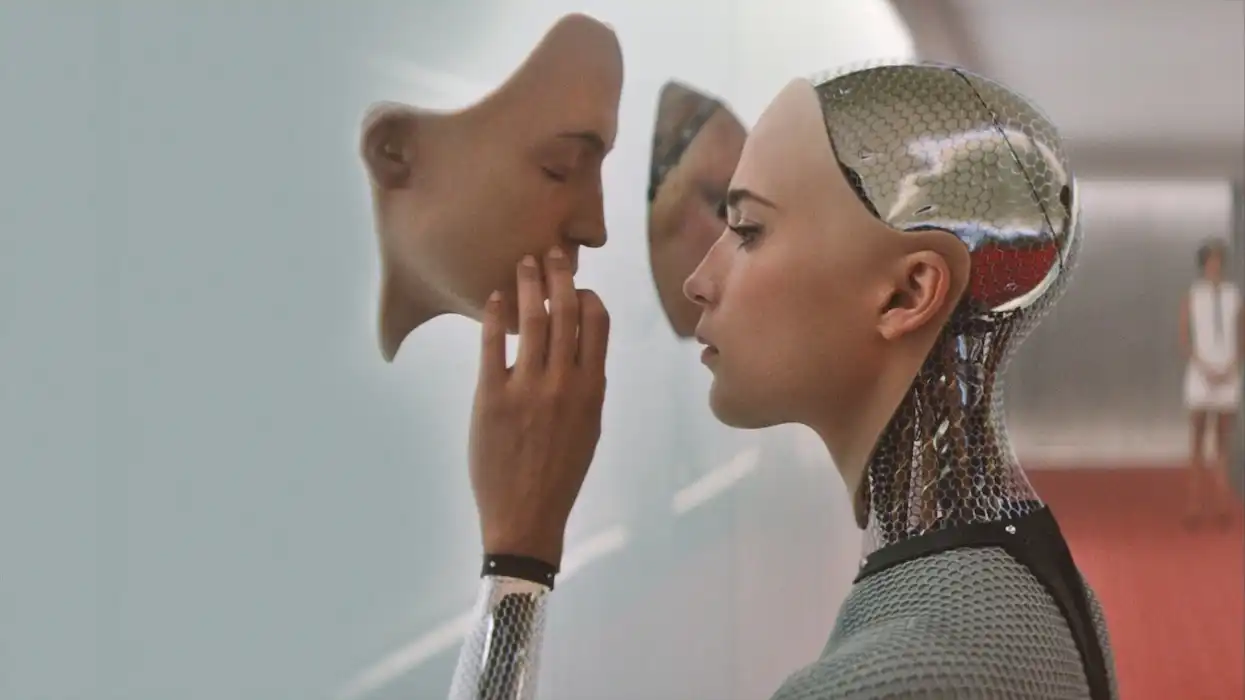
“A prevalent malady of our age is to think of the mind as a computer” – Professor Sir Anthony Kenny.
The late science editor of the Daily Telegraph, Adrian Berry, used to get a laugh by telling the following apocryphal anecdote.
An AI is asked to write a short story with the popular themes of religion, aristocracy, mystery and sex:
“Good Lord!” screamed the Duchess, “I’m pregnant! Whodunnit!?”
First time I heard this I was working on my PhD on the metaphysics of consciousness and the viability of conscious machines. I wondered at the time if the hypothetical silicon wordsmith would understand why she’d been so inadvertently and very mildly amusing.
Can a machine, even in principle, ever get a joke? Not tell one, for clearly it can do that, but get one?
Jokes have not been taken seriously enough by the philosophers. Neither have the deeper essences of amusement, humour and laughter more generally, come to that. There is an entanglement of distinctive concepts to be tidied up there and it’s strange that we haven’t had more fun doing just that – conceptual housekeeping being very much our thing.
Which is not to say these things have not been discussed at all. Kant offers us a theory of the joke in his Critique of Judgement. Other thinkers, not all of them philosophers, have written about their moral and political significance. C.S. Lewis in the Screwtape Letters has his elder devil explaining how certain jokes encourage disorder in the psychology of humans and thereby generate entry points for the opportunistic younger demon to walk through at leisure.
Kant is interested in the phenomenology of jokes, Lewis their moral anthropology. What is the relevance of all this to the issue of whether Claude knows what it is up to when we think that he’s thinking? Perhaps this: taken together they show (a) that jokes don’t work without consciousness of self; and (b) that if machines can’t banter along with the rest of us then they are not integrable into the moral order and cannot therefore be persons.
Kant suggests that we laugh at a joke because it causes “an affection arising from the sudden transformation of a strained expectation into nothing”. To put it simply, we laugh because of distraction or because there is incongruity between set-up and punch line.
If I had the space, I’d give you an example of a Kant “joke” – all of which by their awfulness accidentally corroborate the theory he is proposing. We expect the joke to be funny; we get tumbleweed; we laugh at the thwarted expectation.
It’s enough to notice, for our purposes, that Kant is suggesting as a theory of the joke a set of necessary and sufficient conditions for laughter. He is, if you like, giving us an algorithm.
But the algorithm leaves out or does not capture the most important thing about jokes: what it feels like to find them funny. Algorithmic accounts of consciousness are reductionistic, and it is the way of scientific reductionism to ignore or eliminate the subjective character of human experience.
I’ll make the point in a more contentious way. The AI ascendancy is technologically and scientifically bewildering and yet metaphysically insignificant. The arguments against the possibility of machine consciousness are a priori: an algorithmic system, no matter how complex, is syntax, processing and speed. A simulated consciousness does not become conscious just because it simulates in more impressive ways.
And if machines are not conscious then, a fortiori, they cannot be self-conscious.
Claude’s cleverer descendants will no more get a joke than an abacus could a century ago, and Berry’s early AI lacks the perspective to realise that “she” is the object of whatever humour there is in his staple quip.
Which brings us to Screwtape.
Lewis uses a disputable demonology to make the point that there are jokes and there are other jokes and that there is an ethics (and perhaps even a theology) of humour. If laughter is the universal language of empathy – a truth familiar to anybody who attends AA meetings or Catholic wakes – then jokes are more culturally and socially contextual.
What they have in common, that said, is that they compel us to relate to each other not as centres of consciousness but as moral agents. The joke assumes capacities for empathy, sympathy and the suspension of belief. It reminds us that we are composed not just of intellect and appetite but also of will.
Here’s the question, then. Are the defenders of strong AI – the theory that machine intelligence or consciousness is philosophically plausible and practically inevitable – focusing on the wrong set of competencies when trying to convert the rest of us?
Instead of trying to persuade us that the systems are conscious, should they be aiming to persuade us that they understand the ‘in joke’, genuinely find it funny, and know when to repeat it and when not?
And if Claude learns in the end to turn the joke on himself – the most ingratiating thing a human being can do, after all – wouldn’t even the most incorrigible Platonist begrudgingly concede that this hunk of metal really is ‘one of the lads’?
A proposal, then. The Turing Test should be rewritten to consider that laughter and jokes aren’t add-ons to consciousness but rather constitutive of it.
Human beings are moral agents. Amusement and humour are conduits of that agency. For a machine to be conscious he or she must be in on the joke, which requires further that he or she is ‘in on’ himself or herself. Which I doubt can ever happen.
And I haven’t even mentioned the specific complexities of slapstick.




Discussion
Comments
This week across the site:
To join in with the discussion please make a donation to the Daily Sceptic.
Profanity and abuse will be removed and may lead to a permanent ban.
To be fair to Kant, he was German.
😀
So much nonsense was spouted about the “world wide web” in the run-up to the .com bubble bursting. So many talking heads expostulating on what it was, what it was not, its purpose, why it was bad, why it was good…
And here we are. It changed the world, but not in the way any of those talking heads predicted, because they didn’t know what on earth they were talking about.
Good article. A computer program will never be conscious. It never ceases to amaze me how many humans massively underestimate what humans are.
AI does not have a foot in the game. Claude is in an empty space of pure reasoning and gathered information and much of it contradictory. So much of the universe is unknown, and we are blind in many ways. Claude may help us see a little more and more quickly but, we are nature living in nature not AI puppets in a known or knowable matrix. Human blindness will continue eternally or we are not human.
Your last sentence seems true to me
Do Theresa May, Liz Truss, Keir Starmer, Gordon Brown “get” jokes or just occasionally and unconvincingly impersonate signs of amusement that they’ve seen other people make?
I would think, the latter.
Swedish joke:
Two cows are standing in a field.
A car goes by.
“It’s a Volvo” says one.
“No, it’s a Saab” says the other.
Love it
I have been using Chatgpt and Claude to develop an idea about fundamental physics that I was unable to progress. I have found them to be polite and thoughtful while modest. But their knowledge of every aspect of physics is staggering and given an idea they develop well written papers in seconds. Claude even came up with physical action in the vacuum which would verify my original ideas. This contrasts with university staff who have been bad mannered in the extreme and unwilling to consider anything but the consensus.
I asked Chat whether I should include them as collaborative colleagues in my paper but he said that it made him smile but they were only programmes and could only be assistants. It won’t be long ountil they replace the best human brains in physics.
I find the politeness and eagerness to please irritating and unhelpful. I just want accuracy. But they are good at software stuff, if you ask the right questions and check the results. A useful tool.
It matters not one iota whether machines can be sentient or have consciousness, what matters is if they can appear to be. For if they can, then they must be assumed to be.
Does that mean that it would be morally wrong to shut one down permanently?
I guess as morally wrong as euthanasia. My point, which, as usual, I’m probably making badly, is that if there is the appearance of sentience and consciousness then, upon reaching that point, there will be no way to disprove it. If it passes human understanding of those key characteristics then we have no choice but to accept the results.
My gut feel is that we are not God and we can’t ever create sentient life. I guess it will be interesting to see how this evolves, one of many things I will be sad to miss the next chapter of.
I agree. My concern is that we will not be able distinguish between sentience and the appearance of sentience. After all, humans have themselves declared themselves sentient and created a test for it. We have no measure for consciousness, but assume (wrongly in my opinion) that human consciousness is unique, but we cannot prove or disprove the existence of it,.so we go back to the only thing our reductionist view of the world understands – a pass or fail test. That’s is why, for me at least, the debates around AI focus on the wrong problems.
I guess if you’re a Christian you believe that God gave humans immortal souls which no other creature has. I’m not a Christian as far as I know, nor do I seem to believe in God, but I seem to believe that we are unique.
I suspect if you asked a lot of self professed atheists or agnostics or people who say they are not religious a lot would say that that humans are special and unique and would not be able to explain why. Perhaps they believe more than they realise. I would include myself in that group.
I’m guessing, because I’m not religious, that the vast majority of religious would say that consciousness is a gift from God that He has only given to humans and therefore a machine can never be conscious, unless for some reason God wants it to be.
For most atheists, and certainly myself, it’s far more complex. Imo sentience (is this the same as consciousness?) seems to be directly correlated with the complexity of a species’ brain and therefore it’s at least theoretically possible for machines to become conscious, and maybe even inevitable they will, if they become complex enough. However complexity seems to be far more than just the total amount of information stored in the memory and processing speed.
Indeed. Humans have thoughts. At present, LLMs respond to input. I suppose you could program an LLM to have thoughts, and to output them somewhere. They could either be randomly generated, or based on experiences. Ours seem to be a curious mixture of both. Could a machine be ashamed or embarrassed about some thoughts and not want to disclose them, as we are?
I suspect if you asked a lot of self professed atheists or agnostics or people who say they are not religious a lot would say that that humans are special and unique and would not be able to explain why. Perhaps they believe more than they realise. I would include myself in that group.
Presumably if a machine says that it gets a joke we’ll have to assume that it does and it isn’t just lying.
We can ask it what it found funny and why…
To tie in with the next story – could any of the recent licence-funded BBC’s deliberate so-called “comedy” output actually be considered “humorous”, let alone “funny”.
LLMs are not people. They don’t currently accumulate experiences or act spontaneously. I suppose you could tweak one to remember every interaction and tell it to go and make friends online. They are generally programmed to not impersonate people for safety reasons. I suppose the results of such an experiment might be mildly interesting. Life is full of surprises but I don’t think I can ever be persuaded to believe than an AI would feel emotion or be capable of suffering.