

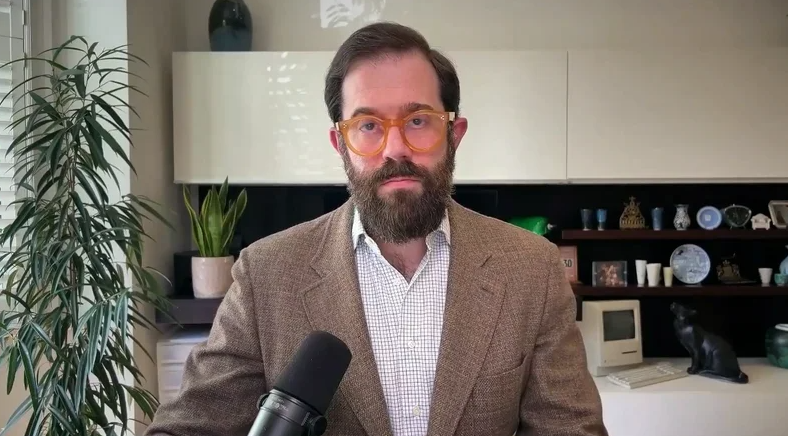
Writing in the Spectator, Jewish journalist Jonathan Sacerdoti recalls how the Green Party attempted to get him arrested after police were sent to his home for opposing the party’s antisemitism. Here’s an excerpt.
Sitting in the GB News greenroom on Sunday evening, I watched the two guests on air before me – one from Reform, one from the Greens – debate whether Nigel Farage should have reported Zack Polanski to the police for potentially inciting violence against him. Was it a challenge to free speech?
The timing was almost too neat. Only last week, I learned the outcome of the Green Party’s own attempt to silence me, after police were sent to my home and I was threatened with arrest for opposing the party’s antisemitism.
Everything was set for my first interview of the day – lights on, cameras ready, my guest a professor of architecture – when the doorbell rang. A petite blonde woman said, with theatrical concern, that she was a police officer, and perhaps should come inside in case the neighbours saw. She wasn’t in uniform. She had come alone. She wore no body camera. Yet I knew immediately what was happening.
As a writer and broadcaster in 2020s Britain, one almost expects the police eventually to arrive and allege some sort of thought crime, particularly if one writes about anti-Jewish racism and violence, free speech, the Middle East, Islam or trans issues. I write about all of them.
I recognised the moment for what it was. A rite of passage, and an attempt to place a boundary around my speech. Informing her as I did so, I reached for my phone and began recording, as much for posterity as for evidence.
The police rarely visit my house – not when someone smashed my car window (“It’s not life or death,” a bored operator told me), not when shoplifters threatened to strike a local shop worker with a stolen bottle of wine. But one balmy day in June, they found time for me.
The officer said she’d come to “invite” me to the station for a “voluntary interview”, so I could give my “account”. The allegation: harassment. The complainant, a Green canvasser, had come to my home in April – after I’d already told a previous Green canvasser in no uncertain terms that I didn’t want the party returning.
As the son of a Holocaust survivor, I’d watched the Greens’ trajectory with alarm: a party accommodating a politics around Israel, Zionism and Islamist activism I regard as hostile to Jews. Then, as I was tending to my wisteria, a canvasser arrived with a keffiyeh – inseparable, to me, from arch terrorist Yasser Arafat and the infamous PFLP plane hijacker Leila Khaled who had made the garment internationally famous as a symbol of Palestinian terrorism. If an Englishman’s home is his castle, it felt reasonable for me to defend mine from someone carrying that offensive item. I told her I didn’t want Green canvassers at my house, then told her what I thought of her party’s handling of anti-Jewish racism, and asked whether she, like her leader, thought Jews were worried about the ‘perception’ of danger rather than the real thing – after firebombed ambulances and synagogues, and Jews killed on Yom Kippur in Manchester.
She said she had lots of “antizionist” Jewish friends, and suggested there’d be fewer attacks if Israel “stopped killing children”. Ah! The legendary anti-Zionist Jewish friends. The wanton child killings. We Jews were asking for it, right? These two rhetorical grenades thrown, she refused to answer further questions as I walked with her a few doors beyond my own – odd, for someone selling a political agenda door to door. But I had been ‘triggered’ as the kids would say. I felt angry, harassed, targeted because of my Judaism and my opinions. When another neighbour joined in, bemoaning the Reform flyers posted through her door, we eventually all went our separate ways. I went to join my family for Shabbat lunch, shaken that this political tension had breached even my own garden gate.
Ten weeks later, the police arrived. I had harassed nobody – I had argued, heatedly, with a party representative who’d come to my home after being told not to. Canvassing carries an obvious risk: voters may answer back.
Though she came to fish for ‘evidence’ from me, the police officer let slip far more than she’d intended to, in answer to my questions. The woman in the keffiyeh hadn’t even made the complaint. It was the earlier canvasser, who she revealed was actually a Green candidate then and now a councillor, and who alleged I’d called her “terrorist scum”. I had not. Worse still, the Greens knew all about me and had a “system” to collate their intelligence, according to the policewoman.
My professor looked on aghast – he’d presumably read Kafka; now he had front row seats, or had even become an extra to my Josef K.
“What evidence has she got?” I asked, then: “how can you harass someone that comes to your house…knowing that I didn’t want her here?… She came to harass me in my home.”
Harassment in law requires a course of conduct involving at least two separate incidents, aimed at the same person. I didn’t know either woman, didn’t know where they lived or worked, or in fact anything about them other than their allegiance to the nasty party. They knew where I live, what I do, my ethnicity and religion, and even my husband’s name. I know who I think was harassing whom.
After the officer left, I called my lawyer, who was funded by the heroic Free Speech Union. Even the police seemed to sense the problem. The complainant, whom they insisted on calling the “victim”, was pressing them to act, though the CPS itself recognised the weakness of an allegation with literally no evidence. Maybe, they said, I’d like to write a letter of regret, to make this all disappear?
Regret? For what? I’d broken no law. I declined. If ‘voluntary interviews’ and letters of regret are becoming the new tools for silencing lawful political speech, we must refuse them at every opportunity.
Worth reading in full.
Stop Press: The Metropolitan police spent four months investigating Times journalist Jack Grove after he tried to expose Jason Arday, the Cambridge Professor at the centre of a plagiarism row.



Discussion
Comments
This week across the site:
To join in with the discussion please make a donation to the Daily Sceptic.
Profanity and abuse will be removed and may lead to a permanent ban.
Well of course they did. Antisemitism is rife in all our institutions and has been for years.
What would happen if you turned the tables and reported the canvasser for harassment?
Given there’s no evidence and no crime, could you have reported the police officer for wasting police time, an offense according to section 5(2) of the Criminal Law Act 1967?
The police are effectively engaging in politics. Very sinister. They should have more sense than let themselves be used by political actors.
Police. Sense
In the same sentence?
And why would anybody want to voluntarily attend a police interview?
Seriously, of what possible benefit it would be to anyone to volunteer any information?
Anything you say could possibly be twisted and deliberately misinterpreted in order to fabricate some kind of evidence against you.
Because if you choose not to attend a voluntary interview you can be arrested, they’re not actually all that voluntary.
If I was ever invented, I’d try and arrange a time and make it clear I would wait for up to an hour after the time the interview was meant to be then leave the police station. I’d also insist the whole interview was recorded and insist that I could also record it on my phone so nothing could be twisted.
This would be better than being arrested and held for 18 hours before being questioned, as has happened to quite a few people, so the process becomes the punishment.
Well done. Keep it up however tough it becomes. Whoever thought that anti-semitism would engulf our country.