


The illusion that the backlog had been brought under control has lasted barely long enough for the congratulatory speeches to be delivered.
There was a time, not so long ago, when a Wes Streeting ministerial victory lap greeted every NHS waiting list release. A few thousand fewer patients waiting led the media to report that the Government had “turned the corner”. The public was assured that the NHS was finally getting back on its feet.
Curiously, those celebrations have become rather quieter.
The latest NHS England figures tell a story that Ministers would prefer not to discuss. The Referral to Treatment waiting list has risen for two consecutive months, from 7.11 million pathways in March to 7.28 million in May 2026.
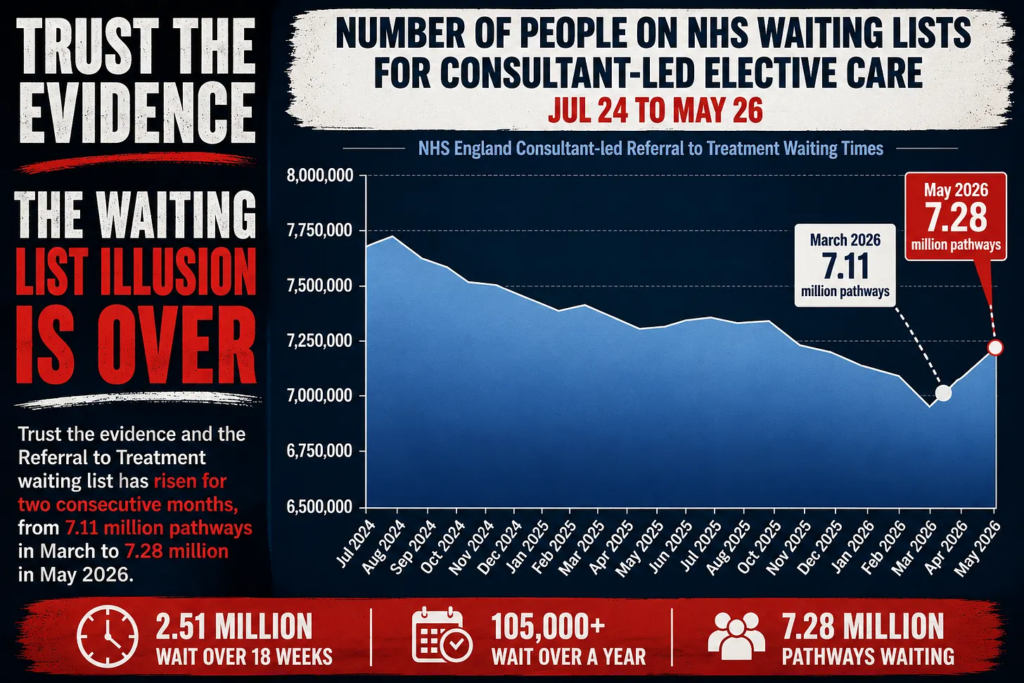
Around 2.5 million patients are still waiting beyond the 18-week constitutional standard. More than 105,000 have waited over a year, an increase on the previous month. The median wait remains 12.4 weeks, a long way from the pre-pandemic norm of 7.7 weeks.
For much of the past year, critics questioned whether the reported reductions represented genuine improvements in NHS productivity. The number of patients treated simply did not account for the magnitude of the fall. The Nuffield Trust repeatedly pointed out that completed treatments remained below the number of new referrals. If more patients are joining the queue than leaving it through treatment, the queue should grow, not shrink.
However, something else was happening. That something was called ‘validation’, a wonderfully antiseptic bureaucratic term that conceals a very simple reality: removing patients from waiting lists.
Between April and September last year, NHS England allocated £18.8 million to hospitals for waiting-list validation. Hospitals received around £33 per patient to review and remove individuals from elective waiting lists if deemed clinically appropriate, resulting in about 567,000 removals in six months. For example, the Shrewsbury and Telford Hospital NHS Trust removed 14,148 patients and received over £460,000 in payments.
So what happened to these patients? Because NHS England has not published a detailed breakdown of waiting list removals by reason, we don’t know. Were they kicked off only to rejoin?
One might have expected such a significant intervention to attract rather more public debate. Instead, the reductions in waiting lists were presented as evidence that the Government’s recovery plan was succeeding.
So, the awkward question was never properly answered: if treatment numbers alone could not explain the reductions, how much of the improvement reflected administrative removals rather than expanded clinical capacity?
Now the question answers itself: despite the validation exercise, hundreds of thousands of additional removals from the waiting list, and months of ministerial optimism, the backlog has started climbing once more.
Worryingly, this is happening in spring. Anyone familiar with NHS operations understands why that matters. Winter is when elective services are cancelled, beds fill with emergency admissions and waiting lists inevitably worsen. Spring and early summer are traditionally the recovery period — the months when hospitals ‘make hay’ by catching up on planned care before the next winter arrives.
If waiting lists are growing now, what exactly happens when winter returns?
The Government’s silence is perhaps understandable. It is difficult to boast of progress when the trend reverses almost immediately after the celebrations.
The earlier press releases proclaiming success have not been matched by equivalent statements explaining why the backlog is rising again. Nor has the reversal attracted anything like the media attention devoted to the earlier reductions. Falling waiting lists made headlines; apparently, rising waiting lists are less newsworthy.
Meanwhile, industrial relations with consultants have broken down, threatening further disruption to elective services. Leadership at the Department of Health has changed – yet again, just as the NHS enters another year carrying one of the largest elective backlogs in its history.
The uncomfortable truth is that the NHS has ceased to define success by restoring timely care. Instead, expectations have quietly been lowered. An 18-week maximum wait was once a constitutional standard. Today, the median patient waits over 12 weeks before treatment even begins, millions wait longer than the legal standard, and more than 100,000 people have spent over a year in the queue.
Perhaps the greatest achievement has not been reducing waiting lists but normalising them: the extraordinary has become ordinary. Delays that would have provoked outrage a decade ago are discussed with bureaucratic detachment, accompanied by colourful dashboards and carefully worded press releases celebrating marginal improvements against catastrophically poor baselines.
Nothing in the latest figures suggests the NHS is on a trajectory back towards normal waiting times. On the contrary, they suggest a system that remains fundamentally incapable of matching demand with capacity, even after extensive waiting-list validation and sustained political attention.
Unless something changes far more fundamental than the composition of the waiting list itself, there is every reason to fear that today’s “temporary” backlog is a permanent feature of the NHS.
This post was written by two old geezers who have never been validated.
Dr Carl Heneghan is the Oxford Professor of Evidence Based Medicine and Dr Tom Jefferson is an epidemiologist based in Rome who works with Professor Heneghan on the Cochrane Collaboration. This article was first published on their Substack, Trust the Evidence, which you can subscribe to here.



Discussion
Comments
This week across the site:
To join in with the discussion please make a donation to the Daily Sceptic.
Profanity and abuse will be removed and may lead to a permanent ban.
Well.given that the reduction was simply kicking patients OFF the waiting list, this is no surprise.
Typical CT reporting times in Europe
Country
Typical CT reporting time
Notes
UK
1–4 weeks (often >28 days)
Severe radiologist shortage; large backlog. doctorum.co.uk+1doctorum.co.uk. The NHS Radiology Backlog: What Every Patient Should Know | DoctorumThe Royal College of Radiologists. NHS England continues to miss turnaround time targets | The Royal College of Radiologists
Germany
24–72 hours
Much higher radiologist density; many scans reported same or next day.
France
48–96 hours
Strong radiology workforce; delays mainly in rural areas.
Netherlands
1–3 days
Highly digitised system; widespread teleradiology.
Belgium
1–5 days
Private/public mix reduces bottlenecks.
Spain
2–7 days
Some regional variation; major cities faster.
Nordic countries (Sweden, Denmark, Finland)
1–5 days
High staffing levels; strong cancer pathways.
Important: European countries do not face anything like the UK’s 30% radiologist shortfall, and most have not accumulated a decade-long diagnostic backlog.
🧭 Why the UK is an outlier
The UK’s long waits are the result of:
That’s a Copilot reply to my question prompted by a family member’s nightmare.
In a slightly related point, a friends long awaiting CT scan had to be cancelled the other day, a few hours before it was due, because the CT scanner had overheated, and they can’t predict when it’ll be cool enough to run again… sums up the NHS perfectly, buy a multimillion pound piece of equipment, but don’t construct a suitable controlled environment for it to operate in 24/7 so you can save a few quid… meanwhile, very, very expensive asset sits idle, costing money and not reducing waiting times. Madness. This kit should be operating 24/7 apart from planned maintenance windows…
So the waiting list is growing in spring and summer, which is unusual. I assume it must be the result of the record-breaking, climate-change-driven extreme heatwaves that have killed so many thousands of people in the UK. Or perhaps I’ve overheard too many news reports on the MSM…
The heat is clearly impacting your usual clear thinking! 😉
Keep fit, keep well and more importantly keep out of the nhs unless absolutely necessary. Unfit for purpose from the looks of it.
Two 2 years ago I undertook a (rare) visit to the Drs about my finger that was locked. They said the would refer me. Did not hear anything. When I enquired they told me I was no longer on the list. I was not told. The finger is now permanently bent double, so I went to the Drs again and she told me to contact the Consultant myself…. Was this to avoid putting me on a waiting list?
It’s now “the Do It Yourself NHS” Really not sure what the staff do all day as everything comes back to getting each patient to sort things out for themselves and generally involving as little direct communication with a human being as possible.
Just one anecdote that illustrates the nonsense. Mum was on waiting list for cataract eye operation. 3 years and repeated cancelled appointments. I truly believe that they hoped she would just die. Then, assessment said she was no longer ‘urgent’ and op cancelled. A few weeks later another assessment and she was put back on list and operated on a few weeks later. Ta dah… only on list and operated on in a few weeks … what a success!
There is an easy way to fix this, but they wont do it.
Who wants to go to a state controlled medic whose purpose is to restrict and ration medical care according to state policies ?
People that will tell you, you don’t need an operation, nothing can be done, you need to come back when you are more disabled, you are too young, you are too old etc
Deceit really.
They took thousands OFF the waiting list.
Hence the reduction
Exactly – as I see it, if they were managing this problem properly, there are only 3 outcomes possible once you are on a list for say, a knee replacement operation:
1 – you get a knee operation and you leave the list as a successful outcome…
2 – you die while waiting, and leave the list as an unsuccessful outcome (but not the result of a surgery issue)…
3 – you are removed from the list by some political massaging of the process, to make it look better than it is – a non successful outcome, a pain in the arse for the patient, and wasted time and energy for the NHS as it’ll cause rework – a non successful outcome, the government are framing as a successful outcome…
As you outlined Jeremy, this is likely all about #3, and possibly some #2, and a certain amount of #1. Further analysis would be useful to understand if the number of number #1 outcomes have increased, as that is what we need for the increased funding being poured in.
I have a family member that was referred at the end of January (2026) for an urgent MRI scan within two weeks. He finally got an appointment through for the end of this month. In the meantime the hospital kept contacting him every couple of weeks to ask if he still needed the appointment and if he didn’t phone within a couple of days he would be taken off the list and referred back to his GP. So those removed are probably forcibly removed rather than want to be removed.
He has also, because his health has deteriorated so much, had to buy his own portable oxygen machine. An NHS the envy of the world – just not sure which world is envious.
It’s not unusual to receive a text message which provides a link that goes to a short questionnaire about whether you still need treatment (yes/no) then asks if you wish to give any further information, followed by confirming your DoB. I’ve had at least half a dozen of these while waiting for a plastic surgery procedure that was finally done about a year on from referral. Some of these texts appeared less than a week apart.
The system does appear to be rather broken.
Anyone else see the headline that only 20% of GPs work full time?
20%. That many? My surgery has 12 GP”s and only one works full-time.
12 GP’s!!! 12!! Pure luxury, bloody royalty (said with broad Northern accent (which no doubt will become mandatory soon)), round my way you’d be considered blessed to even smell a GP, a recent local charity draw offered a first prize of a chance glimpse a GP and possibly stroke some outer garments….. 12 GP’s….
I didn’t say that you could actually see any of them. I am not totally convinced they are real people but just photos the practice found on the Internet.
Thing is your GP’s work for a private company, they may even be a partner or director of it, so if they want to work / hire part time workers then they are welcome to.
they only contract their services to the NHS on a consultation by consultation basis, so it should make no difference.
My GP surgery has 35 GPs. Only one works full time.
It would certainly be of great interest to learn why and on what grounds some patients are ‘validated’ and some aren’t. Are the people who do the ‘validating’ incentivised, possibly with a proportion of the £33.00? Do they pick them by throwing dice, or darts? We really need to know far more about the process.
What happened about the patients who were validated off the waiting lists? Were they told? Or are they still patiently waiting for their turn?
Some of them might have shelled out to have the work done privately -perhaps by the same consultant who happened to have a part time job next door. That happens in the NHS, which allows such organisations to use the same individuals. Been there, done that, as a patient when I had some private provision paid for by an employer.
The NHS is a centrally planned system that offers a cafeteria system – you can only pick from a menu. Queuing is designed into the system as is control of resources (rationing).
What are the waiting lists for the French or Dutch healthcare systems? Or is the question inapplicable?
Central planning and rationing produces long queues.
The Soviet Union exemplified that better than anywhere else
Just because it is called the NHS and it’s treated with almost religious reverence, it’s still rationing and central planning. Of medical services.
Queueing is normal in a socialist society and economy. It is the only way, apart from outright corruption and influence peddling) to spread scares resources across unlimited demand. I fear that the corrupt practices are followed with relatives of NHS employees getting fast, proirity treatment while others wait.
1948 Pre-NHS:
2 600 hospitals;
390 000 beds;
400 000 waiting list;
50 million population;
Not staffed by immigrants.
2026 NHS:
1 600 hospitals;
145 000 beds;
7 million waiting list;
68 million population;
Staffed by immigrants without whom it would collapse – allegedly.
Spot the difference?
Bang those pans.
The left narrative is that healthcare only became widely available when the post war government introduced the NHS. They implemented a report by a Liberal (not LibDem) peer which had been commissioned by the Tory led coalition government.
It is clear and has been a few decades now that the operating model and financial funding arrangements are grossly inefficient. Neither of them lead to competition on service or quality and the cost of beds and procedures is unknown because there is no market.
Contrast that with other state guaranteed health systems. The left fawn over most things from continental Europe but they refuse to recognise the superiority of the German and French models. They are not the only better overseas systems – they are all better than ours.
1 100 hospitals and 90 000 beds were in the voluntary sector providing for poorer people. Therefore there was no cost to the Treasury or taxpayer.
1 500 hospitals and 390 000 beds were run by local authorities paid for mostly – 60% – out of the related, so local people paid their money locally, for their local health care managed by elected officials accountable to them. There was a block grant of 40% from Central Government.
All these hospitals were built established/built prior to the 20th Century. The NHS has not built a single new hospital.
There were also private hospitals.
So in total only about 30% of healthcare costs were incident on the Treasury and general taxpayer. The NHS transferred the whole cost to the Treasury and taxpayer, took away local control and we are where we are.
Up to the 1911 National Insurance Act – which nobody wanted except the political class – 75% of the population had private health insurance. Not just the wealthy, ordinary working folk.
The NHS was just part of the “nationalise everything” (workers control the means of production) ideology of the Marxist-Socialist Labour Government. There was no proper,… Read more »
Great post. Destroying the lunacy of Communism health care in one graphic. Dare we add the murdered and dead from the Rona plandemic, the protocols and those magic jabby stabbies that are religious totems for the sheeple?
Correction: Pre-NHS there were 480 000 beds in total.
The 390 000 beds were in local government run hospitals, but there were an additional 90 000 beds run by the voluntary sector.
Louder, you’re not banging them hard enough prols, no wonder our beloved NHS is failing, lack of enthusiasm, oh, and climate change….
Pre-1948 … indeed up to recent years …. NHS staff would not have dreamed of going on strike.
Post 2024 …. they seem to be permanently on strike.
Nothing to do with the “values” of the imported staff, obviously.