


The other night, as the evening descended, I was walking home past the local Heron Foods (a bargain basement supermarket) and saw what can only be described as a brouhaha. A man wearing a black tracksuit and hat was straining, red-faced, veins practically bursting from his neck and forehead, to escape from the vice-like grip of three 50-something female shop staff who had apparently interrupted him from walking out with a bag full of stolen items. Well over a dozen customers were standing around watching this little scrum, which was taking place right in the entrance to the shop.
Saying this not to present myself as a tough guy or man of steel (well, maybe just a little bit) I immediately dived into the fray and helped to restrain the shoplifter while the staff prized the bag from his hand. This achieved, we let him go. He immediately squared up to me, declaring that he was going to knock me out. I stood my ground and said something to the effect of, “Try me” (I believe several female customers who were watching thereupon swooned) and there was a brief stand off. I thought for a moment that we were indeed going to come to blows. Then the raw emotion of the moment seemed to overcome him and he asked me, genuinely affronted, “What the fuck were you doing?”
All I could really say in response to this was, “What do you think I was doing?” But then another passer-by, a gentleman in a hi-vis jacket on a bike, came over and stood next to me and the shoplifter thought better of any attempt at fisticuffs. Announcing that I was a “prick” (he may have had a fair point; perhaps he reads my Substack), he walked off into the dusk and that was that – although I did get 9p knocked off the price of the drink I bought as a prize for my public spiritedness.
I spent some time chatting to the women who had confronted this man. One of them had suffered some quite nasty injuries to her wrist and fingers, but they were phlegmatic about the experience. This type of thing, they said, happened more or less on a daily basis, and that particular shoplifter was well known to them. The police would do nothing, so it was pointless to report the crime. The only thing to do was to get used to it. They planned to serve the customers currently in the shop and then close up for the night; they knew from bitter experience that the shoplifter would likely be back later to cause trouble.
As I walked home, I reflected on what had happened. I could not believe that until I had come along nobody had bothered to help (although many of the onlookers had been happy to obsequiously offer their praise to the staff and myself afterwards). But, overall, I was more saddened than surprised. The civic order, if I can be pompous for a moment, is deteriorating. There is a kind of meme which has spread through bien pensant commentary in recent years to the effect that crime is falling and that Britain has never been safer. But that is not how any of us really feel. What we feel is that there is a pervasive and growing sense of disorderliness afoot. It is as though there is a tension building. The threads of decency, consideration and neighbourliness that hold a society together are coming under increased pressure, and it is hard to shake off the feeling that someday soon they might snap. We all, I think, sense this. And we aren’t really persuaded therefore by the arguments that ‘acshually crime is falling’ or ‘it’s just because of social media’.
In other words, there is an eggheadish Panglossianism around, the central thesis of which is: you’re all a bunch of ninnies. The data show that there is less crime than ever before, and you are all getting your knickers in a twist because there is now just more reporting of crime – generally in informal settings such as YouTube or the Daily Mail.
Yet what we feel when we actually go outside goes totally against that thesis: our ‘lived experience’ is that society is more abrasive, more aggressive, less comfortable, and simply less nice than it has been in living memory. And I think that, rather than reading this against the data, it actually gives us the opportunity to think about the meaning of those data in a more contextual and critical way.
Let’s take a graph that Fraser Nelson, the chief cook and bottle-washer of the egghead Pangloss brigade, circulated about a year ago on X, to illustrate what I mean:
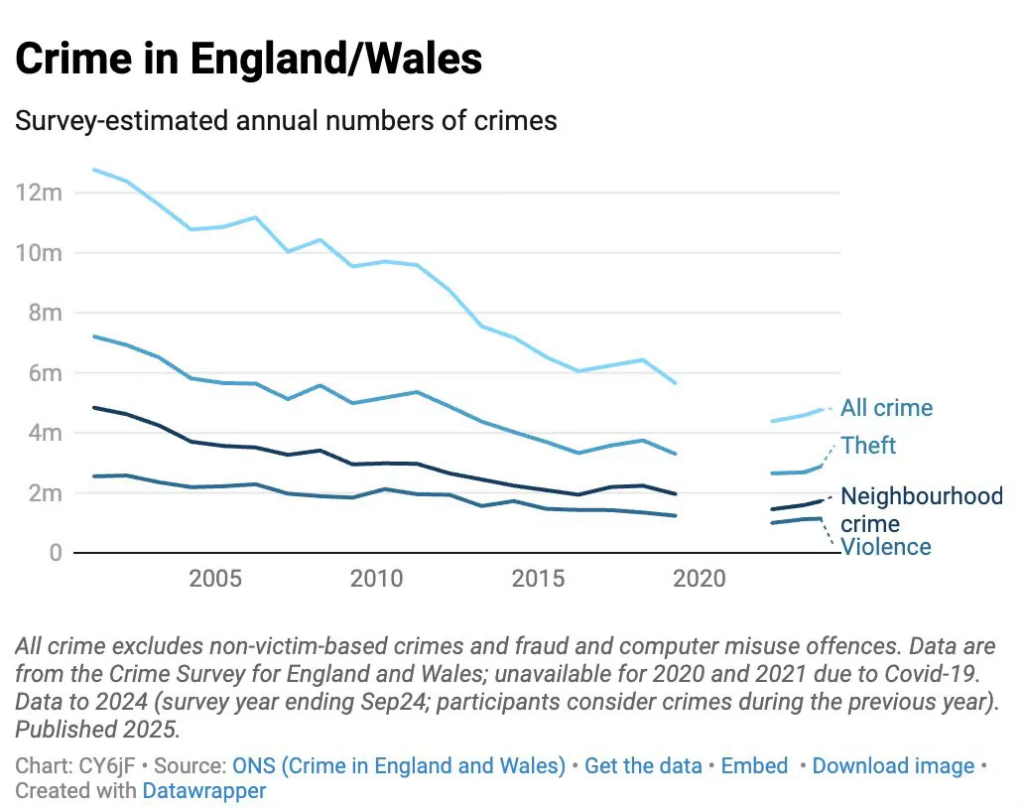
Now, one very important thing to note about this graph, as you will no doubt indeed have noted, is that it even in its own terms it shows that crime has actually been going up since the Covid lockdown era, albeit from an apparently low base. But that is if we simply take the graph at face value – which is something that, with graphs, one should never do. Graphs only ever at best depict part of the truth, and at worst tend to depict what we contract lawyers call ‘half-truths’ – that is, things which, while technically true in one sense, act to conceal what is in fact real.
What is important in this graph is what it does not depict. What it does depict is ‘survey-estimated’ data on the number of some crimes (read the small print). There are three, to my eye very important, things that it does not depict:
- Fraud and “computer misuse offences”
- The extent to which people carry cash about their persons
- The extent to which people leave their homes or are out-and-about
These three things are related. You will, if you read this Substack, most likely remember what life was like in 2000. Most people were not on the internet in those days, and life was much more public than it now is: very few people worked from home, and our social lives were pretty much exclusively carried out in the physical world – at each other’s houses, in the pub, in the theatre, in the cinema, in restaurants and so on. And we mostly paid for things in cash: we walked about with wallets and purses stuffed with physical money.
Over the past 25 years this has radically changed. People’s lives have since then become vastly more solitary and vastly more interior. We stay at home a lot more than we used to, spend an awful lot more time watching screens and do a great deal of socialising in a form that did not really exist in 2000, namely digitally. We also have for the most part abandoned cash.
It seems perfectly natural then, that crime survey data should over the period 2000-2025 have shown a downward trend (setting aside other factors, such as an ageing population) in respect of non-fraud and “computer misuse offences”. This is simply because the opportunities for many categories of crime have correspondingly vastly decreased: mugging is a much less effective career choice when very few people carry around enough cash to readily hand it over; violent crime is much less likely to occur when almost nobody is at the pub and nobody is staring at anybody else’s girlfriend because everybody is at home playing video games or watching porn; opportunistic burglary is much less likely to occur if people are at home all the time; armed robbery is not a rewarding pursuit in a cashless society; and so on.
It would have been bizarre, cast in this light, to have seen crime levels – i.e., crime taking place in the physical world – increase over the past 25 years. But this makes the graph Nelson shared largely meaningless. What we really want to see is the rate by which what we can call ‘physical crime’ has decreased in proportion to the extent to which people are actually physically outside of the home and in proportion to the extent crime now takes place online.
A graph depicting the rate of physical crimes alongside the trend lines for the amount of minutes people on average spend outside of the home, and the rate of fraud and “computer misuse offences”, may look very different. In fact, I am certain it would look very different. And it may indeed paint a very different picture to the one Nelson, Noah Carl and others do. It may depict a society not where ‘crime is falling’, but in which certain categories of crime are lower than in the past in nominal terms, and yet in which the risk of victimisation is higher. If there are five incidents of shoplifting a day in your local neighbourhood, for example, it may feel a lot more salient if people are only on average outside for an hour a day versus, say, five hours; and in relative terms the rate of shoplifting may actually be much higher.
This I think explains an awful lot of the discrepancy between the public perception that crime is increasing versus the picture painted by a partial reading of the crime survey data showing that it is ‘falling’. A fall in nominal terms may still feel like an increase, and may actually be a real-terms increase if the opportunities for crime to occur are much fewer.
And this is borne out by our real-world experience. Listen: I grew up on Merseyside in the 80s. I can remember a time when there was a genuine risk, when parking in Liverpool city centre, that your car radio would get nicked – this happened to our family car at least once that I can recall. I can also remember a time when it was not entirely uncommon for joyriders to leave the burned-out husks of stolen cars on pieces of waste ground or along the seafront in my home town.
But I can’t remember a time when it was an everyday occurrence, at which nobody batted an eyelid, for female shop staff to have to put themselves physically at risk to stop people from brazenly walking out of a shop with a bagful of merchandise without paying. And I can’t remember a time when this was such a common occurrence that nobody would even bother thinking to call the police if it happened. Nor, I think, can I remember a time when it was considered an unusual act for a bystander to intervene to help stop a crime from happening in front of his eyes. Now that I come to think of it, I can’t remember a time when it was a commonplace for staff to close a shop early of an evening in concern about potential ‘trouble’, either.
This is what the egghead Panglossians, typically living in nice leafy suburbs, and themselves spending an awful lot of each day sat in front of computer screens, fail to understand or really even think about. The minority of us who do actually spend time out and about see the bigger picture: the risk of being a victim of crime is a lot less if you’re at home all day watching Netflix. But that doesn’t mean that the risk is less when you venture outside of your front door. And nor does it say anything about the risk of the elderly being victimised by fraud.
The kind of gaslighting that tells us that ‘crime is falling’ is not, I think, intentional, but it is gaslighting, all the same. When it comes to facts on the ground, ordinary people tend to have a pretty accurate perception of the way things really are, and a political class that was in touch with those perceptions would recognise this to be the case and act accordingly. That we are afflicted with an intelligentsia that prefers to look at and lionise (narrow, partial, misleading) data, of course, is the mother of many more problems than the one identified here – though one evident to anybody with eyes to see. How to bridge the gap between public perceptions and a political class willing to act on those perceptions is of course a question too big for this post to answer, but one idea might be for the Fraser Nelsons and Noah Carls of this world to actually, you know, walk around outside in central Gateshead, Rochdale, Blackpool or Hartlepool a bit more.
Dr David McGrogan is an Associate Professor of Law at Northumbria Law School. You can subscribe to his Substack – News From Uncibal – here.
Stop Press: Sean Egan, the Morrisons store manager who says his life was completely “devastated” after he was sacked for confronting a repeated shoplifter, has appeared on Good Morning Britain to tell his story.


Discussion
Comments
This week across the site:
To join in with the discussion please make a donation to the Daily Sceptic.
Profanity and abuse will be removed and may lead to a permanent ban.
It’s not only the police who are useless and encourage theft but rights lawyers acting pro bono and in the CPS. They will sue shops if their client thief is injured. If David had intervened and thumped this scrote he could have been on the end of a huge claim. The law needs changing to exempt theives from rights and claims for injury. And of course the police should be told to police crime or get another job.
The claim that the crime rate has come down owes a lot to the lower murder rate which is no credit to the police but to the effectiveness of modern trauma centres that prevent deaths that would have occurred 50 years or so ago.
At a petrol station/garage in Lutterworth I had to go to the shop to prepay. I was puzzled as I wanted to fill up. I asked why and was told they had lots of people driving away without paying. I asked don’t you have cameras he said “yes but when we report the crime the police never do anything about it – it was costing us money”. They didn’t follow up one incident. This is how they reduce crime stats!
No police = no crime
Theft of & from cars has reduced enormously due to the change to integrated car radios, & the use of immobilisers.
In the 90s 500,000 car radios were nicked per year.
“You cannot take any people, of any colour, and exempt them from the requirements of civilization — including work, behavioural standards, personal responsibility and all the other basic things that the clever intelligentsia disdain — without ruinous consequences to them and to society at large.”
Thomas Sowell
I used to think of Fraser Nelson as a waste of space. That opinion was formed when I heard him speak soon after his appointment as editor of Speccie.
It is now clear he has not advanced since then. He has absorbed but not questioned the Blairite-Cameroon thesis that by sticking to the left of the public and promoting globalisation and immigration – all will e well.
Read Allister Heath in DT today. Spot on.
The police would do nothing, so it was pointless to report the crime.
So there’s another reason why reported crime stats are going down.
The police is there to protect the establishment, not ordinary people.
In fact it is there to protect the establishment FROM ordinary people.
Ordinary people have to figure out their own protection from each other.
And they can forget being protected from the establishment. There is no protection for ordinary people from the abuse of the establishment.
I have copied this from someone else’s post.
Peel’s Principles for the police:
1. To prevent crime and disorder, as an alternative to their repression by military force and severity of legal punishment.
2. To recognise always that the power of the police to fulfil their functions and duties is dependent on public approval of their existence, actions and behaviour and on their ability to secure and maintain public respect.
3. To recognise always that to secure and maintain the respect and approval of the public means also the securing of the willing co-operation of the public in the task of securing observance of laws.
4. To recognise always that the extent to which the co-operation of the public can be secured diminishes proportionately the necessity of the use of physical force and compulsion for achieving police objectives.
5. To seek and preserve public favour, not by pandering to public opinion; but by constantly demonstrating absolutely impartial service to law, in complete independence of policy, and without regard to the justice or injustice of the substance of individual laws, by ready offering of individual service and friendship to all members of the public without regard to their wealth or social standing, by ready exercise of… Read more »