


The media called it the Storm of the Century.
Hurricane Melissa, which devastated Jamaica last week, was certainly catastrophic with the death toll at the time of writing standing at 28 in the country. And, based on atmospheric pressure, it was the most intense Atlantic hurricane since Wilma in 2005. But Storm of the Century it most certainly was not.
Sadly, Jamaica has a long history of such hurricanes. One killed an estimated 400 people there in 1722. Hurricane Charlie in 1951 cost another 152 lives. The Greater Antilles hurricane of 1909 killed an estimated 4,000 across the Caribbean, notably in Haiti, but dumped an incredible 135 inches of rain on Jamaica. And so the list goes on.
The biggest storm of the lot came in 1780. Known as the Great Hurricane, an estimated 27,500 lost their lives across the Caribbean.
Every time there is a big hurricane, the media are quick to use them as climate porn, putting the blame on global warming. As usual, the BBC was quick off the mark with this outright lie from its weathergirl, Sarah Keith-Lucas: “The frequency of very intense hurricanes such as Melissa is increasing.”
Not according to NOAA, the US National Oceanic and Atmospheric Administration, which is the acknowledged leading authority on Atlantic hurricanes. In its latest review on hurricanes published earlier this year, it stated:
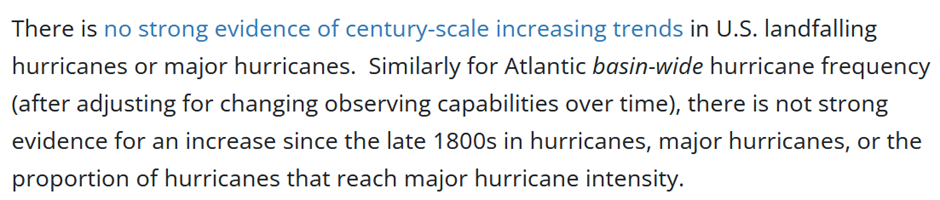
Major hurricanes are the strongest hurricanes, rated Category 3 and over. Below is the plot of hurricanes that have made landfall as


Discussion
Comments
This week across the site:
To join in with the discussion please make a donation to the Daily Sceptic.
Profanity and abuse will be removed and may lead to a permanent ban.
To be a pedant it was the storm of the 21st century so far. All the examples shown predate 2000. But of course the MSM are always going to hype extreme weather for political purposes to support net zero. We wouldn’t expect anything less.
Physicist Dr Ralph Alexander, delving into newspaper reports of extreme weather over the last century…
https://www.thegwpf.org/content/uploads/2024/03/History-Weather-Extremes.pdf
“…This report refutes the popular but mistaken belief that today’s weather extremes are more common and more intense because of climate change.”
We will soon be forced to only access ‘trusted media outlets’ if the EU and Starmer have their way.
Like the Beeb !!!!!
All the pictures that I have seen of storm damage showed most of it was caused by torrential water not high winds, but no-one seems to be talking about rainfall quantities.
Both with Melissa this year and one last year, before they hit land they were going to be ‘greatest ever” or “one in a thousand year event”. However, after they hit the damage and destruction was reported, but the hyperbole was entirely missing. They were bad, but not that unusual. I believe it was Beria, Stalin’s sidekick, that said “if you repeat a lie often enough it becomes the truth”. This seems to be the motto of climate science.
It was Lenin.
Modern technology enables the creation of hype and hysteria.
Before television, the news of a hurricane in Jamaica would have only resulted in a newspaper article with a few black and white photos, several days after the event.
These days, you will have live reporting, carefully choreographed, with dramatic background scenery and a reporter acting to convey a sense of the extraordinary.
The whole thing is very obviously manipulative and used to reinforce some ideological message (climate change, for example).
Also, I have noticed: when the BBC latches on to an ideologically expedient message, they just go on and on about it. The Jamaica hurricane was 15 minutes on the main 6 o’clock news, as if nothing else of any significance had happened on that day.
Our weather forecasts are the same. Anything other than 18 centigrade with low winds and little rain (preferably not in the south east) is a matter of contorted anxiety by the presenter (oh, have I exaggerated?).