

Over the past 15 months we’ve had a barrage of statistics presented to us shouting about how great the vaccines are at preventing hospitalisation from (or with) Covid. However, these statistics have been light on detail on how they were calculated and we’ve not seen much sight at all of the raw data that the statistics were based upon.
Until now. In April, a paper was published by the UKHSA (currently in pre-print, which means that it hasn’t yet undergone the usual peer-review process) on its statistical analysis of a selection of hospitalisation data by vaccination status. The intent of this paper was to support its statements that the vaccines prevent hospitalisation. However, the paper also includes the raw data upon which the UKHSA statistics were derived, and these data tell a very different story to that presented by the UKHSA. The data show:
- Far higher accident and emergency admission rates for reasons other than Covid in the vaccinated than in the unvaccinated.
- Much higher rates of hospitalisation due to non-Covid acute respiratory illness in the vaccinated.
- Even higher A&E admissions and hospitalisations in the double-vaccinated (not boosted).
- Even where the data suggest that the vaccines offer some protection (the risk of admission to intensive care resulting from Covid infection) the results look like they might be an artefact created by the assumptions used by the UKHSA.
In addition, the data strongly suggest that the UKHSA is using an inappropriate method in its statistical analysis of vaccine effectiveness – the test-negative case-control (TNCC) method. It is likely that it has been significantly overestimating the effectiveness of the vaccines at preventing hospitalisation.
The data released by the UKHSA and expounded below aren’t proof that the vaccines have caused a great deal of harm and injury to the population, but they do raise a huge red-flag that something is amiss. Urgent investigations need to be undertaken to clarify the situation regarding the safety and effectiveness of the vaccines.
A note on the Test-Negative Case-Control (TNCC) method
The basic concept of measuring vaccine efficacy (in a trial) or effectiveness (based on real-world results) is relatively straightforward – simply calculate the ratio of the proportion of the vaccinated that get infected (or hospitalised) with the proportion of the unvaccinated that get infected (or hospitalised). However, while this simple method can work well, it can be affected by differences in the types of people vaccinated and unvaccinated and more powerful methods are preferred.
The ‘gold standard’ for measurement of vaccine efficacy/effectiveness (VE) is the prospective matched cohort design. This is quite simple in concept – you simply divide the study into a number of groups of individuals with similar characteristics, based on the vulnerability to the disease and the typical effectiveness of vaccines. Matched cohort studies nearly always split into groups of similar age and sex, and will usually include many other factors thought to be related to risk of disease. For example, for Covid these might include race, BMI and whether the individual has diabetes – all factors identified in early data as being relevant risk factors.
The ‘prospective’ part means that the individuals are placed into their groups before they are given their doses of vaccine, but this isn’t the only way – it is possible to undertake a retrospective study where people are placed into their different groups after they are vaccinated (potentially some time after).
The problem with matched cohort trials is that they’re rather expensive and also require you to know what factors to control for when calculating vaccine efficacy/effectiveness. This led to the development of the test-negative case-control method. With this method you compare the ratio of positive (have the disease) to negative (don’t have the disease) tests results for a given condition (e.g. admission to hospital). This method, when applied correctly, automatically corrects for many biases, such as propensity to be tested or seek medical care, and is both accurate and removes much of the complexity and costs associated with matched-cohort studies. The important part is the ‘when applied correctly’ – if it is applied incorrectly then you end up with inaccurate and potentially misleading results.
The UKHSA data – Emergency admissions
Let’s apply the TNCC method to the data in the UKHSA paper on vaccine effectiveness at preventing hospitalisation. Fortunately, it offers raw data in its supplementary document. I’ll start with hospitalisations ‘with symptomatic Covid’ for those aged over 65 who presented to A&E for reasons other than accident/injury (Table S12 in the paper), and to keep things simple will look at ‘any vaccine’ (i.e., any number of doses) vs ‘no vaccine’ and only for the Omicron period (the data covers the period from 22nd November to 2nd February).
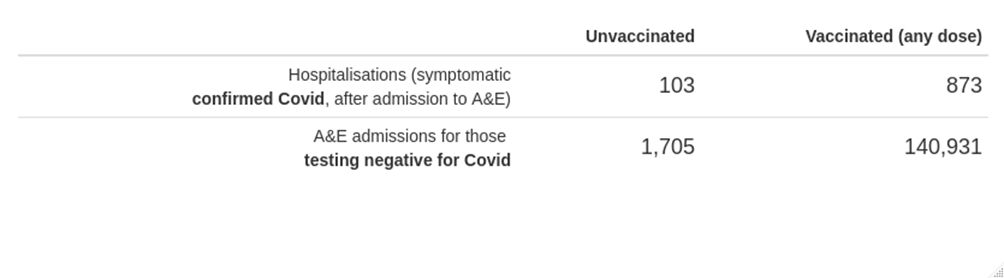
To show the TNCC method in action we can use the figures in the table above to gain an estimate of VE using the TNCC methodology:
VE = 100 × (1 – (873÷140,931) ÷ (103÷1,705) ) = 90%
Thus even with this simplified case where we only consider the protection offered by the vaccines to the ‘vaccinated group’ (with any number of doses, though most are boosted in the over-65 age group), we can see that TNCC estimates that the vaccines offer significant protection from hospitalisation, around 90%.
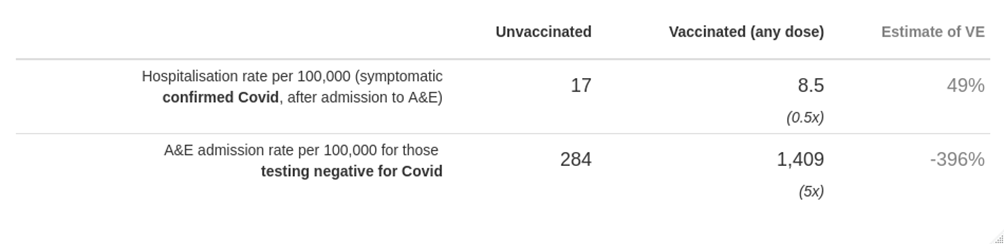
But wait – those raw numbers for A&E presentation by vaccination status look more than a little suspicious. We know that during the study period approximately 10 million individuals aged over 65 had been vaccinated with at least one dose of vaccine, and around 600,000 remained unvaccinated. Thus we can present the raw figures above as a ‘per 100,000’ to remove the effect of the size of the vaccinated vs unvaccinated groups.
Wow. According to the raw data the vaccinated are presenting to A&E without having Covid at around five times the rate of the unvaccinated. Sure, there are more hospitalisations with symptomatic Covid in the unvaccinated, but only by eight per 100,000.
In Table 2 above I have also included an estimate of vaccine effectiveness based on these raw data. Now, I’m being a bit naughty here as the data aren’t meant to be used this way – this is why I’ve used the UKHSA trick of greying out the text in the hope that no-one will notice. Nevertheless, for population-wide data this shouldn’t be too far out.
Now, I’m sure that epidemiologists up and down the land are shouting that the data shouldn’t be used in this way – and they’re right. It certainly doesn’t prove that the vaccinated are getting ill because of the vaccine. There are a number of reasons why this result might be found:
- The vaccinated might be much more likely to be hypochondriacs/malingerers and thus be going to A&E even though they’re not ill at all. More realistically, the vaccinated might have a lower threshold for the severity of symptoms required to get medical assistance at A&E. If this was the case then there would be vaccinated individuals presenting themselves to A&E where the average unvaccinated person with similar symptoms wouldn’t.
- The vaccinated might be much more unhealthy in general than the unvaccinated.
However, the sheer scale of the differences between the A&E visits not-for-Covid is huge, and given that these are population-wide figures I’d suggest that it couldn’t all be explained either by health seeking behaviours or because of general health – but I’d accept they they could certainly contribute.
Nevertheless, the TNCC assumption would be that the vaccinated are simply the type of people that are five times more likely to go to A&E (whether because of differences in behaviour or health) and thus they’re also going to be five times more likely to attend A&E with symptomatic Covid. The researchers would therefore adjust the figures to allow for this difference between the groups, boosting VE. I’d suggest that this latter point isn’t necessarily the case – it is very often the case that behaviours aren’t proportional like this, for example, just because an individual chooses to drive at 40mph in a 60mph zone, doesn’t mean he or she will drive at 20mph in a 30mph zone.
The alternative explanation:
- Some of the visits to A&E might be due to a reaction / side-effect / complication of the vaccines.
- The vaccines might have an impact on the immune system for diseases other than Covid, resulting in increased illness and thus presentation to A&E.
Just to be clear – we don’t know whether the vaccinated are seeing much higher admissions rates to A&E due to a vaccine effect or simply because the vaccinated have different behaviours and general health to the unvaccinated. However, anecdotal data on pressures on A&E services and on the general health of the nation (‘worst cold ever’) suggest that the vaccines may be at least partially responsible.
More on the emergency admissions data
The UKHSA paper also includes incidence by vaccination status (Table S12 again). We have to be a bit careful here as we don’t know when the individuals were vaccinated, but we do know that the incidence of Covid varied substantially through the period. Without information on which individuals were vaccinated on which date we run the risk of introducing a bias. However, we do have information about some aspects of the vaccinated population:
- Around 600,000 individuals over the age of 65 remain unvaccinated, and this hasn’t changed much for over six months (this is why it was safe to use this assumption in the prior analysis).
- The vaccination data suggest that around 90,000 individuals over the age of 65 took the first dose of vaccine during spring 2021 but didn’t receive the second dose.
- The vaccination data suggest that around 440,000 individuals over the age of 65 took their first and second doses of vaccine according to the vaccination schedule (i.e., early/late spring 2021) but didn’t receive the booster/third dose.
Table S12 splits out hospitalisation data for those vaccinated with their first dose more than 28 days before their positive test, and vaccinated with their second dose more than 175 days before their positive test. Thus we can tentatively include these specific data in our analysis – individuals that had their first dose (only) or second dose (no booster) some time before the study period started.
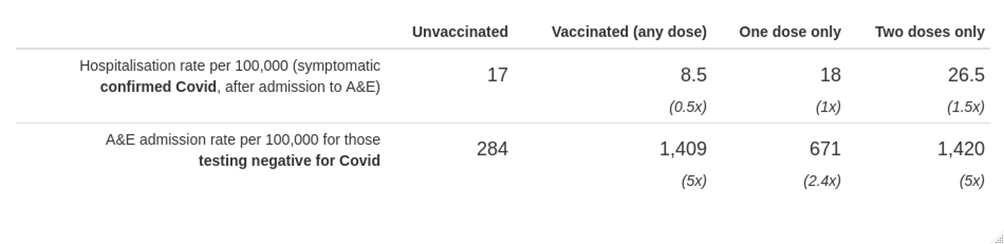
Two points immediately stand out.
First, the hospitalisation rate with symptomatic confirmed Covid in those that had a single dose of vaccine ‘some time before’ the study period is similar to the hospitalisation rate in the unvaccinated but their A&E presentation rate for ‘not Covid’ is 2.5 times the rate of the unvaccinated. The TNCC assumption would be that the similarity in the symptomatic Covid rate is a fluke and what’s important is that on average they’re simply the type of individuals that would go to A&E more often and if that group of individuals hadn’t been vaccinated they’d have had 2.5 times more hospitalisation rates ‘with Covid’. I suggest that it is far more likely that the single-dose individuals have no vaccine induced protection against hospitalisation but that they are very much more likely to attend A&E.
Second, the A&E attendance rate of the double-vaccinated (only) without Covid is very similar to the A&E attendance rate of the vaccinated (any dose). However, their hospitalisation rate ‘with Covid’ is 2.5 times greater than that of the vaccinated (any dose) – the double-dosed that didn’t take their booster appear to have the ‘worst of both worlds’: increased A&E attendance (non-Covid) and increased admission rates ‘with Covid’.
Summary so far:
- The UKHSA has provided us with some raw data on hospitalisations by vaccination status.
- Examination of the data suggests that ‘with Covid’ hospitalisation rates in the unvaccinated aren’t too far from those in the vaccinated (any dose). However, non-Covid admission rates for A&E are much much higher in the vaccinated (any dose) than the unvaccinated.
- The TNCC approach would suggest that the vaccinated are simply ‘the type of people’ more likely to attend A&E and that the vaccines really do offer substantial protection against hospitalisation ‘with Covid’.
- Examination of other data suggests that the single dosed have ‘with Covid’ rates similar to the unvaccinated but 2.5 greater A&E attendance (without Covid) and that the double dosed (only) appear to have the worst situation of all – much higher Covid hospitalisation and much higher non-Covid admission to A&E.
Admission rates for acute respiratory illness
Table S7 in the UKHSA paper presents data on hospitalisations after an A&E visit where the individual had symptomatic Covid (again, Omicron, over 65). This sounds like the condition for the previous table, but in that table the ‘Covid negative’ column counted all non-accident or injury A&E visits, whereas the data in Table S7 only consider those that had symptoms similar to Covid.
I’ll present only the rates this time (feel free to look up the raw numbers yourself).
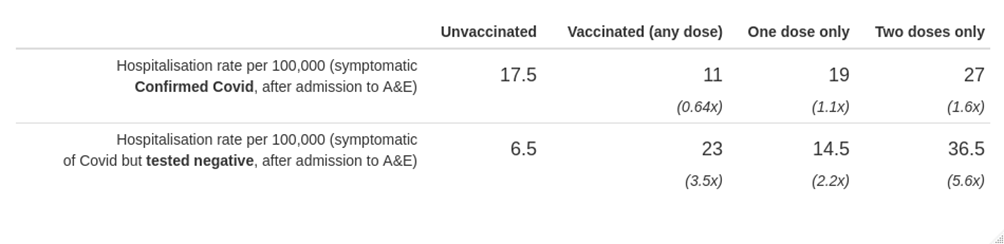
That’s perhaps even more interesting. In terms of the overall ratios it is a similar situation to the previous table – approximately 40% lower hospitalisations with symptomatic Covid in the vaccinated compared with the unvaccinated, but around four-fold higher rates for admission with symptoms that look like Covid, but aren’t Covid. But the interesting part is in the detail:
- Even though the absolute rates are very much lower, the unvaccinated still have the lowest admission rate to A&E. However, the difference for the data in the table above is that a doctor had assessed the individual and determined that he or she was ill enough to warrant hospitalisation. Thus the data in the table above are not influenced by the ‘symptom severity threshold’ that different individuals have before they’ll go to A&E. This is particularly of note because it suggests that the very high rates of presentation to A&E in the vaccinated in Table 1 and 2 are unlikely to be simply because of the vaccinated are more likely to go to A&E for ‘more trivial reasons’ than the unvaccinated – it looks like the vaccinated as a group really are more likely to be ill.
- Over twice as many of the unvaccinated are hospitalised with symptomatic Covid than with a condition that looks like Covid but isn’t (17.5 vs 6.5 hospitalisations per 100,000). However, twice as many of the vaccinated are hospitalised with ‘looks like Covid but isn’t’ than ‘with Covid’ (23 vs 11 hospitalisations per 100,000).
This latter point is important – one of the potential problems with vaccines (in general) is viral interference, that is, that a vaccine changes the immune response to other infectious diseases. Is it the case that the vaccines are significantly increasing the incidence of other respiratory infections? I note that last autumn/winter we had a mini-epidemic of what was popularly called ‘the worst cold ever’ – is this related?
However, the hospitalisation rate for symptomatic Covid might be more complex than it looks. In the UKHSA paper it appeared to define hospitalisation ‘with’ Covid to 14 days after the first positive test; if the individual presented to A&E after this 14 day period his or her data was excluded. It is possible that vaccination delays (rather than prevents) disease progression, in which case some of the hospitalisations with a condition that ‘looks like Covid but isn’t’ might in fact be due to a Covid infection that took longer than 14 days to develop to the point where hospitalisation was necessary. In addition, if the vaccinated were more likely to test themselves earlier in the progression of the disease then they might also be more likely to ‘run out of time’ and present themselves after the 14 day period has finished.
There’s another interesting aspect of these data – overall, the unvaccinated appeared to get around 24 hospitalisations per 100,000 of an illness that ‘looked like Covid’ (whether it was Covid or not) whereas the vaccinated appeared to get around 34 hospitalisations per 100,000. By this measure, vaccination is associated with an increased risk of a serious respiratory illness (whether Covid or not).
Again, the single-dosed appear to have the same risk of Covid as the unvaccinated, but increased attendance with looks like Covid but isn’t, and the double-dosed appear to have the ‘worst of both worlds’ – increased rates of attendance both with Covid and with looks like Covid but isn’t.
One more point – comparing Table 4 with Table 3, there appear to be far fewer admissions to A&E with Covid than without Covid. This indicates the current pressures on NHS A&E services are not related to Covid infections but ‘other things’.
The UKHSA data – Secondary uses data
The UKHSA paper also offers data using the NHS ‘secondary uses dataset’ (Table S10). This covers all hospitalisations and offers more granularity on the reasons for the hospitalisation and the level of treatment offered. The authors use a selection of the full dataset, where the admission was for an acute respiratory illness, and for several levels of seriousness.
First up are the data on hospitalisations for admissions for an acute respiratory illness where the individual was discharged the same day.
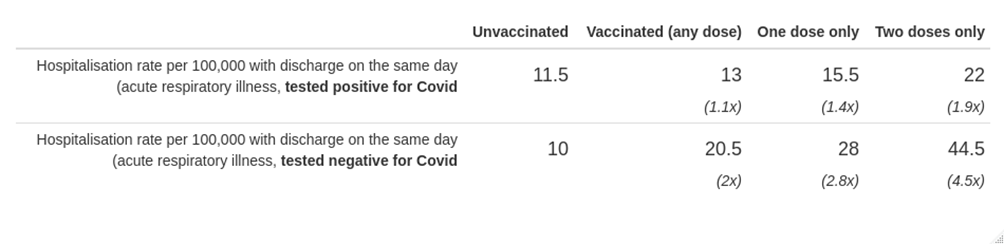
Two aspects stand out:
- The rate of serious Covid infection that warranted admission into hospital but that was not serious enough for an overnight stay was higher in the vaccinated than in the unvaccinated. This suggests that the vaccines increase the risk of being ‘somewhat unwell from Covid’. Note that this isn’t simply ‘infected’ – these individuals were deemed by experts to be sufficiently at risk of their illness to be admitted to hospital, even if they didn’t pass the threshold for an overnight observation/treatment.
- The hospitalisation rate of ‘somewhat serious but not Covid’ acute respiratory illness in the vaccinated was around twice as great as that in the unvaccinated, and even higher in those having only one or two doses of vaccine
This time we see that overall the risk of ‘somewhat serious’ acute respiratory illness (whether due to Covid or not) appears to be similar in the vaccinated and unvaccinated, and that those having taken one or two doses of vaccine (only) appear worst off.
What about a more serious symptomatic infection – perhaps acute respiratory illness requiring several days of hospitalisation and supplementary oxygen?
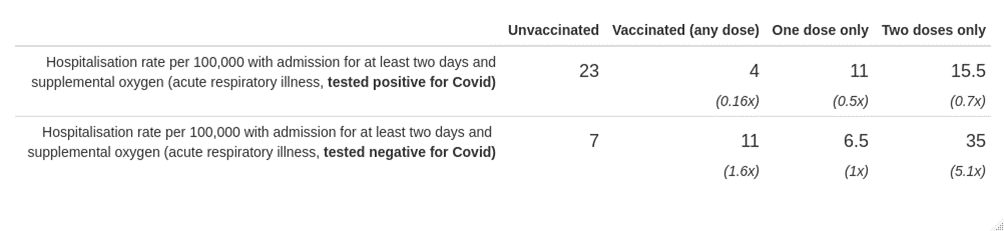
Here, at last, we appear to see some benefit from the vaccines – the unvaccinated appear to be rather more likely to be hospitalised for a few days following Covid infection (acute respiratory illness requiring supplementary oxygen), and even though they also appear to be less likely to be similarly hospitalised without Covid, this isn’t by so great a margin to remove the protective effect of vaccination.
But yet, I keep returning to the matter of the 14 day limit after the positive test. Individuals typically get to the point where they require supplementary oxygen some time after infection. If the unvaccinated aren’t testing themselves at the point where symptoms start but the vaccinated are, then they’ll be relatively more likely to get to the stage where oxygen is required within that 14 day period. Any delay in symptomatic disease in the vaccinated would only make this effect worse. Is the supposed effectiveness of the vaccines at preventing severe disease simply an artefact arising due to the fact that it takes longer to get to the point where the symptoms are severe, or due to the unvaccinated being more test-averse?
The UKHSA doesn’t report on the basis for the use of a 14 day limit – I’d very much like to see supporting data, or a sensitivity analysis in its paper, comparing rates for 14, 21 and 28 days after the positive test.
Conclusions
The UKHSA has at long last published raw data on hospitalisation rates by vaccine status, for those infected with Covid as well as those that aren’t. The results are very concerning, showing significantly higher A&E admission rates in the vaccinated for reasons other than Covid, and much less difference in admission rates for symptomatic Covid in the vaccinated vs unvaccinated than suggested by the estimates of vaccine effectiveness published by the UKHSA.
What I’ve shown here isn’t proof that the vaccines are causing harm – but it is a huge red-flag that strongly suggests that there might be a serious problem, and certainly indicates that a proper analysis of illness after vaccination needs to be undertaken urgently.
Furthermore, the significant differences in the ‘negative test’ arm of the UKHSA data suggest that the test-negative case-control method is not appropriate, and that a full retrospective matched-cohort study into vaccine effectiveness and safety should be undertaken.
Amanuensis is an ex-academic and senior Government scientist. He blogs at Bartram’s Folly.




Discussion
Comments
This week across the site:
To join in with the discussion please make a donation to the Daily Sceptic.
Profanity and abuse will be removed and may lead to a permanent ban.
My first thought when starting to read this article was that maybe there are more vaccinated going to hospital because the unvaccinated simply don’t want to go anywhere near a hospital. I certainly don’t. I was only thinking earlier on today before reading this that I never want to go to my surgery again to see a doctor and I never want to go to hospital or have anything to do with them. I have no trust in the NHS now whatsoever.
It could be. It certainly is an understandable mindset given where we’ve been over the last 2 years.
But in that case the difference in behaviour of the vaccination vs unvaccinated are sufficient to invalidate the TNCC method that the UKHSA is using to promote the use of the Covid vaccines.
I was reluctantly 2V&B since I needed to travel.
How long do I carry this “vaccine” around in my body before it’s all flushed out and I’m restored to my virginal status?
If there had been long-term trials, there may be an answer to that question.
Since there weren’t, the working assumption is that it is indeed like virginity- once lost, never restored.
Perhaps ask again in 10 years time, when the data from the phase 3 trials (which the world is currently undergoing) can be assessed.
How long does the ‘effect’ of a measles vaccine last? Or tetanus?
Too much information.
All we need to know is that TPTB are out to kill us with their vaccines.
Last week, an otherwise-sensible man I know told me by e-mail he was going to get his FOURTH jab later that day.
I asked him if he was aware that the alleged protection lasts for only a few weeks and suggested he gets boostered every month in the future.
No answer!
They were pushing ”boosters” in a small NHS tent on our market square last week. As people walked past, some yellow-gileted oik was hailing people with ”Are you up to date with yer boosters?” I wonder if he had any takers? I wonder if he had any punches on his nose?
I just do not have any kind of sympathy for the vaccinated I know of most well people through social events around early thirties mid forties at work early fifties who all proclaim they took it
it was the right thing to do and it protects others and that the unvaccinated must take it , but let them mess with their health and fertility if single in a relationship no children let them see what happens when they try for a child
just a few weeks back in such a lovely walk in Essex. I was walking with 27 people and there was a debate regarding a rather ignorant , person around early fifties saying the vaccine works and hardly any died taking it no knowledge of the Yellow Card Scheme
also a nurse was still going on how they saw thousands of people in hospital no mention of young healthy under 50
I just did not want to say much except the vaccine is clearly not a vaccine it does not stop the virus from creating a sterile environment and stop transmission and cannot stop you spreading it , however people still at vegan meet-ups and… Read more »
My daughter has two thirty-ish friends who both got jabbed in their first trimester.
Both subsequently lost their babies.
An admittedly small sample, but still rather concerning.
You have no empathy for those who were given the jab against their will or understanding? Those people are across the age ranges. You need to take time to think before you post.
“a condition that looks like Covid but isn’t”
I Can’t Believe It’s Not Covid!®
Doctors & Scientists’ Episode 27: 4-Foot-Long Blood Clots, Rare Cancers + COVID Vaccines With Ryan Cole, M.D.
https://live.childrenshealthdefense.org/shows/doctors-and-scientists-with-brian-hooker-phd/3vVzGhG804
Great interview with Ryan Cole. More up to date info from the last half. Recommended
Oh god. Is this going to put me off my tea? Maybe I’ll check this out later, once my spaghetti has long been digested! 😮
Thanks. Good interview.
They discuss, amongst other things, the approval of Remdesevir for babies as young as 1 month old.
funny how so called conspiracy theorists knew this say 18 months ago
Thanks for this analysis. And thanks to all those who made this type of analysis possible I.e those smart enough to maintain an all important control group of 100% unjabbed. Always knew that this would be key in uncovering the true nature of this democidal scandal
The Government did better than I expected in the local elections or if you prefer, musical chairs.
I’ve been thinking about a suitable replacement for BJ and reached the conclusion that we may only actually need a scam detector. I’m quite sure it’s not beyond the wit of man to create such a thing, obviously it would need to be able to detect scams both externally and internally, simple!
Unfortunately, democracy so often means voting for the party most likely to ensure that the ones you don’t like don’t get in.
The one thing that’s fairly certain is that, no matter how badly the Tories have managed this pandemic, it would have been worse had Labour been in charge
(I’m trying to no be party-political here — Labours utterances on the Tories’ Covid policies have mainly been to say that not enough was being done of whatever it was the Tories were doing. In terms of ‘parties’ etc, it is clear that a decent proportion of each political party was up to the same activities).
“Unfortunately, democracy so often means voting for the party most likely to ensure that the ones you don’t like don’t get in.”
I used to think that, but these days I am more inclined to agree with Peter Hitchens – conservatives should have stopped voting Conservative a long time ago, and spoiled their ballot papers or voted for actual conservative candidates, in order to destroy the Conservative party and allow an actually conservative major party to emerge. He’s a bit of a pessimist these days and thinks it is too late now – perhaps he’s right.
Watch on YouTube:
‘Russ Abbot, Lie Detector.’
About 3 minutes.
Not really relevant to this topic, but hilarious.
….
“a proper analysis of illness after vaccination needs to be undertaken urgently.”
Exactly. And we know it won’t be, as we also know that a myriad of other aspects of this whole business require proper analysis. Because our leaders are incompetent and/or evil, take your pick. Even a dummy like me can come with all sorts of questions that seem obvious that no government or other relevant body has looked into. They are all idiots or liars.
You can certainly come up with alternative explanations for the possible issue that amanuensis has kindly flagged here, but what I believe you cannot do is point to any remotely conclusive data anywhere that shows how the unprecedented trillions spent on covid measures, lockdowns, testing, vaccines, masks have had any statistically significant, measurable positive impact on public health – in fact the data point mainly in the opposite direction.
If covid was the unprecedented threat it has been portrayed as, and the vaccines and other bollocks were anywhere near useful, after several trillion dollars spent worldwide you’d think it would not be too hard to show a positive impact.
The biggest problem is that the medics and scientists mark their own homework.
There need to be conferences where they are required to face brutal criticism, based on trenchant but dispassionate analysis.
But what do they do? They organise a meeting with the RSM to ‘reflect on the two year learning journey of Covid19’.
That meeting needs serious barracking and interruption by protestors.
We really need to have robust, independently agreed, defined metrics for every policy introduced before they’re started. That way we can avoid the trick of deciding what constitutes ‘success’ after the event (and cherry-picking the thing that looks best) — or even just ignoring success criteria altogether.
But, of course, politicians never ever ever do this — it is beaten into them at the earliest opportunity that to do so will only result in people realising that they’ve failed to do what they said they’d do. This is seen in all aspects of politics, from having a new roundabout installed in a town all the way to national-scale fiscal policy.
The public really do need to be educated on the types of tricks used by politicians, but (of course) the politicians make it such that the public aren’t informed of their tricks wherever possible.
A good example of this is the current plans to make ‘disinformation’ more or less illegal. A reasonable solution would be for governments to have to define rigidly what things are disinformation, and then if it turns out that the government was incorrect they should have to offer a public apology (paid to be on the… Read more »
“A good example of this is the current plans to make ‘disinformation’ more or less illegal. A reasonable solution would be for governments to have to define rigidly what things are disinformation, and then if it turns out that the government was incorrect they should have to offer a public apology (paid to be on the front page of newspapers etc) and compensation to those that they claimed were spreading dis/misinformation.”
Sorry but why should a government be in the business of defining what constitutes disinformation? They are the last people you’d want doing that.
“The public really do need to be educated on the types of tricks used by politicians, but (of course) the politicians make it such that the public aren’t informed of their tricks wherever possible.”
Someone posted the other day that people should be taught statistics and specifically how statistics can be used to manipulate data and present things in different ways to support different conclusions for the same data. That seemed like a good idea. I discussed with someone who has recently (last 10 yeas) been in secondary education in the UK. Their sociology GCSE (or some GCSE anyway) did indeed cover this. Guess what – the example was how the wicked Far Right distort the amount of benefit fraud. Perhaps they indeed do, but the trouble is that because education in the UK has now been more or less completely taken over by the political left, what kids will learn is never going to be balanced. What they truly need to learn more than anything else is how to spot the Noble Lie, but they won’t get taught that because the educational and political establishment are all busy telling Noble Lies.
Apparently the fact that most of us are still alive is all the proof some people need.
In comments under a DM article about some woman who was vaxxed + boosted and had corona for the second time, some (probably paid) commenter kept saying that “she was still alive, wasn’t she”, as if that were proof enough that the vaxx and masks were worth it. Forget most people didn’t wear masks to start with (and many never wore them at all) and there was no vaxx for almost a year – and yet, the vast majority of us are still here to tell the tale.
This is why we, the unofficial ‘control group’, are more important ( and obvious ) now than ever. Keep shoving it in people’s faces, I would! Anything to help the pennies start to finally drop. We are the inconvenient contradiction to their cult-like belief system and they’re going to have to acknowledge that sooner or later.
“Covid and with looks like Covid but isn’t.”
Covid looks like Covid, but also isn’t.
Those Who Lined up to Get injected with a Bioweapon Hospitalised for Non-Covid Reasons at FIVE Times the Rate of the Unvaccinated, U.K. Government Data Show
Fixed the title for you.
Amanuensis, you’ve mentioned before that you think the vaxx might simply delay progression of disease, rather than prevent it. I think you’re right – an individual’s immune system either clears the virus or it doesn’t.
Have you seen the latest feedback on Pfizer’s Paxlovid drug? In a small percentage of people the viral load declines after taking the expensive pfizermectin, only to rebound some 10 days later. Pfizer has apparently said that the same thing happened to approx. the same number of people in the placebo group. Both the vaxx and the drug appear to provide some relief against symptoms but for some individuals only temporarily. I think this backs up your theory of delaying progression rather than prevention of disease.
Great work Amanuensis.
Thanks!
Pilots Injured by COVID Vaccines Speak Out: ‘I Will Probably Never Fly Again’
This ‘data’ could just as much be because of the psychological effects on people depending upon when the get ill compared to the date of their latest COVID jab, plus, of course, the fact that the older age groups are jabbed to a far higher degree than younger age groups and are generally far more likely (taking the pandemic out of the equation) to be hospitalised.
What scientists, clinicians and journalists SHOULD be concentrating on is the huge raft of data on their ‘vaccine’s’ safety and efficacy being issued by the likes of Pfizer after that court case in the US. Notice how there has been a virtual blackout in the mainstream media on that subject.
The data are per 100,000, so already take into account percentage jabbed.
I agree, it is possible that at least some of the effect seen is behavioural — that’s one reason why we really need to do proper analysis on the safety and effectiveness of the vaccines, and not rely on TNCC (which hasn’t been validated for Covid).
The Pfizer data would also support a proper and substantial study being undertaken.
“Safety and effectiveness” 2,000 dead in UK attributed directly to the ‘vax’ , 20,000 plus dead the EU . 20,000 plus dead in the US plus millions suffering from serious side effects ….these figures judged to be the authorities to be underestimates at best.
Add ‘official’ acknowledgement that the vaccines (1) do not prevent you from being infected by the virus and (2) do not stop you from transmitting he virus to others.
Exactly what specific further “study” would like to see before forming an opinion on their “safety and effectiveness”?
We need a proper large scale matched-cohort longitudinal study.
It would have been better if was randomised and prospective, but it is too late for that now.
The lack of such studies is inexplicable. Sure, there was an ‘urgency’ at the start of vaccination as they tried to get through the most vulnerable — but they could have been preparing the way at the time they were giving out the very first jabs. This would have been expensive, but nothing like the costs of Covid so far (including the pathetic track and trace). Also, the costs to the economy of illness and disability is huge, and a proper study would have almost certainly been cost effective.
They could even have done this with the younger jabs (<30) and boosters, but they didn’t even bother with those.
It is almost as it our authorities are doing everything in their power to avoid doing a proper study.
That’s why you need rival organisations trying to show how clever they are, without fear of cancellation. Otherwise the vested interests of a medical system attempting to govern a country will eventually kill many of us by neglect and blind dogma.
We need accurate and honest reports on the number of deaths verified by coroners as a direct result of taking the jab and to investigate the large number of ‘side-effects/vaccine damaged’ people many of of whom do not report their problems or attribute then to the vax .
It seems that the underplayed and under publicised ‘ Yellow Card’ system has all but given up accepting reports of the injuries being caused .
We also need more of those previously healthy people, who are ill to begin to be encouraged to attribute their varied conditions and health problems to the vaccinations which currently many seem not to do and we need the Medical profession to take their concerns seriously which currently appears not to be the case!
This whole process has been smothered in obfuscation and a refusal to face the facts – the ‘vaccine’ is dangerous for far too many people to be considered either “safe” and we all know it is not “effective” .
Anyone would think they had something to hide.
Per 100k does not take into account the nature of the groups – just the numbers affected. What they need to do is take into account all factors so that they can compare people on a like-for-like basis, which ain’t easy, as you’d have to take out the following factors:
Age, general health (including what other ailements they may have and their severity and what treatments they are getting), race (because genetics may play a part), size (height, build) and physical condition (fitness, level of muscularity/fat in combo with size), allergies, sex, financial and mental health.
Rather tricky to do, given most people tend not to give all that sort of data, even when giving a ‘history’ to a doctor, let alone when getting a jab.
To me, of the older age groups, those not getting the COVID jab are likely to come from three main groupings or a combination thereof:
a) those who clinically cannot have them;
b) those who are well above average in terms of health / fitness for their age, and who don’t like relying on pills / medical interventions unless absolutely necessary (and who likely are quite savvy / intelligent – though not necessarily acamedically);
… Read more »
Plus, unless im mistaken, its also important that each of age groups above 65 are at similar levels of vaccination uptake, especially above 70. Ie there is not a big bias in having lots more of 65-70 year olds (healthier in theory and hence potential to lower the rates in unvaxxed group unfairly) in comparison to over 80s. 65-70 is about 3-4% down in vax uptake compared to 80 plus, but 70 plus is all very close.
These gene-based injections are a depopulation bio-weapon.
The globalist element within our governments wants to murder us and our children.
Resist.
Avoid digitisation.
Use cash.
Meditate.
Connect.
This only proves that everyone needs to take another shot. And then another, and so on. The problem is people not having enough of this safe and effective… ‘stuff’ injected into their bodies. Anyone that thinks otherwise is obviously deranged.
Regards,
Bill.
However, I’ll say thanks but no thanks to your kind offer of a shot for me personally. I’ve considered it very carefully and I’ve decided to make my doses available to the rest of the world’s people.
Sincerely
Bill.
I’ve donated all my shots to members of my state government.
How right you are. Anything that is effective at making you safe, should be encouraged. Or, better still, enforced. You know, to keep everyone else safe too. You can’t be too safe. Everything that makes you safer is, by definition, good and desirable. Just imagine a world where everyone is so safe, that they simply don’t know what being in any kind of danger means any more. Surely living in such a world is so desirable that everything else should be sacrificed in order to achieve it. And it is possible, if only everyone were to comply fully with our benefactors who know best. So get more and more jabs. You know it makes sense.
But it would be so much WORSE if…
Hmm. Maybe not.
(This is not an advertisement)
If you are an attention seeking, drug taking hypochondriac, keen on being seen as a pin cushion for untested medication then you’re going to love our latest vaccine, which WE guarantee won’t work. With too many side effects to count, our latest vaccine will really
changechallenge your immune system. Pop along to your localdrugsupplierDoctor for details and remember, being completely mental isn’t a crime.It would be interesting to see a study on the causes of A & E admission between jabbed and un-jabbed.
I suspect heart attacks, strokes, blood clots and myocarditis will feature far more highly in the jabbed population.
We do have the data on hospital emergency consultations.
In this we don’t see much change at all in terms of consultations with cardiac specialists. This might be because we don’t have data by age and the very high consultation rate in those aged over 60 would dominate; any increases in consultation rates in those aged under 50 or so would be very small in comparison (even if very high and worrying for that age group).
We do see a significant rise in emergency consultations due to stroke.
There’s also a significant increase in consultations due to cancer, but this is probably (not definitely) due to lack of medical surveillance and early treatment during lockdown.
Thanks for the analysis, excellent work. I just want to make sure I understand the rates – does the data show increased rates of stroke and cancer amongst the vaccinated? Or just an overall uptick?
Just an uptick — they don’t give the numbers by vaccination status.
I’ve heard eye emergencies have spiked. Includes blindness.
Jefferey Jaxen “NEW DATA SHOWS TROUBLING TREND IN VACCINATED” – https://rumble.com/v11zuuo-new-data-shows-troubling-trend-in-vaccinated.html
Public Health England data from about 5 minutes 45 seconds into the video
Nicely understated there. ‘Don’t worry, vaccinated person. You’re just part of a troubling trend.’
I prefer Spike Milligan’s version. There’s a lot of it about!
I would like to ask Amanuensis a question.
You’re claiming that vaccinated people are being hospitalised at 5x the rate of the non vaccinated. But given that over 90% of the population have been vaccinated, that should mean that the overall hospitalisation rate is also not far off 5x what it was before.
I’m pretty sure that is not the case!
You’re right — these rates need to be compared with actual hospitalisation data, which aren’t vastly higher.
But note that these data are for illness only (even the test negative). The majority of hospitalisations are after accidents or injury, so you’d not expect to see the 5x difference in total admissions.
Also note that anyone attending hospital more than 14 days after their positive test wouldn’t be included in the numbers (at all) — given the huge numbers infected during the Omicron wave this’ll also remove many hospitalisations from the rates presented in this post.
The post was for data for those aged over 65 — the data are less clean for those aged under 65 and while the data do show a similar effect it is smaller in magnitude.
Finally, we’re still in a period where the NHS are begging people to stay away, yet total A&E rates are still high.
I’d like to understand that in context (ie what percentage of overall admissions are covered by your figures) but I can’t find stats which break down admissions by condition.
A fivefold increase in admissions is just massive. So great, that you would surely expect staff to notice and for it to cause an immediate crisis in an NHS which was on the edge in the first place.
But that has happened – any suggestions why?
At least half of A&E admissions are due to accident/injury. Also, most admissions are in those aged <65, and then mostly accident/injury — the data suggests a lower excessive hospitalisation rate in the vaccinated aged under 65.
I’d guess that a 5x increase in hospitalisations resulting from illness in those aged >65, and 2x in those aged <65 (that’s a guess based on what we can see) should lead to a 50% increase in overall A&E admissions.
We’ve not seen this overall increase — however, as I suggested upthread this is at a time where the NHS are begging people to stay away — if the NHS pleadings would have managed to reduce A&E admissions by 30% then my calculated 50% increase would get you back to ‘normal levels’.
I’d also note that the NHS does seem to be in an immediate crisis.
Thanks for the figures.
As you say, your analysis implies a circa 50% increase in A&E admissions. This hasn’t happened, so you need to find reasons why not.
I think there is evidence to suggest some people were not presenting for care as readily as in normal times (although this is declining). Although that also means they were less likely to be particularly sick in the first place.
However, there’s a strong counter-acting pressure from GPs into A&Es and NHS 111, because the GPs can’t handle it. I know for a fact that’s happening on a significant scale in my town. Increased difficulty in getting GP appointments is a major issue across the country.
Your figure is just too big to be explained by behavioural factors. Either something is wrong in the figures, or some additional explanation is missing.
Why don’t you get off your fat arse and do it instead of instructing others.
Typical socialist.
If that’s your hypothesis, then find the evidence for, and against it.
One minute you’re instructing people on what they should do, the next your presenting your vague idea on something with no evidence.
Present your factual evidence then.
I was suggesting a reason that might help his argument.
Re the 50%: If the prominent efforts to discourage people from attending A&E managed to reduce attendance ‘for ordinary reasons’ by 30% then the additional 50% I’ve suggested would get figures back into the normal range. I’d suggest that a 30% reduction isn’t an unbelievable figure.
But I’d accept that the figures do show something is up that isn’t easily explainable — that’s why we need proper studies to be done, and also why using the TNCC methodology isn’t appropriate for these data (and thus indicates that the UKHSA’s estimates of VE are likely to be misleading).
Ok, thanks
Bollox. I spent the best part of 6 months in hospital over 2020/2021 and didn’t see or hear of covid.
One ward I was in was completely empty other than me.
Appreciate that however, my point was that Fingal just talks out his backside.
That was probably at the request of the other patients
Yeah. I’m not stupid enough to get vaccinated like you.
Refusing vaccinations come with considerable benefits. Imbecile……
It’s not a claim, it’s data analysis.
Thanks — it is an important point. The data show that the vaccinated have 5x the A&E admission rate than the unvaccinated. The question that needs to be answered is why. It isn’t necessarily that it is due to the vaccines (could be health or behavioural) — but we won’t know unless we look.
It’s a tough job when you’re surrounded by experts like Fingal……………..
Appreciated by most of us though. As you suggest, if we don’t ask, we don’t get.
New UK government data shows the COVID vaccines kill more people than they save (Steve Kirsch) – https://stevekirsch.substack.com/p/uk-government-data-shows-nobody-should?s=r
Steve is late to that party — we were discussing prior releases to these data back in November (see posts by Prof Norman Fenton).
Also Joel Smalley – ONS manipulating figures/data fraud, article from him today.
Metatron substack.
(Apologies if referred to elsewhere)
There’s certainly something weird going on with the ACM data. I’ve got my own hypothesis (who was vaccinated and when), but the only way we’ll find out is by looking into it — which is something our authorities seem very keen to avoid doing.
It definitely wasnt a deadly pandemic by any standards, many of us realised that from the start and the politicians by their actions appeared to also, so they must have wanted it to look like a pandemic for other reasons
“It definitely wasn’t a deadly pandemic by any standards”
That’s about it, as far as a ‘virus’ is concerned, but there has been a pandemic of State Control and Profiteering.
Many more people have been vaccinated than not, and a lot more older people have even vaccinated than younger people. Think elderly vs children. So it isn’t any surprise that hospital admissions are higher for the vaccinated. Sorry, but this is just fake news.
The data are per 100,000, so already account for proportions vaccinated.
I’ve done no analysis on the impact of the vaccines for those aged under 65 — I don’t know why you bring children into your comment.
The reason why I didn’t analyse hospitalisations for those aged under 65 is because there’s too much variation in hospitalisation risk by age and non-uniform vaccination rates by age. That said, even with this restriction the data do also suggest increased hospitalisations in the vaccinated aged under 65.
So if 90% of over 65s are vaccinated, and 10% not, are you saying that this doesn’t have a bearing on the rates of hospitalisation in general? Bearing in mind that the 10% might be relatively fit and healthy, and that the 90% covers almost all other people?
Per 100,000 cases ‘so already account for proportions vaccinated’!
No, because it is 100,000 of two potentially very different groups.
It’s like saying “the rate of couch potatos being admitted to hospital is lower than the rate for people who regularly exercise”…
Congratulations! You win the dumbest take of the comments award.
The figures were per 100,000!
I thought the ‘vaccine’ was supposed to stop you even contracting the virus never mind spreading it or needing hospital treatment – why don’t we talk about the ‘fake vaccine’ that simply doesn’t work in the manner originally claimed but does appear to make you ill?
There is a web of deliberate deception at work here and discussing who and who is not in hospital gets nowhere near addressing it!
I am not in a good mood today so I will indulge in some schadenfraude.
We warned you we said it was exotic technology, untried, untested. But no, you believed the telly!
Great work. But, it further highlights the scandal of UKHSA removing any comparative data from the weekly vaccine surveillance reports. As deficient as they were they were interesting that they showed the declining position of the boosted. They were also useful insofar as they trashed the Prof Spiegelhalter/More or Less argument about NIMS v ONS population data.