Cases

The Figures Don’t Match Up To the Fear, a Doctor Writes

There follows a guest post from our in-house doctor, formerly a senior medic in the NHS, who says the widely trailed tsunami of hospitalisations has not only failed to arrive after ‘Freedom Day’, but we seem to be on the downslope of the ‘third wave’.

The philosopher Soren Kierkegaard once remarked: “Life can only be understood backwards, but must be lived forwards.” I have been reflecting on that comment, now we are three weeks since the inappropriately named July 19th ‘Freedom Day’. Readers will remember the cacophony of shrieking from assorted ‘health experts’ prophesying certain doom and a tidal wave of acute Covid admissions that would overwhelm our beleaguered NHS within a fortnight. Representatives from the World Health Organisation described the approach as “epidemiologically stupid”. A letter signed by 1,200 self-defined experts was published in the Lancet predicting imminent catastrophe.

Accordingly, this week I thought I should take a look at how the apocalypse is developing and then make some general observations on the centrality of trust and honesty in medical matters.

Let’s start with daily admissions to hospitals from the community in Graph One. Daily totals on the blue bars, seven-day rolling average on the orange line. Surprisingly the numbers are lower than on July 19th. How can that be?

Perhaps there are more patients stacking up in hospitals – sicker patients tend to stay longer and are hard to discharge, so the overall numbers can build up rather quickly. So, Graph Two shows Covid inpatients up to August 5th. Readers should note that Graph Two includes patients suffering from acute Covid (about 75% of the total) plus patients in hospital for non-Covid related illness, but testing positive for Covid (the remaining 25%). How strange – numbers seem to be falling, not rising. This does not fit with the hypothesis – what might explain this anomalous finding?

Maybe the numbers of patients in ICU might be on the increase – after all, both the Beta variant and the Delta variant were said to be both more transmissible and more deadly than the Alpha variant. Graph Three shows patients in ICU in English Hospitals up to August 5th. It shows a similar pattern to Graph Two – a small fall in overall patient numbers in the last two weeks. I looked into the Intensive Care National Audit and Research Centre ICU audit report up to July 30th. This confirms the overall impression from the top line figures. Older patients do not seem to be getting ill with Covid. Over half the admissions to ICU with Covid have body mass indices over 30. Severe illness is heavily skewed to patients with co-morbidities and the unvaccinated. Generally speaking, the patients have slightly less severe illness, shorter stays and lower mortality so far.

Finally, we look at Covid related deaths since January 1st, 2021, in Graph Four. A barely discernable increase since the beginning of April.

So, whatever is going on with respect to the progress of the pandemic, the widely trailed tsunami of hospitalisations has not arrived yet – in fact, we seem to be on the downslope of the ‘third wave’.

Should We Be Surprised That Case Numbers Have Been Falling?

“Scientists are scratching their heads over the precipitous decline in daily COVID-19 infections”, says a recent article in the journal Nature. “A sharp fall in the number of people testing positive has surprised scientists”, says a piece in the FT. According to the epidemiologist John Edmunds, “Nobody really knows what’s going on.”

Should scientists really be surprised by the fall in case numbers? Yes, some remaining restrictions were lifted on July 19th – the U.K.’s supposed ‘Freedom Day’. But cases have fallen in the absence of restrictions many times before. It’s therefore hardly surprising they would do so again.

To identify previous examples where infections fell in the absence of restrictions, I utilised the Oxford Blavatnik School’s COVID-19 Government Response Tracker. Specifically, I looked for examples where cases fell from a peak at a time when there were no mandatory business closures in place, and there was no mandatory stay-at-home order.

I was able to identify nine examples. (And note: one’s ability to identify examples is limited by the fact that almost all countries have had either mandatory business closures or a mandatory stay-at-home order in place during each successive wave of the virus.)

The nine examples are as follows: Sweden in the spring of 2020; Japan in the spring, the summer and the winter of 2020; North Dakota in the winter of 2020; South Dakota in the winter of 2020; Wyoming in the winter of 2020; Utah in the winter of 2020; and Iowa in the winter of 2020.

In all nine cases, infections fell in the complete absence of either mandatory business closures or a mandatory stay-at-home order. (Though in some of the cases, there were restrictions on large gatherings, or other less intrusive measures in place.)

It should be noted that all these locations other than Japan have relatively low population densities – which presumably equates to lower transmission, all else being equal. (And Japan’s “success” in dealing with the virus may be due to some cultural or biological factor that is common to every country in South East Asia.) Nonetheless, differences in population density are of degree not of kind.

So what explains the declines – did people just change their behaviour voluntarily? Not necessarily, as I’ve noted before. In South Dakota, cases began falling rapidly in mid November, despite almost no government restrictions and little change in people’s overall mobility. How could this happen?

One possible explanation is super-spreaders. We know there is substantial variation in transmissibility across individuals. Most people don’t transmit the virus to anyone; but a few people spread it to many others. Perhaps cases start declining once enough of these super-spreaders have been infected.

Whatever the true explanation, lockdowns are not necessary for infections to start falling (even if they may cause this to happen slightly earlier or slightly faster than otherwise). Why, then, are the scientists so puzzled?

One reason, as Philippe Lemoine noted in our recent interview, is that some epidemiological models simply assume that only lockdowns can have a large effect on transmission. Not particularly scientific, you might say, but that’s modelling for you.

The fact that infections have been falling in the U.K. is actually even less surprising than I’ve suggested so far. That’s because over 93% of Britons now have Covid antibodies – acquired from either vaccines or natural infection (whereas in the examples listed above, the numbers were far lower).

In summary, a decline in case numbers is only surprising if you’re reasoning from a flawed model.

Reported Covid Cases Down by More Than a Fifth on Last Thursday in U.K.

Reported Covid cases have fallen by 22% compared to last Thursday and cases are falling in every English local authority. MailOnline has the story.

The Department of Health posted another 31,117 infections spotted in the last 24 hours, down by more than a fifth (22%) on last Thursday.

But hospitalisations rose by nearly a quarter to 932 admissions a day, and another 71 deaths were recorded which was the same as last week. Experts say hospitalisations may fall in the next seven days, and that they lag behind cases because of the time taken for someone who has caught the virus to fall seriously ill.

Separate Public Health England data today added to the promising picture by suggesting Covid cases were now falling in all of England’s 149 local authorities, and every age group except the over-80s.

Their weekly report showed, however, that fewer tests were being carried out which may be behind the drop in cases. But the positivity rate – the proportion of swabs that detected the virus – also fell, suggesting the trend is genuine and not skewed by a lack of swabbing.

But another report from the Covid symptom-study app today suggested Covid cases are not falling as fast as official figures suggest, and may have just plateaued last week.

King’s College London scientists estimated just over 60,000 people were catching the virus every day in the week to July 24th, the latest date available. This was barely a change from the previous week.

Worth reading in full.

Covid Cases Have Fallen Every Day For a Week

Covid cases across the U.K. have fallen for the seventh day in a row, reaching 23,511 on Tuesday. This is the lowest number recorded in a single day in the whole of July. MailOnline has the story.

The Department of Health recorded another 23,511 infections across the U.K. over the past 24 hours, down by half on last Tuesday. This marks the biggest week-on-week fall in cases since they started coming down last week.

There were 131 Covid deaths, which was up by more than a third in seven days and the highest number since mid-March when the second wave was dying down.

Boris Johnson desperately tried to dampen rampant optimism about falling Covid cases today, saying people must not jump to “premature conclusions” and the Government will be “very cautious”.

But his comments came just hours after ‘Professor Lockdown’ Neil Ferguson hinted the U.K. could be looking back at the pandemic in just two months time.

Professor Ferguson suggested the current dip was down to the end of the Euros football tournament and warmer weather allowing people to spend more time outdoors.

He added there would be “uncertainty” into the Autumn, but stressed that the calculations had “fundamentally” shifted because of the vaccines. …

Experts have suggested that high numbers of young people catching the disease during the Euros could have helped to squash the latest peak, as they now have some immunity and otherwise may not have been vaccinated.   

Worth reading in full.

Stop Press: SAGE panjandrums have been trotting out excuses for why they got this so wrong. According to MailOnline, the top contenders are:

  • The vaccine roll-out
  • School holidays
  • The end of the Euros
  • Warmer weather
  • The ‘pingdemic’

But, surely, all of these things were completely foreseeable? Why, then, were they not included in the models? And given that the scientific ‘experts’ left all these things out, why should we trust SAGE’s modelling again?

Caroline Lucas MP Says “Cases Are Soaring”. Hasn’t She Seen the Data?

A reader has forwarded an email sent by Green Party MP Caroline Lucas via the platform of March for Change in which she reiterates the need for an immediate public inquiry into the Government’s handling of Covid. As with most people calling for a Covid inquiry, she accused Boris Johnson of lifting the coronavirus restrictions “too soon”. That restrictions suppress infections is simply taken for granted.

The odd thing about this email is that it appears to have been written a week ago since it makes no reference to the fact that the number of daily cases yesterday was 40% lower than it was on July 18th, the day before ‘Freedom Day’. By going ahead with ‘Freedom Day’, Caroline Lucas claims, the Prime Minister has “chosen to bury his head in the sand and simply hope for the best”. As a result of this criminal recklessness, “the third wave of Covid [is] sweep[ing] across the country”, she says, and”cases are soaring”.

In fact, official figures show that cases are falling or levelling off in every region of England, including Caroline Lucas’s Brighton constituency. As Will Jones has pointed out, “the myth of the exit wave persists” – and the fact that this myth is so impervious to facts makes it look like a pro-Lockdown conspiracy theory.

The same goes for Lucas’s claim that hospitals are filling up (see orange line in graph below).

Professor Adam Finn of the Joint Committee on Vaccination and Immunisation says the fall in reported Covid cases “means less viral transmission and eventually fewer hospitalisations and deaths than we feared and expected a week ago”. The biggest problem faced by the NHS is the huge backlog of patients who haven’t received treatment because of successive lockdowns. Not to mention those whose illnesses haven’t even been diagnosed. Isn’t Caroline Lucas concerned that sending out emails like this, including false claims about the case rate, will discourage even more sick people to seek much-needed hospital treatment?

Next time Lucas accuses a lockdown sceptic of trafficking in ‘misinformation’, they should point to this dangerously misleading email.

Stop Press: U.K.’s Covid cases have dropped for the sixth day in a row, according to MailOnline.

Stop Press 2: The Director of March For Change has tweeted an apology to Caroline Lucas for sending out an out-of-date, earlier draft of an email in her name. This is almost certainly a result of our eagle-eyed reader bringing this matter to our attention, the above article and those other Daily Sceptic readers who emailed Caroline Lucas’s office to point out the mistake.

Covid Cases Plummet For a Fifth Day in a row

Coronavirus cases across the U.K. have fallen by nearly 40% in a week, dipping below 30,000 for the first time in a fortnight. BBC News has more.

The UK recorded 29,173 new cases on Sunday – down from 48,161 logged a week earlier on 18 July.

The number of new infections by date reported has fallen for five days in a row for the first time since February.

It is also the first time since the start of the pandemic that a sustained drop in cases has not coincided with a national lockdown.

“The data at present is looking good for at least the summer,” said Prof Paul Hunter from the University of East Anglia.

“Today’s figures do not of course include any impact of last Monday’s end of restrictions. It will not be until about next Friday before the data includes the impact of this change.”

Worth reading in full.

Is it too early to start naming and shaming the doomsters and gloomsters who predicted ‘Freedom Day’ would lead to a surge in cases? Prof Hunter says today’s figures don’t include the impact of the unlocking, but why? After all, the average incubation period for COVID-19 is five days, which means that if ‘Freedom Day’ was going to cause a spike we would be beginning to see it by now, six days after July 19th.

Nevertheless, prudence dictates it’s a little early to start gloating.

Stop Press: Experts said last night said the U.K. may have passed the peak of the third wave. MailOnline has more.

Increase in Positive Covid Test Results Once Again Not Matched by Increase in Covid Deaths

An increase in the number of recorded positive Covid tests in the past seven days has not been matched by a corresponding increase in the number of recorded Covid deaths – so why aren’t we unlocking on Monday? The MailOnline has the story.

A further 24,885 people tested positive for coronavirus [on Saturday], up from 18,270 last Saturday and the sixth day in a row the daily figure has surged above 20,000.

But the 18 deaths recorded in the last 24 hours marks a drop of 21.7% on the 23 recorded on this day last week.

It is a positive sign that jabs are keeping the number of serious cases small.

The latest data shows there were 358 people admitted to hospital with the virus on June 29th – up 54% on the last week [but starting from a low figure]. 

Despite the rise, current levels are a fraction of the number of people in hospital the last time infections were this high at the end of the second wave. 

Meanwhile, fully-vaccinated Britons are expected to be free to live as normal after coming into contact with a coronavirus sufferer within weeks. …

Dr Bharat Pankhania, a Senior Clinical Lecturer in Communicable Diseases at the University of Exeter’s medical school, said he thought it was “perfectly OK” for people who had received two doses of a coronavirus vaccine to be exempt from quarantine measures.

Dr Pankhania told BBC Radio 4’s Today programme: “The gold standard would be to be cautious even if you have been immunised twice – in other words, fully immunised.

“However, as a measured action going forward I think it is okay and my reasons are as follows: an immunised person is less infectious and furthermore the testing of people who are in quarantine isolating is pretty inaccurate, so balancing both, I think it is perfectly okay.”

Asked whether he thought vaccines had broken the link between infections, hospital admissions and death, Dr Pankhania said: “You are absolutely right in that we are now noticing that while the case numbers have gone up, a proportionate similar rise in the number of hospitalisations and deaths has not occurred and therefore we feel that the vaccines are working and they are working really well at preventing people from entering ICU, ventilators and death.

“Therefore, having uncoupled that, we can start thinking about other uncoupling measures as well, such as no need to quarantine after being fully immunised.”

Worth reading in full.

Quarantine to End for Double-Jabbed Brits within Weeks

The Government has all but confirmed plans to end the requirement for fully vaccinated Brits to quarantine after coming into contact with a person who has tested positive for Covid. Ministers are concerned that some people could “game” the system, but are set to announce that the rules will change within weeks nevertheless. The Times has the story.

In the clearest sign yet of ministers’ plans to replace virus restrictions with a focus on personal responsibility, they intend to drop all legal requirements on those who have had both jabs if they encounter a confirmed case.

Despite acknowledging that unvaccinated people may also start ignoring quarantine rules and could “game” the system, ministers want to introduce the proposals next month.

Official estimates suggest that infections will increase by as much as 26% under the plans but the Government is likely to accept the risk to avoid further disruption to businesses, schools and public services. The change would bring England into line with other countries such as the U.S. and Germany. …

It is understood that at a meeting of the Covid operations committee on Monday ministers are expected to sign off a plan that will mean the fully vaccinated will be “advised” to take daily tests but not be required to do so.

Cabinet members believe that changing the system could allow them to focus financial support on people who test positive, after repeated complaints that infectious people and their contacts were not isolating properly because of a lack of compensation.

However, Government scientific advisers have warned that most people will refuse to take daily tests and that the change will mean compliance with quarantine guidance will go “out the window”.

Worth reading in full.

Infections Are Rising in Scotland but Hospitalisations Remain Low

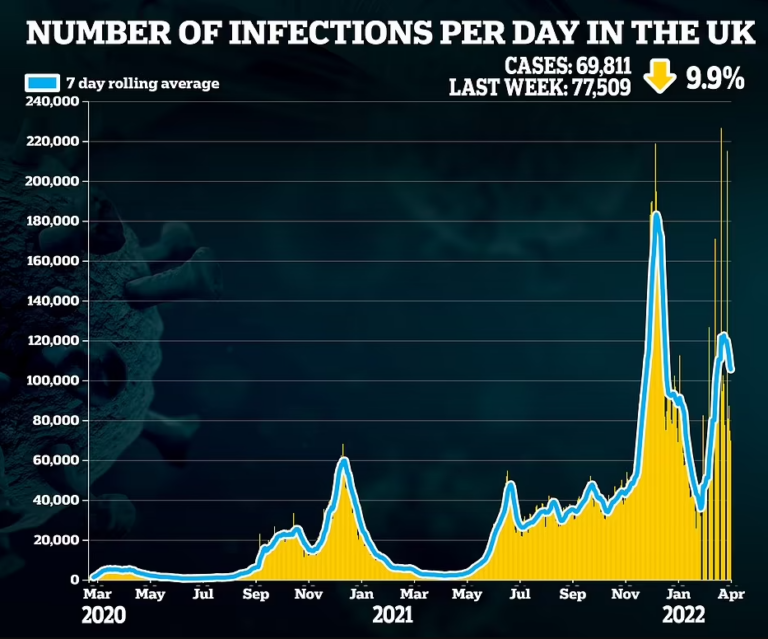
Compared to the other U.K. nations, Scotland’s third wave of infections appears to be more advanced. On June 22nd, 3,253 cases were recorded (going by date of specimen) which is the highest daily total since the start of mass testing. See the chart below, taken from the government’s COVID-19 dashboard:

However, as even Nicola Sturgeon has acknowledged, “Most cases are now in younger, yet to be vaccinated groups, so fewer are becoming v ill.” In fact, the recent surge appears to be related to Euro 2020.

A dramatic gender gap has opened up in the last two weeks, with men aged 15–44 substantially more likely to test positive than their female counterparts. The BBC quotes behavioural scientist Stephen Reicher as saying “the obvious explanation is that people were getting together for the football”.

Compare the chart above with the one below, which shows the number of patients admitted to hospital with COVID-19:

The first time there were over 3,000 cases recorded in a single day, on 29th December, the number of patients admitted to hospital with COVID-19 was 153. Yet on 22nd June, the number was only 35 (roughly four and a half times lower).

As Fraser Nelson noted in a tweet yesterday, the number of hospitalisations per 1,000 cases 10 days earlier (for the whole of the U.K.) has been trending downward for the past four months. At the end of February, the number was about 100. It has since fallen to less than 30.

Ministers Could Announce End of Automatic Isolation for English Pupils in Days

Following a good deal of pressure to end the policy of sending schoolchildren home if someone in their ‘bubble’ tests positive – which the Telegraph has launched a new campaign against today – the Government is said to have decided that pupils will no longer be required to automatically isolate. The change is likely to occur when schools return in September, with an announcement to be made in the coming days. A testing regime is likely to be introduced in the place of automatic isolation.

The Guardian has the story.

A quarter of a million children missed school in a single week because of coronavirus infections, self-isolation or school closures this month – the most disrupted week since schools fully reopened across the country in March.

It came as the new Health Secretary, Sajid Javid, said most Covid restrictions in England “must come to an end” on July 19th…

But, in a move likely to anger some Conservative backbenchers, he did not rule out keeping measures such as masks and social distancing in place.

The Guardian understands that ministers plan to overhaul the system for pupils, under which they are separated into bubbles – sometimes numbering more than 200 children – and forced to quarantine at home if anyone in their group tests positive for Covid.

An announcement is expected to be made in coming days to give schools time to prepare for the return in September, likely to be replaced with a testing regime.

A senior Government source said: “We will have a different system when schools return in September which combines proportionate protections when someone tests positive with trying as much as possible to keep schools open.”

The Schools Minister, Nick Gibb, confirmed on Tuesday morning that the Government was conducting trials of daily testing in secondary schools which were due to be completed on Wednesday. This regime would enable schoolchildren to go into school provided they receive a negative result, eliminating the need for the entire classroom to self-isolate when a single child contracts the virus.

“We’ll look at the data and see whether that is an effective alternative to self-isolation,” Gibb told BBC Radio 4’s Today programme…

Steve Brine, a former Health Minister, said he was “looking for a change in policy as much as a change of tone” [following the replacement of Matt Hancock by Sajid Javid] and called for the rules on isolation bubbles to be overhauled. “Haven’t our young people suffered enough?” he asked. “Are we really going to continue to do this to ourselves?”

Jason McCartney, the Tory MP for Colne Valley, said children and families were being forced to isolate up to four times in a matter of months. He said it was “having a huge impact on education, mental health and wellbeing” and called for extra PCR testing and a new approach to the policy.

Areas in northern England have been particularly affected by the rise in children isolating, with Government figures showing one in 30 children in state schools were out of the classroom on June 17th. That included 9,000 pupils with confirmed Covid and 16,000 with suspected coronavirus, and more than 7,000 whose schools had shut because of outbreaks.

Worth reading in full.