

We’re publishing a guest post by our in-house doctor today looking at the latest ICNARC data. This is the weekly audit of NHS ICUs. It only covers the period up to November 14th, but suggests that unvaccinated Covid patients in ICU are not placing an unmanageable strain on the NHS, as some health professionals have claimed. On the contrary, as of November 15th, there were only 400 unvaccinated Covid patients in ICUs across the whole of NHS England and they were outnumbered by vaccinated patients.
Today the Prime Minister will be making a decision on further measures to limit social interactions by British citizens. Information leaked from SAGE appear to indicate the ‘scientific advisers’ to the Government are pushing him to reinstitute more aggressive social controls in an effort to control the virus.
As Monday and Tuesday (the 27th and the 28th) are bank holidays, there will be no release of Covid related data on the NHS website. Therefore, the public will be able to see even less information than usual about the quantifiable evidence on which their liberty is being curtailed.
On Christmas Eve, the Intensive Care National Audit and Research Centre (ICNARC) released an updated weekly report containing useful new information. Readers may recall that until recently, ICNARC had not produced an audit of vaccination status in ICUs. We now have data up to November 15th and this week a more granular analysis has been published. The link to the report is here and the relevant pages are 44-48.
I urge readers to examine this report for themselves in tandem with my analysis as a guide to interpretation. There has been so much misinformation around vaccines and severe Covid on both sides of the argument that a high-quality ICNARC audit is invaluable in assessing quantifiable known facts about the situation.
Readers should note that all patients included in this audit were suffering from the Delta variant. The time period ends on November 15th, well before Omicron became established in the U.K. Therefore, the debate around whether Omicron is more or less severe than Delta is irrelevant for the purposes of this commentary.
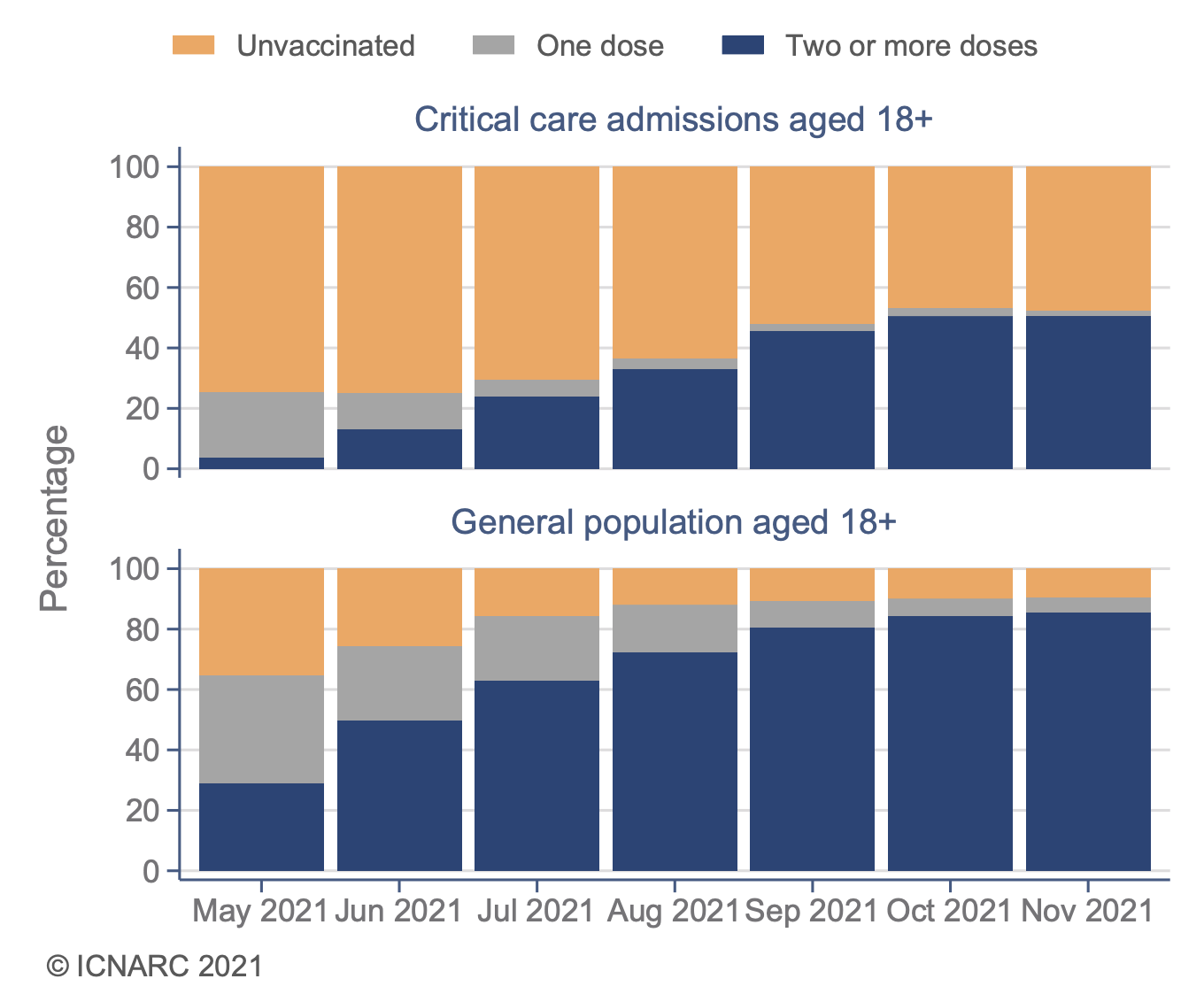
Figure 27 on page 46 shows the changing proportions of vaccinated people in ICU units between May and November compared to vaccination status in the general U.K. population. Over this period vaccination uptake increased in the community from around 60% partially or double vaccinated in May to over 80% double vaccinated in November.
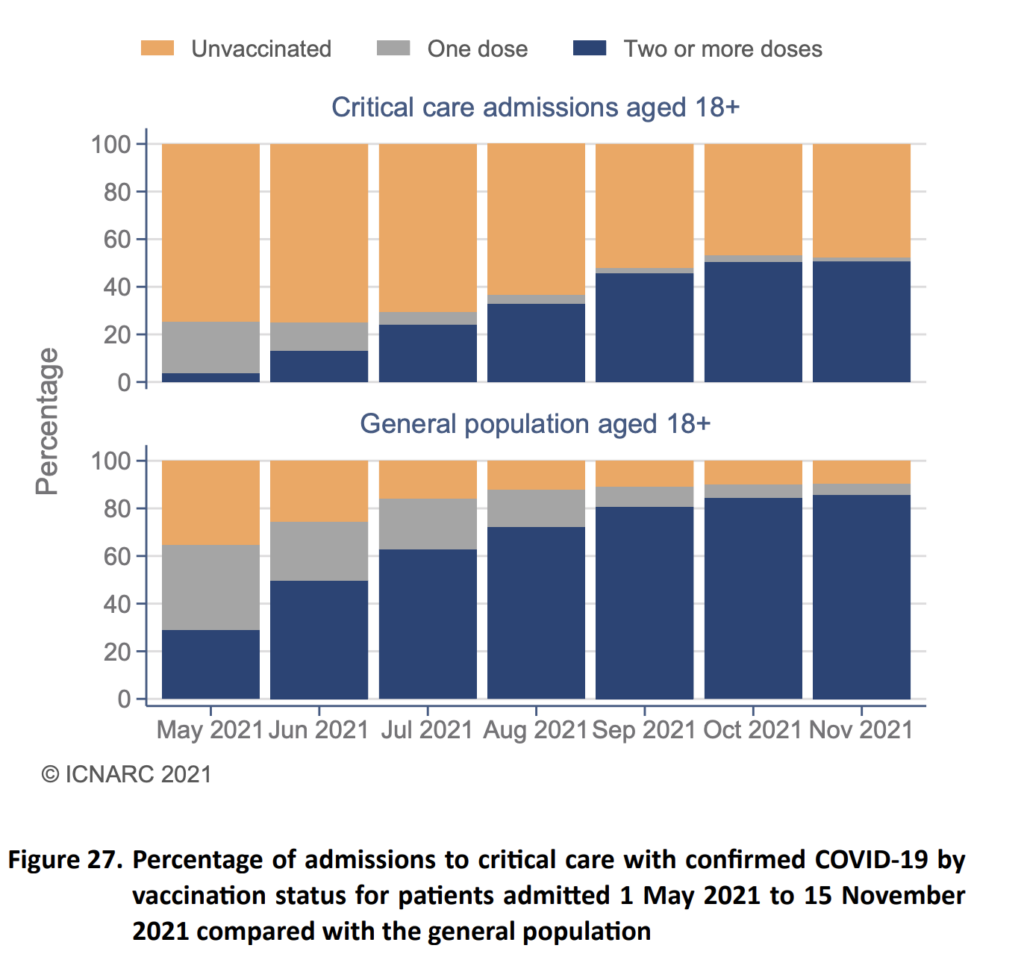
In May, 35% of the population were unvaccinated but 75% of ICU patients came from this cohort. By November about 15% of the population were unvaccinated but they accounted for 48% of the ICU population. The inference is that the risk of contracting severe Covid is substantially higher in the unvaccinated population than the vaccinated. Note there is no more recent data than November 15th, so we don’t have any evidence that the percentage of unvaccinated Covid patients in ICUs has increased since the Omicron variant hit.
Figure 28 on page 47 is interesting. It shows that London is significantly different to the rest of the U.K. in respect of unvaccinated admissions to ICU. In summary, London has a consistently higher percentage of unvaccinated patients in ICU compared to the rest of the U.K. – in November about 60% of London ICU Covid patients were unvaccinated compared to a range in the rest of the U.K. of between 40 and 50%. This probably reflects a lower vaccine uptake in the capital compared to the rest of the U.K. I will return to this point later.
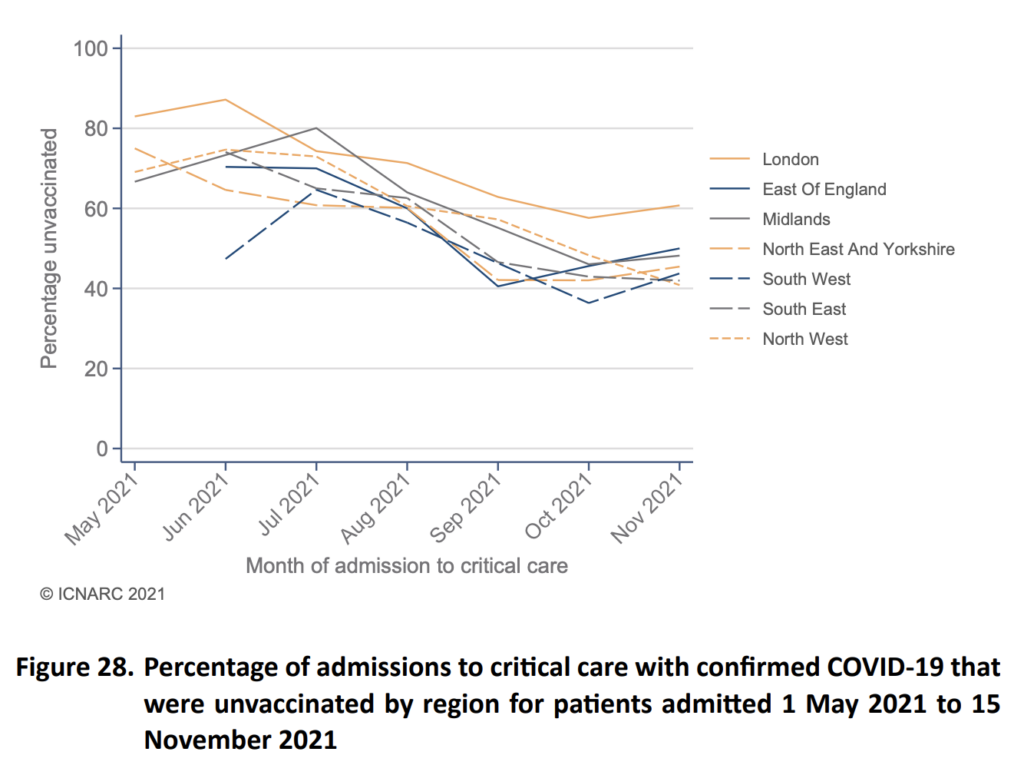
Table 16 on page 48 of the report is the most revealing new information. It provides a detailed analysis of vaccination status mapped to important demographic and clinical data around disease severity. I will take some time to unpick it for benefit of slightly nerdy ‘statos’ like myself!
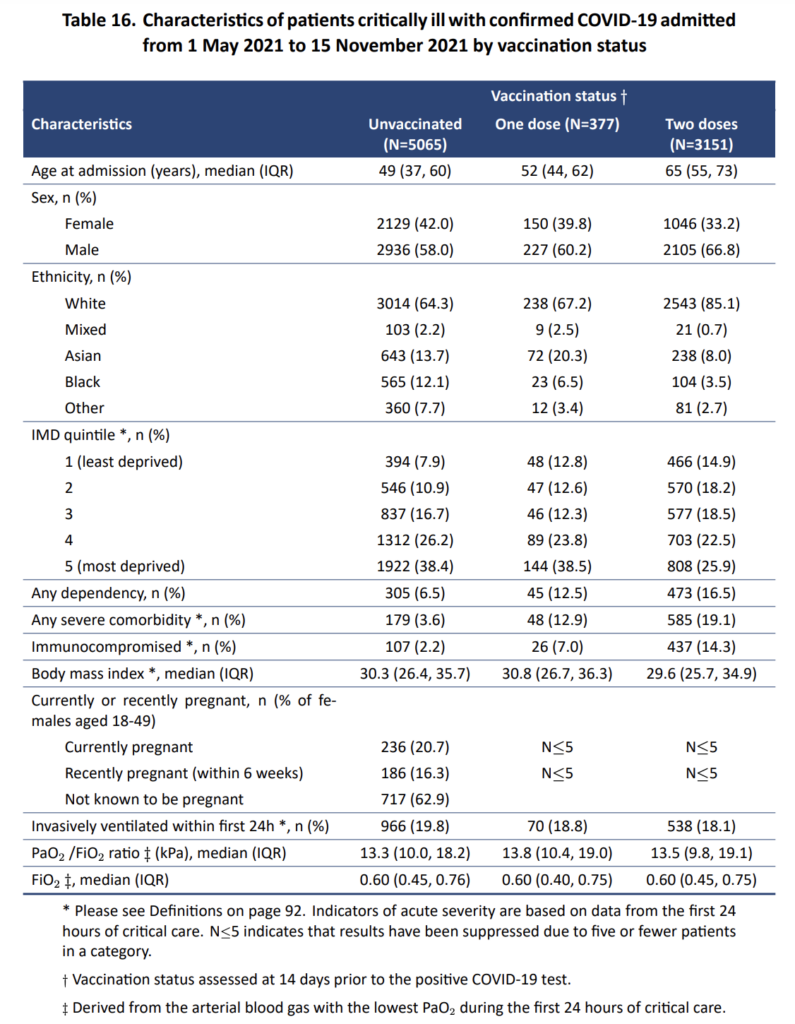
The first observation is that unvaccinated patients on ICU tend to be younger than the double vaccinated (a mean age of 49 versus 65). There was a wider interquartile range in the unvaccinated than the vaccinated groups – this means that almost all of the patients in ICU under 40 were unvaccinated. There tended to be more females in the unvaccinated group (42% vs 33%).
Blacks, Asians and other ethnic minorities made up 33% of the unvaccinated cohort, but only 14% of the vaccinated group. This probably reflects lower vaccination uptake in these communities compared to the ethnically white British segment of the U.K. population.
Turning to socio-economic status (SES), there was a gradient observed in the two groups, with 64% of the unvaccinated group deriving from SES classes four and five compared to 48.4% in the vaccinated group. Again, this may reflect lower vaccine uptake in lower SES groups in the community.
The differences in physiological status are the most interesting data. In aggregate, vaccinated ICU patients were more likely to have serious comorbidities or vulnerabilities than unvaccinated patients. About 50% of the vaccinated patient group had serious pre-existing health conditions compared to 12.3% in the unvaccinated group.
Interestingly, the body mass indices were much the same in both groups. (I had expected the unvaccinated group to be fatter than the vaccinated, but this was not the case.) It was also interesting to see the physiological severity as measured by the requirement for early ventilation and the gas exchange ratios were the same across all groups. Finally, there was a significant group of pregnant or recently pregnant women in the unvaccinated cohort, not seen in the vaccinated group – this may reflect the age differences between the two groups.
So, in summary, my assessment of this information is as follows:
- Unvaccinated patients represented about half of patients in ICU compared to about 15% of the general population. Therefore, the risk of ICU admission in the unvaccinated is higher than the vaccinated population.
- Unvaccinated patients in ICU tend to be younger and healthier (before admission) than their vaccinated counterparts, half of whom were significantly unwell before contracting Covid.
- Unfortunately, ICNARC have not yet provided information around mortality rates between vaccinated and unvaccinated patients. I think it is probably reasonable to assume that unvaccinated patients, being generally younger and fitter than the vaccinated groups, are more likely to survive ICU.
- In quantitative terms, there were about 820 Covid patients in English ICUs in mid-November. By Christmas Eve this had fallen to 747. If 48% of patients are unvaccinated this represents about 400 unvaccinated ICU patients in England in November.
- London has a higher percentage of unvaccinated patients in ICU (60%) than the rest of the country. This may reflect skews to a younger demographic and a higher proportion of ethnic minorities, hence lower vaccine uptake in the capital.
- Reports in the media claiming that 90% of the ICU patients in London are unvaccinated are not supported by this audit – unless something has radically changed between November 15th and the end of December. My anecdotal information reports that there are some ICUs in London where the percentage of unvaccinated patients in ICU does approach 90%. These are hospitals in the East End and South East areas. My suspicion is that these higher rates are being extrapolated in the press as representative of the whole of the U.K. Actually, they are not even representative of the whole of London.
My final point goes to how this valuable information has been portrayed in the press. The ICNARC data provide good evidence of the protective effects of vaccination against Covid and the higher risk of being severely ill with Covid if one has not been vaccinated. Otherwise healthy patients who are unvaccinated are at higher risk of contracting severe Covid than their vaccinated peer group. However, the effect has been exaggerated by commentators in the mainstream media and the overall numbers are quite low (400 unvaccinated ICU patients in the whole of the U.K.).




Discussion
Comments
This week across the site:
To join in with the discussion please make a donation to the Daily Sceptic.
Profanity and abuse will be removed and may lead to a permanent ban.
I would want further information on the claim that almost all of those under 40 in ICU were unvaccinated. We know that some had been pregnant or recently pregnant which can put a massive strain on the body but there is no logical reason why suddenly there were very few in ICU under the age of 60 previously with the more virulent strains but there are now. Is it possible that some of these are there for elective surgery and have happened to test positive too now that electives are back on? I am not buying the raw figures and analysis
Most of the people in hospital with the ‘virus’ are nosocomial infections, but are useful for distorting the figures.
I wrote about this report here. Are the double jabbed being removed from the stats? https://nakedemperor.substack.com/p/are-the-double-jabbed-removed-from
And what about the boost to the numbers of seriously ill (therefore likely to end up in ICU) that occurs as a result of the vaccination? These victims are probably still labelled ‘unvaccinated’ because the protection from the vaccine does not officially start until x days have elapsed.
The people who write articles on here keep saying the jabs are working but are they really and at what cost to the future health of the jabbed?
The jabs briefly increase anti-bodies to the spike protein but NOT to other parts of the virus.
Soon after being jabbed people’s immune systems are compromised and they are more susceptible to the virus for a couple of weeks.
Long term, due to Original Antigenic Sin, Antibody Dependent Enhancement, etc. plus all the possible side effects from the experimental jab people will be potentially more ill from the jab than they would be from Covid.
There are rogue batches of the jabs which are causing the most harm. People are playing Russian roulette with their lives depending on which batch they are jabbed with.
Many of the contributors on here have been jabbed themselves and we really need to challenge the notion that these experimental jabs are helping to curb hospitalisations and death from Covid.
Seconded
And susceptible to other viruses for a while, quite likely. It could be a contradictory jab (CJ).
All this unnecessary analysis to prove the “vaccine” is effective when 82% of the adult UK population has already been double vaccinated. Why so much effort and propaganda for such a small percentage (18%) of the population?
Many of whom are just children?
Depends how you work out the sums, but it could be that more than 18% of us have said no. Quite recently it appeared that roughly 23 million in England have not used it at all, and if they redefine unvaccinated (as less than 3, or 4 and so on) it could easily change.
Denominators for vaccinated patients were based on the numbers vaccinated from NIMS over the time period 17 April 2021 to 1 November 2021 (14 days prior to the date range of the analyses). Denominators for unvaccinated patients were based on the Office for National Statistics (ONS) population estimates for 2020 minus the numbers vaccinated. (P44, ICNARC report)
If ICNARC used NIMS to estimate the population in England (62.7m as opposed to ONS estimate of 56.5m) as UKHSA does, then the proportion of “unvaccinated” (including those actually vaccinated but who don’t count as such because the poor wee vaccine hasn’t been given a chance to work yet) in ICU “with covid” would look even lower.
In my experience the unvaccinated have tried extremely hard to stay away from an NHS they no longer trust. They have their Ivermectin, vitamins D and zinc. They rely on their own immune systems to work this through.
Indeed. Re. Recommended vitamin D supplements, the NHS site has quietly doubled the number recently, and others even more. Spot the products available in various supermarkets as well. This is the time of year when we need them, given the lack of light (UV B) used to create our own automatically, via our skin.
What is the definition of “vaccinated”? It says in the footnote to Table 16: “Vaccination status assessed [my emphasis] at 14 days prior to the positive COVID-19 test.” But suppose someone has a single dose then ends up in an ICU within, say, one week. Would they be counted as “vaccinated” or “unvaccinated”? Could make a difference to these conclusions!
As far as I can see, it does not define when the positive covid test was, presumably just that they are still testing positive at admission to ICU. If there is no time limit on when the patient first tests positive, it is therefore feasible that a person could have received their first jab several weeks before ending up in ICU with complications, so long as the time between receiving the jab and first testing positive was no more than 14 days. Given that the figures above only start in May 2021, long after the start of the vaccine rollout, the once-jabbed people not counting as vaccinated will almost all fall into the (relatively) younger age groups. The way the data are presented appear to be a prime example of statistical manipulation.
“the effect has been exaggerated” – by playing a one armed bandit game against some of us, by deliberately hiding the statistics about damage caused by the other side, i.e. ‘negative effects’. It’s actually possible that some are so healthy they don’t end up in the system at all, all being well.
Body Mass Index 30-across all three categories
1 to 10% of deaths/adverse events reported. Yet most vaccines pulled from the market for only 50 deaths. UK is on nearly 1900, and VAERS, Eudravigilance and the Yellow Card reporting sites are only part if the world. I wonder what the real total us.
1 to 10% of deaths/adverse reactions reported.
“If” those who remain unvaccinated do my free salt water cure at the onset of any viral like flu or cold, then they won’t get Covid because that is a practical impossibility – kill the virus or Coroanvirus BEFORE it is allowed to become covid anything: Covid Crusher: Mix one heaped teaspoon of Iodine table salt in a mug of warm clean water, cup a hand and sniff or snort the entire mugful up your nose, spitting out anything which comes down into your mouth. If sore, then you have a virus, so continue morning noon and night, or more often if you want, until the soreness goes away (2-3 minutes) then blow out your nose and flush away, washing your hands afterwards, until when you do my simple cure, you don’t have any soreness at all, when you flush – job done. Also swallow a couple of mouthfuls of salt water and if you have burning in your lungs, salt killing virus and pneumonia there too.
My simple salt water cure, kills all Coronaviruses and viruses, as soon as you think you have an infection, or while self isolating, before the viruses mutate into the disease in your head… Read more »
Our healthcare system is about to experience a tsunami! Potential side effects of jabs include chronic inflammation, because the vaccine continuously stimulates the immune system to produce antibodies. Other concerns include the possible integration of plasmid DNA into the body’s host genome, resulting in mutations, problems with DNA replication, triggering of autoimmune responses, and activation of cancer-causing genes. Alternative COVID cures EXIST. Ivermectin is one of them. While Ivermectin is very effective curing COVID symptoms, it has also been shown to eliminate certain cancers. Do not get the poison jab. Get your Ivermectin today while you still can! https://ivmpharmacy.com
Thanks for your post, I usually enjoy the deep dive into the data that you kindly provide. Unfortunately on this occasion I disagree with some of your conclusions.
While the proportionate admissions to ICU might suggest V are protected more than Uv, I think the two graphs in fig 27 show a very clear decline in Vac efficiency as its rolled out to younger age groups. Those graphs should be mirror images of each other so that the more people that are V, the more ICU only has Uv patients (in the ideal situation where mass V reduces absolute risk in the population), but of course it doesn’t because the relative risks of covid itself are not equal across ages. As pointed out by HART, the Number Needed to Treat is around 228, that is, the number of people needed to be V to prevent 1 severe case is over 200 (quite high from a public health economist point of view), and clearly ICU admissions of V people have not been declining across the year at the same rate as the V has been rolled out to younger age groups. What I take from fig27 is the glaringly obvious diminishing… Read more »
The numbers are obviously not representative. England has a population of about 55.98 million people. Assuming they were all unvaccinated and had a risk of 0.004% of needing ICU because of COVID, this would amount to 2239 people. If they were all vaccinated and thus, had a risk of 0.0006%, it would be 336 people. Vaccinating 55.98 million people in order to keep 1903 of them out of ICU is certainly not an efficient use of public resources, especially not if they all need to be revaccinated periodically.
And then, neither 2239 people in ICU nor 336 in ICU have (as far as I know) any relation to real COVID hospitalization numbers.
Headline in Times today… a total lie???
Yes and no, see reply to Mark above. Using the numbers from the article, about 0.004% of the unvaccinated and about 0.0006% of the vaccinated people are in ICU. The 0.004% is really 0.0039… rounded and 0.0006 times 60 is 0.0036. This would even justify writing about more than 60 times liklier but for one thing: These numbers are relative frequencies of something which happened in the past, not the relative frequencies of something which will happen in future (probabilities).
OTOH, getting this into the head of people who generally believe that sociology is a science and not an exercise in bullshitting the gullibe but who just object to COVID sociology which is surely something comepletely different is probably impossible.
I’ve seen the future and it was an exact replica of what little we happen to know about the past! is apparently a highly credible claim, provided it comes with the necessary academic titles attached and fits in with the – possibly manufactured – political beliefs of an audience.
🙁
Thanks Mark. Quite aware of lies, damn lies and statistics. The percentages here are so small and slight variances causes big swings. Like when our local cases went up by 100% overnight – from 1 to 2 people.
I’m not Mark :-). I was just referring to something I wrote earlier about relative frequencies derived from statistics about something versus probabilities (likeliness of a certain outcome of some random selection process, eg, throwing a dice).
When one keeps throwing a dice and keeps a statistic about the outcomes, the relative frequencies with which each number appears in this statistic will approach 1/6. That’s because there are six possible outcomes and all are equally likely. Thus, it is said that the probability of throwing a six is 1/6.
However, it’s possible to create statistics about pretty much anything and to calculate relative frequencies of anything in them. But dividing a number a by some number b does not turn the resulting quotient into a probability. If the underlying process the original numbers came from was random, the relative frequencies would approach the propability when collecting numbers for long enough. But the process of developing or not developing serious COVID is certainly not random. And even if it was, the relative frequencies of anything in a statistic terminated at an arbitrary cutoff point (like all of these studies) can be completely different from the actual probability.
As a famous… Read more »
I’m a simple man. You quote Knuth, I click like.
What I like about statistics and probability in general is how counter intuitive they are.
Something can be perfectly random and extremely unlikely at the same time.
Error in here: 0.0006 times 60 is 0.036, not 0.0036.
The calculaton in the Times article (assuming its the same as in the Mail) claims to be based on people catching COVID. It seems to be copied from an otherwise undescribed table giving a “rate per week per 100,00” from INARC.
UKHSA has up to date stats on vax status and death. Really worth looking up their vaccine surveillance reports which show, for example, x5 deaths in the very old when double jabbed.
So any excess of unvaccinated in ICUs are mainly; youngish females , non-white , London, and pregnant. Where do 33% plus of people ‘get covid, ie have positive PCR tests? In hospitals. I conjecture that a good proportion of these pregnant non-white London females were in hospital already and have ended up in ICUs , probably for a short period of time, because of PCR tests and concerns over their pregnancies.
Wonderful health service probably reflected across Europe.
And the report also shows that the only group showing increase in ICU admissions is non-elective, non-covid patients.
Coloureds also more likely to have low vitamin D level; and to be poor and therefore have worse health care etc.
Assuming that 15% is correct and that this refers to the UK and not to England, there should be 10,083,000 unvaccinated people. 820 people in ICU, 48% of them unvaccinated equals 393.6. Hence, 0.004% of the unvaccinated are on ICU, versus 0.0006% of the vaccinated. Both of these numbers are much too small to communicate anything about general trends: 0.004% means 4 of 100,000 people.
The only sensible conclusion from these numbers is that the statistical risk of ICU admission because of COVID is generally vanishingly small and not worth making any fuzz about. Blaming 99,996 people for something that happened to 4 other people is insane.
Lastly, you’re missing the gut of Savage Jabberers argument: It goes as follows People who had all n (n >= 3) Pfizer injections I consider currently necessary for COVID prevention did what I wanted, hence, they’re the worthy sick and those who didn’t are the unworthy sick. The latter clearly don’t deserve anything because of their unworthiness, the classical standpoint of the bourgois noveaux riches asked to contribute anything to the community. It can be generalized a little more: People in need to NHS care belong to the lower orders and are… Read more »
“My final point goes to how this valuable information has been portrayed in the press. “
This is how the same ICNARC data was misrepresented by the Daily Mail two days ago:
Unvaccinated people who catch Covid are 60 TIMES more likely to end up in intensive care, new research reveals
https://www.dailymail.co.uk/news/article-10344695/Unjabbed-people-catch-Covid-60-TIMES-likely-end-intensive-care.html
But the exact same grossly misleading and scaremongering analysis also comes up in the Mirror,the Sun, MSN and other outlets.
A remarkable coincidence.
Newly created statistic shows that the relative frequency of ICU admission is 60 times higher for unvaccinated people than for vaccinated people is an anecdotical datapoint and creation of statistics is not research as it’s not determining new information but systematizing known information.
There’s nothing in that which would enable predicting the future, in particular, there are no probabilities in here. A probability is the relative frequency a certain outcome of a random selection process will approach given enough tries. There’s none here.
Sociologists are really the augurs of our time because they do something terribly complicated most people don’t understand and claim this would enable them to predict the future. As such, they’re just soothsayers armed with computers and not scientists.
I think blood groups should be taken and form part of these statistics to get a more accurate picture since there is a significant variation in immune response.
There needs to be a real effort to accurately number the % of unvaccinated in the population. Some recent government numbers suggest the 20% estimated number is under the true number.
The Government/Advisers/Experts don’t really want every last person to have the jabs; They would have nobody (the unvaxinated) to blame for this shambolic overreaction.
Excellent article, however how do we reconcile “The ICNARC data provide good evidence of the protective effects of vaccination against Covid” with the observed negative vaccine effectiveness over several weeks (see for example https://dailysceptic.org/2021/12/24/vaccine-effectiveness-drops-to-minus-75-in-18-29-years-olds-as-omicron-slices-through-vaccine-protection-and-booster-effect-starts-to-wear-off/)?
Also what about natural immunity? Has this been taken into account? Presumably that also reduces your risk?
It’s all so confusing. How do I build up an accurate picture of effectiveness Vs risk to enable informed consent?
Anyone know what the criteria are for getting oneself admitted to ICU these days?
One criterion would be to call round to me and attempt to get me to take a SARS‑CoV‑2 gene serum.
Yeah, that might leave the protagonist qualified to get into an ICU.
This last sentence is critically important. Most sceptics don’t disagree that the vaccines give some level of added protection in the vulnerable but that it’s the loss of overall perspective in the responses that are questionable.
Exactly. In six and a half months a total of around 7,500 people have spent any time in ICU “with covid”. One can pore over the breakdown of that cohort and create as many headlines as required but in a population of 65 million they represent 0.01% of society. Put inversely, regardless of vaccination status, 99.99% of people did not require ICU attention “with covid” during this time.
“Most sceptics don’t disagree that the vaccines give some level of added protection in the vulnerable”
At what cost to their health?
The jabs briefly increase anti-bodies to the spike protein but NOT to other parts of the virus.
Soon after being jabbed peoples immune systems are compromised and they are more susceptible to the virus for a couple of weeks.
Long term, due to Original Antigenic Sin, Antibody Dependent Enhancement, etc. plus all the possible side effects from the experimental jab people will be potentially more ill from the jab than they would be from Covid.
The people who write articles on here keep saying the jabs are working but are they really and at what cost to the future health of the jabbed?
I may well agree with this as I’m currently listening to this excellent damning report on the flawed Pfizer trial:
https://rumble.com/embed/voaxg5/?pub=qdzr7
A brilliant defence for anyone under pressure to be jabbed
https://www.conservativewoman.co.uk/a-brilliant-defence-for-anyone-under-pressure-to-be-jabbed/
Direct link:
https://www.deconstructingconventional.com/post/18-reason-i-won-t-be-getting-a-covid-vaccine?postId=4b6beceb-3fa2-45d4-9e95-3b96defba00b
“Over 80% double-vaccinated” ?
The Executive Summary on page 3 of the UK Health Security Agency ‘Covid-19 surveillance report – week 50’ states that “…by 12 December 2021, the overall vaccine uptake in England for dose 1 was 67.9% and for dose 2 was 62.2%“.
Is it me? Who’s right?
A medical expert in a podcast the other day explained one way in which they fiddle graphs.
One particular graph that showed a massive peak of deaths in the unvaccinated as compared to the “vaccinated” had been faked in the most childish way.
An X-amount of people due to old age or other ailments are going to die every week, regardless of there being a pandemic or not. The way they faked the graph was that they never entered the data for a specific number of unvaccinated people in the period that they actually died.
They actually held this data over, and then at a later period entered it into the statistics, which doubled it up with the unvaccinated people who had passed-away from natural causes during this later period. When these statistics were then displayed as a graph, they showed as a massive spike in unvaccinated deaths as compared to “vaccinated” deaths.
This medical expert noticed this because he knew that a certain average number of old people are going to die in England in any given month. For instance, in the month of September, 2021, from data available from previous years and decades, an… Read more »
Not that easy to follow. Can you provide a link to the podcast you’re referring to?
The attached picture explains it in quite simplistic terms. But, then, Covid-19 bedwetters have shut themselves off to all simplistic understanding.
But don’t worry, you might grow out of it.