

We are in the middle of a vast argument about what is normal. We at the Daily Sceptic are clearly on one side.
- We say that the Centre / Mainstream / Establishment / Institutions have been ‘captured’ by the Lunatic Left.
- They say that Discourse has been commandered by the tropes / slews / backslidings of the Radical Right.
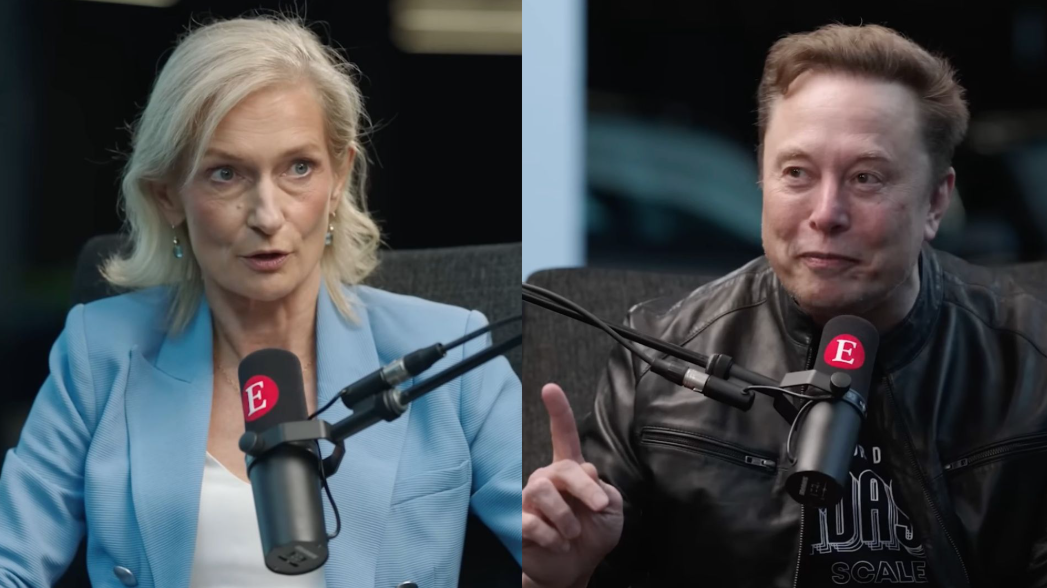
I am going to write about a serious academic book. But first, let’s hear from Elon Musk, in a brief exchange he had this summer with Zanny Minton Beddoes (PPE, Harvard, IMF, Bilderberg amongst her credentials, or should I say dredentials), the editor of the Economist. Whatever one thinks of Musk, here he talks sense. I cut out some of the cross-talk, sentence-collapsing and repetition.
BEDDOES. You support not just the populist Right, but the far Right, in fact very fringe parties in some countries.
MUSK. No, I support the normal people.
BEDDOES. Okay.
MUSK. What you call the far Right, falsely…
BEDDOES. You think is the normal person.
MUSK. Literally, you could go back 10 or 15 years, and these policies were completely normal. In fact…
BEDDOES. I’m not sure…
MUSK. Take a speech from Obama and Hillary, and then go to someone, who’s on what I call the lunatic Left, and [show them it and] say, ‘What do you think of the speech by Trump?’ [They would say] ‘Like, oh wow, he’s the worst person ever.’ [To which you could say] ‘Actually, that was a speech by Obama’ or ‘Actually, that was a speech by Hillary’.
BEDDOES. [Tries a non sequitur on him] I agree that the centre of gravity in this country has shifted, certainly in the Democratic party, but that’s not what I’m talking about…
MUSK. It’s just normal people, and here are the principles and tell me which of these sound terrible: that we should have secure borders, that we should have safe cities, that we should have sensible spending? Which of those three are far Right? I want to admonish you and the media for the absurd characterisation of the far Right. It is false, misleading and nonsense.
What is normal?
1. The old hypothesis, favoured by the Economist and indeed everyone. Normal = Butskellism and Thatchblairism as it flows from the 1960s to the 2020s: the BBC, Private-Public Politics, Political Correctness, End of Death Penalty, Sexual Emancipation, Rainbow Coalitions, Deadnaming, Cancellation etc.
2. The new hypothesis, favoured by Musk, the Daily Sceptic and other [cough] Far Right volk, sorry, I mean, folk. Normal = aye, secure borders, safe cities, sensible spending, and maybe also some old morals and mores. Read-a-book territory.
Now, Musk points back to 10 or 15 years ago. But I think that he actually means 40 or 50 years ago. And even 40 or 50 years ago what “normal people” thought was already unappealing to the political classes. For the thousandth time, contemplate the career of Enoch Powell, now looking like the greatest statesman of the 20th century bar none, who was, by the 1970s, sound on almost everything. He was made pariah by the race-relations industry, and cancelled by the concerted effort of the Conservative party, Heath and the misunderstanding of his position even by people like Thatcher, not to mention everyone else further to the Left.
Between 2016 and 2026 the Cat was Let Out of the Bag.
This is, as I’ve said before, has thrown up the most interesting politics for two centuries.
But instead of remaining in mere assertion, let me offer you some hard analysis of a recent book by a young academic in political science. Vicente Valentim received his PhD in only 2021, and has made a book out of it, published by Oxford University Press in 2024. It is entitled The Normalisation of the Radical Right: A Norms Theory of Political Supply and Demand. I would never have read of it, or even heard of it, had I not taken a look at a review in the Times Literary Supplement by Geertje Bol, published on June 12th 2026, reviewing three books on liberalism, one by Adrian Woolridge (Centrists of the World Unite!), one by David Williams (Liberalism in Time) and the venerable Harvey C. Mansfield of Harvard (The Rise and Fall of Rational Control). Bol says that Woolridge and Williams urge a return to the centre. Against this, Bol notes that the centre is part of the trouble. And this is where he mentions Valentim’s book, saying that it shows that the centre has “fuelled” the rise of far Right parties.
Unusually for an academic book, Vicente Valentim’s argument is very interesting, and also interesting for what he is arguing against. But I think there are problems with it.
Valentim wants to explain the rise of the radical Right. He says there are two literatures on why it has arisen, but against them he offers an alternative.
1. One literature says the radical Right has arisen for economic reasons. Stung by fiscal crisis, cost-of-living etc., blah, blah, Guardian editorials. ‘It’s the economy, stupid.’
2. Another literature says the radical Right has arisen for cultural reasons, to express sentiments about threatened identities. ‘It’s the racism, stupid.’ Actually, that sounds like a lot more Guardian editorials. Though even when they think this, they tend to explain it as ultimately being caused by economic problems. You know: ‘You are racist, which is bad, but you are probably good, and would stop being racist if there was more government spending, right?’
Valentim says these are members of the same species of explanation. They are about suddenly changed attitudes: as if changed behaviour (radical Rightism) is caused by changed preferences, attitudes or motivations.
Not so, says Valentim.
He thinks this fails to explain why the rise of the radical right has taken place so quickly. Especially since all the research suggests that views are fairly stable across time. So he prefers another suggestion:
3. The radical Right has risen, not because they have new views, for any reason, but because they are able to express, for the first time, their old views. He suggests that “social norms” until now have restrained everyone from admitting that they have radical Right opinions, but now these norms are shattered, thus launching on us a radical Right politics. Radical Right politics is, therefore, latent. It comes into the open only when norms relax, for whatever reason, and it becomes obvious to many that there is more support for radical Right views than was previously thought or admitted. This, in turn, encourages some “political entrepreneurs” (Trump, Farage etc.) to offer a political forum for such views, which then enter the political conversation, thus swinging it round to a much more Rightist equilibrium point. Almost everyone calls this “the normalisation of the radical Right”, as per Valentim’s title, or something else similar.
Now, this is good, as a particular explanation. I think it has something correct about it. What I find objectionable, however, is the fact that Vicente Valentim comes out to explain “the normalisation of the radical Right” as if this is problematic, rather than coming out to explain ‘the normalisation of any political position’ including, say, Leftist positions (on, say, Abortion, Contraception, Homosexuality, Multiculturalism, Open borders, COVID-19, Net Zero, the NHS, Burnham’s “National Care Service”, Palestine etc.)
So this is a message for Valentim. Are you are political scientist or not? Or let me change the terms. Are you a philosopher or a politician? You should be a philosopher. If you were a philosopher, you would attempt to understand politics in the round, and notice that there is a normalisation process on the ‘lunatic Left’ as well as a (mostly reactionary) normalisation process on the “radical Right”; and that the lunatic Left has mostly played white in chess and is itself responsible for provoking the “radical right.” If you are a politician, admit it more bluntly. Say, ‘I am on the Left, or on the confused centre that genuflects to the lunatic Left, and hence I find the radical Right, but not the lunatic Left, to be a problem in politics that needs to be explained.’
In general, Valentim is polite. He ends his Oxford University Press book by saying: “One of the ambitions of this book is to reinvite a return to democratic culture.” But this is code for: “I have no problem with the normalisation of the lunatic Left.”
To return to Musk. His comment is a very good reminder, and in simpler terms than Valentim can manage, that the concept of “normality” or “norms” is contested, and, anyhow, has not only a historical dimension – it exists in time – but a political dimension – one can take sides about it. Put history and politics together and you have to talk first about what Musk is talking about before one talks about what Valentim is talking about. And what Musk is taking about is the great reorienting of our society whereby it came to disavow the entire ancien régime view of marriage and morals, states and security, and the dangers of getting into debt.
No doubt, the radical Right or ‘far Right’ has been “normalised”, but, as Valentim says, it was only “normalised” because it was originally “normal”. And, as Musk suggests, its original normality was denied and distorted by the regime which became significant in the 1960s, overwhelming in the 1990s, and (as it permeated down the administrative-corporate-educative limestone of our once-great nation) stupidly monopolistic and jobsworthily draconian in the 2010s.
James Alexander is a Professor in the Department of Political Science at Bilkent University in Turkey.


Discussion
Comments
This week across the site:
To join in with the discussion please make a donation to the Daily Sceptic.
Profanity and abuse will be removed and may lead to a permanent ban.
I have always considered myself to be centre right. However I have been radicalised by successive left leaning governments and their “Leftist positions (on, say, Abortion, Contraception, Homosexuality, Multiculturalism, Open borders, COVID-19, Net Zero, the NHS, Burnham’s “National Care Service”, Palestine etc.)” to the extent that my previously slight right wing bias has hardened. Significantly. Which makes friendship or even just conversation with the woke or even just myopic normies impossible.
A key strength of Musk which is rare in public life is that he literally DGAF what people (especially bien pensants) think about him.
Most of us have not moved to the right, it is that the left has moved so far left, they have dragged the centre way over, leaving us to appear further to the right.