

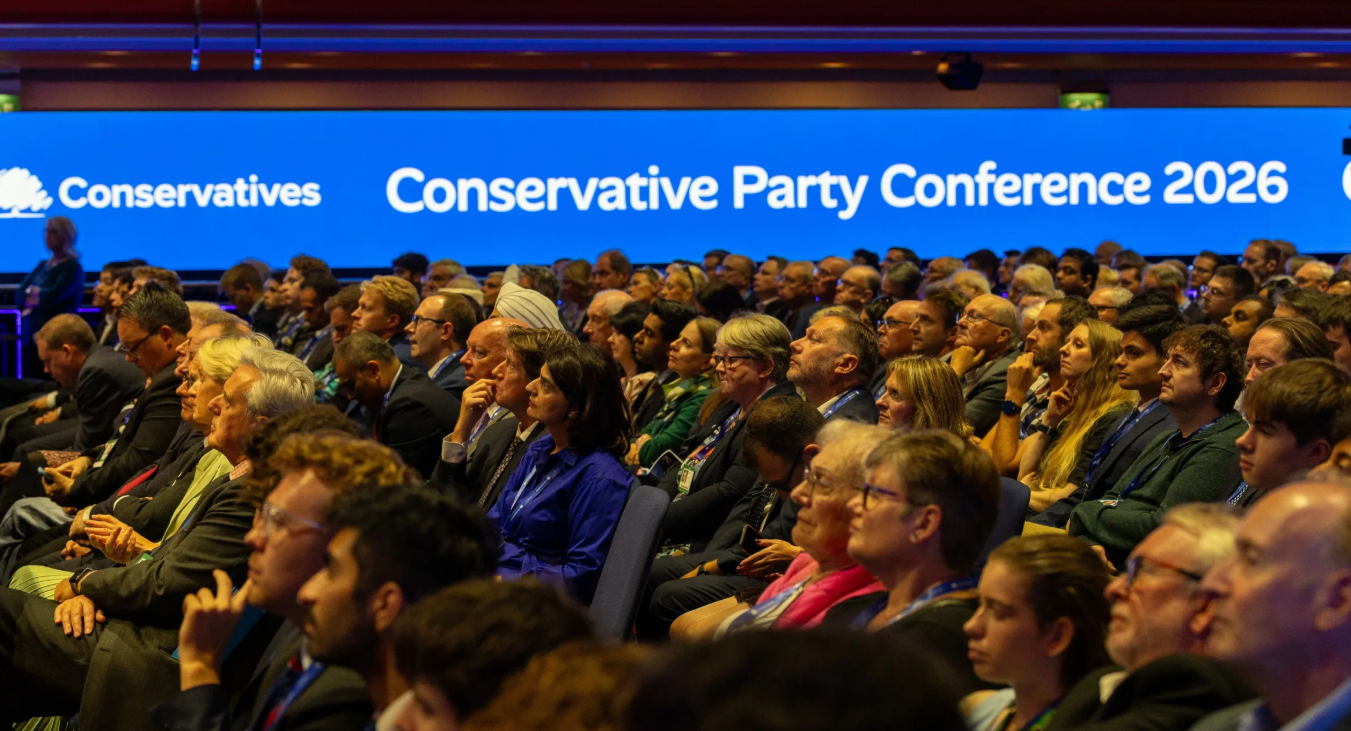
I trekked up to Birmingham for Conservative Party conference, a journey that increasingly feels like one I spend far too much time making. The train was full of familiar faces. People I recognised from Westminster, people I’d seen at previous conferences and the inevitable quiet conversations about what was coming over the next few days.
There is something quite funny about travelling to a party conference. You can usually tell where people are going without anyone actually saying it. The conversations get a little more political, the names become more familiar and, by the time you arrive, everyone seems to already have somewhere they need to be. I’d already been to Reform conference, so this time I found myself making comparisons almost immediately.
Before anyone accuses me of making a sweeping statement about British politics, I’m really only talking about the two main Right-wing parties here. I haven’t been to Labour conference this year, and I certainly wouldn’t claim that energy is exclusive to Reform. Andy Burnham, for example, clearly has a sense of energy and personality around him that you can feel when he’s in a room. But having now been to both Reform and Conservative conferences, the contrast between these two was difficult to miss.
For the Conservatives, I was directed to a very nice, some might even say glamorous, hotel to collect my press pass. There was a help desk, people asking delegates where they were from and what they needed, checks and ID requirements. After around 20 minutes, I was handed a very professional blue pass with Conservative Party branding running all the way along the lanyard.
At Reform, my first memory is rather different. A queue stretching almost out of the building. It was absolutely packed. You could argue that some of that was because the process of getting people inside wasn’t particularly quick. Or you could simply look at the crowd and conclude that quite simply, a lot of people wanted to be there.
My friend had already booked her Conservative conference receptions for the next few days and planned which events she was going to attend through the Conservative Party conference app. Reform had never felt quite so meticulously planned. And yet, strangely, that was part of its appeal.
At the Conservative venue, which itself was a slightly bizarre maze of different floors, the first thing I saw was the GB News stand, with presenters broadcasting live. It wasn’t just GB News. Sky News, Times Radio and others had impressive studio setups inside the conference too.
The setups were good, but what struck me most was what they represented. There was an established relationship between the conference and the mainstream media, with major broadcasters having a physical presence inside the event. I don’t remember seeing quite the same scale of physical broadcast presence at Reform. The media attention was certainly there. But it felt less embedded.
Walking around the Conservative conference hall, one of the first things that caught my eye was the National Education Union. If you follow my work, you’ll know that education is one of the things I talk about most, particularly the influence of organisations like the NEU and the arguments around Ofsted. So seeing the NEU handing out leaflets about abolishing Ofsted immediately caught my attention.
My immediate thought was: why is the NEU at Conservative Party conference? It didn’t exactly scream Conservative to me. In fact, given that Laura Trott is the Shadow Education Secretary, it didn’t seem particularly aligned with her position either. I went over and spoke to them, and they mainly explained their organisation and what they do. But the fact they were there at all was fascinating.
It also illustrated something about the Conservative Party conference. It isn’t simply Conservatives turning up and talking to Conservatives. There were think tanks, charities, businesses, campaign groups, media organisations and all sorts of other organisations represented. You could walk past the Daily Express, Cancer Research and then find yourself talking to the NEU. At times, the conference felt less like walking into a political movement and more like walking into the annual conference of a collection of financial and professional organisations from the City.
And then there was the aesthetic. At Conservative conference, there was a very recognisable type of attendee. Barbour jackets. Tweed. The sort of wealth that doesn’t need to be announced because you can see it from a mile away. For many, Conservatism seemed deeply established in their lives. Politics was part of the family. Some had been involved for years. Some had family connections to the party.
At Reform, the people I know are much more likely to have normal jobs and come from ordinary towns. Many aren’t career politicians at all. They’ve simply decided that they want to get involved. That’s quite a fundamental difference.
The Conservatives feel like a political party that has been doing this for decades. Reform feels like people who have suddenly decided they want to change something.
But there was one place where the Conservative conference surprised me: the Young Conservatives’ dinner. There were around 50 young people, all enthusiastic, engaged and, importantly, actually enjoying themselves. Some were preparing for the upcoming election to choose the leader of the Young Conservatives.
As a young person myself, it was refreshing to be surrounded by people my own age who genuinely cared about politics. And the important thing was that it wasn’t some carefully orchestrated party event. It had been organised by young Conservatives themselves.
That made me think that perhaps the Conservatives have more energy among young people than the wider conference gives them credit for. Some of the most interesting moments coming out of conference have been young Conservatives speaking, including the now viral clip of Kemi Badenoch’s appearance at their party, where she joined them for Sweet Caroline. It reminded me that beneath the corporate machinery, there is actually a grassroots enthusiasm there too.
The difference is that Reform’s enthusiasm is much harder to miss. You feel it from the moment you arrive.
At Conservative conference, the evening seemed to have its own carefully constructed timetable. Politico had a reception. The IEA had a reception. Other political organisations and media outlets had their own drinks events. There was always another invitation, another room, another gathering. Then there was the Hyatt Bar, where Kemi Badenoch later appeared. You could spend the day at conference, go to a fringe event, attend a drinks reception and then end up in a hotel bar with half of Westminster. It was an entire political social ecosystem.
At Reform, the evening felt much less like a calendar and much more like a spontaneous decision. People ended up at the casino. There was a DJ. People were dancing, having fun and just being free. Nobody seemed particularly concerned about whether it looked polished. And, frankly, that was part of the fun.
It was chaotic in a way the Conservative conference wasn’t. That isn’t necessarily a criticism. I think some people actively like Reform’s lack of polish because it makes the whole thing feel less corporate and less choreographed.
But Reform has plenty it needs to get better at. Organisation matters. Professionalism matters. A political party cannot run indefinitely on enthusiasm alone.
The Conservative conference showed the other side of the equation. You can have the app, the press pass, the studio, the fringe programme, the drinks receptions and the perfectly organised conference timetable. And yet none of those things automatically creates enthusiasm.
That is what I kept coming back to on the way home. The Conservatives have spent decades building the machinery around their political movement. Reform has something much newer: people who feel personally invested in what they are doing.
The Conservatives have built an ecosystem around their conference. Reform still feels much more grassroots.
Perhaps the ideal political conference would have both. The Conservatives could use some of Reform’s spontaneity. Reform could certainly use some of the Conservatives’ organisation. Because you need the people who know exactly where the press desk is, which room the reception is in and what time the drinks start. But you also need the people who turn up because they genuinely care.
You can print the perfect lanyard. You can build the app. You can plan every reception down to the last glass of wine. But you can’t put passion on a fancy lanyard.



Discussion
Comments
This week across the site:
To join in with the discussion please make a donation to the Daily Sceptic.
Profanity and abuse will be removed and may lead to a permanent ban.
From the description I am glad I was at Reform. I remember some of the descriptions from the Tory conference from my attendance decades ago.
The only aspects of he Reform Conference I would change is security speed and timetable clarity. The first was slow and intense for good reason. The second was complex because of the number of overlapping side events.
Tge people at Reform’s conference were just great.
Slick and professional or Kayfabe?
Kayfabe : the tacit agreement between professional wrestlers and their fans to pretend that overtly staged wrestling events, stories, characters, etc., are genuine.
Perhaps the Conservatives have slick and professional but lack the genuine feeling whereas Reform currently have the feeling of being genuine but struggle with professionalism?
Professional wrestling – kayfabe – politics. Genius analogy.
And to run one of the world’s most complex and prosperous nations?
Slick and professional beats passion every time.
Next, look for a leader with integrity…
Except that it hasn’t. It’s produced a pig’s breakfast.
Obviously you don’t want complete incompetence but you need people who are true patriots and who have the right political instincts.
A bit of integrity would be nice but good luck with that. Better to severely limit the power of the state.
The Conservative Party is an instrument of the establishment. Any impression it gives of wanting substantial change is fake and merely intended to subvert actual change.
There is very little reason to think otherwise.