

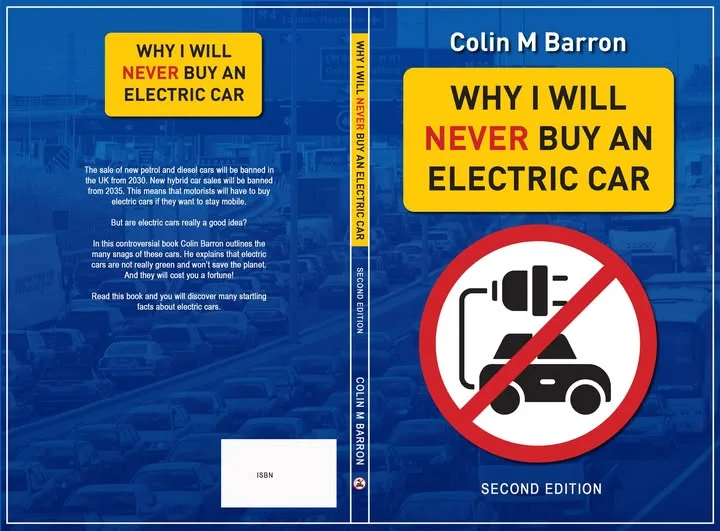
In summer 2023 I published a controversial book called why I Will Never Buy an Electric Car. This proved popular with 220 reviews on Amazon alone. The original edition covered the history of motor transport and then went on to discuss the many snags of electric car ownership. Short range. Limited charging infrastructure. The enormous expense of replacing lithium-ion batteries which only last a few years. Battery fires. Problems with charging in cold weather. And of course the fact that the production of electric cars – particularly the batteries – is associated with huge carbon emissions.
Now three years on, I have published an expanded Second Edition of the book which brings the reader up to date with everything that has been happening since 2023. Ed Miliband’s fanatical push for Net Zero has not resulted in electricity bills being reduced by £300 per year as he claimed as Britain now has the most expensive energy in the world.
Electric cars are an even poorer choice for the average motorist than they were three years ago. Government subsidies have now vanished and electric car owners have to pay Road Tax – from which they were formerly exempt – and there are plans to introduce a pay-per-mile charge for all EV drivers. Owners of petrol and diesel cars are also being squeezed and just before the book went to the publishers the Government announced proposed legislation – due to go through Parliament in the summer of 2027 – which requires owners of all internal combustion engine cars to submit to a yearly exhaust emission level check. The implication of this proposed legislation is that any cars which fail the new emission regulations – which may happen just because their catalytic convertor is a few years old – will have to be scrapped. I believe this is a cynical ploy to take many petrol and diesel cars off the road and force people into electric cars.
My new book also contains a chapter on how electric car ownership fits in with the United Nations Agenda 2030 plans, which see no future for private car ownership as the emphasis will be on limited public transport with many people travelling on foot or on a bicycle.
There is also a new chapter on bicycles e-bikes and e-scooters since these form an important part of the Government’s plans for the future of transport.
I have also included a section on the so-called ‘Arran Ferry Fiasco’, in which I explain how this has largely been caused by the SNP Government’s desire to meet CO2 emission targets. The main reason why the new car ferries MV Glen Sannox and MV Glen Rosa have proved so expensive and have been delayed for years is because of their complicated dual-fuel system which employs both LNG and diesel. This has pushed up the cost of the ferries and yet the new vessels have a higher carbon footprint than the ship they are supposed to be replacing, the MV Caledonian Isles.
Why I Will Never Buy an Electric Car (Second Edition) is available from Amazon in Kindle (just £1.77), paperback and hardback versions.
Colin M. Barron is a former NHS hospital doctor who is now retired. He is also a writer with 14 published books. His website is www.colinbarron.co.uk.




Discussion
Comments
This week across the site:
To join in with the discussion please make a donation to the Daily Sceptic.
Profanity and abuse will be removed and may lead to a permanent ban.
How much is an infrastructure problem? There’s been a vast population increase but there’s been no significant increase in road and parking infrastructure. So pricing people off the roads in the interests of “climate change” gets politicians off the hook because they have not properly thought this through.
“I believe [yearly exhaust emission level checks are] a cynical ploy to take many petrol and diesel cars off the road
and force people into electric cars.“I fixed your sentence.
My golf club is 32 minutes away by car or 1 hour 30 minutes by tube and bus (5 on/off jaunts) and I’ve never tried a golf bag, shoes and trolley on public transport but I can imagine it being a total pain.
It costs me £5 in petrol and an Uber is £35 (hybrid or electric, my choice).
I guess golf has no place in the brave new world.
Some direct government subsidies have gone but effectively there’s still a huge fuel subsidy. As of tomorrow when VAT is temporarily removed from electricity, there is zero tax of the kWhs powering an EV. Conversely, about 55% of the cost of petrol is tax.
What’s more, low cost electricity is effectively only available to those with a private driveway. No private drive & no EV charger & you’ll pay 10x more per kWh.
That’s quite a subsidy.
Electric cars aren’t anything to do with climate change or CO2. It’s about reducing oil/gas consumption which the UK and Europe as a whole have basically almost none of.
Hell, climate change is about that.
UK/European elites used to rule the world and control the oil and gas in it. They no longer control the oil and gas but still want to rule the world. And as oil and gas is what so far has conferred the power to rule the world, one solution is to destroy demand for oil and gas.
Another is to attack countries that have oil and gas but refuse to be controlled by us. Let’s see which countries have we been fighting with lately… Iran, Russia, Venezuela. Shockingly countries with some of the biggest reserves in the world and with ideas of their own.
We’re all just pawns in power games.
We have plenty oil and gas. We just have a government which has banned it penalised extraction. And there is, on historical evidence, plenty more of we would just explore.
We’ve not attacked Russia or Venezuela.
Comment of the week award
An interesting idea though we already have far too much bureaucracy and regulation on such things. I’d bet many of the ‘popping’ exhaust systems which lately seem so fashionable would fail.
I’m sure that a number of vehicles I’m aware of have dodgy MOT certificates – why would we expect annual tests be any different? A local BMW which has had a massive crack across the screen for many years springs to mind. Either the MOT tester ignores it or the owner has been really unlucky and keeps getting a similar crack just after getting it fixed and a new MOT cert. I reckon it has a lot to do with whether your cousin works at an MOT testing station.
I’d have thought that roadside testing would be more effective. If a car seems noisy or smokey or smelly then stop it and test it – right then.