


This week, the Archbishop of Canterbury is visiting Israel and Palestine and meeting with Palestinian Christians there, who have made a plea for churches in the West to support them and campaign for peace in the region. For reasons I will shortly explain, I think this visit, like the earlier one by Rachel Treweek, Graham Usher and Guli Francis-Dehqani (bishops of Gloucester, Norwich and Chelmsford) are disastrous for the Church of England, for Jews in Britain and for our relationship with the Jewish community.
The Archbishop, Sarah Mullally, has been posting daily on Facebook about her meetings in Israel and Palestine. Like the three bishops before her, she went to the home of Layan Nasir, who was detained without trial in the Israeli Government, and appears to have become the representative of such people.
The presentation of this on social media and in articles is that here is someone who is experiencing unjust oppression; we must stand with the unjust; and therefore we must stand with Layan. What very few people ever do in these situations is asked why she was detained.
The reason is that she was in the leadership of a student organisation, Democratic Progressive Student Pole (DPSP), which (it is claimed) was welcoming new students to Birzeit University. This Arabic human rights website argues that the proscribing of DPSP is oppressive, against free expression and supports the maintenance of an “apartheid” regime:
The intention of maintaining the apartheid regime is a core element of the definition of the crime of apartheid under the Rome Statute of the International Criminal Court. Israel spearheads a protracted campaign of silencing, intimidation, smears and delegitimisation in pursuit of this goal imposed through various policies including mass arbitrary detention, systematic torture and other forms of ill-treatment against individuals or groups seeking to challenge its apartheid regime.
This is language designed to appeal to liberals in the West in order to recruit their support, which it appears to have done very effectively. (There is no mention here, of course, of human rights in Arab countries.)
But what the website won’t tell you is that DPSP is the student arm of the Popular Front for the Liberation of Palestine (PFLP) at Birzeit University.
The Popular Front for the Liberation of Palestine (PFLP; Arabic: الجبهة الشعبية لتحرير فلسطين, romanised: al-Jabha ash-Shaʿbiyya li-Taḥrīr Filasṭīn) is a Palestinian Marxist-Leninist organisation founded in 1967 by George Habash. It has consistently been the second-largest of the groups forming the Palestine Liberation Organization (PLO), the largest being Fatah.
A secular organisation, the PFLP has generally taken a hard line on Palestinian national aspirations, opposing the more moderate stance of Fatah. It does not recognise Israel and promotes a one-state solution to the Israeli-Palestinian conflict. The military wing of the PFLP is called the Abu Ali Mustafa Brigades.
The PFLP pioneered armed aircraft-hijackings in the late 1960s and early 1970s. More recently, the group has participated in the ongoing Gaza war alongside Hamas and other allied Palestinian factions. It has been designated a terrorist organisation by the United States, Japan, Canada and the European Union.
In particular, the PFLP was involved in the atrocities of October 7th 2023.
The controversy about Layan Nasir was the lack of due process in relation to her detention. But we need to put it in context, that she was in leadership of the student wing of an organisation in an active terrorist war involving torturing and slaughtering Israelis. A comparison would be someone who was leading a student wing of the IRA at the height of the troubles in Northern Ireland.
In the photos posted on social media, Sarah Mullally is seen in their living room, and prominent on the wall is a painting of a man; when they are standing and praying, Sarah is standing right in front of him.
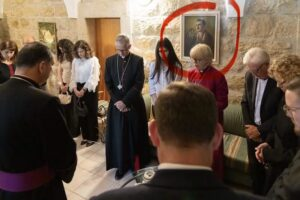
This man is Layan’s great uncle, the brother of her paternal grandfather Kamal Nasser. Nasser was born in 1924 and became a celebrated political leader, writer and poet. In 1967, he joined the leadership of the Palestine Liberation Organisation (PLO), led by Yasser Arafat, who invented the term ‘Palestinian’ to refer to those who wanted to destroy Israel and return to their land (prior to that, ‘Palestinian’ had been a regional term that described modern Israel, Jordan and Syria). Nasser was also a ‘Palestinian Christian’ — and this is the point where we need to recognise that, in this context, the term ‘Christian’ really functions as a tribal and ethnic identifier, more than the sense of someone who has made a personal commitment to Jesus as we might use it.
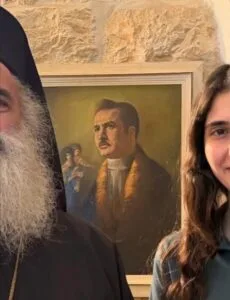
Nasser had joined the PLO just at the point where it made the Khartoum Resolution, in response to the defeat of the Arab armies by Israel in the Six Day War of 1967. This was known for its three ‘Nos’: no peace agreement; no negotiation; no recognition of the state of Israel. This led inevitably into more warfare, culminating in the Yom Kippur War of 1973.
Part of the violence of the PLO, which (with Russian help) developed into the foremost global terror organisation, was the 1972 Munich massacre, when Palestinian terrorists infiltrated the Olympic village, killed two Israeli athletes, took nine more hostage and eventually killed them during a failed rescue attempt. Nasser was one of the people who masterminded this operation.
For anyone outside the situation, it is hard to understand how ‘Palestinian Christians’ could be involved with anti-Israeli and antisemitic terror. But in fact the links between the two are longstanding and well-developed. Nasser’s father was Reverend Butrus Nasir, who was a leader within Palestine’s Arab Protestant community from Bir Zeit. The founder of the PFLP, a radical Marxist terror organisation, was George Habash, a ‘Palestinian Christian’.
And the Greek Orthodox Church has had long links with the PLO going back to the 1960s. Many ordinary Palestinian Orthodox Christians and clergy of Palestinian descent are sympathetic to or actively involved in Palestinian nationalist politics — many Palestinian officials across ministries, the PLC, the PNA and the PLO are Christians. There’s also a documented history of crossover between Greek Leftists and the PLO more broadly: during the late 1960s and early 1970s, many Greeks belonging to the anti-dictatorship socialist movement trained in PLO camps in Lebanon, and when the PLO was forced to leave Lebanon, Greece — under PM Andreas Papandreou, who had close ties with Arafat — became its first destination.
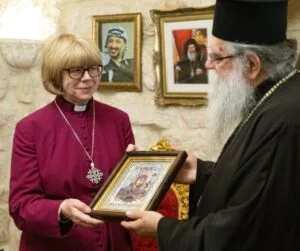
That is why we can see a picture of Yasser Arafat on the wall of the office of Archbishop Benedictus, as he is meeting Sarah Mullally. Our Archbishop has managed to be photographed in front of, not one, but two notorious terrorist leaders within the space of a couple of days — quite an achievement! And you can see the intertwining of terrorist resistance with Christian devotion in the painting of Nasser: in the background of the canvas, there is a traditional iconographic depiction of the Virgin Mary holding the infant Christ.
It is worth reflecting how both Israelis and British Jews will be made to feel by seeing these images.
(For transparency: I raised these questions on Sarah’s Facebook feed, and I also wrote directly to Lambeth Palace. I have not had a response from either.)
We then need to ask: why did the Archbishop decide to make such a one-sided visit to the region which such a complex and contested situation? Why was not more care taken?
It might be claimed, ‘Well, it is obvious that she opposes terrorism, so that does not need to be stated.’ But that is clearly not the case. Just this morning on my Facebook feed I see that a once-respected evangelical ethics scholar has posted a Guardian piece containing antisemitic blood-libel lies about ‘Israel targeting children’ in the Gaza conflict, and citing the ‘genocide scholars’ — that is, those Arabists who were willing to pay €50 to join the International Association of Genocide Scholars (IAGS — no qualifications required: “We are inclusive and welcome activists…”)
Why didn’t Sarah Mullally take care to engage with all angles on this visit? If her agenda was dispassionate concern for those who have suffered, why didn’t she visit any of the families of the 1,195 slaughtered on October 7th, or of the 250 abducted? Or of the 1,010 killed and 8,341 Israelis wounded in the second Intifada? In December 2023, a survey showed that 83% of West Bank Palestinians supported the atrocities of October 7th. Did she meet any of these? It is implausible to think that this number does not include ‘Palestinian Christians’.
When we visited Israel in 2018, on a tour organised by the Anglo-Israel Association, it was carefully planned to do precisely this — to help us understand the complexities and dynamics of the situation, rather then to help us take sides. So we met former PLO negotiators, PLA politicians, settlers, those running the Keren Shalom crossing, the British Ambassador and many others.
What we encountered was ignorance and a lack of interest in the view of ‘the other’ on all sides. Thus, when we visited settlers in the West Bank, the only comment they could make was “Look — the hills are empty — there is plenty of room for us all” without demonstrating any awareness of the implications of this idea. More seriously, when we met former PLO negotiators, I asked one of them “How important do you think the Holocaust was to those with whom you were negotiating?” “Er, it was unfortunate,” came the reply — unsurprising, since the Grand Mufti of Jerusalem in the 1940s, Amin Al-Husayni, met with Hitler to offer Arab support to his ‘final solution’ of the eradication of all Jews.
But we also encountered generosity and peace-seeking. Those running the Karen Shalom crossing into Gaza were genuinely desperate to keep aid flowing in — but were hampered by the consistent use of lorries to smuggle in arms and explosives. The children’s hospital that we visited in Tel Aviv treated Gazans for free — despite the hideous experience of treating Wafa Al Bass, who returned to kill those who had treated her.
And the hideous irony for many of the victims of October 7th is that those who lived in the kibbutzim near the border with Gaza did so because they wanted to build bridges and work for peace. They welcomed Gazans to work with them — to provide employment and build understanding. Yet those very people they had welcomed passed their detailed knowledge on to allow the terrorists to find their secure rooms and murder them.
Without engaging with these other views, the Archbishop is certain to come away with a partial and a partisan understanding of the situation. I gather that she did visit the Nova exhibition in London, exploring the horrors of October 7th, and met with some of the families — but strikingly this was not reported in her feed on Facebook. I wonder why?
This raises wider questions about why bishops in the Church of England have decided to make the Palestinian cause such a focus, out of all that is happening in the world. Why are they not visiting Nigeria and meeting Christians there suffering — not because of dispute about land, but actually because of their Christian faith? Why are not other nationalists causes in the region gaining their attention?
Why do some causes command all-consuming attention and allegiance while others are largely ignored or downplayed? Why do those who profess concern for justice, human rights, and self-determination jump in with both feet in some cases, yet remain thunderously silent in others? …
The Kurds are the real victims of the Middle East, not the Palestinians. Kurdish people, denied their own state, have experienced genocide. The West doesn’t care because their oppressors aren’t Israeli.
And what about the other examples of oppression in the world? The Uygars in China? The conflict in Myanmar? Any number of other oppressive regimes? What about the violence and oppression happening in the states neighbouring Israel? What about women’s rights in Egypt, where 98% are subject to female genital mutilation?
This is not ‘whataboutism’. It is asking about priorities, and why the bishops have made this situation a key one. This is indeed a reflection of antisemitism, as Baroness Deech make clear in her letter to the Church Times last week:
The basic definition is as follows: “Antisemitism is a certain perception of Jews, which may be expressed as hatred toward Jews. Rhetorical and physical manifestations of antisemitism are directed toward Jewish or non-Jewish individuals and/or their property, toward Jewish community institutions and religious facilities. Manifestations might include the targeting of the state of Israel, conceived as a Jewish collectivity. However, criticism of Israel similar to that levelled against any other country cannot be regarded as antisemitic.”
It is then amplified by examples, of which a very pertinent one is this: “Applying double standards by requiring of it a behaviour not expected or demanded of any other democratic nation.”
Double standards are evident when multiple questions are raised about Israel and no other foreign country. They are evident when the unjustified words ‘apartheid’ and ‘genocidal’ are applied to Israel, when those words could well be used validly of, for example, China and the Uyghurs, India and the Dalits, Myanmar and the Rohingya, and Saudi Arabia and religious minorities.
We do not hear loudly from the Church about the dead children in Yemen, Syria, Sudan, Nigeria and Iran, or the kidnapped Ukrainian children. We do not hear protests about the checkpoints in Belfast dividing two communities. Only when Jews are involved are there such loud condemnations. The Church’s preoccupation with the Jewish state, as if it were the worst — the Jew among nations — amounts to double standards, because the ethical difference between the attitude to Israel’s conduct, its casus belli, and the conduct of other states at war is clear. Genocide and apartheid are inflammatory words designed to stir up hatred and to re-contextualise the actual genocide of the Jewish population in the Second World War.
A response the following week suggested that the motivation here is our past involvement as a nation and our continued connections with the region. But we have connections with these other places — and we have deep connections with this conflict which are not being challenged.
The state of Qatar has been a major supporter of Hamas, fuelling (literally) the rocket attacks on Israel for years. Best estimates suggest that from 2018 to 2023, Qatar transferred roughly $30 million per month into Gaza, totalling around $1.8 billion over six years. And Britain has major economic, trade, energy, investment and defence links with Qatar — so why have no bishops spoken up about this? We have been just one small step removed from directly funding terrorism.
And through our contributions to the UN, we have been funding UNWRA, which is perpetuating Palestinian victimhood by declaring that — alone in all the people displaced around the world in the aftermath of WW2 — all descendants of anyone who was displaced in 1947-48 is designated a ‘refugee’. It does not keep records of who qualifies; anyone can claim to be, and there is good evidence that UNWRA is providing funding for people across the world who have moved away from the region, and even those who have died whom they have not removed from their register. It funds education in Gaza which teaches children to want to kill Jews, and UNWRA employees were involved in October 7th.
Where are bishops speaking up about this?
This whole approach is disastrous for the Church of England, for Jews in Britain and for peace in the region. I do not believe that this is a disaster because of a quasi-magical use of the biblical idea that ‘I will bless those who bless you’, transferring the promise of Abraham to the modern secular state of Israel, since the Bible itself makes the transfer in a quite different direction, as I explore here. But it is a disaster.
For the Church of England, once more we have our leaders taking sides in a complex and contested issue on the basis of poor research and understanding, and apparently riding on yet another Left-liberal social cause. This demonstrates again our bishops’ inability to engage thoughtfully and responsible with complex issues, and undermines confidence in their leadership. And it offers more confirmation of the Left-liberal bias of the House of Bishops as a whole, as Edward Skidelsky writes in the Spectator:
Shortly before he died in April of this year, my father Lord Robert Skidelsky commissioned a little research into this question. He asked his invaluable assistant, Attila Mestehazy, to run through all 693 speeches delivered by the reverend Lords between January 1st 2024 and September 19th 2025, looking out especially for words and arguments associated with Christianity. The results were dismaying, if not entirely unexpected. ‘Bible’, ‘gospel’ and ‘Christianity’ each appear in somewhat under 1% of all bishops’ speeches. ‘Jesus’ appears in 3%. ‘God’ shows up a bit more often, at 6%, perhaps indicating an attempt at inter-faith solidarity. ‘Sin’ appears not at all. …
A deeper dive into the 693 speeches confirms the impression of overwhelming secularity. On most issues, the bishops take a position indistinguishable from the left wing of the Labour party, albeit decked out occasionally in Christian rhetoric.
I think it is extraordinary that, on visiting Bethlehem, Sarah Mullally managed to reduce the incarnation to a social cause:
From the manger, Jesus proclaims, meekly but powerfully, the beginning of a new world where the poor, the sick, the excluded and the marginalised are brought into the very heart of God.
Not a mention of the fact that he came to “save his people from their sins” (that is literally the meaning of his name! Matt 1.21) or to call us to “repent and believe” (Mark 1.15).
For Jews in Britain, they are once more told that the established Christian church is not on their side. Someone commented to me that, every time the General Synod has debated this issue, we have ended up deeply offending the Jewish community here. We look set to repeat this.
And for the peace process, this is a disastrously once-sided and partisan approach. As Bijan Omrani notes in the Telegraph this week:
One wonders whether her pronouncement is made out of the profoundest naïveté. Does she not realise the consequence of repeating a narrative where the Palestinian people are nothing more than the helpless victims of Israeli occupation? Of omitting to condemn the repeated refusals of the Palestinians to accept serious offers of peace over the generations, not to mention declining to excoriate the brutality of Hamas, the demand of its founding charter to eradicate Jews, its hiding behind civilians and the complicity of ordinary Palestinians in the terror wrought by Hamas?
Mullally’s embrace of this Palestinian victimhood narrative will simply make it more difficult to combat the terrorism and totalitarianism of Hamas, which is the more fundamental cause of the misery of the people and the prolonging of the conflict – not to mention the oppressive treatment of Christians in their territory. This failure of courage, to confront the difficult truth of the situation, is hardly going to advance the cause of justice.
Sarah Mullally, at the time of her enthronement, said that she wanted to be a quiet voice for unity, and that she stood against antisemitism. In undertaking this ill-conceived and ill-advised trip, she is doing neither.
Revd Dr Ian Paul is a theologian, author, speaker and academic consultant. He blogs at Psephizo, where this article first appeared.

Discussion
Comments
This week across the site:
To join in with the discussion please make a donation to the Daily Sceptic.
Profanity and abuse will be removed and may lead to a permanent ban.
No, the Church of England’s problem with Christianity!
there, fixed it for you
Why doesn’t she just change her job title from Archbishop to Ayatollah and have done with it?
Quite shocking to see the Archbishop pictured in front of those portraits. Yet another PR coup against Israel. She is poorly advised and ill informed.
Perhaps Sarah Mullally and other church leaders honestly do view the Israel-Palestine question as a sad but clear-cut case of sustained oppression. As a young person in a really rather left-wing community I almost subconsciously absorbed that impression myself. I could listen to and sympathise with Israeli perspectives, but to me those were individual unfortunatenesses against a backdrop of near-total suffering on the other side. I left that community later in life, but the people I know who didn’t leave still talk that way about the Middle East. It’s not at all to their credit, but I suspect the church leaders may still be in that community, surrounded by that ‘truth’ to the exclusion of more truthful truths.
By the way, it’s a small point, and my Arabic isn’t what it used to be, but Wikipedia’s romanised version of the Arabic name of the PFLP is not in the same order as the original 🤨
The woman is an idiot. Might as well abandon Christianity as a lost cause, since woke women have taken over
Woke men such as Welby and the previous and current Popes were much better at the job, weren’t they? Carry on ingratiating yourself, though, eh? ‘Tis the norm on here, after all;
“I’m not that woke,” Welby says today. “I’m really very conservative in lots of things. And better to be woke than asleep. The Church in the 1960s or 1970s, on issues of race, was sound asleep. It missed out on what would probably be two to three hundred thousand people who came from the Caribbean, whom we turned away. I wish they’d been a bit more woke, frankly. We’d be a better Church for it.” Had the Anglican Church embraced priests and congregants from the Windrush generation, today’s emptying churches might have looked different.
In the past, when questioned on gay marriage, Welby would take the Church line but then bend it towards human reality. Marriage is between a man and a woman for the purposes of having children, he’d say – and yet a same-sex partnership can be just as meaningful; “I struggle with this issue” you’d hear, again and again. But in February this year, the Archbishop of Nigeria declared that Welby had “begun a second… Read more »
I think you might be confusing causation and correlation Mrs C?
The rot set in long ago, when the church decided they were charity social workers rather than purveyors of the word of God…
I’m not sure that many of them are really believers at all, today. Our political classes have followed a similar trajectory, away from belief, and towards ideology.
Ever since women became involved, religion has gone downhill
Let me make a suggestion. Maybe Lambeth Palace received advice e from FCDO. It is clearly anti-Israel and pro-Arab (OK I know some people involved are not actually Arabs).
The attitude of FCDO is long standing, certainly longer back than the last General Election so we can’t simply blame this government. We can blame the political class.