

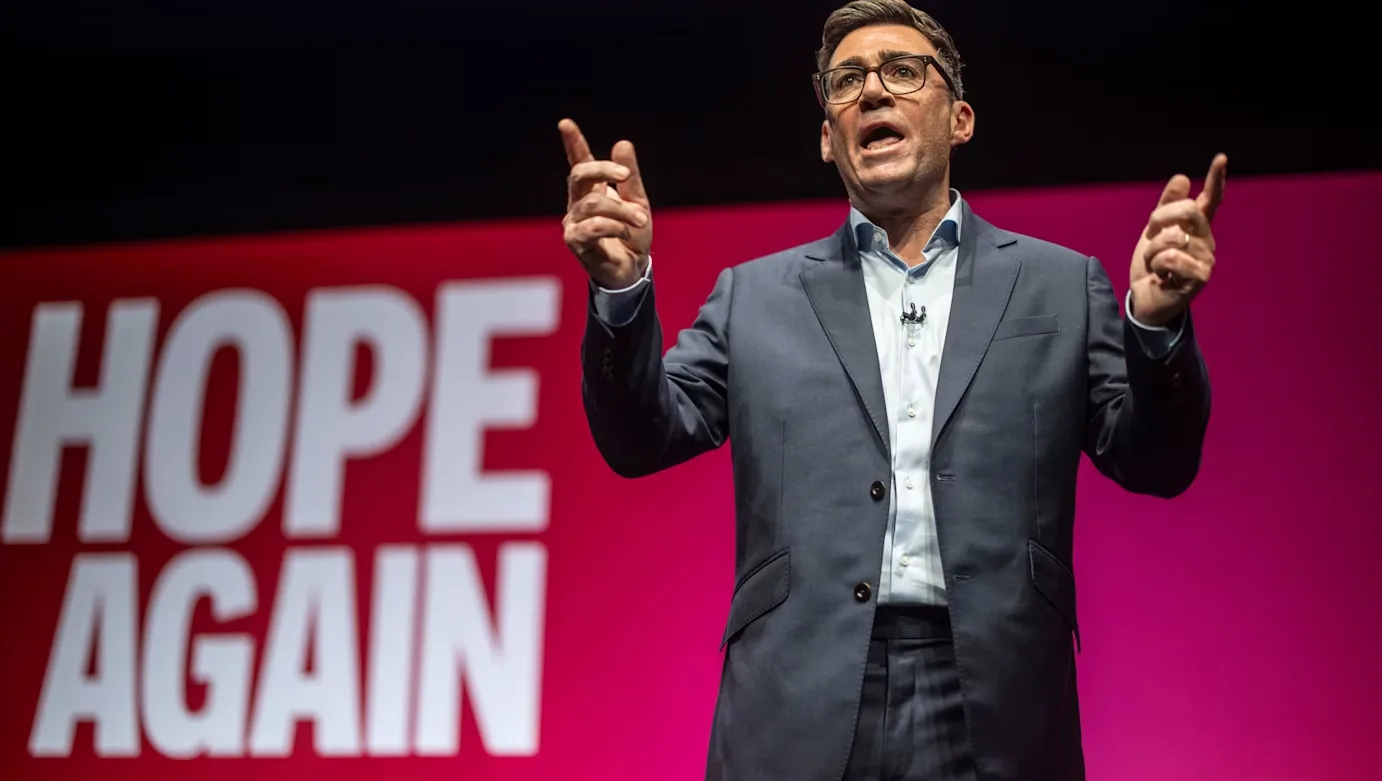
I was lying on bed, recovering from a small bout of ill health, and I thought, “Let’s see if Burnham’s conference speech is on.” It wasn’t – yet – so I began listening, instead, to an interview of Burnham by Kuenssberg on the BBC. I stopped YouTube after a few seconds, in irritation. (It might be appropriate, Andy, to talk about “my gran” and “my dad” if you are talking to an old man at his door or an old lady in a bakery, but is it appropriate to play the Hovis card when on the BBC? Very odd. You can refer to ‘Dad’, since that is what you called him, but, for God’s sake, otherwise refer to him as ‘my father’. Come on, you went to Cambridge, you faker.)
I know that a few weeks ago I said Burnham was a Harry Potter sort of figure, with his Number 9¾ North. Aye, but, in fact, it might be truer to say he is a Beano sort of figure. He is a throwback: a reminder of better days, of rationing cards, trade unions, not-on-your-life, over-my-dead-body, oh-you’re-a-charmer, seaside postcards, holiday outings on a bus, solidarity, memories of the CND marches. He is a Roger the Dodger, he is not so much Billy Whizz as Burnie Vibes, or, perhaps aptest of all, he is Our-Andy-with-his-10-Year-Plandy.
Another thing I noticed from his interview with Kuenssberg was that she spoke to him as if he were slightly stupid. Be careful, Kuenssberg: that could be considered collusion. I don’t think he is stupid. I am still not sure what he is. He certainly hides his political intelligence very well: a major political achievement in its own right – perhaps.
The final thing I noticed, which is worth mentioning since it was also evident – though less evident – in the conference speech, was that Burnham played a clever trick. Kuenssberg was asking him about the cost of all his policies and he switched the meaning of the word “cost”. It was a trick that depended on the double signification of the word. For instead of talking about the cost of spending something, he began speaking about the moral cost of not doing anything i.e., not spending anything. I applauded that. Clever, Burnham. Watch him, Kuenssberg.
He reminded me a bit of Corbyn, even Starmer: that Labour habit of reaching for the moral high ground whenever that drowning sensation of being asked a question is felt. That Labour habit of slightly irritably pushing through to the no-I-really-need-to-talk-about-this: suffering people at the bottom or sides or somewhere in our society. It’s a social worker move.
Before I get to the conference speech, let me say that I also reviewed a few podcasts (centre to Left) to see what everyone was saying. The Rest is Politics and Political Currency were genial and authoritative, The News Agents was rubbish, and Novara Media was actually better: in the way that the aggressive Left is always better than the caressive, preening Left. Novara said, and I paraphrase, ‘Burnham = Corbyn’. It also said, “The Greens pushed Labour to the Left.” Which is the sort of thing one does not hear on Campbell ‘n’ Stewart or Osborne ‘n’ Balls.
It’s a bit embarrassing, but I have five pages of notes from the Burnham conference speech. In pencil. I even paused him to write some of it out:
The politician in me wants to give the tub-thumping speech today. But the patriot in me tells me something very different is needed. This country is not where anyone would want it to be. Politics as usual has taken it backwards. More of the same isn’t good enough. That’s why I have to break the mould today. I’m going to give you a real speech.
This requires explanation. Burnham is trying for sincerity. Sincerity means: what he says is what he means. But it also means that he is playing for high stakes by being willing to mean what he says and stick to it.
That’s fine. And of course it has an attractive, appealing sound. It affected the Labour faithful from Campbell downwards. They all spoke about much emotion.
But it is a dangerous game to play. For it attempts to close down the gap between surface and depth. And the gap between surface and depth is the only room for manoeuvre possessed by the politician in difficult and changing circumstances. The only way Burnham is going to be able to play this game is to refuse to answer questions.
To put it exactly. If one is honest, as a politician, one cannot be open. If one is economical with the truth, then one can be open. Burnham, like every politician, has to choose.
Burnham is in the interesting position of being able to pretend to be an outsider. He called himself an “outsider”. I know, everyone always mentions his history at Cambridge, as a Labour party apparatchik etc. The facts are one thing. But the styling of himself is another thing. And what we have to recognise is that the Manchester burble allows Burnham to pose as more of an outsider than, say, Farage. And the accent helps. Let’s face it, Burnham has the accent of Old Labour. Just as Farage has the accent of rackety Right.
Anyhow, he promises “to make politics work for you… I will say it straight. Britain has been on the wrong path for a long time.”
He made a list of the things that had gone wrong. I was again impressed so wrote it down. His list:
- Deindustrialisation.
- Deregulation.
- Privatisation.
- Austerity.
- Brexit.
His argument was that all of these have given us a world of “vested interests” not “the public interest”.
Rory Stewart pointed out that everyone in business would immediately reply that the United Kingdom is one of the most highly regulated systems in the world. And Rory was right about this. (Rory also pointed out that almost everyone would say that life was materially better in the 1990s and 2000s than in the 1970s and 1980s.) But it doesn’t matter, because Burnham has a history and a theory.
His history is that “we built the common good, or at least we did until the 1980s”. “The British Right talk about taking back control. They are the ones who gave it away in the first place.” (At first I couldn’t work out whether he was blaming Heath for joining the EEC, or, more likely, simply engaging in a Burnham sleight-of-hand where he shifted the meaning of his keyword from control=sovereignty to control=socialism. But I am sure this is another version of the trick he used on Kuenssberg.) That’s Burnham’s history. You know it already. Everything was good from 1945 to 1979. He speaks of “the flawed thinking of the last 40 years”, which takes us back to 1986.
I’ll come back to Burnham’s theory.
You also know the new policies:
- Founding a National Care Service.
- Modifying the Triple Lock.
- Reopening Europe. Maybe.
- Looking into Electoral Reform.
Those are the big ones. The others were perhaps more suggestive than solid. For instance, it sounds strong “to repeal Margaret Thatcher’s ideological ban on public ownership of water companies” but that is not the same thing as bringing them under public ownership: in practice, everything will continue as before, if the capitalists behave well. There is possibly to be a Great British Grid to keep energy prices down, a public company to compete with the private ones. Burnham wants to protect leaseholders and increase “social housing”. There’s to be no VAT on electricity bills. There is the business of the £2 bus ride. Change will happen “not through crude cuts” but through “investing in people”.
The “Social Care” business is especially interesting. He spoke of his grandmother, who apparently had her ring stripped from her finger while in care. I immediately thought “by another inmate”, but someone in the Spectator or somewhere seemed to think he was implying it was a carer what done it; anyhow, this is an indication of my unconscious bias, that I would finger a member of the public above an honourable member of the caring class.
“Care” is a vexing word. Care has nothing to do with the Latin caritas, which means ‘love’ and gives us the word charity. My dictionary tells me that “care” comes from: “Old English caru (noun), carian (verb), of Germanic origin; related to Old High German chara ‘grief, lament’, charon ‘grieve’, and Old Norse kǫr ‘sickbed’.” In other words, care is something negative. It is like ‘passion’. Passion is negative: it means suffering. And care is sorrowing. Care is not, primarily, ‘looking after’ someone. It is ‘looking over’ them and crying. Now, Burnham would say that that is because in those easy days nothing-could-be-done whereas in our tougher times something-can-be-done.
I think all of this needs to be subjected to a Hitchens refutation.
A Hitchens refutation is where you listen to someone for half a minute, and then you say something like (though these are my words, not his), ‘Burnham is proposing a National Care Service. The only reason we need one is because we DO NOT CARE. In fact, he should call it a National Do-Not-Care Service. If we cared, we’d look after the children, the infirm and the old within our families. It is because we do not care for our families that this problem has arisen.’
(My own theory about why Burnham is in favour of social care and wants to elevate it to a National Care Service is because he dislikes assisted dying, knows it is state murder, and, as a good Catholic, understands that caring is infinitely and absolutely better than letting die. Not that he is going to say this openly. The only problem is that if the National Care Service further bankrupts the nation, and the Triple Lock cannot be unlocked, then we will turn to ‘assisted dying’ out of economic necessity.)
Part of the justification for an NCS was the intrinsic value of care. But the other part was the standard COVID-19 trolleyish stuff about how unless-we-do-this-the-NHS-will-collapse. That is to say, this badly built and expensive building will fall over unless we build another badly-built and expensive building next to it and attach them with scaffolding.
“I may pay a political price,” he said.
Aye, Burnham. It’s politics. One pays a political price. Price of entry. Price of exit. Price of existence.
One of his far-fetched connections is that one can enhance our social security and our national security. Aye, but not at the same time and by the same means. Stop bundling, Burnham. You are not a rag-and-bone man.
Then, as the Hovis element faded out, Burnham switched to my sort of talk. Theory. He said, “I have a theory of growth.” In fact, I think it is Burnham’s entire theory of political order. It is this.
- The state has to control the fundamentals: law, order, but, more importantly, the economic base: the regulatory system, the infrastructure, the water and electricity and housing. Burnham mentioned the game Monopoly and, indeed, apart from the novelty of AI (Go To Jail), everything else was pretty much the politics of the Monopoly Board. Sort out the water works, the electricity board, the houses: plus, I suppose, we’ve sorted out the hotels (thanks, Piddington, for taking up the slack) and we’re halfway done with the railways.
- Then, devolve to localities, and this is the sort of ‘HOPE’: that somehow making everything Corbynly democratic we will suddenly have “power in every postcode”, as well as disputes in every deliberation, redtape in every regulation, tie-up in every transaction, mental health in every mediation. Burnham calls it “devolution”. I call it HOPE squared with a cherry on top.
- That is his theory. If the state grasps the essentials, then Britain will be “rewired” and fire off like a Sunak-Starmer-SpaceX-rocket.
Burnham, as commentators noted, did not tar his opponents with a brush. That was good. He even said (I paraphrase as my pencil could only do so much):
Politics has been about point-scoring: it should be about problem-solving.
Now I have repeated ad nauseam that this is absolute rubbish. (Politics is not about solving problems. It is about settling them. If problems can be solved, we do not need politics for them.) But all this talk is a sign from Burnham that he is aiming for the statesmanlike apex condition of achieving-unity and avoiding-opposition. He calls it “consensus”, and it is perhaps because he likes consensus that he talks about that dread subject “electoral reform”.
Electoral reform? Some commentators, like Novara, got very excited, as if Burnham meant Proportional Representation, whereas a milder commentator, like Stewart or Osborne or someone, said, more soberly, that he probably meant Alternative Vote.
For those who care (I teach in a politics department, but this is the bit I find boring):
- Proportional Representation = The End of British Politics, The Beginning of European Style Stitch-Ups, Permanent Consensus, to be brought to an end only by a British AfD or Die Linke. Burnham might like it, as he’ll be able to lead a Left coalition for the next 20 years.
- Alternative Vote = The Continuation of British Politics, with the proviso that second-votes-used-against-extremists will likely mean an enforced centrism: hence a lot more Establishment BBC type maunder, to be brought to an end only by etc. – though, all together, a lot less revolutionary than proportional representation.
“So everyone’s vote counts,” said Burnham. “He didn’t say counts equally,” said Campbell, quite wittily, showing that even we at the Sceptic may admire Campbell’s perspicacity at times.
What else?
Burnham reflected on “the son of a man who failed his 11-plus becoming Prime Minister”. (What’s the logic there?) Well, I, too, may reflect, with some bitterness, on the son of a man who passed his 11-plus not becoming Prime Minister. But I might also console myself with the reflection that I did acquire a sense of logic.
Burnham talked a lot about “working class aspiration”. I noticed this, but did not make as acute an analysis as Steven Methven on Novara Media did. Methven recognised that Burnham spoke of the “working class” instead of (as Starmer used to do) “working people”. Words, words, words. Always important. Methven suggested that “class” suggests solidarity and lacks the exclusion of suggesting that only those actually in work are members of the group and should be cared about. So “working class” means thinking about children, the infirm, the old (as well as the layabouts). But something I’d add is that “working people” is a very strange hybrid phrase that seems to include many members of the middle classes, the upper classes – and the King. “Working people” was part of the New Labour embourgeoisification of everyone, whereas “working class” is Old Labour. And the Left likes it. Novara was very cheerful about it.
Now, what did Burnham leave out? I counted:
- Immigration
- Pandemic
- Public sector expansion
- The Debt
And of course he was so fond of blaming increased immigration on Brexit that he could talk about Brexit as if it has failed. He did not entertain, as Osborne, Campbell et al., never entertain, the possibility that it has failed because thwarted and muerta’d and afuera’d by its enemies.
Finally, Burnham likened his 2026 to 1945, 1964 and 1997, as one of the great moments in Labour history. Ed Balls noticed that this elegantly left out 2024. Aye, we are all magnanimous about those who are not our rivals.
The commentators can be summarised. They liked it. Burnham is a communicator. He cheered everyone up. (Let’s rejoin Europe, now!) The Spectator and Telegraph were a bit sour. But everyone else exulted. And Owen Jones declared that Burnham has proved that “the Left has won the argument”. Innocent little Owen, again. No, for even Burnham said, at the end of his speech, with more honour, that “You may disagree.” And I respect him for that. I’d take a pint with him over a pint with a dogmatist like Jones.
The other interesting thing is that there was a sort of colour-blindness to Burnham’s speech that no one seemed to notice. He talked about “working-class aspiration” and yes, once, he did offer “thanks to those who come and contribute”, but I got the impression that there might be a nativising strain in Burnham. Just a thought. Perhaps he was signalling in his own way. If we were to go back to the 1970s, we would have more problems, no doubt, but we would have more growth and fewer immigrants. Certainly, there was no mention of a multi-cultural multi-racial multi-religious society, no mention of social difficulties. No mention of civil war. Burnham is, on one side, a continuation of the law-and-order disapprove-of-nationalists I-am-a-patriot sort of thing. But what he was doing, verbally, was to attempt to drag the axis of political debate back to where it is safe, where the problem is, for instance, care. That is, to an old problem, a problem of the old, a problem we can rally round, everyone. Burnham, I speculate, probably really likes consensual problems, and probably really dislikes divisive ones. Let’s see.
Rees-Mogg called the speech socialism, Kevin Maguire called it communism, Bastani called it a glimpse of the end of neoliberalism. Well, I am saving my drink for after I write. I don’t know what to call it. Perhaps it is a sort of grand gesture at solidarism, setting up the grand conundrum of how the state can, with its vast capacity for inefficiency, and paying for everything five times once all the administrators are factored in, afford a National Do-Not-Care Service.
Anyhow, that was the great speech by Our Andy (With His 10 Year Plandy).
James Alexander is a Professor in the Department of Political Science at Bilkent University in Turkey.


Discussion
Comments
This week across the site:
To join in with the discussion please make a donation to the Daily Sceptic.
Profanity and abuse will be removed and may lead to a permanent ban.