

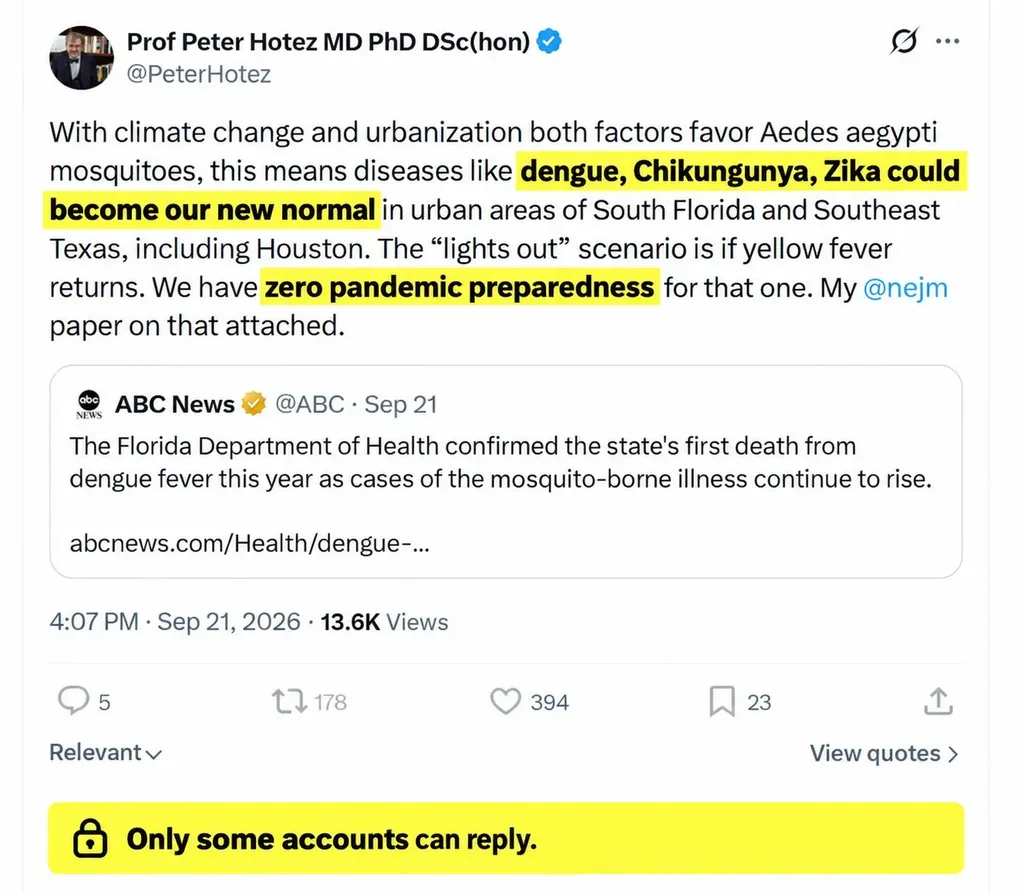
Monday September 21st 2026, quote-posting an ABC News item about Florida’s first (i.e., only) dengue death of the year, Peter Hotez (Dean of the National School of Tropical Medicine at Baylor) wrote that climate change and urbanisation favour Aedes aegypti mosquitoes, that dengue, chikungunya and Zika “could become our new normal in urban areas of South Florida and Southeast Texas, including Houston”, and that the ‘lights out’ scenario is a return of yellow fever, for which “we have zero pandemic preparedness”. He attached his own paper in the New England Journal of Medicine, ‘Yellow Jack’s Potential Return to the American South‘. Beneath the post, where the replies would be, a line reports that nobody can reply.
Zero preparedness
The yellow fever sentence is false, and it is the easiest one in the post to check. The 17D vaccine has existed since 1937, Max Theiler took the Nobel Prize for it in 1951, and it remains among the most effective vaccines ever built for anything: one dose grants protection the World Health Organisation now calls lifelong. What yellow fever lacks is supply. The world’s doses are grown in embryonated chicken eggs by a handful of manufacturers and cannot be hurried, which is why Angola and Kinshasa were vaccinated with fractional doses in 2016. That is a manufacturing problem; it deserves a budget and an argument, and it is not an empty cupboard. The reader told the cupboard is empty has been told something untrue in order that he be frightened.
I wrote to Dr Hotez last week:
You and Dr Bottazzi also designed, licensed and obtained authorisation for Corbevax within two years of a virus nobody had heard of. A field that can do that is not at zero against a flavivirus against which we have been vaccinating for 89 years, and I say that as someone with no stake in which platform (mRNA versus adenovirus, et al.) does the work.
How the claim gets built
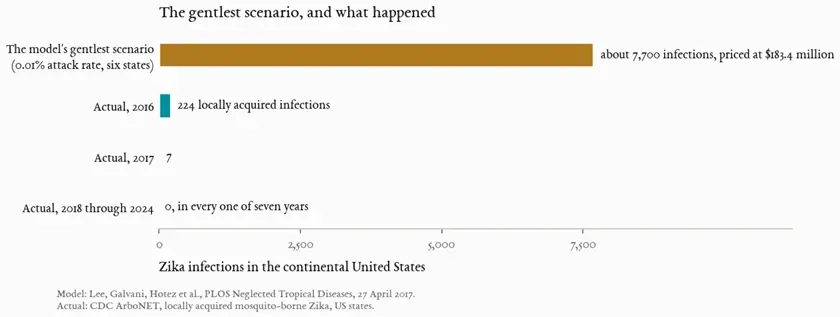
The method is visible in Hotez’s own literature. In April 2017 PLOS Neglected Tropical Diseases (the journal he founded and edits), published ‘The potential economic burden of Zika in the continental United States‘, by Bruce Lee, Alison Galvani, Peter Hotez and colleagues. The paper modeled Zika attack rates from 0.01% to 10% across Alabama, Florida, Georgia, Louisiana, Mississippi and Texas, and attached a price to each. The gentlest scenario the authors would contemplate, one hundredth of 1%, came to $183.4 million in medical costs and lost productivity; 1% came to $1.2 billion.
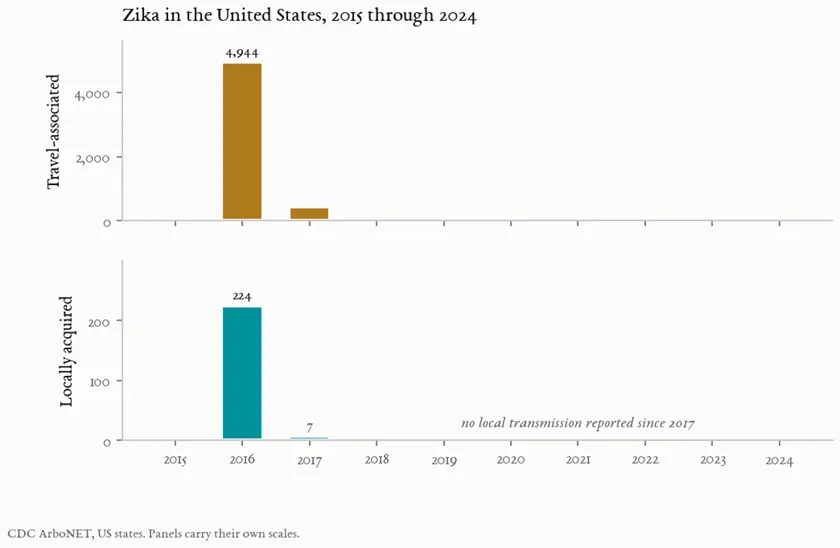
Notice what that does. The paper forecasts no epidemic and therefore cannot be caught forecasting one; it prices a range whose smallest member is already large and leaves the reader holding a number. The range has no floor at zero, and zero is what happened. The continental United States recorded 224 locally acquired Zika infections in 2016, seven in 2017, and none in 2018, 2019, 2020, 2021, 2022, 2023 or 2024. Six states with some 75 million people between them, and the model’s floor required roughly seven thousand infections. The forecast was not just wrong by a factor; it ran out of denominator, thus it was ‘infinitely’ wrong. Nine years later, there is no follow-up paper, and the arithmetic sits in a public table that nobody has been asked to reconcile with the ‘price list’ – or those listed prices of up to $1 billion.
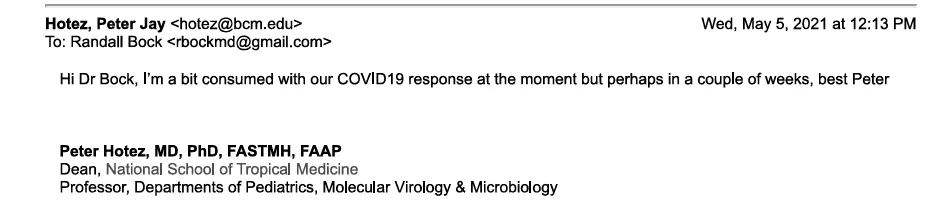
I put the obvious questions to him in May 2021: whether the United States keeps a microcephaly registry (microcephaly in infants being said to be a result of Zika in pregnancy) and whether anyone had consulted it since 2016, whether Zika had played out as the model said, whether there had been any consequence stateside, and whether a follow-up was coming.
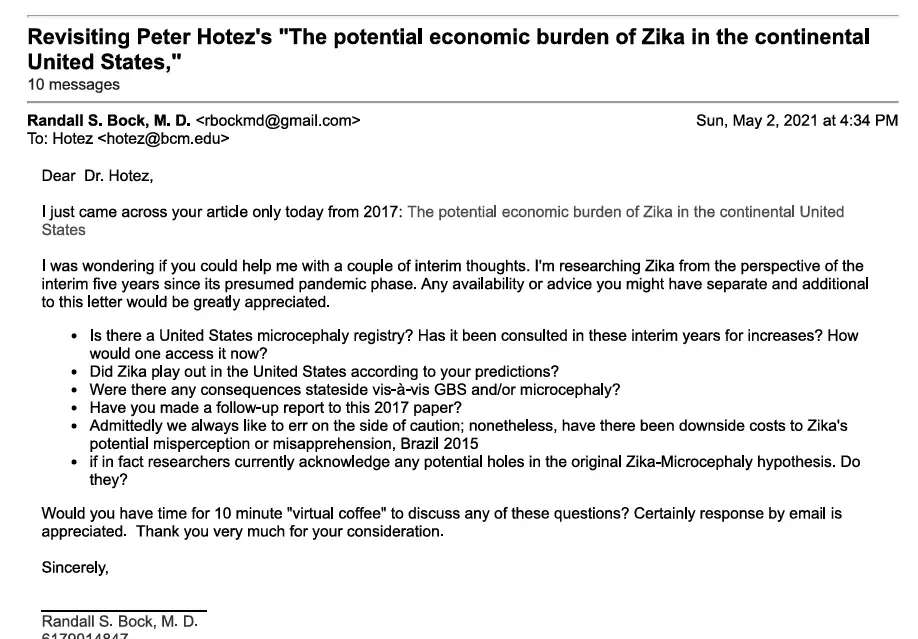
He answered in one sentence, saying that he was consumed with the Covid response and would return to it in a couple of weeks. That was five years and four months ago, and the questions are the same questions.
The United States keeps no national microcephaly count, and it stopped keeping one deliberately. The National Birth Defects Prevention Network collected microcephaly from state programmes and published the counts in its annual report until 2014. Janet Cragan and her colleagues at the CDC give the reason in Birth Defects Research: across the programmes reporting for 2006 through 2010, estimated prevalence ranged from 0.5 to 19.0 per 10,000 live births, a 38-fold spread inside one country, produced by “differences in the clinical definition of microcephaly, the timing and setting of diagnosis, case ascertainment methods and other factors.” Their sentence: “For these reasons, microcephaly was dropped from the list of defects requested in the NBDPN Annual Report in 2014.” In the same analysis, 41.8% of the American cases counted as microcephaly had a head circumference at or above the tenth percentile.
Set the dates side by side. In 2014 the people who count birth defects in the United States decided that microcephaly could not be measured consistently enough to add up across their own states, and stopped adding it up. In November 2015 a country with no registry, no test for the virus and a threshold it would move four times in five months announced an epidemic of the same condition, and the world believed it. The standardised American case definition was written afterwards, by that same network (NBDPN) with the CDC, in response to Zika.
The three viruses in Hotez’s tweet
Zika is a real virus and it is human-harmless. The World Health Organisation’s own history records that before 2007, 60 years after the virus was isolated from a caged sentinel monkey outside Entebbe, “no outbreaks and only 14 cases of human Zika virus disease had been documented worldwide”. Fourteen, found by antibody surveys aimed at other viruses rather than by anyone having fallen ill, with no clinical syndrome to describe and no test to describe it with.
Two exhibits get produced against that and neither holds. On Yap in 2007 three patients tested positive on a commercial dengue kit, the local diagnosis was dengue, but months afterwards serum sent to the CDC’s arbovirus laboratory in Fort Collins yielded Zika RNA in 10 of 71 samples, whereupon the case definition was rewritten from six thousand miles away on the strength of clinicians’ recollections and retrospective questionnaires about a virus that cross-reacts with dengue so thoroughly that the CDC published no algorithm for separating them until 2019. Nobody on Yap was hospitalised, nobody died, no birth defect was reported, and I have argued in the American Journal of Medicine, in ‘Investigating Zika-Microcephaly’s Crash‘, that the paper deserves an expression of concern. Guillain-Barré is the other exhibit, and it is not a Zika problem; it follows Campylobacter, cytomegalovirus, Epstein-Barr and influenza, and assigning a cluster of it to the newest name in the room is the reasoning that produced the microcephaly claim, performed on the same evidence in the same months by the same people.
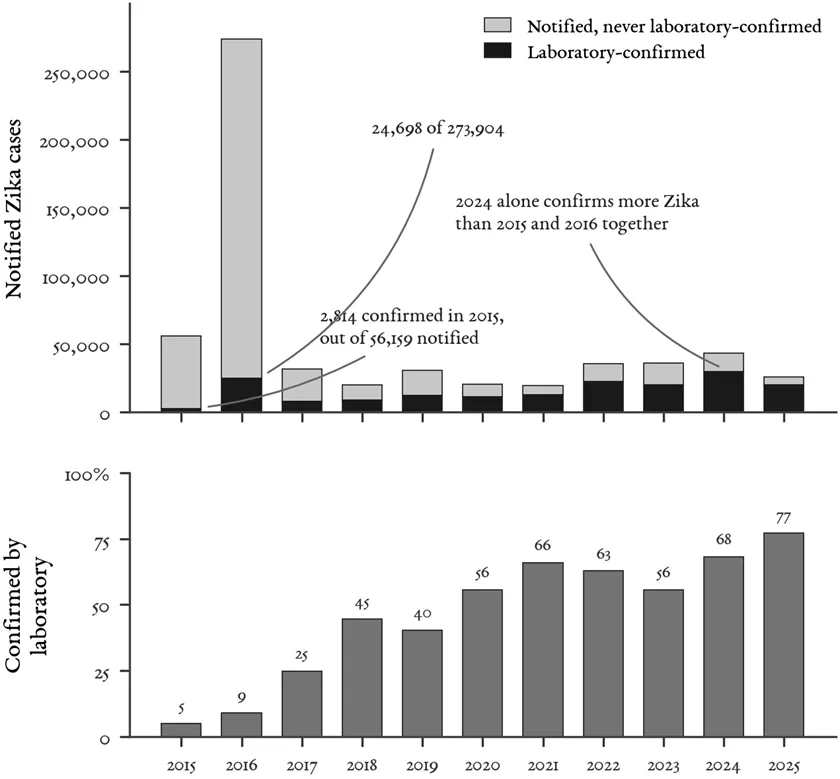
Brazil settles the rest, and the file is public at TabNet. In 2015 the country notified 56,159 cases of Zika and laboratory-confirmed 2,814 of them, 5%, because there was no test; the confirmed share then climbed to 77% by 2025, and in 2024 alone the ministry confirmed 29,556 infections, more than 2015 and 2016 together. Some 85% of all laboratory-confirmed Zika in Brazilian history has been recorded since the emergency was declared over. The virus stayed in the Northeast and circulates there still; the syndrome did not. Brazil confirmed 911 congenital cases in 2015, 403 in 2016, eight in 2017, none at all in 2022, and six in 2023, in a country that delivers two and a half million babies a year.
Dengue is the serious one of the three. It kills; an 80 year-old woman in Hillsborough County died on September 4th of septic shock and multiple organ failure, and Florida has recorded 332 cases this year with more than 150 of them locally acquired. Brazil has counted dengue in the millions annually for 30 years, and across all those pregnancies it has produced no congenital syndrome, which is the fact that should have governed everyone’s thinking in November 2015. Chikungunya produces a miserable arthritis that can last months, very rarely kills, and carries no teratogenic record either.
Three viruses, three vaccines
Set the word preparedness beside what happened when countermeasures for these viruses actually arrived. Sanofi’s dengue vaccine Dengvaxia was developed over nearly a decade and licensed in more than a dozen countries, and hundreds of thousands of Filipino schoolchildren received it before it emerged that children without prior dengue exposure were at risk of more severe disease on a later infection (a kind of negative vaccine effectiveness); the programme was suspended in 2017 amid criminal referrals and a collapse in Philippine childhood vaccination that health officials there were still measuring years afterward. The live chikungunya vaccine Ixchiq was licensed in 2023, and the Food and Drug Administration paused its use in people over 60 in May 2025, restricted it in August, and then suspended the licence outright, having recorded a death from vaccine-caused encephalitis and more than 20 serious adverse events in which recipients developed the illness the product was meant to prevent, with 21 hospitalisations and three deaths in all; the agency found that the benefits did not outweigh the risks under most plausible scenarios.
Zika is the third. The Department of Health and Human Services obligated $456,670,965 across 32 Zika contracts, $344.6 million of it before Congress appropriated a dollar, including $72,971,523 to Moderna, and in May 2017, with the epidemic finished and the microcephaly gone, agreed provisionally to as much as $125 million more, while the Gates Foundation pledged the company up to $100 million for messenger-RNA vaccines generally. There is no licensed Zika vaccine and no syndrome left for one to prevent. Three viruses were named as the coming normal; two of their vaccines were pulled for hurting people, and the third never arrived after half a billion dollars.
The dovetail
The coupling of these viruses to the climate is the project, rather than a flourish, and Hotez has published it under his own name. In September 2025 he brought out ‘Science Under Siege: How to Fight the Five Most Powerful Forces That Threaten Our World‘ with Michael Mann, the climatologist, and its premise is that climate science and infectious-disease science face one enemy and should mount one defence against five forces: plutocrats, professionals-for-hire, petrostates, fraudsters and the media. The tweet is that book compressed into a paragraph.
The merger buys a great deal. The instrumental temperature record is a real measurement series gathered over a century and a half, and whatever anyone concludes from it, the thermometers were reading something; Zika-microcephaly is a percentile counted with a ruler Brazil moved twice while the counting ran, in a country with no prior registry and no test. Coupling them lets the weaker claim travel on the stronger one’s passport. The question is arithmetical: how many confirmed congenital microcephaly cases, against what baseline, measured with what instrument. It has an answer, the answer is in a public file, and the answer does not turn on anyone’s view of radiative forcing.
The offer I made in 2021 stands: time in conversation on the record, unedited, on Zika and microcephaly and the Brazilian file, with Dr Hotez knowing more tropical medicine than I ever will; although perhaps recalling Ronald Reagan’s witticism.
The trouble with our liberal friends is not that they’re ignorant; it’s just that they know so much that isn’t so.
Randall Bock, MD trained at Yale University (BSc, Chemistry and Physics) and the University of Rochester School of Medicine. He is a practising primary care physician and public health critic. His autism analysis, ‘Unraveling Autism’s Surge’, was republished by Robert W. Malone MD as “essential reading… a treatise on the enigma scientists have labelled autism”. His works include ‘Investigating Zika-Microcephaly’s “Crash”‘ (American Journal of Medicine, July 2022) and Overturning Zika. Find him on Substack and X.

Discussion
Comments
This week across the site:
To join in with the discussion please make a donation to the Daily Sceptic.
Profanity and abuse will be removed and may lead to a permanent ban.