

This is an edited version of a speech I gave to a small group of British financiers and lawyers in Dubrovnik yesterday.
When Keir Starmer visited the White House in February 2025, J.D. Vance used the occasion to raise what he called “infringements on free speech” in Britain. Our then Prime Minister, sitting a few feet away in the Oval Office, was having none of it. “We’ve had free speech for a very, very long time in the United Kingdom,” he said, “and it will last for a very, very long time.” He added that he was “very proud of our history there”.
Was Sir Keir right to dismiss those concerns? I want to answer that question not with anecdotes, of which I have a great many, but with numbers.
Arrests, charges and convictions
Let’s start with a new report from Big Brother Watch, entitled Britain’s Free Speech Problem. Its headline finding is that between January 1st 2021 and December 31st 2025, 62,199 people were arrested in the UK on suspicion of committing just three communications offences. These are section 127 of the Communications Act 2003, which criminalises sending a “grossly offensive” message over a public electronic network; section 1 of the Malicious Communications Act 1988; and section 179 of the Online Safety Act 2023, the new “false communications” offence.
That’s a shocking figure, but it’s an underestimate. Several police forces didn’t respond to Big Brother Watch’s Freedom of Information requests, including Police Scotland. Big Brother Watch estimates the true figure is 73,023. So on a conservative estimate, the police are arresting an average of 34 people a day for things they’ve said, the vast majority online, and the true figure is closer to 40 a day. Russia, incidentally, is thought to arrest around 400 people a year for similar offences.
Of those 62,199 people, 18,520 were charged and 12,292 were convicted. That’s more than 12,000 people with criminal records for speech offences in five years. And that number is likely to go up if the proposals to curtail the right to trial by jury, first put forward by David Lammy when he was Justice Secretary, become law. Research by the Free Speech Union found that in the year to June 2025, 14% of people tried for speech offences in a magistrates’ court were acquitted, compared with 33% in the Crown Court, where the case was heard by a jury. Twelve ordinary men and women, it turns out, are less likely than a district judge to conclude that an intemperate tweet merits a criminal conviction. Leave the decision to them and more people will be convicted.
Is it getting worse?
But is the number of people being arrested for speech offences actually increasing? Yes, it is, as a similar piece of research by the Times established last year. It FoI’d every police force in England and Wales and asked how many arrests they’d made relating to just two of those three offences: section 127 of the Communications Act and section 1 of the Malicious Communications Act. Like Big Brother Watch’s data, the Times‘s is incomplete. Only 37 forces responded. But the trend is unmistakable:
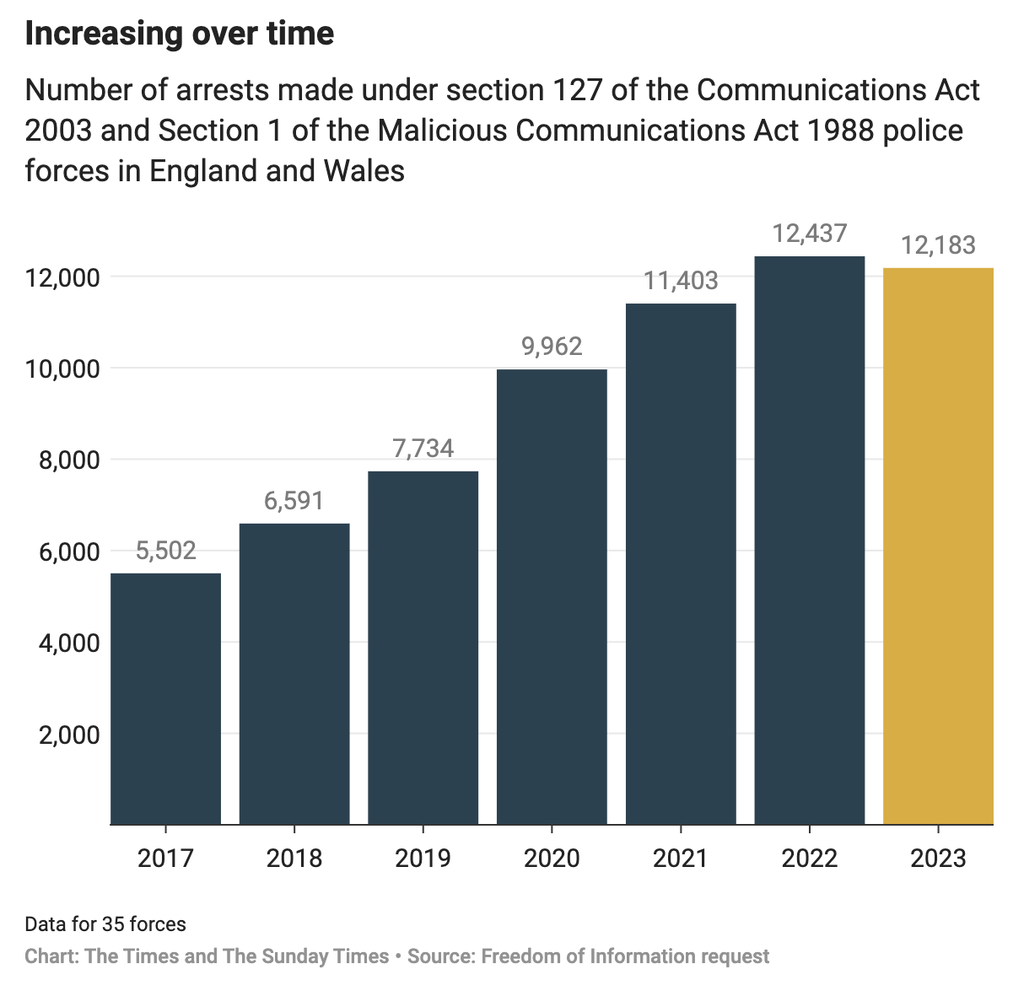
Between 2019 and 2023, the number of arrests rose by 58%, and since 2017 it has more than doubled. The 2023 figure works out at an average of 33 arrests a day.
Non-Crime Hate Incidents
You might think that if most people arrested for these offences aren’t convicted, and the proportion charged in the Times data is lower than in Big Brother Watch’s, then no great harm is done. Not so. Even when no charge follows, the complaint that triggered the arrest may be recorded as a non-crime hate incident (NCHI). (Yes, that can still happen in spite of the recommendation by the College of Policing and National Police Chiefs’ Council that NCHIs should be phased out.) NCHIs can show up on an enhanced criminal records check and prevent you getting a job as a teacher or a carer.
How many of these non-crimes are there? In 2020, the Telegraph FoI’d police forces in England and Wales and discovered that around 120,000 had been recorded between 2014 and 2019. That’s more than 65 a day.
Priorities
There can be little doubt that the police are prioritising the investigation of speech offences over other crimes. Consider the proportion of offences that resulted in someone being charged in the year ending March 2026. For rape, it was 3.4%. For burglary, 5%. For vehicle crime, 2.8%.
The Telegraph found that in 48.2% of neighbourhoods in England and Wales, not a single burglary was solved in a three-year period. Rick Muir of the Police Foundation told the paper that in large parts of the country, burglary had effectively been decriminalised.
So if you come home to find your front door kicked in and your laptop gone, my advice is not to bother reporting it. Instead, spray paint “Transwomen aren’t women” on the door and report the burglary as a ‘hate crime’. You’ll have six armed police officers on your doorstep in 10 minutes.
The Online Safety Act
That brings me to the third offence in Big Brother Watch’s data, section 179 of the Online Safety Act, and to the Act more broadly.
The Online Safety Act (OSA) empowered Ofcom to fine social media companies if they fail to remove illegal content – or, if the content is accessible to children, ‘legal but harmful’ content – and the fines are so eye watering, the threat will inevitably lead to over-removal, including the removal of perfectly lawful posts that are only accessible to adults. Ofcom can fine malefactors up to £18 million or 10% of their annual global turnover, whichever is greater. In Meta’s case, global turnover was $200.97 billion in 2025, so a 10% fine would come to $20.1 billion, or about £14.9 billion. And Ofcom would be entitled to use Meta’s revenue as the benchmark, because Facebook isn’t a separate company. Faced with that sort of downside, what sensible compliance officer isn’t going to err on the side of caution?
The Act is worse in this respect than its European cousin, the Digital Services Act. The DSA requires platforms to take down unlawful content once it has been flagged to them by regulators. The OSA requires social media companies to proactively remove content that is likely to be unlawful, before anyone has flagged anything.
We don’t yet know how much over-removal is taking place, because UK service providers aren’t due to disclose that data until the middle of next year. But to give you a sense of the scale of what’s coming, consider Reddit. In 2019, Reddit’s staff removed 222,000 items for policy breaches and banned 21,900 forums. Reddit’s unpaid army of volunteer moderators – digital curtain-twitchers – removed a staggering 84.1 million items. Those are global figures, not UK ones, but they tell you what content moderation on an industrial scale looks like.
What sort of content is being removed? If you think it’s ‘just’ hate speech, that isn’t much comfort. Who decides what is and isn’t hate speech? Are we happy to let Meta, X and Google make that call? What about Ofcom? To give you an idea of what gets flagged as ‘hate speech’, in April 2020 change.org took down a petition by Kellie-Jay Keen urging the Oxford English Dictionary not to change its definition of woman from “adult human female”, following demands for it to be replaced by something more “trans inclusive”. The reason given by the platform was that defining a woman as an “adult human female” is “hate speech”.
What about ‘misinformation’ and ‘disinformation’? Surely we can trust the platforms to get that right? On November 19th 2020, the Spectator published an article headlined ‘Landmark Danish Study Shows Face Masks Have No Significant Effect’. Facebook flagged it as “false information”. The authors were Carl Heneghan, Professor of Evidence-Based Medicine at Oxford (CEBM), and Dr Tom Jefferson, a senior research fellow at the CEBM and lead author of the Cochrane review ‘Physical Interventions to Interrupt or Reduce the Spread of Respiratory Viruses’. It’s a safe bet that Carl and Tom knew more about the efficacy of face masks and the robustness of the Danish study than the humanities graduate Facebook had employed to fact-check them.
Age-gating
Where content isn’t removed or flagged, it can now be age-gated. Since July 2025, platforms have been obliged under the OSA to age-gate content that is ‘legal but harmful’ to children, so it became inaccessible to users unless they could prove they were 18 or over. Among the things placed behind this gate in the first few weeks were Goya’s painting Saturn Devouring His Son, Katie Lam’s speech in the House of Commons about the grooming gangs, and a Spiked video about online censorship.
In addition, the Government has already amended the OSA to allow it to bring forward regulations restricting under-16s’ access to social media.
Both measures should alarm anyone who cares about democracy because the Representation of the People Bill, currently in the House of Lords, will extend the franchise to 16 year-olds. How are 16 year-olds supposed to make informed decisions at the ballot box if they can’t access social media until their 16th birthday, or watch speeches made in the House of Commons until they’re 18, when platforms like TikTok are now their main source of news?
In theory, these restrictions should be tempered by the duties in sections 17, 18 and 19 of the Act, which oblige platforms to protect content of democratic importance, news publisher content and journalistic content. However, those sections haven’t yet been activated. All the takedown duties are in force; all the keep-up duties are not.
What’s coming?
Unfortunately, it’s likely to get worse. A couple of months ago, the Department for Culture, Media and Sport published a Green Paper called Watch This Space. It proposes giving Ofcom the power to compel social media platforms, including YouTube, to give greater prominence in their algorithms to content produced by the BBC, ITV, STV, Channel 4, Channel 5 and S4C, along with other “trusted news providers”. Ofcom itself agrees – it recommended it be given this power in its current review of public service broadcasters.
But whether a source counts as “trusted” won’t be determined by how much people actually trust it. According to Ofcom’s own latest data – which, ironically, it initially forgot to publish – viewers of GB News trust it more than viewers of the BBC, ITV, Sky News and Channel 4. If people trusted the BBC, they wouldn’t need an algorithm to force-feed it to them, like a child being told to eat his greens.
So how would Ofcom decide which news sources deserve this privileged status? The Green Paper suggests a good “starting point” would be the definition of a “recognised news publishers” in the OSA, which stipulates the hoops a news provider has to jump through to be entitled to the protections in sections 18 and 19. At present, the criteria are fairly broad. But they could be amended by an Act of Parliament, adding a requirement that a news publisher has to bend the knee to a state-approved regulator to enjoy this special status. That would, in effect, bring back state licensing of the press, something we haven’t had in Britain since 1695.
There would be other consequences. The Trump administration might well retaliate by encouraging American platforms to give more prominence to US news providers, which could mean the output of our public service broadcasters being buried in their biggest overseas market. British content creators on platforms like YouTube could see their audiences suppressed, undermining their business models. And it would be extremely damaging to alternative news publishers that rely on reaching large audiences through social media to build their subscription revenue. (I should declare an interest here, since Skeptics Ltd, a company which I’m the largest shareholder of and which publishes the Daily Sceptic, is one of them.)
Then there’s the idea floated by Lucy Powell, Labour’s Deputy Leader. She has suggested the Representation of the People Bill be amended so that social media platforms are subject to some of the same restrictions as licensed broadcasters during election periods. So political debate, the thing elections are supposed to be about, would be curtailed on the platforms where most people now conduct it, precisely when it matters most.
The counter-disinformation state
The British state also has non-legislative ways of monitoring and suppressing content it disapproves of. Andy Burnham used his first speech to the United Nations General Assembly this week to announce the creation of a National Centre for Information Defence. Emily Thornberry, chair of the Foreign Affairs Select Committee, welcomed it: “A British counter-disinformation centre is long overdue, and very welcome.”
That’s an odd thing to say. What she should have said is that yet another British counter-disinformation centre is long overdue, because by my count we already have at least nine. There’s the National Security Online Information Team, the Government Communication Service, the Media Monitoring Unit, the Research, Information and Communications Unit, the Defending Democracy Taskforce, the Joint Election Security and Preparedness Unit and the FCDO’s Information Threats and Influence Directorate. Then there’s the work the National Cyber Security Centre and GCHQ do investigating hostile cyber activity and information threats, the Social Cohesion Taskforce and, not to be forgotten, the Army’s 77th Brigade.
These surveillance agencies are always sold as a response to threats from hostile foreign states such as Russia, China and Iran. But they aren’t confined to monitoring foreign threats: more than half of them monitor and in some cases flag domestic content. The new centre was sold in the same way. Burnham justified it by citing Russian mis- and disinformation, but in the next breath he tied it to “community cohesion” and preventing a “distorted and untrue narrative about Britain”. In other words, it’s there to stop British people saying things about Britain that the Government would rather they didn’t.
Prevent
These agencies are part of the UK’s growing counter-extremism ecosystem, and its most famous face is Prevent, supposedly the linchpin of the state’s counter-extremism strategy.
In the year to March 2025, 8,778 referrals were made to Prevent, a 27% increase on the previous year. Of those referred, 21% were classified as “extreme right-wing” and only 10% as “Islamist”. That’s in spite of the fact that about three quarters of MI5’s counter-terrorism caseload is Islamist, and only a quarter extreme right-wing.
Why the discrepancy? Part of the answer may lie in something the Free Speech Union discovered last year: a Prevent “refresher awareness course” on a Home Office website, designed to help public sector employees identify people they should refer to the programme. It identified “cultural nationalism” as a warning sign that someone was at risk of being radicalised by extreme right-wing ideology, and described expressing concern about mass immigration as an attitude associated with cultural nationalism. By that standard, a good chunk of the electorate – including the current Home Secretary – should be on the watch list.
Before that, a report produced for Prevent by the Research, Information and Communications Unit (RICU) set out a list of things to look for in people’s homes that are telltale signs of white nationalism. It included the complete works of Shakespeare, as well as books by Orwell, Huxley, Tolkien, Conrad and Burke. Other warning signs include DVDs of the Dam Busters, Zulu, the Great Escape and the Bridge on the River Kwai, and box sets of Yes Minister, the Thick of It, the original House of Cards and Michael Portillo’s Great British Railway Journeys.
The censorship-industrial complex
Beyond these state agencies there’s a whole censorship ecosystem of NGOs, lobby groups and think tanks – what the FSU dubbed in a report published earlier this year ‘Starmer’s misinformation mafia’. It includes the Center for Countering Digital Hate, whose internal documents reportedly set out an aim to “kill Musk’s Twitter”; the Council for Countering Online Disinformation; Stop Funding Fake News; Hope Not Hate; Labour Together; and the Global Disinformation Index.
Why?
Why are the British authorities so concerned about what ordinary people say on social media?
As David Betz and Michael Rainsborough have pointed out, it’s as though the state is acting like a colonial power occupying a foreign country, and has built a surveillance and suppression apparatus to manage the unruly indigenous population. Got to keep a close eye on the natives and nip any potential uprisings in the bud.
Hannah Arendt wrote about this in the Origins of Totalitarianism – techniques of control developed to govern colonies are later used by former colonial powers to govern their own domestic populations.
It also reflects our governing class’s collapsing faith in multiculturalism. They used to believe “diversity is our strength”. Not any more. Now they view many British cities as tinderboxes that could explode at any moment, so the lid must be kept on tight. One rogue tweet about a planned asylum hotel in a predominantly white neighbourhood could light the blue touch paper.
More broadly, it reflects a loss of faith in liberalism itself. The reason the governing class pretends that anyone who dissents from progressive orthodoxy has been manipulated by bad actors trafficking in mis- and disinformation – a claim comprehensively debunked by an FSU briefing entitled ‘Misinformation about misinformation’ – is that it’s easier than acknowledging that these disputes are, at bottom, conflicts of values. Having lost their faith, they don’t want the burden of defending the policies that flow from it in the public square. Far easier to pretend that everyone would agree with them if only they were properly informed, and that anyone who doesn’t must have been reading something they shouldn’t.
Censorship doesn’t work
I won’t spend too much time on the usual justifications for free speech as I’m sure you’re more than familiar with them. It’s how we make informed decisions about who to vote for. It’s how we make progress in science and technology and expand the frontiers of human knowledge. It’s how we test and evaluate different ideas about how to organise society and what a good life looks like. It’s a bulwark against totalitarianism. And it’s the most valuable human right of all, because without it we cannot defend any of the others.
Instead, I’ll leave you with an argument that even the defenders of the status quo might find persuasive: censorship isn’t working. In spite of the British state’s efforts to suppress dissent, Reform UK is leading in the polls. So is the AfD in Germany and the National Rally in France, despite similar efforts across the EU to suppress narratives that threaten the hegemony of the EU’s political elite. In the three biggest economies in Europe, the parties the EU is most determined to suppress are the most popular.
Our masters would do well to heed Louis Brandeis, the great Supreme Court Justice, who wrote in Whitney v California in 1927: “If there be time to expose through discussion the falsehood and fallacies, to avert the evil by the processes of education, the remedy to be applied is more speech, not enforced silence.” That became known as the counter-speech doctrine and until about 15 years ago it was the prevailing wisdom of political elites on both sides of the Atlantic.
We can but hope they rediscover it soon. Otherwise, Sir Keir’s assertion that free speech will last in Britain for a “very, very long time” may turn out to be one of his more optimistic predictions.
Stop Press: Watch the FSU’s Connie Shaw react on GB News to Andy Burnham announcing a National Centre for Information Defence to tackle ‘disinformation’. “This Government has a very dim view of the British public, it is very patronising,” she told Jacob Rees-Mogg’s State of the Nation.


Discussion
Comments
This week across the site:
To join in with the discussion please make a donation to the Daily Sceptic.
Profanity and abuse will be removed and may lead to a permanent ban.
Is that the same Jacob Rees-Mogg who wants all the young English lads to go and die in Ukraine whilst the country gets taken over by young male invaders?
The whole idea of this Free Speech Tyranny is to have only Government approved speech. Government policies are so far removed from the needs and requirements of UK Citizens, and nothing more than coercion (NET ZERO, MASS IMMIGRATION, GENDER POLITICS etc) that they need to silence, ban and jail all who expose their absurdity.
I not prepared to say, particularly as you now have Spies penning articles for the DS!
As the old USSR joke went: “There is no truth in Izvestia, and no news in Pravda.”
Possibly the most depressing article I have read in five years.
If we had free speech in the UK there would be no need – and therefore no subscriptions – for the Free Speech Union.
QED
Never mind free speech I have a major problem with the DS website. Why do they keep messing about with it.
Why must I login so often.
Why can’t I see all stories but instead have to wait for them to rotate around the website banner.
Im sure web designers find novelty great fun and it may pay well but meanwhile they are pissing off this subscriber. How much more can I take.
MODERATOR HERE
I understand that our Tech Genius is helping to address your problems? If, after trying his suggestions, you still have the same issues, email [email protected] to let us know and we’ll keep trying. The number of technical complaints we receive is extremely low, it’s often just a local, specific matter that needs addressing.
Thank you for supporting the Daily Sceptic
Sorry for the frustration. All our login sessions are 30 days if ‘Remember me’ is unticked, 90 days if ticked. It is likely this is a privacy setting in your browser clearing sessions each time you login. I have also emailed you to help investigate. Carousel shows only the latest story. The rest are ‘bookmarks’ for Weekly Podcast, Most Read and Most Commented (last 72H).
I think the site is fine and in general don’t mind the changes but the “carousel” being the only place to access the latest story is a negative for me. It makes sense for it to appear in the carousel but there should be a stable link to it below, just like there are for the other recent stories. I’m sure I am not the only one who visits the site periodically to see if there is a new story, having read all the others, and it’s frustrating to wait for it to come into focus. Thanks for your work on this important site.
I will confer with the DS team. Thank you.
Yes. I had that problem. It’s worth ticking the box. But I agree with transmissionofflame that the carousel is a bit annoying. Perhaps that needs attention, maybe slow it down a bit, but that will also cause probs.
I have slowed it down by 1 second, let us know if that’s better.
I will after I’ve had time to test it without thinking about it, if you get my drift.
Yes, it is better now, some may find it too slow so I suggest awaiting feedback.
We have to hope that the silent majority still exists and will exercise its traditional role of counterbalancing the loud and thoughtless.
Silent majority now ‘silenced majority ‘.
Our country is under siege in plain sight. Those who support it will be buried by it and those who oppose it will be swept away. Just saying, while I’m free to do so.
As I posted earlier
We haven’t had freedom of speech in this country for a long time. Certain kinds of speech were made illegal by the first Race Relations Act in the 1960s, the scope of which has been expanded periodically since and no supposedly right wing government has done anything to stop that. Radio and then television content has been state regulated from the start and no Fake Conservative government has done anything to stop that either.
Once the principle is established that it’s OK for the state to prohibit certain kinds of speech, you are lost. That ship sailed a long time ago.
We have not had a right wing government since the 1950s if we had they would have undone the mess that the postwar Communists under Attlee created. We would also have never joined the EU.
The only major reversal of the creep toward socialism was privatisation under Thatcher
Yes, to certain people, there is too much of it around, disrupting the technocratic state.
Does Britain have a free speech problem?
Sorry. It’s not in my best interest to say.
It’s difficult these days, with polarisation of Political Parties (although some would say they’re all the same), and media, to establish your own non-partisan view on any subject. In the end, you parse the information you see trying hard to spot the propaganda and deep fakes. You focus on the evidence you see with your own eyes and act accordingly. Unfortunately, most people now guard their views outside what they consider to be safe spaces in case they get reported for wrong speak.
As you say, “ most people now guard their views outside what they consider to be safe spaces in case they get reported for wrong speak “. This was something that was expressed by many of us at the FSU meet – up in Exeter. What a sad state of affairs.