

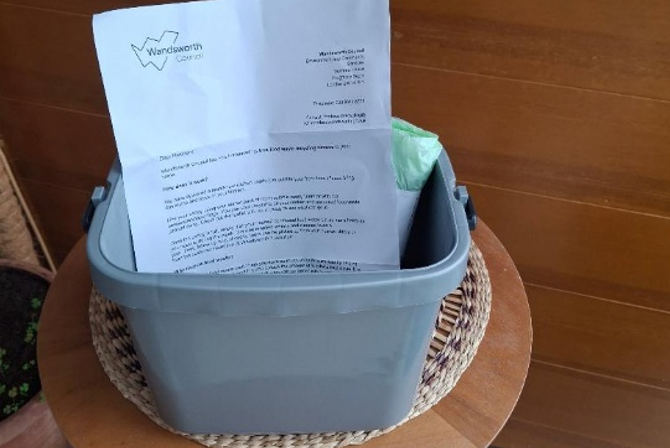
On Thursday I found a parcel waiting at the front door of my Wandsworth flat: a ‘free’ food waste caddy, a starter roll of compostable liners and a note from the council that deserves a place in the annals of municipal self-congratulation. Recycling my food waste, it explained, could save me “as much as £720 every year”. My leftovers would become “a sustainable power source and liquid fertiliser”. And because it is “much cheaper” for the council to recycle scraps than to bin them with the rubbish, the whole exercise “helps keep your Council Tax low”. Each of these claims turns out to be false, an evasion or a subsidy in disguise.
There is no such thing as a free lunch, as Milton Friedman never tired of pointing out. A local authority that pretends otherwise is not practising environmental stewardship. It is practising virtue signalling at other people’s expense. Let’s take the £720 first. It is not a recycling saving at all. It is a Love Food Hate Waste talking point about buying less food in the first place, describing what the average family could save by throwing away less edible food. That is a saving from wasting less, not from recycling more. WRAP, the climate NGO behind the campaign, now puts the annual cost of edible food binned by a family of four at £1,000. But the money is lost by typical household behaviour, not because food waste remains uncollected by the local council.
Separately collected food




Discussion
Comments
This week across the site:
To join in with the discussion please make a donation to the Daily Sceptic.
Profanity and abuse will be removed and may lead to a permanent ban.
I don’t know the economics of food waste collection well, but the system we’ve had in Oxfordshire for decades seems like a good practical solution. Food waste is put out in a separate caddy, which has the benefit of keeping other waste clean and dry, and presumably easier to handle. The food waste is put into anaerobic digesters which make gas which is burnt to make electricity, with the residue becoming fertiliser. In some parts of Oxfordshire some of this fertiliser is set aside in public places for rate payers to help themselves to, but most of it is sold to local farmers, who seem happy to use it.
What’s not to like about that system?
Nothing, as long as everyone’s happy to pay for it. Although domestic waste presumably makes up a small proportion of the total waste going to the anaerobic digester.
I would imagine a lot of households in places like Oxfordshire would have there own gardens/outdoor spaces? Why not just compost it for your own use? no caddies, no transport diesel, no landfill and you get to fill your own pots and flower beds!
Its a similar madness as melting down a glass bottle just to reform it into ..a glass bottle! Just wash it out and reuse it, masive savings in energy!
Surely, a natural concern is what the impact on the volume of landfill would be. Shouldn’t that be a consideration? Or is the author talking about the net difference just food waste makes, in which case less of a worry?
Under pay your council tax next year, and when challenged you can point to the council letter promising you a saving.