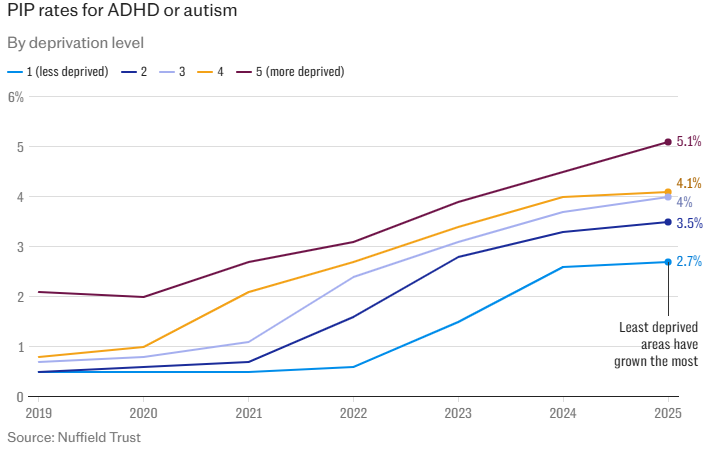
Benefit claims for teenagers diagnosed with attention deficit hyperactivity disorder (ADHD) and autism have more than tripled since the pandemic, with the sharpest rise seen in the richest areas, as researchers warn of the “harmful pathologisation” of the population. The Telegraph has the story.
More than one in 40 teenagers in the most affluent areas received Personal Independence Payments (Pip) last year for ADHD or autism, a study from the Nuffield Trust has found.
The findings have come to light before a Government review into ADHD, autism and mental health services as concerns grow over their diagnosis rates.
Researchers said higher rates of new ADHD diagnoses in wealthier areas could partly reflect affluent families making greater use of private routes to diagnosis.
They warned that soaring demand for diagnosis and treatment risked “crowding out” the most severe cases and the “unnecessary and possibly harmful pathologisation of a sizeable proportion of the population”.
The Nuffield Trust report shows a quarter of 16 to 24 year-olds screened positive for ADHD symptoms in 2023-24, up from around 14% in 2007. Researchers stressed that screening positive for symptoms does not amount to a clinical diagnosis.
Self-reported autism among 16 to 24 year-olds has also risen, from around 5% in 2022 to 9% in 2025.
Seven in 10 GPs believe adult ADHD is overdiagnosed, while more than eight in 10 patients referred for assessments ultimately had received a diagnosis, doctors estimated.
However, Professor Peter Fonagy, who is leading the [Government] review, has insisted the wider rise in mental health problems among young people is real.
He said his review would conclude that problems had increased since the 1990s, with one in four 16 to 24 year-olds struggling with mental health problems.
Prof Fonagy rejected suggestions that a “snowflake generation” was behind the rise, saying it was now “harder to be young”.
He said economic and employment uncertainty, combined with the pressures of social media, had created a “very toxic” environment for young people.
Right, so according to Prof Fonagy, ADHD is ‘social media disease’. Maybe they should put down their phones then rather than draining the public purse.
https://www.dailymail.com/news/article-16090129/Russia-attack-British-drone-factory-missile-Kremlin-warns-described-UK-evil.html Andrei Fedorov, a former deputy foreign minister of Russia, has confirmed…
https://www.japantimes.co.jp/news/2026/09/17/world/russia-brazen-attacks-europe/ A Bloomberg source close to the Kremlin said outright that Russia intends to “make…
Hard Right populist AfD? One day it’s Far Right, others Hard Right,…
JXB
|
Email me alerts for this discussion
Please login to comment
To join in with the discussion please make a donation to the Daily Sceptic.
Profanity and abuse will be removed and may lead to a permanent ban.
9 Comments
Newest
OldestMost Voted
Cotfordtags
1 hour ago
What truly amazes me are the number of Government reviews, set up to control benefit claims that end up increasing the burden on the taxpayer. The socialist talking heads keep banging on about the Timms review which they claim will be the start of benefit reduction, but his first pronouncement is that it should be easier to claim. Now this professor says that far from over diagnosis, child mental health claims are real. Why is this? Why are more children so much less resilient and incapable of dealing with the world than sixty years ago. We had little, were under constant threat of nuclear destruction, more likely to have a father in a war zone and if not in the military, more likely to be doing a high risk job, so you might not see him at the end of the day. Death came earlier for grand parents and no-one knew a great grandparent. Punishment for wrong doing was likely to be more violent (is there any punishment today?). Why are the modern generations so feeble?
I guess the outcome depends on the ‘experts’ you hire to write the review. But I agree with you, he is talking piffle. How is ‘economic and employment uncertainty’ worse now than in, ay, the 1970s or 1980s? Perhaps it is all due to evil ‘social media’ – in which case, when kids can no longer use social media, we can stop the PIP payments?
Why is this? Why are more children so much less resilient and incapable of dealing with the world than sixty years ago.
Well either modern children have been made less capable or the world is a worse place and more difficult to deal with than previously.
I recall some questions for school exams and I’ve seen some recent examples – kids seem to have been made less capable.
Is the world a better or worse place? There’s definitely less starvation in the developing world which I’d say is ‘better’. Expecting kids (or adults) to always be available for communication and respond immediately through mobile phones and messaging apps is ‘worse’.
On balance I think our supposedly enlightened modern forms of upbringing, nurturing and education have done kids no favours at all. It used to be that kids from ‘broken homes’ were expected to be at a bit of a disadvantage compared with others. We seem to have fixed that by breaking most homes.
JohnK
2 hours ago
Perhaps it is a statistical side effect. Comfortably off = professional assessment, and no assessment = no diagnosis?
disgruntled246
4 hours ago
Because they know how to play the system.
Having been a parent, and worked in a school as well, I see so many middle class parents who can’t or won’t admit that their child is a little bar steward. So much easier to say oh yah he’s got ADHD than address the fact that the child needs boundaries and to know what is acceptable behaviour, and they are not there to be their child’s friend. Incidentally it is also, as is the pleading of ‘mental health’ for everything (had a bad day at the office? Don’t go home and kick the cat, say ‘my anxiety is really bad right now’), unfair to people who really do have these conditions and engenders scepticism of those actually worthy of sympathy.
I knew one middle class parent who had a diagnosis for her son, I think he was autistic, which apparently made everything so much easier for him at school. SO she was looking to get her daughter diagnosed with gender dysphoria, just in case she ‘needed’ treatment later.





Discussion
Comments
This week across the site:
To join in with the discussion please make a donation to the Daily Sceptic.
Profanity and abuse will be removed and may lead to a permanent ban.
What truly amazes me are the number of Government reviews, set up to control benefit claims that end up increasing the burden on the taxpayer. The socialist talking heads keep banging on about the Timms review which they claim will be the start of benefit reduction, but his first pronouncement is that it should be easier to claim. Now this professor says that far from over diagnosis, child mental health claims are real. Why is this? Why are more children so much less resilient and incapable of dealing with the world than sixty years ago. We had little, were under constant threat of nuclear destruction, more likely to have a father in a war zone and if not in the military, more likely to be doing a high risk job, so you might not see him at the end of the day. Death came earlier for grand parents and no-one knew a great grandparent. Punishment for wrong doing was likely to be more violent (is there any punishment today?). Why are the modern generations so feeble?
I guess the outcome depends on the ‘experts’ you hire to write the review. But I agree with you, he is talking piffle. How is ‘economic and employment uncertainty’ worse now than in, ay, the 1970s or 1980s? Perhaps it is all due to evil ‘social media’ – in which case, when kids can no longer use social media, we can stop the PIP payments?
Well either modern children have been made less capable or the world is a worse place and more difficult to deal with than previously.
I recall some questions for school exams and I’ve seen some recent examples – kids seem to have been made less capable.
Is the world a better or worse place? There’s definitely less starvation in the developing world which I’d say is ‘better’. Expecting kids (or adults) to always be available for communication and respond immediately through mobile phones and messaging apps is ‘worse’.
On balance I think our supposedly enlightened modern forms of upbringing, nurturing and education have done kids no favours at all. It used to be that kids from ‘broken homes’ were expected to be at a bit of a disadvantage compared with others. We seem to have fixed that by breaking most homes.
Perhaps it is a statistical side effect. Comfortably off = professional assessment, and no assessment = no diagnosis?
Because they know how to play the system.
Having been a parent, and worked in a school as well, I see so many middle class parents who can’t or won’t admit that their child is a little bar steward. So much easier to say oh yah he’s got ADHD than address the fact that the child needs boundaries and to know what is acceptable behaviour, and they are not there to be their child’s friend. Incidentally it is also, as is the pleading of ‘mental health’ for everything (had a bad day at the office? Don’t go home and kick the cat, say ‘my anxiety is really bad right now’), unfair to people who really do have these conditions and engenders scepticism of those actually worthy of sympathy.
These days it’s hard to tell which is the child and which the parent.
Yes, children (and adults!) need boundaries. The boundaries need to be enforced with effective sanctions – rather like a nation’s borders.
I knew one middle class parent who had a diagnosis for her son, I think he was autistic, which apparently made everything so much easier for him at school. SO she was looking to get her daughter diagnosed with gender dysphoria, just in case she ‘needed’ treatment later.
flipping heck.