


What the German mainstream calls the ‘firewall’ has held. Despite winning an impressive 43.8% of the vote in regional elections in Saxony-Anhalt, the opposition AfD, or Alternative for Germany party, has fallen three seats short of the absolute majority in the regional parliament that would have ensured that the party could form a government under prime minister candidate Ulrich Siegmund.
But critical German observers are pointing to a massive anomaly in the voting data that raises the obvious question: how exactly did the ‘firewall’ hold?
Here is a graph published by the X-account Datenfuzzi comparing the results of in-person voting to the results of voting by mail-in ballot.
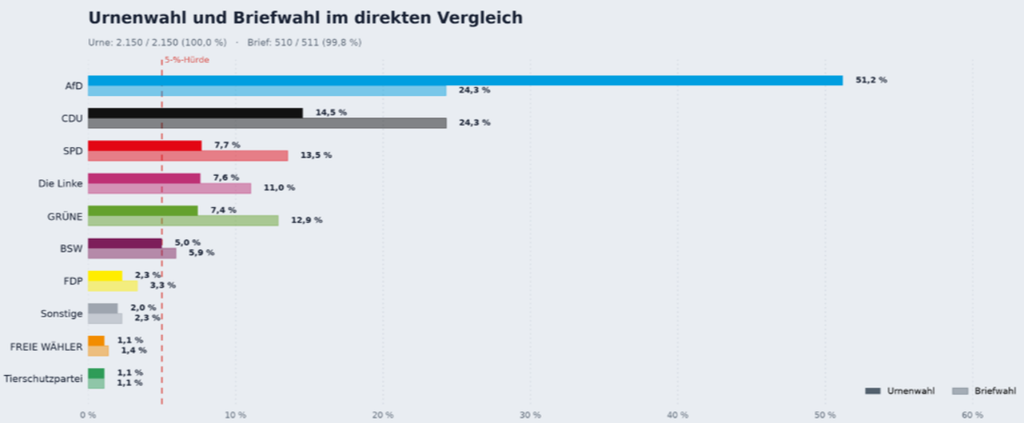
The first, darker line represents the in-person voting results; the second, lighter line represents the results of voting by mail-in ballot. As you can see, the AfD received over 50% of the votes cast in person (51.2%), but less than half that percentage of the votes cast by mail-in ballot. All the main establishment parties, by contrast, performed significantly better in the mail-in ballots than in the in-person vote. So too did the post-Communist ‘Left’ party (Die Linke).
Here is a visual illustrating the point that can be seen on several German X feeds.
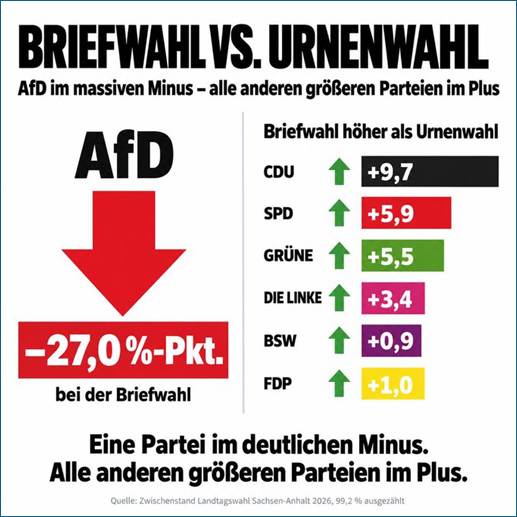
The AfD’s share of the mail-in vote is 27 percentage points less than its share of the in-person vote, whereas all the other parties had a larger share of the mail-in vote compared to the in-person vote: the Christian Democrats of Chancellor Friedrich Merz +9.7 percentage points, Merz’s Social Democratic coalition partners +5.9 percentage points, and so on.
Numerous German-speaking commentators are wondering: how is this possible? Is it a reflection of some party or demographic preference for in-person voting? Or is it rather a reflection of the greater susceptibility to manipulation of mail-in ballots?
As the lawyer Dirk Schmitz notes in an interview with the German alternative media Tichy’s Einblick, the lesser security of mail-in voting has been recognised on several occasions by Germany’s own Constitutional Court. Schmitz argues that mail-in voting should be a limited exception to in-person voting rather than a widely-used alternative.
In the Saxony-Anhalt elections, however, mail-in ballots represented 27% of all votes cast, making it clear that it was precisely the mail-in ballots that deprived the AfD of its absolute majority.
Now, the AfD will have to depend on the support of another post-Communist party – the Sahra Wagenknecht Alliance (BSW) – to be able to elect Siegmund as prime minister and form a government. The BSW is a break-away faction of the ‘Left’ party. The BSW barely managed to achieve the threshold of 5% of the vote required for obtaining seats in the parliament, but it will now play the role of ‘kingmaker’.
Despite certain ‘overlaps’ with the AfD on policy matters, BSW officials have, however, made clear that they do not want their representatives to vote for Siegmund. (See here, for instance.) Instead, the BSW has proposed the election of a “non-partisan” prime minister supported by “changing majorities”. There are signs of the establishment parties now rallying to this so-called ‘BSW model’ in order to keep the AfD out of power.
John Rosenthal is a journalist and political analyst who writes on European politics and transatlantic issues. You can subscribe to his Transatlantic Intelligencer Substack (where this article first appeared) here.




Discussion
Comments
This week across the site:
To join in with the discussion please make a donation to the Daily Sceptic.
Profanity and abuse will be removed and may lead to a permanent ban.
Rigged election results – never!
Are the AfD just jealous that they’re not popular with the dead?
As the joke in America goes, my father was a staunch Republican until the day he died now he votes for the Democrats.
Hello Mr Rosenthal, I have been following the Robert Kogon page for years and was too dozy to switch. But this analysis made me chip in a fiver to say thanks. Numbers talk, don’t they.
Postal voting should be banned.
There are some pretty good arguments for postal voting, just as there are for welfare… both need to be controlled better as it is obvious that they are both easily manipulated by those who would use them to their own advantage.
It would be interesting to know if the percentage of mail in votes was similar in previous elections.
Or if it’s increased by a good margin for this election, baring in mind the polls prior?
Good question and I suspect we all know the answer.
In recent times some parties have encouraged people to register for postal voting, as long as they are reasonably sure that they are likely to vote for their candidates. Where I live, that has been the case with likely Labour voters. No doubt other parties do the same, in an effort to increase turnout, especially in local Council elections, which typically suffer from low turnouts.
If you can’t be arsed to go to the polling station, you don’t get to vote.
Simples.
Across the globe, the ‘progressive’ parties benefit from postal voting. We don’t even have to consider the possibility of corrupt power faking votes and stuffing the mail in ballot boxes, it just needs well organised knowledge of those who will never vote and ensuring that you get hold of their ballot paper. Elderly, disabled, children away at universities (we know the lack of inclination for the young to vote). Layer on the mass voting by certain communities and before you know it, the progressives have thwarted the will of the people. Mail in should be banned except in the most extreme situations.
In this country it is the Conservatives who are now suffering from postal voting having originally been all in favour thinking their better organisation would be an advatage
Yes, as in the 2010 Kerry McCarthy Postal Vote Scandal in Bristol,
and in the same election year, The Independent reporter Jerome Taylor was beaten up by a Bangladeshi Muslim mob in Tower Hamlets, merely for asking why 18 Bangladeshi Muslim men were registered to vote at a single ONE-BEDROOMED FLAT.
‘The first punch came, landing on my nose, sending blood down my face’ | The Independent | The Independent
Also:
British Democrats: Tower Hamlets Councillors seek second jobs in Bangladesh
“The Council faced backlash after removing 78 British and English flags. Councillors condemned those displaying the flags as extremist ‘Far Right’ thugs.”
“The controversy over Tower Hamlets councillors running for parliamentary seats in Bangladesh’s 2026 election, while still serving in the UK, raises concerns about their dual political loyalties and commitment to local constituents.”
“Individuals with dual nationality should not be allowed to stand for election in the UK, as this could help mitigate potential conflicts of interest.”
” It’s not against UK law for a councillor to be a candidate or be elected in a foreign country—it should be. “
They should be blacklisted (i was going to say blackballed but they probably already are hat tip yes minister).
No way can dual nationalities be in govt at any level.
Good.
In Britain many people in care homes do not vote but it is not possible for political parties to get inside to canvas or to arrange postal votes. Given that the old political parties control many such institutions and their supporters will often be in charge of private ones, it is easy to see why many of them might end up voting for the old class.
This was proven in the UK by the Bristol Labour MP Kerry McCarthy Postal Vote Scandal in the 2010 election. A full TWO WEEKS BEFORE VOTERS WENT TO THE POLLS, she boasted on social media that she had already won the election by postal ballots, especially from Somalian Muslims to whom she had dedicated most of her time in office, welcoming them and settling them in council housing in Bristol. She received a mere slap on the wrist, and is STILL the Labour MP for Bristol East to this day.
Bristol Labour MP cautioned for electoral fraud – BBC News
It was the Outrageous Commonwealth Voting Rights in UK Elections that caused this. They must be abolished, as former British diplomat Lord Andrew Green of Migration Watch has been warning for years.
Absolutely, it is a sick joke that those people can vote here.
Wow, the complete reverse via mail-in?! Who’da thunk it..?
How convenient…