


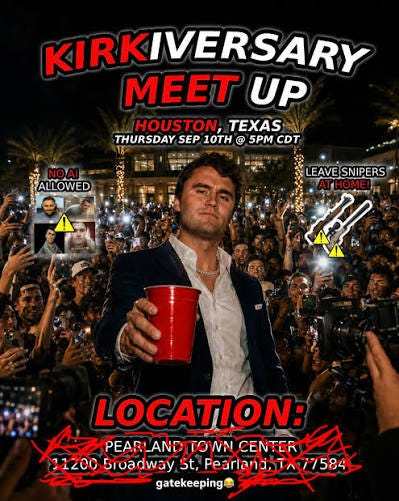
There is something profoundly wrong about what we are watching today. On the anniversary of Charlie Kirk’s assassination, thousands of people are going onto TikTok, X and Instagram to celebrate it, producing jokes and memes about his death and apparently finding enormous amusement in the fact that a young husband and father was shot while taking part in a political discussion. They have even produced the revolting little word ‘Kirkiversary’ for the occasion. Kirk was a controversial political activist and deliberately so; his entire public career was built around arguing about contentious subjects, often in places where he knew that much of his audience disagreed with him. I disagreed with some of what he said myself. That is what political argument is for. Yet we appear somehow to have reached the point where substantial numbers of people regard the assassination of somebody with whom they disagree as a legitimate subject for comedy, and I find it difficult to dismiss that merely as another example of the internet being unpleasant.
Something has happened to parts of the Western Left over the past 20 years which deserves rather more examination than it receives. The old political vocabulary of disagreement has gradually been replaced by a vocabulary of moral contamination. People are no longer merely wrong about immigration, race, abortion, sexuality, gender or economics; they are fascists, Nazis, racists, bigots, extremists and threats to democracy. Political arguments which would once have taken place between people who regarded one another as misguided, selfish, naïve or simply stupid are increasingly presented as struggles between virtue and wickedness. The reductio ad Hitlerum which was once regarded as the point at which an internet argument had become ridiculous has escaped from the internet and become a normal part of political discourse.
This has consequences because language changes the moral category into which we place other people. If Charlie Kirk was merely a conservative with whom you profoundly disagreed, his murder remains exactly what it appears to be: the killing of another human being for his politics. If, however, you have spent years being told that people such as Kirk are fascists, that fascism represents an immediate threat to vulnerable people, that speech can itself constitute violence and that allowing such people a platform places others in danger, the moral calculation begins to change. It becomes possible to persuade yourself that compassion towards the victim is somehow a betrayal of the people he supposedly threatened. Eventually his death can be regarded not merely with indifference but with satisfaction.
Nobody has to stand up and say that political opponents should be murdered. The important work has already been done when they cease to be regarded as ordinary human beings.
Kirk is an especially revealing example because his principal activity was talking. He went onto university campuses and invited students to argue with him. They did. Some exchanges were intelligent, others were ridiculous, some undoubtedly generated more heat than light, but the basic proposition was an extraordinarily conventional one: here is what I believe, tell me why I am wrong. Universities were once assumed to be particularly appropriate places for precisely this activity. One might have thought that a political culture which constantly proclaims its commitment to democracy would regard argument as preferable to violence. Yet a man who made a career from arguing with his opponents was shot and there are now people celebrating the anniversary of the shooting.
What makes the spectacle particularly ugly is that much of contemporary progressive politics has wrapped itself in the language of compassion. We have spent years hearing about kindness, inclusion, safety, vulnerability, trauma and harm. Institutions have developed increasingly elaborate rules governing words which might upset people, universities have agonised over speakers who might make students feel unsafe, and ordinary political language is routinely scrutinised for the possibility that somebody somewhere might experience it as threatening. Yet the actual violent death of a political opponent can apparently be absorbed into the same culture as a joke. The man himself disappears almost completely. So does his family. He becomes a political symbol onto which every accusation can be projected, and once that transformation is complete there is remarkably little humanity left towards which compassion needs to be extended.
There is a word for this and it is dehumanisation. Human beings are capable of considerable cruelty while continuing to think of themselves as decent people, provided they can first persuade themselves that the object of that cruelty belongs to a category towards which the normal rules do not apply. The frightening part is rarely that people suddenly decide to become wicked. It is that they construct an explanation in which something that would previously have appalled them becomes morally permissible because of who is receiving it. The more convinced somebody becomes of his own righteousness, the easier this can become.
Which brings me to another word which will sound hopelessly unfashionable to some readers, but which I think deserves to be used: demonic. I mean that in its theological sense rather than as a piece of political name-calling. Christianity has always understood the demonic primarily through corruption: hatred replacing charity, lies replacing truth, division replacing fellowship, cruelty becoming pleasurable and human dignity being obscured until another person’s suffering can be enjoyed. The most dangerous corruption is the one which persuades us that we remain righteous while participating in it. There is something profoundly disturbing about watching apparently ordinary people, many of whom presumably regard themselves as compassionate and morally serious, laughing at the assassination of another human being while apparently believing that their hatred of him demonstrates their virtue.
None of this gives the Right licence to behave in the same way. There are people on the Right perfectly capable of dehumanising their opponents and there is no shortage of ugliness in online conservative politics. If some prominent figure on the Left were murdered tomorrow and conservatives responded by inventing an anniversary celebration of their own, it would be equally disgusting. The whole point of maintaining a moral principle is that it continues to apply when the victim is somebody whose politics you despise. If we abandon that, politics becomes little more than tribal vengeance conducted by people waiting for permission to treat the other side as less than human.
The Left nevertheless has a particular responsibility to look at what is happening within its own culture because this did not emerge from nowhere. If you tell people repeatedly that their political opponents are Nazis, fascists and existential threats, if you teach them that disagreement can itself be a form of violence, if every political dispute is presented as another front in a struggle between the oppressed and their oppressors, it should hardly be surprising when some begin to lose the distinction between defeating an argument and destroying the person making it. The people celebrating ‘Kirkiversary’ may be an extreme manifestation of that process, but they did not invent the language which made it possible.
Western democracy rests upon an assumption which is so basic that we rarely bother articulating it: the people with whom we share a country are going to disagree about important things, sometimes profoundly, and we are nevertheless going to continue living alongside one another. We argue, campaign, vote, demonstrate, publish, ridicule and occasionally become extremely angry, but somewhere beneath the noise sits the recognition that our opponents remain fellow citizens and fellow human beings. Europe learned the alternative over centuries of religious and political violence, and the liberal democratic settlement which emerged from that history was not an expression of sentimental niceness. It was a practical recognition that societies in which political disagreement becomes a struggle between morally legitimate people and morally illegitimate people eventually become very unpleasant places indeed.
So I find ‘Kirkiversary’ rather more significant than a collection of sick jokes made by deranged people on the internet. It suggests that within parts of our political culture the ordinary restraints of human sympathy are becoming dangerously conditional. A man can be shot for his politics and, provided the correct labels have first been attached to him, people who consider themselves compassionate can celebrate his death without apparently noticing the contradiction.
Hatred has been dressed up as virtue, cruelty as justice, and delight in another human being’s death as evidence of being on the right side.
Christianity has spent 2,000 years warning us about that particular inversion.
It called it demonic.
C.J. Strachan is the pseudonym of a concerned Scot who worked for 30 years as a Human Resources executive in some of the UK’s leading organisations. Subscribe to his Substack page.


Discussion
Comments
This week across the site:
To join in with the discussion please make a donation to the Daily Sceptic.
Profanity and abuse will be removed and may lead to a permanent ban.
Read the article on the BBC website about those who have lost their jobs because they wrote “critical” things about Charlie Kirk just after his death. No acknowledgement at all about the sickening satanic abuse and cheering that went on after he was shot. The same goes for Mangione and Clancy murders. Just briefly “step over” the fact that a father and three little children were murdered in cold blood and forget about the deranged women eulogizing about the murderers.
Absolutely vomit inducing.
This is surely the American version of the Left’s celebration of Mrs Thatcher’s death: “ ding dong, the witch is dead “. I really cannot understand these people. Should the lying warmonger Blair kick the bucket before I do, I won’t be celebrating his death, but I certainly won’t mourn it.
It seems to be on the left today requires you to be sick in the mind.
This is indeed profoundly wrong. I heard this awful word was being bandied around by these so called ‘kind’ woketards on the Rita Pahani LEfties Losing It Show on SkyAus (recommended). I had to stop watching when they showed that tattoo parlours were actually offering special ‘Kirkversary’ tattoos for necks in the spot were he was shot. Truly shocking….
Something has happened to parts of the Western Left over the past 20 years which deserves rather more examination than it receives. The old political vocabulary of disagreement has gradually been replaced by a vocabulary of moral contamination.
Sorry, it’s not only in the past 20 years. The Russian Marxists murdered tens of millions of “wrong-thinkers”. The Chinese Marxists over 50 million. Leftwing regimes all over the Earth have carried out mass-murder of “wrong-thinkers” on a huge scale. In the 1790s the Jacobins murdered hundreds of thousands of “wrong-thinkers” in France. As the historian Martin Malia points out, atrocity is built-in to the regimes of the Left. In fact, atrocity is the central political component of the madleft.
The Left have always been fascist. Kirkiversary is just another milestone proving that statement.
The most intolerant, violent, fascistic and yes stupid group of people are the Leftard and whatever labels they choose; globalists, marxists, socialists, communists, environmentalists, genderists, open borderists; whatever.
They have spent 60 years waging violent civil war against the likes of myself. Unlike the author, and as a good traditional Catholic, I affirm my right to use force and violence in return. If these arselings want a civil war bring it on.
It all makes sense, the penny has dropped. Treat EVERYTHING the left says as the opposite of the truth, and then season it strongly to get closer to the reality
The poster: ‘Leave snipers at home’ and ‘No AI allowed’. You see, we can agree on something.
FTFY
I have just realised that I am basically a white supremacist and racist.
I don’t care.